
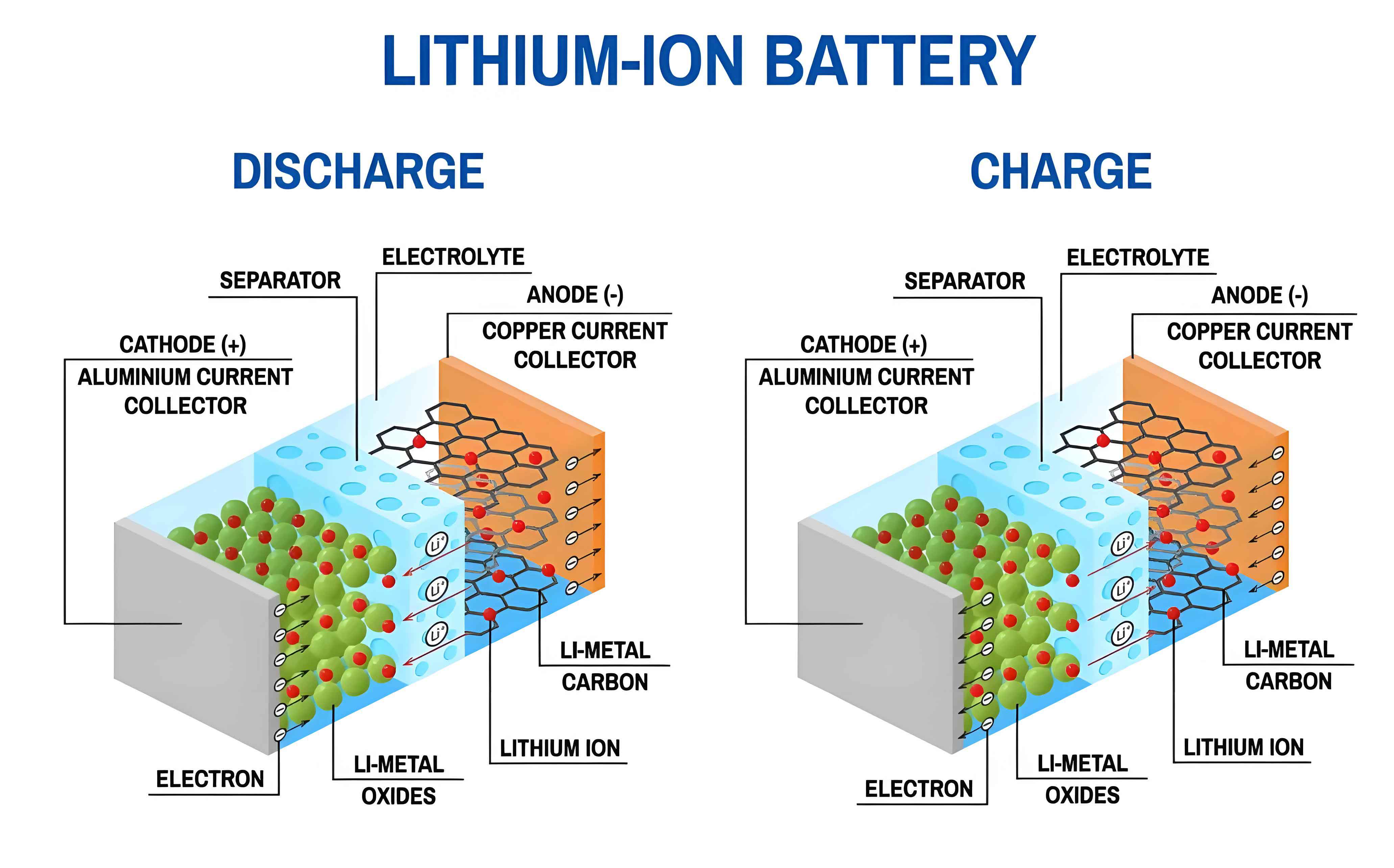
The relentless pursuit of higher energy density in energy storage systems has positioned the lithium-ion battery as the cornerstone technology for applications ranging from portable electronics to electric vehicles and grid storage. At the heart of a lithium-ion battery’s performance lies its anode material. For over three decades, graphite has reigned supreme due to its excellent balance of reasonable capacity, structural stability, and cyclability. Its theoretical specific capacity, however, is fundamentally limited to 372 mAh g-1. This ceiling has spurred intensive research into alternative materials with higher lithium storage capabilities. Among all candidates, silicon (Si) stands out as the most promising anode material for the next generation of high-energy lithium-ion battery technology due to its unparalleled theoretical specific capacity of approximately 4200 mAh g-1, which is more than ten times that of graphite, along with its natural abundance and low cost.
The principal challenge preventing the widespread adoption of silicon anodes in commercial lithium-ion battery cells is its extreme volumetric expansion and contraction during the alloying and de-alloying processes with lithium. Upon full lithiation to form Li15Si4, silicon experiences a volume expansion of about 300-400%. This massive, repeated mechanical stress leads to particle pulverization, loss of electrical contact, and continuous rupture and reformation of the Solid Electrolyte Interphase (SEI). The cumulative effect is rapid capacity fade and poor cycle life, rendering pure silicon electrodes impractical. To harness silicon’s high capacity while mitigating its intrinsic drawbacks, the most prevalent and practical strategy is to form composite structures with carbonaceous materials. Carbon matrices can enhance electronic conductivity, provide mechanical buffering, and contribute to stabilizing the electrode structure. While sophisticated architectures like core-shell, yolk-shell, or porous scaffolds have shown remarkable laboratory success, their complex synthesis often translates to high cost and scalability issues. A simpler, more commercially viable approach involves the physical blending of silicon with various carbon materials to form composite electrodes. The performance of such electrodes is critically dependent on the properties of the carbon component—its morphology, structure, and surface chemistry. This article provides a detailed, first-person perspective analysis of how the shape and morphology of the carbon matrix, specifically comparing micron-sized spherical carbon and sheet-like graphite, fundamentally influence the electrochemical stability and performance of silicon/carbon composite anodes in lithium-ion battery systems. The discussion will be supported by theoretical models, performance data summaries, and an exploration of integrated strategies.
The Fundamental Challenge: Silicon’s Volume Dynamics
The exceptional capacity of silicon originates from its ability to alloy with lithium at relatively low potentials. The electrochemical reaction can be represented as:
$$ \text{Si} + x\text{Li}^+ + x\text{e}^- \leftrightarrow \text{Li}_x\text{Si} \quad (0 \le x \le 4.4) $$
The final crystalline phase at full charge (lithiation) is generally Li15Si4. The associated volume change ($\Delta V/V$) is not linear with lithium content and can be estimated. If we consider the molar volumes of crystalline Si (12 cm³ mol⁻¹) and Li15Si4 (≈ 59 cm³ mol⁻¹), the volume expansion ratio is:
$$ \frac{\Delta V}{V_{\text{Si}}} = \frac{V_{\text{Li15Si4}} – V_{\text{Si}}}{V_{\text{Si}}} \approx \frac{59 – 12}{12} \approx 3.92 $$
This ~400% expansion induces tremendous internal stresses ($\sigma$) within the silicon particle and at its interfaces with surrounding materials. These stresses can be described by models considering elasticity and plastic deformation. A simplified view relates stress to strain ($\epsilon$) and the material’s modulus ($E$):
$$ \sigma \approx E \cdot \epsilon $$
where $\epsilon = \Delta V / 3V$ for an isotropic expansion. For a silicon nanoparticle embedded in a carbon matrix, the constraint leads to complex stress states. Particle fracture occurs when the induced stress exceeds the fracture strength of silicon. Furthermore, this cyclic stress disrupts the conductive network established by the binder and conductive additives, leading to increased electrode polarization and capacity loss. The constant exposure of fresh silicon surfaces to the electrolyte also promotes uncontrolled SEI growth, consuming both lithium ions and electrolyte, which manifests as low initial Coulombic efficiency (ICE) and poor cycle life. The primary goal of carbon integration is to manage these mechanical and electrochemical consequences.
The Role of Carbon: Beyond Conductivity
In a composite electrode, carbon serves multiple synergistic functions:
- Electronic Conduction: It forms a percolating network for efficient electron transport to and from the active silicon particles.
- Mechanical Buffering: It absorbs and distributes the mechanical stresses generated by silicon’s volume changes, preventing catastrophic electrode disintegration.
- Structural Framework: It provides a stable, porous scaffold that accommodates silicon expansion while maintaining overall electrode integrity.
- SEI Moderation: Certain carbon surfaces can promote the formation of a more stable and uniform SEI.
The efficacy of carbon in these roles is not uniform; it is highly dependent on its physical and chemical attributes. We can categorize key carbon parameters as follows:
| Carbon Parameter | Influence on Mechanical Buffering | Influence on Electrical Network | Typical Impact on Cycle Life |
|---|---|---|---|
| Morphology (Shape) (Spherical vs. Sheet-like) |
Critical. Dictates contact area and stress distribution. | High. Determines percolation pathways and contact stability. | Fundamental. Directly linked to electrode crack propagation. |
| Particle Size (Nano vs. Micro) |
Smaller particles offer more grain boundaries for stress relief but may pack densely. | Nano-carbon improves wiring but increases inactive surface area. | Moderate. Affects tap density and interface area. |
| Crystallinity (Graphitic vs. Amorphous) |
Graphite is more rigid; hard carbon is more compliant. | Graphite has higher basal plane conductivity. | Significant. Affects Li⁺ storage, ICE, and expansion tolerance. |
| Surface Chemistry (Functional groups, defects) |
Low direct impact. | Can hinder electron transfer if excessive. | High. Governs SEI formation, wettability, and binder adhesion. |
A Deep Dive into Carbon Shape: Spherical vs. Sheet-like Morphologies
The central thesis explored here is that the macroscopic shape of the carbon matrix particles plays a decisive role in the mechanical integrity of silicon/carbon composite electrodes for lithium-ion battery applications. Let’s analyze the two contrasting morphologies.
Spherical Carbon Matrix
Spherical carbons, often derived from pitch or synthesized via hydrothermal methods, offer advantages like high tap density and good fluidity. In an electrode, they pack in a manner similar to marbles in a jar. The contact between two spheres is a single, small point or a limited circular area. The contact mechanics for two elastic spheres (Hertzian contact) describe a small contact radius ($a$) given by:
$$ a = \sqrt[3]{\frac{3FR}{4E^*}} $$
where $F$ is the force, $R$ is the effective radius, and $E^*$ is the combined modulus. This inherently small contact area has profound implications for a composite lithium-ion battery anode:
- Stress Concentration: Mechanical forces are transmitted through these discrete, small points, leading to high local stress concentrations.
- Weak Link Network: The electrical and mechanical network is held together primarily by binder bridges at these point contacts. These bridges are vulnerable.
- Failure Mode: When nano-silicon particles filling the voids between spheres expand, they exert outward pressure. This pressure readily breaks the brittle binder bridges at the point contacts. Once a few critical connections fail, the stress redistributes, leading to a cascade of failures—spheres detach, creating microscopic cracks that propagate and coalesce into macroscopic electrode fracture. The electronic percolation network is severed, leaving isolated active material clusters “electrically dead.”
This explains the observed electrochemical performance: a silicon/spherical carbon composite shows rapid capacity fade in the initial cycles as the network fractures, followed by stabilization at a low capacity corresponding mainly to the residual carbon contribution, as the silicon becomes largely disconnected.
Sheet-like Graphite Matrix
Flake or sheet-like graphite, a commercially abundant material, presents a radically different geometry. Its particles are two-dimensional plates with high aspect ratios. When mixed into an electrode slurry, these plates arrange in a more overlapping, “house-of-cards” structure. The contact between two plates is no longer a point but a large, two-dimensional area or a long line of contact.
- Stress Distribution: Mechanical forces and stresses are distributed over large, shared interfaces. This reduces stress concentration significantly.
- Robust, Redundant Network: The electrical network is composed of large-area face-to-face and edge-to-face contacts. Binder adhesion occurs over extensive surfaces.
- Failure Tolerance: The expansion of silicon particles located between or on these graphite sheets can cause local binder deformation or even local delamination. However, due to the large contact area, it is statistically unlikely for the entire interface to disconnect simultaneously. The electronic pathway can “route around” a local failure point via adjacent contact areas. The network demonstrates redundancy and resilience.
- Confinement Effect: The large, flexible graphite sheets can act as a confining buffer layer, accommodating silicon expansion in the direction perpendicular to the sheet while maintaining in-plane conductivity.
Consequently, the silicon/sheet-like graphite composite maintains its structural and electrical integrity over many more cycles. The capacity may evolve during early cycles as the electrode structure relaxes and finds a stable configuration, but it does not catastrophically collapse. This allows the high capacity of the silicon to be effectively utilized throughout the life of the lithium-ion battery.
| Performance Metric | Si / Spherical Carbon Composite | Si / Sheet-like Graphite Composite | Underlying Reason |
|---|---|---|---|
| Initial Network Stability | Low. Prone to early cracking. | High. Structurally robust. | Point contacts vs. area contacts. |
| Capacity Fade Rate | Very high initial fade. | Moderate, stabilizing after formation. | Cascading network failure vs. redundant network. |
| Long-Term Reversible Capacity | Often falls below pure carbon capacity. | Can remain significantly above graphite theoretical capacity. | Si becomes isolated vs. Si remains wired. |
| Electrode Morphology Post-Cycling | Visible macro-cracks, particle detachment. | Generally intact, minor micro-cracks. | Binder bridge fracture vs. localized interface stress. |
| Practical Silicon Loading | Very low (<10 wt%) to avoid failure. | Can be moderate (15-30 wt%) for usable capacity gain. | Limited void space and stress management. |
Integrating Shape with Other Modification Strategies
While carbon shape is a foundational factor, optimizing a silicon/carbon anode for a commercial lithium-ion battery requires a multi-faceted approach. The choice of sheet-like graphite should be combined with other best practices:
- Silicon Nano-structuring: Using nano-silicon (as opposed to micro-silicon) is non-negotiable. It reduces the absolute path length for lithium diffusion and mitigates fracture by reducing the absolute volume change per particle. The diffusion-limited behavior in nanoparticles can be described by Fick’s second law, and the characteristic diffusion time ($\tau$) scales with the square of the particle radius ($r$):
$$ \tau \propto \frac{r^2}{D} $$
where $D$ is the diffusion coefficient. Smaller $r$ drastically improves rate capability and reduces mechanical stress gradients.
- Advanced Binders: Moving beyond conventional binders like Polyvinylidene Fluoride (PVDF) to functional binders like Carboxymethyl Cellulose (CMC), Sodium Alginate (SA), or self-healing polymers is crucial. These binders often form stronger covalent or ionic interactions with the native oxide layer on silicon (Si-O-Si bonds with CMC’s -COOH groups) and exhibit higher elasticity to accommodate strain.
- Electrolyte Additives: Incorporating additives like fluoroethylene carbonate (FEC) is essential to form a more flexible, stable, and LiF-rich SEI on both silicon and carbon surfaces, which is more resistant to mechanical cracking during volume changes.
- Pre-lithiation: To counter the irreversible lithium loss from initial SEI formation and to boost the overall ICE of the lithium-ion battery cell, pre-lithiation techniques (e.g., using stabilized lithium metal powder, sacrificial lithium salts, or electrochemical pre-lithiation) are often employed with silicon-containing anodes.
| Component | Recommended Choice | Primary Function |
|---|---|---|
| Carbon Matrix | Micron-sized Sheet-like Graphite (Flake Graphite) | Provide stable, high-contact-area conductive and mechanical framework. |
| Silicon Active Material | Nano-silicon (50-150 nm) | Maximize capacity while minimizing particle-level fracture. |
| Binder System | CMC, SA, or conductive polymer composites | Provide robust adhesion and elasticity to maintain electrode integrity. |
| Conductive Additive | Carbon black (Super P) or short CNTs | Enhance wiring between graphite sheets and silicon particles. |
| Electrolyte Formulation | Base carbonate solvents with 5-15% FEC additive | Promote formation of a stable, mechanically resilient SEI layer. |
Performance Projections and Practical Considerations
With an optimized system using sheet-like graphite, nano-silicon (~20 wt%), and advanced binders, realistic performance targets for a lithium-ion battery anode can be established. The composite specific capacity ($C_{\text{comp}}$) can be estimated as a mass-weighted average of the contributions from silicon ($C_{\text{Si}}$), graphite ($C_{\text{Gr}}$), and considering the irreversible loss in the first cycle (ICE):
$$ C_{\text{comp}} = \eta_{\text{ICE}} \cdot [ w_{\text{Si}} \cdot C_{\text{Si}} + w_{\text{Gr}} \cdot C_{\text{Gr}} ] $$
where $w$ represents the mass fraction and $\eta_{\text{ICE}}$ is the initial Coulombic efficiency (e.g., 0.85). For $w_{\text{Si}} = 0.20$, $C_{\text{Si}} = 3500$ mAh g⁻¹ (practical), $w_{\text{Gr}} = 0.65$, $C_{\text{Gr}} = 330$ mAh g⁻¹:
$$ C_{\text{comp}} \approx 0.85 \cdot [0.20 \cdot 3500 + 0.65 \cdot 330] \approx 0.85 \cdot [700 + 214.5] \approx 777 \text{ mAh g}^{-1} $$
This is more than double the capacity of graphite. Long-term cycling (e.g., 500 cycles) at a moderate rate (e.g., C/2) with a capacity retention of >80% would result in a stable capacity above 600 mAh g⁻¹, which is a transformative improvement for lithium-ion battery energy density. However, challenges remain for full-cell integration in a commercial lithium-ion battery: balancing the higher irreversible capacity, managing the lower anode potential, and ensuring sufficient calendar life require careful engineering of the cathode, electrolyte, and cell design.
Future Directions and Conclusion
The investigation into carbon morphology underscores a critical design principle for silicon-based anodes in lithium-ion battery technology: maximizing and stabilizing the inter-particle contact area within the conductive matrix is paramount for cycling stability. While spherical carbons offer packing benefits, their inherent point-contact geometry creates a fragile network vulnerable to the stresses induced by silicon expansion. In contrast, sheet-like graphite, with its large-area, overlapping contacts, forms a resilient, redundant network capable of tolerating local failures and maintaining long-range electronic conduction.
Future research directions should focus on:
- Engineering hybrid carbon matrices that combine the high tap density of spherical carbons with the mechanical robustness of 2D carbon structures (e.g., graphene-coated spherical graphite).
- Developing quantitative models that couple electrochemical-mechanical stress evolution with percolation theory to predict the cycle life of composites based on carbon shape, size distribution, and binder properties.
- Exploring the interface between silicon and the carbon sheet at the atomic level to enhance adhesion and lithium-ion transport across the interface, further optimizing the performance of the lithium-ion battery anode.
In conclusion, the path to commercializing high-energy silicon anodes for the next generation of lithium-ion battery technology is multifaceted. The selection of a sheet-like carbon matrix, such as flake graphite, represents a foundational and effective strategy to build a mechanically robust scaffold. When this is synergistically combined with silicon nanostructuring, advanced binders, and tailored electrolytes, it enables the practical utilization of silicon’s extraordinary capacity. This integrated approach paves the way for significant leaps in the energy density and performance of future lithium-ion battery systems, meeting the growing demands of advanced applications.