
The widespread adoption of lithium-ion batteries in electric vehicles, aerospace, and other high-demand sectors underscores their critical role in modern energy storage systems. As a typical time-varying nonlinear dynamic system, the lithium-ion battery’s safety and reliability during operation are influenced by various uncertain factors in service environments. Accurately capturing internal battery dynamics is essential for optimizing capacity utilization, mitigating aging processes, reducing overcharge and discharge rates, and enabling early warning and control of potential failures. This constitutes a key aspect of ensuring the safe operation of lithium-ion batteries. Traditional methods for state of charge (SOC) estimation, such as those based on electrical parameters and data-driven models, often rely heavily on extensive training data and may struggle with precision under complex or unknown operating conditions, especially in applications like aerospace power sources or military equipment where nondestructive testing is paramount. Leveraging the multiphysical characteristics of lithium-ion batteries, extracting new physical feature parameters that correlate with health states offers a promising alternative for nondestructive evaluation of SOC. In this context, ultrasonic guided wave detection technology emerges as a viable approach, exploiting the interplay between electrochemical-mechanical coupling effects and acoustic propagation characteristics within the multilayer porous structure of lithium-ion batteries.
My research focuses on developing a comprehensive theoretical model to describe the acoustic propagation behavior in lithium-ion batteries, incorporating chemo-mechanical coupling effects and multilayer porous attributes. This model aims to elucidate the intrinsic relationship between guided wave propagation characteristics and the SOC of lithium-ion batteries, providing a theoretical foundation for acoustic parameter selection in health monitoring. Subsequently, an experimental ultrasonic guided wave detection system is constructed to validate the theoretical predictions and investigate the influence of different discharge rates on acoustic feature parameters. The ultimate goal is to establish a nondestructive testing and evaluation pathway for the operational status of lithium-ion batteries, potentially enabling acoustic analysis of aging failure factors.
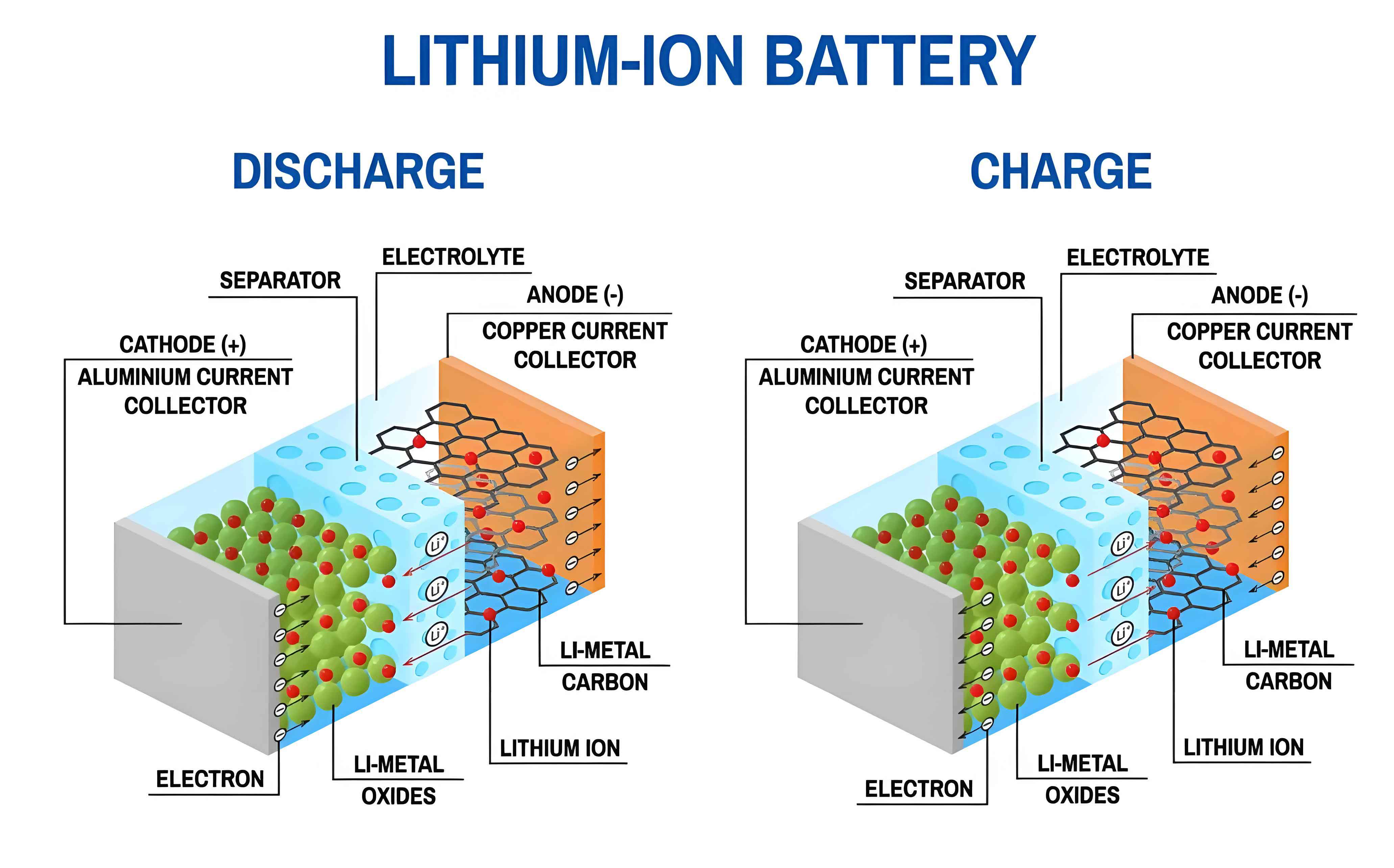
The swing process of lithium ions during charge and discharge cycles induces dynamic changes in electrode mechanical properties, which in turn affect the acoustic wave propagation characteristics within lithium-ion batteries. For the multilayer porous structure of a lithium-ion battery, I introduce a robust state-vector formalism combined with the Legendre polynomial method and the classical Biot theory. This approach simultaneously accounts for the chemo-mechanical coupling effects arising from the interaction between local current density of particles, lithium-ion diffusion processes, and induced stresses. The relationship between guided wave propagation properties and SOC is interpreted in the form of eigenvalue-eigenvectors, derived from the governing equations of the system.
The chemo-mechanical coupling effect is pivotal in understanding the acoustic behavior. During lithium-ion intercalation and deintercalation, significant volume changes occur in electrode materials, leading to diffusion-induced stresses. These stresses not only cause particle cracking and degradation but also influence the acoustic wave propagation. The induced diffusion stress can be expressed analogously to volumetric thermal expansion. For a given electrode material, the stress tensor component \(\sigma_{ij}\) is given by:
$$
\sigma_{ij} = 2\mu \beta_{ij} + \lambda \beta_{kk} \delta_{ij} – \left( \lambda + \frac{2\mu}{3} \right) \Delta C_s \Omega \delta_{ij},
$$
where \(\lambda\) and \(\mu\) are Lamé coefficients, \(\beta_{ij}\) is the strain tensor, \(\Omega\) is the partial molar volume, \(C_s\) is the current lithium concentration in the electrode material, \(\Delta C_s = C_s – C_0\), and \(C_0\) is the initial lithium concentration. The term \(-\left( \lambda + \frac{2\mu}{3} \right) \Delta C_s \Omega \delta_{ij}\) represents the diffusion-induced stress influenced by the lithium concentration field. In graphite anodes, this stress is more pronounced due to greater volume expansion compared to cathodes like lithium cobalt oxide. For modeling purposes, this diffusion-induced stress is treated as an initial stress in the acoustic wave propagation analysis.
To model the acoustic propagation in a multilayer porous lithium-ion battery, I consider a unit cell structure comprising positive electrode/separator/negative electrode/separator layers stacked along the \(x_2\)-axis in a global coordinate system \((x_1, x_2, x_3)\). The electrodes are themselves composite structures of active particles, binders, and conductive additives. The effective elastic modulus and density of electrode materials are estimated via weighted mass fractions of internal components. Assuming wave propagation along the \(x_1\)-direction in the \(Ox_1x_3\) plane, the wave equations for the \(k\)-th layer of porous saturated material, incorporating chemo-mechanical coupling, are derived using Biot theory and incremental deformation theory. The equations of motion for the solid and fluid phases are expressed as:
$$
\begin{aligned}
\sigma^1_{1j,j} – \frac{1}{2}\left( \frac{\partial u^1_1}{\partial x_3} + \frac{\partial u^1_3}{\partial x_1} \right) \frac{\partial S^1_{11}}{\partial x_3} + S^1_{11} \frac{\partial w^1_3}{\partial x_2} + \left( S^1_{22} – S^1_{11} \right) \frac{\partial w^1_2}{\partial x_3} &= \rho^1_{11} \ddot{u}_1 + b^1 \left( \dot{u}^1_1 – \dot{U}^1_1 \right), \\
\sigma^1_{2j,j} – S^1_{22} \frac{\partial w^1_1}{\partial x_3} + S^1_{11} \frac{\partial w^1_3}{\partial x_1} &= \rho^1_{11} \ddot{u}_2 + b^1 \left( \dot{u}^1_2 – \dot{U}^1_2 \right), \\
\sigma^1_{3j,j} + \left( S^1_{22} – S^1_{11} \right) \frac{\partial w^1_2}{\partial x_1} – S^1_{22} \frac{\partial w^1_1}{\partial x_2} &= \rho^1_{11} \ddot{u}_3 + b^1 \left( \dot{u}^1_3 – \dot{U}^1_3 \right), \\
\varpi^1_{,i} &= \rho^1_{22} \ddot{U}^1_i – b^1 \left( \dot{u}^1_i – \dot{U}^1_i \right),
\end{aligned}
$$
where \(w^1_1, w^1_2, w^1_3\) are rotational components related to displacement gradients, \(\sigma_{ij}\) is the stress in the solid phase, \(\varpi\) is the average pore pressure, \(u_i\) and \(U_i\) are displacement components of solid and fluid phases, \(\rho_{11}\) and \(\rho_{22}\) are density parameters, and \(b\) is the dissipation coefficient. The initial stress components \(S^1_{11}\) and \(S^1_{22}\) are given by \(S^1_{11} = S^1_{22} = -\left( \lambda^1 + \frac{2\mu^1}{3} \right) \Delta C_s \Omega\) for the graphite electrode.
The constitutive relations and stress-strain relationships for the \(k\)-th porous saturated material are:
$$
\begin{aligned}
\sigma^k_{ij} &= 2G^k \xi^k_{ij} + \delta_{ij} \left( A^k d^k + Y^k \beta^k \right), \\
\varpi^k &= Y^k d^k + O^k \beta^k, \\
\xi^k_{ij} &= \frac{1}{2} \left( u^k_{i,j} + u^k_{j,i} \right), \\
d^k &= u^k_{i,i}, \quad \beta^k = U^k_{i,i},
\end{aligned}
$$
where \(A^k, O^k, Y^k, G^k\) are Biot parameters, and \(\xi_{ij}\) and \(d\) are strain components.
To handle the multilayer system efficiently, I employ the state-vector formalism. The state vector for the \(k\)-th layer is defined as \(\Pi^k = [u^k \ U^k]^T e^{-j[\zeta x_1 – \omega t]}\), where \(\zeta\) is the wavenumber and \(\omega\) is the angular frequency. Substituting into the governing equations and applying continuity conditions at interfaces and free-stress boundary conditions at the top and bottom surfaces yields a system of equations. Using the Galerkin method with Legendre polynomials as orthogonal basis functions, the displacements are expanded as:
$$
\Pi^k = \sum_{n=0}^{N-1} \prod_{kl,n} P_n(\chi),
$$
where \(\prod_{kl,n}\) is the unknown amplitude matrix, \(P_n(\chi)\) is the \(n\)-th order Legendre polynomial, \(N\) is the truncation number, and \(\chi = \frac{h}{2}(x_2 – x_0^2)\) maps the thickness coordinate to the interval \([-1,1]\), with \(h\) being the layer thickness and \(x_0^2\) the mid-plane coordinate.
After applying boundary and interface conditions—ensuring continuity of displacements and stresses for both solid and fluid phases across layers—the problem reduces to a generalized eigenvalue equation:
$$
\left[ \Psi_{6 \sum_{k=1}^{\mathcal{Q}} N \times 6 \sum_{k=1}^{\mathcal{Q}} N} – \Gamma_{6 \sum_{k=1}^{\mathcal{Q}} N \times 6 \sum_{k=1}^{\mathcal{Q}} N} \right] \begin{bmatrix} E_{6 \sum_{k=1}^{\mathcal{Q}} N \times 1} \\ \Lambda_{6 \sum_{k=1}^{\mathcal{Q}} N \times 1} \end{bmatrix} = 0,
$$
where \(\Psi\) and \(\Gamma\) are matrices derived from material parameters and wavenumber, \(E\) is the unknown displacement amplitude vector, and \(\Lambda\) is an auxiliary matrix. Solving this eigenvalue problem provides the dispersion relations (wavenumber-frequency pairs) for guided waves in the multilayer porous lithium-ion battery structure, explicitly linking wave propagation characteristics to material properties that vary with SOC.
For numerical analysis, I consider a customized lithium cobalt oxide-graphite lithium-ion battery. The mechanical properties of electrode materials, such as density and elastic modulus, change with SOC due to lithium intercalation/deintercalation-induced volume variations. Using a pseudo-two-dimensional electrochemical model, I simulate external characteristics (charge-discharge curves) and internal details (solid/liquid phase concentration distributions) to obtain SOC-dependent parameters. Key component properties are summarized in Table 1.
| Material | Thickness (μm) | Component | Volume Fraction (%) | Elastic Modulus (GPa) | Density (g/cm³) | Poisson’s Ratio | Porosity |
|---|---|---|---|---|---|---|---|
| Negative Electrode | 77.0 | Graphite | 69.93 | 22.5–91.5 | 2.178–2.278 | 0.32 | 0.1–0.4 |
| Conductive Particles | 2.59 | 31.6 | 1.9 | 0.32 | – | ||
| Binder | 1.48 | 2.0 | 1.77 | 0.29 | – | ||
| Copper Foil | 8.0 | – | 100.0 | 8.0 | 0.35 | 0.01 | |
| Positive Electrode | 57.0 | Lithium Cobalt Oxide | 74.1 | 148.8–228.6 | 4.801–5.022 | 0.32 | 0.3 |
| Conductive Particles | 2.34 | 31.6 | 1.9 | 0.32 | – | ||
| Binder | 1.56 | 2.0 | 1.77 | 0.29 | – | ||
| Aluminum Foil | 12.0 | – | 70.0 | 2.7 | 0.34 | 0.01 | |
| Separator | 15.0 | – | – | 0.5 | 0.92 | 0.35 | 0.3 |
| Electrolyte | – | LiPF₆ | – | 1.0 | 1.27 | – | – |
The theoretical thickness expansion ranges from 0 to 0.576 μm for the positive electrode and 0 to 6.917 μm for the negative electrode over the full SOC range. Using the state-vector and Legendre polynomial method with Biot theory and incremental deformation theory, I compute the multimodal dispersion curves for the customized lithium-ion battery at different SOC levels. The results, shown in Figure 1, indicate that the group velocity of the A₀ mode shifts upward with increasing SOC, as highlighted in the inset. While higher-order modes also exhibit SOC-dependent behavior, the A₀ mode is particularly suitable for practical applications due to its clear propagation characteristics and lower attenuation at moderate frequencies. This establishes a direct mapping between acoustic wave behavior and SOC, enabling ultrasonic nondestructive characterization.
To validate the theoretical model, I construct an experimental ultrasonic guided wave detection system. The system includes piezoelectric sensors, a signal generator, a digital oscilloscope, a data acquisition module, and a high-precision battery tester (CT-4008) for controlled charge-discharge cycles. A customized lithium cobalt oxide soft-pack lithium-ion battery with known geometrical and electrochemical parameters is used as the test specimen. Piezoelectric ceramics (PZT-5A) with a center frequency of 150 kHz are attached as transmitter and receiver, spaced 75 mm apart, to excite and detect guided waves. A modulated five-cycle Hanning window signal at 150 kHz is generated for excitation.
Time-domain signals are acquired at various SOC levels during constant-current discharge. After bandpass filtering and Hilbert transform processing, envelope curves are extracted to determine acoustic feature parameters: signal amplitude (SA) and time of flight (ToF) for the A₀ mode. The results, aggregated over the discharge process, reveal that as SOC decreases, SA gradually attenuates while ToF increases, indicating a rightward shift in the time domain. The experimental ToF values are compared with theoretical group velocities at 150 kHz from the dispersion curves. As shown in Figure 2, the experimental and theoretical ToF trends exhibit high agreement, confirming the feasibility of the measurement and analysis method.
Additionally, I employ continuous short-time Fourier transform to obtain time-frequency representations at different SOC levels (e.g., 100%, 50%, 0%). The power spectral density (PSD) distributions for the A₀ mode show that as SOC decreases, the ToF increases linearly, and the PSD local maximum decreases. This further corroborates the correlation between acoustic features and SOC, providing both time-domain and frequency-domain indicators for lithium-ion battery state assessment.
Beyond SOC estimation, I investigate the impact of different discharge rates (C-rates) on the acoustic characteristics of lithium-ion batteries, as varying operational conditions can accelerate aging. The customized lithium cobalt oxide battery is subjected to multiple cycles with charge rates fixed at 1.0 C (constant-current constant-voltage protocol, 3.0–4.2 V range) and discharge rates varied at 0.5 C, 0.8 C, 1.0 C, and 2.0 C. The voltage and current profiles during cycling are monitored. Ultrasonic guided wave signals are continuously captured during discharge phases, and feature parameters (ToF and SA) are extracted and plotted against cycle time.
The three-dimensional surfaces of ToF and SA versus time and C-rate, as shown in Figure 3, illustrate systematic variations. For any given C-rate, SOC correlates strongly with acoustic features: during charging, ToF decreases and SA increases; during discharging, the opposite trends occur. As the discharge C-rate increases, the cycle duration shortens, and the slopes of ToF and SA versus time curves become steeper. Notably, at a discharge rate of 2.0 C, the ToF at discharge end is smaller and the SA is higher compared to lower C-rates, suggesting reduced lithium deintercalation depth and possible polarization effects due to slower solid-phase diffusion relative to electrochemical reaction rates. These observations imply that high-rate discharges may contribute to uneven lithium distribution and accelerated degradation, detectable through acoustic monitoring.
The consistency of acoustic feature trends across different C-rates during charging phases underscores the reliability of the ultrasonic guided wave method. The observed inflection points in ToF and SA at the end of discharge cycles across various C-rates may indicate polarization phenomena, warranting further investigation into long-term acoustic monitoring coupled with electrical parameter analysis for comprehensive battery health assessment.
In summary, my study demonstrates a robust theoretical and experimental framework for assessing the state of charge of lithium-ion batteries using ultrasonic guided waves. The key findings are:
- The developed theoretical model, integrating state-vector formalism, Legendre polynomials, Biot theory, and chemo-mechanical coupling, accurately describes guided wave propagation in multilayer porous lithium-ion battery structures. Numerical analysis reveals that the A₀ mode group velocity increases with SOC, providing a clear acoustic indicator.
- Experimental measurements on a customized lithium cobalt oxide battery confirm the theoretical predictions. Time-domain parameters (ToF and SA) and frequency-domain parameters (PSD) show consistent, monotonic trends with SOC variations, validating the ultrasonic guided wave detection approach.
- Investigation of different discharge C-rates reveals that acoustic feature parameters maintain strong correlations with SOC under varying operational conditions. Higher discharge rates lead to shorter cycle times and steeper acoustic parameter slopes, potentially signaling aging-related factors such as polarization and inhomogeneous lithium distribution.
This research establishes a foundation for nondestructive testing and evaluation of lithium-ion battery operational status. Future work could involve long-term acoustic monitoring across full battery lifecycles, integration with machine learning algorithms for SOC and state of health (SOH) prediction, and extension to other battery chemistries. By leveraging the intrinsic multiphysical coupling in lithium-ion batteries, ultrasonic guided wave technology offers a promising, non-invasive tool for enhancing battery management systems and ensuring safety in critical applications.
The theoretical and experimental advancements presented here contribute to the growing body of knowledge on acoustic methods for energy storage diagnostics. As lithium-ion batteries continue to power diverse technologies, from electric vehicles to grid storage, reliable and real-time monitoring techniques become increasingly vital. The ability to probe internal states through guided waves opens new avenues for optimizing performance, prolonging lifespan, and mitigating risks associated with battery failures.
Further refinement of the model could include more detailed representations of electrode microstructure, temperature effects, and viscoelastic behavior. Experimentally, miniaturized embedded sensors could enable in-situ monitoring without external probes. By continuing to explore the synergies between electrochemistry, mechanics, and acoustics in lithium-ion batteries, we can unlock deeper insights into their complex dynamics and pave the way for smarter, safer energy storage solutions.