
The rapid growth of renewable energy integration and grid stabilization demands has propelled commercial and industrial cell energy storage systems to the forefront as a flexible and high-quality resource. These systems play a crucial role in bridging the widening gap in grid regulation capacity and enhancing the utilization efficiency of renewable sources. Among various storage technologies, electrochemical cell energy storage systems, particularly those based on lithium-ion batteries, have gained significant traction due to their advantages of relatively low investment, short construction cycles, high energy density, excellent cycle efficiency, and rapid response times. A typical cell energy storage system involves the dense packing of numerous battery cells connected in series and parallel to meet high-capacity requirements. However, this high-density configuration inherently compromises heat dissipation, elevating the risk of thermal runaway—a critical fire safety hazard.
Thermal runaway in lithium-ion batteries is a complex, exothermic chain reaction. When triggered by stimuli such as mechanical damage, electrical abuse, or thermal abuse, it can lead to a catastrophic release of heat accompanied by the venting of flammable gases like hydrogen, carbon monoxide, and methane, potentially resulting in fire or explosion. From an emergency response perspective, the thermal runaway process can be segmented into three distinct phases:
| Stage | Key Characteristics | Observable Parameters |
|---|---|---|
| Initial Stage | Internal heat accumulation; onset of exothermic reactions. | Abnormal temperature rise within the cell; irregular charge/discharge currents. |
| Intermediate Stage | Severe decomposition of cell components; gas generation and pressure build-up. | Visible cell deformation (swelling); release of detectable volumes of electrolyte vapor and combustible gases (CO, VOC, H₂). |
| Late Stage | Ignition of vented gases; sustained flaming combustion; potential for propagation. | Emission of dense smoke; open flame; possible jet fire or explosion (thermal runaway propagation). |
The kinetics of the initial exothermic reactions leading to thermal runaway can be described by an Arrhenius-type relationship:
$$ r = A \cdot \exp\left(-\frac{E_a}{R T}\right) $$
where \( r \) is the reaction rate, \( A \) is the pre-exponential factor, \( E_a \) is the activation energy, \( R \) is the universal gas constant, and \( T \) is the absolute temperature of the cell. Once a critical temperature threshold is surpassed, the reaction becomes self-sustaining and accelerates uncontrollably.
Prefabricated containerized cell energy storage systems, commonly used for commercial-scale deployments, typically house multiple battery racks within an enclosure. The fire protection strategy for such compartments usually relies on a combination of detection and suppression systems. While water-based suppression offers excellent cooling, its conductive nature poses a severe electrical short-circuit risk to the energized battery modules. Consequently, gaseous fire suppression systems are often preferred for their ability to extinguish flames without conducting electricity and with minimal residue, thereby preserving equipment integrity. The effectiveness of a gaseous agent in a confined space like a cell energy storage system container is governed by achieving and maintaining a minimum design concentration for a specified period. The required concentration \( C \) can be related to the volume of the protected space \( V \) and the mass of agent discharged \( m \) through the concept of the specific volume \( v \):
$$ m = \frac{V}{v} \cdot \frac{C}{100 – C} $$
Common agents include HFC-227ea (heptafluoropropane) and FK-5-1-12 (dodecafluoro-2-methylpentan-3-one, known as Novec 1230 or “perfluorohexanone”). The latter is gaining attention due to its lower toxicity and significantly lower global warming potential (GWP). However, its thermal decomposition at temperatures above approximately 550°C raises questions about its efficacy against deeply seated, high-temperature fires within dense battery packs. This study aims to experimentally investigate the characteristic parameters of thermal runaway in a commercial cell energy storage system setup and evaluate the fire suppression effectiveness of a perfluorohexanone-based system.
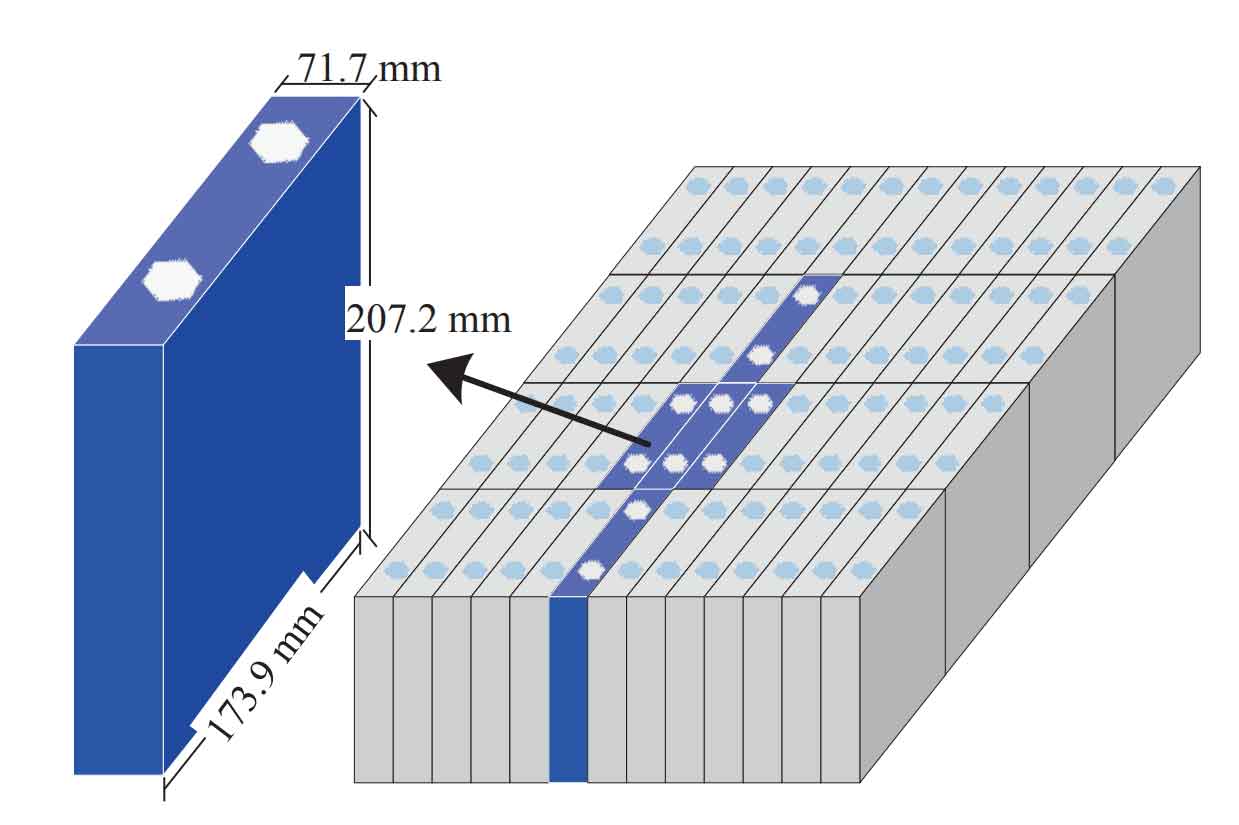
Our experimental design involved constructing a simulated thermal runaway platform within a standard 20-foot shipping container to replicate conditions akin to a single rack in a prefabricated cell energy storage system. The test specimen was a commercial Lithium Iron Phosphate (LFP) battery module with dimensions 1000 × 800 × 240 mm. Thermal runaway was intentionally triggered using internal heating elements to simulate an internal short-circuit scenario. Two 1 kW heating plates were installed inside the battery module enclosure. To monitor the evolution of the event comprehensively, 17 K-type thermocouples (labeled U1-U17) were strategically embedded at various locations within and around the battery module to capture the spatial and temporal temperature profile.
For early fire detection and parameter characterization, ten multi-criteria fire detectors were deployed throughout the simulated rack. These detectors continuously measured smoke density, ambient temperature, carbon monoxide (CO) concentration, and volatile organic compound (VOC) levels. Detector #1 was placed inside the battery module itself to capture the earliest off-gassing signals, while the other nine detectors (2-10) were distributed uniformly across the upper, middle, and lower sections of the rack to monitor gas dispersion and environmental changes.
The experiment commenced with the activation of the primary heating plate. The subsequent thermal runaway event and suppression sequence were meticulously documented. The key timeline of events is summarized below:
| Elapsed Time (min:s) | Event Description | System State |
|---|---|---|
| 10:59 | Detector #1 triggers Alarm Level 2 (CO low alarm at ~194 ppm). | Early Warning. Heating stopped. |
| 37:25 | Audible popping sound from module; visible swelling; initial smoke emission. | Onset of venting. |
| 39:17 – 39:27 | Rapid escalation to copious smoke generation and open flame. | Flaming combustion stage. |
| 39:41 | Detector #4 (above flame) reaches 80°C, triggering Alarm Level 4. | Fire alarm signal; automatic suppression system activated. |
| 39:41 onwards | Discharge of perfluorohexanone agent into the container. | Active suppression in progress. |
| 51:31 | Visible flames completely extinguished. | Fire suppressed. No re-ignition observed. |
The data from Detector #1, located inside the battery module, provided critical insight into the incipient phase of thermal runaway. The progression of its alarm levels is telling. The CO concentration surpassed the low alarm threshold (~190 ppm) approximately 18 minutes before open flame appeared. This was followed by a concurrent rapid rise in CO (exceeding 500 ppm), VOC, and smoke levels, triggering the highest alarm level. The temporal lead of the CO signal is a pivotal finding for fire detection strategy in cell energy storage systems. The concentration of gas \( C_{gas}(t) \) at the detector location can be modeled as a function of source generation rate \( G(t) \) and compartment dispersion dynamics:
$$ C_{gas}(t) = \frac{1}{V} \int_0^t G(\tau) \cdot D(t-\tau) \, d\tau $$
where \( D(t) \) is a dispersion function accounting for airflow and mixing. The early detection of CO suggests \( G_{CO}(t) \) becomes significant well before thermal runaway reaches the flaming stage.
The comparative data from all ten detectors regarding CO concentration revealed a stark contrast. While Detector #1 inside the module provided early warning, the external detectors (2-10) only registered a significant CO increase almost simultaneously with the appearance of dense smoke and flame. This indicates that by the time gases diffused out of the sealed module in substantial quantities, the event had already progressed to a severe state. This underscores a significant challenge in protecting a cell energy storage system: achieving very early detection likely requires sensors placed within each battery module or at the module venting ports, which is currently not standard practice due to cost and complexity.
The temperature data offered another layer of understanding. The spatial distribution of temperature rise was highly non-uniform. As shown in the aggregated data below, only Detector #4, positioned directly above the ignition point, recorded a temperature high enough to trigger its heat alarm (80°C). The prompt activation of the gaseous suppression system upon this alarm effectively limited the ambient temperature rise for all other detectors to below 25°C, demonstrating the system’s capability to control compartment temperature if activated during the early flaming phase.
| Detector ID | Location | Peak Temperature (°C) | Alarm Triggered |
|---|---|---|---|
| #1 | Inside Battery Module | ~20 | CO, VOC, Smoke |
| #2, #3, #5-#10 | Various External Rack Locations | < 25 | CO, Smoke (Late) |
| #4 | Directly Above Fire Origin | > 80 | Heat (80°C), CO, Smoke |
The internal thermocouple data (U1-U17) painted a vivid picture of the intense and localized heat generation during thermal runaway. Following the cessation of external heating, a latent period was observed before several thermocouples, primarily clustered on one side of the module, exhibited a sudden, simultaneous temperature spike exceeding 300°C within seconds. This rapid temperature escalation, described by the steep derivative \( \frac{dT}{dt} \), correlates with the violent onset of flaming combustion. Other thermocouples on the opposite side of the module registered only a minor temperature increase, confirming that the thermal runaway and fire were localized and did not propagate across the entire module during the experiment’s timeframe. The heat release rate \( \dot{Q} \) during this peak can be approximated from the temperature rise of gases and surfaces, though precise calculation requires detailed calorimetry.
The fire suppression test using perfluorohexanone was successful. Upon discharge triggered by the heat alarm from Detector #4, the visible flames were noticeably suppressed and were completely extinguished after a finite period involving multiple discharge pulses as per the system’s control logic. The agent’s rapid vaporization and endothermic effect contributed to cooling the local environment, as evidenced by the containment of high temperatures to the immediate area of the fire. This experiment demonstrated that for a fire in its growing stage within a confined cell energy storage system container of this scale, a sufficient concentration of perfluorohexanone can achieve complete extinguishment. The required minimum design concentration \( C_{min} \) for this specific hazard class (flammable liquids/energized electrical equipment with deep-seated potential) must be carefully determined and applied. The success here can be expressed conceptually as:
$$ C_{achieved} = f(m_{agent}, V_{container}, leakage) \geq C_{min} $$
where \( C_{achieved} \) was sufficient to interrupt the combustion chain reaction for this scenario.
In conclusion, this experimental study on a simulated commercial cell energy storage system yielded several key findings. Firstly, the evolution of thermal runaway follows distinct stages with detectable signatures. Carbon monoxide emission serves as a very early indicator, preceding visible smoke and flame by a significant margin. Implementing internal CO sensing within battery modules could drastically improve early warning capabilities for cell energy storage systems, though practical and economic barriers exist. Secondly, the temperature rise during a single module failure can be highly localized, but the accompanying flammable gas release poses a compartment-wide explosion risk prior to ignition. Thirdly, for fires involving lithium-ion batteries in an enclosed cell energy storage system compartment, gaseous suppression agents like perfluorohexanone can be effective in extinguishing open flames and mitigating ambient temperature rise when applied in a timely manner and at an adequate concentration. The experiment validates its potential as a part of a comprehensive fire protection strategy for such systems. Future work should focus on quantifying the required agent concentration for different fire sizes, understanding suppression effectiveness against prolonged, deep-seated battery fires, and evaluating strategies for early in-module detection to enable intervention before thermal runaway becomes irreversible. The design of a safe and reliable cell energy storage system must integrally address these thermal runaway characteristics through a layered approach combining advanced detection, passive fire barriers, active suppression, and venting strategies.