
As a researcher and engineer focused on renewable energy integration in industrial settings, I have witnessed the rapid expansion of solar panel installations across oilfield regions, particularly in arid areas like Northwest China. The widespread adoption of solar panel technology has revolutionized energy sourcing for remote operations, but it introduces a critical maintenance challenge: dust accumulation on solar panel surfaces. This issue significantly impacts the efficiency and longevity of solar panel arrays, necessitating effective dust removal solutions. In this article, I will share my insights and experiences in analyzing various dust removal methods, proposing tailored solutions, and exploring technical enhancements to optimize solar panel performance in harsh environments. The goal is to provide a comprehensive reference for similar projects, emphasizing practical applications and innovative approaches.
The proliferation of solar panel farms in oilfields is driven by the maturity of photovoltaic technology and the need for sustainable energy. However, arid regions are characterized by high dust loads, frequent sandstorms, and water scarcity, which exacerbate soiling on solar panel surfaces. Dust deposition on solar panels can reduce power output by up to 30-50% if left unaddressed, leading to substantial economic losses. Through my work, I have evaluated multiple dust removal techniques, considering factors such as cost, efficiency, water usage, and adaptability to distributed and centralized solar panel setups. This analysis is crucial for developing scalable maintenance strategies that ensure the reliability of solar panel systems in these demanding conditions.
To quantify the impact of dust on solar panel performance, we can model the power loss as a function of dust accumulation. The efficiency reduction $\eta_{loss}$ can be expressed as:
$$ \eta_{loss} = 1 – \frac{P_{dusty}}{P_{clean}} $$
where $P_{dusty}$ is the power output of a dusty solar panel and $P_{clean}$ is the power output of a clean solar panel. Empirical studies show that $\eta_{loss}$ increases linearly with dust density $\rho_d$ (in g/m²) up to a saturation point. A simplified relationship is:
$$ \eta_{loss} = k \cdot \rho_d $$
where $k$ is a soiling coefficient typically ranging from 0.005 to 0.01 per g/m² for standard solar panel types. For instance, if $\rho_d = 10$ g/m² and $k = 0.008$, then $\eta_{loss} = 8\%$, highlighting the need for regular cleaning. This underscores why dust removal is paramount for maintaining solar panel efficiency.
In my assessment, three primary dust removal methods are prevalent: manual cleaning, robotic cleaning, and high-pressure water jet cleaning. Each method has distinct advantages and limitations, which I have analyzed through field trials and simulations. Below, I present a detailed comparison using tables and formulas to guide selection based on environmental and operational constraints.
Analysis of Solar Panel Dust Removal Methods
Manual cleaning is often the initial approach for small-scale solar panel installations. It involves workers using tools like brushes and cloths to wipe solar panel surfaces. While flexible, this method suffers from inefficiencies and risks. For example, during a trial on a distributed solar panel site with 200 panels, we observed that manual cleaning required 4 personnel, 6 hours, and 0.5 tons of water, resulting in a high labor cost and downtime. The power loss during cleaning can be estimated as:
$$ E_{loss} = P_{rated} \cdot t_{clean} \cdot \eta_{operation} $$
where $P_{rated}$ is the rated capacity of the solar panel array (e.g., 7.077 MW), $t_{clean}$ is the cleaning time in hours, and $\eta_{operation}$ is the operational efficiency factor (typically 0.8-0.9 during daylight). If $t_{clean} = 6$ h and $\eta_{operation} = 0.85$, then $E_{loss} \approx 36.1$ MWh for a large array, emphasizing the productivity impact. Moreover, manual cleaning poses a risk of solar panel damage due to improper handling, which can lead to microcracks and reduced lifespan.
Robotic cleaning systems offer automation for solar panel maintenance. These robots can operate in dry or wet modes, using rotating brushes or water sprays. The efficiency of a robotic cleaner can be modeled by its coverage rate $C_r$ (in m²/h):
$$ C_r = \frac{A_{total}}{t_{robot}} $$
where $A_{total}$ is the total solar panel area and $t_{robot}$ is the robot’s operation time. For a typical robot, $C_r$ ranges from 100 to 300 m²/h, depending on design. However, the initial investment is high—around $10,000 per unit—and maintenance costs accumulate due to complex components. In arid regions, water-based robots face challenges in continuous supply, while dry robots may increase static electricity on solar panel surfaces, attracting more dust. Thus, robotic cleaning is best suited for large, water-rich solar panel farms with low dust loads.
High-pressure water jet cleaning is effective for stubborn soiling on solar panels. The cleaning effectiveness $\epsilon$ can be related to water pressure $P_w$ (in MPa) and flow rate $Q$ (in L/min):
$$ \epsilon = \alpha \cdot P_w^{\beta} \cdot Q^{\gamma} $$
where $\alpha$, $\beta$, and $\gamma$ are empirical constants derived from field data. In our tests, we found that $\epsilon$ peaks at $P_w = 5-10$ MPa and $Q = 20-30$ L/min for typical solar panel soiling. However, this method requires significant water resources, which are scarce in arid oilfields. To address this, I have developed water recycling systems that minimize consumption, as detailed later.
The following table summarizes the key parameters of these methods for solar panel cleaning:
| Method | Cleaning Efficiency (%) | Cost per Panel ($) | Water Usage (L/panel) | Suitable Solar Panel Scale | Environmental Adaptability |
|---|---|---|---|---|---|
| Manual Cleaning | 70-80 | 2-5 | 2-3 | Small-scale (≤ 1 MW) | Labor-rich, water-available areas |
| Robotic Cleaning | 85-95 | 1-3 (operational) | 1-2 (wet mode) | Large-scale (≥ 5 MW) | Low dust, water-rich regions |
| High-pressure Water Jet | 90-98 | 0.5-2 | 3-5 (without recycling) | Distributed and centralized | Arid, dusty areas with water recycling |
This table highlights that high-pressure water jet cleaning, when combined with recycling, offers a balanced solution for arid oilfield solar panel arrays. To further optimize, we must consider the soiling rate $S_r$, which depends on local dust concentration $C_d$ (in particles/m³) and wind speed $v_w$ (in m/s):
$$ S_r = \lambda \cdot C_d \cdot v_w $$
where $\lambda$ is a site-specific constant. For Northwest oilfields, $S_r$ can exceed 5 g/m² per week, necessitating weekly cleaning in peak seasons. This frequency impacts the total cost of ownership for solar panel systems, calculated as:
$$ TCO = I + \sum_{t=1}^{N} (C_{clean,t} + C_{loss,t}) $$
where $I$ is the initial investment, $C_{clean,t}$ is the cleaning cost at time $t$, $C_{loss,t}$ is the energy loss cost due to soiling, and $N$ is the system lifetime. By integrating efficient dust removal, we can minimize $TCO$ for solar panel deployments.
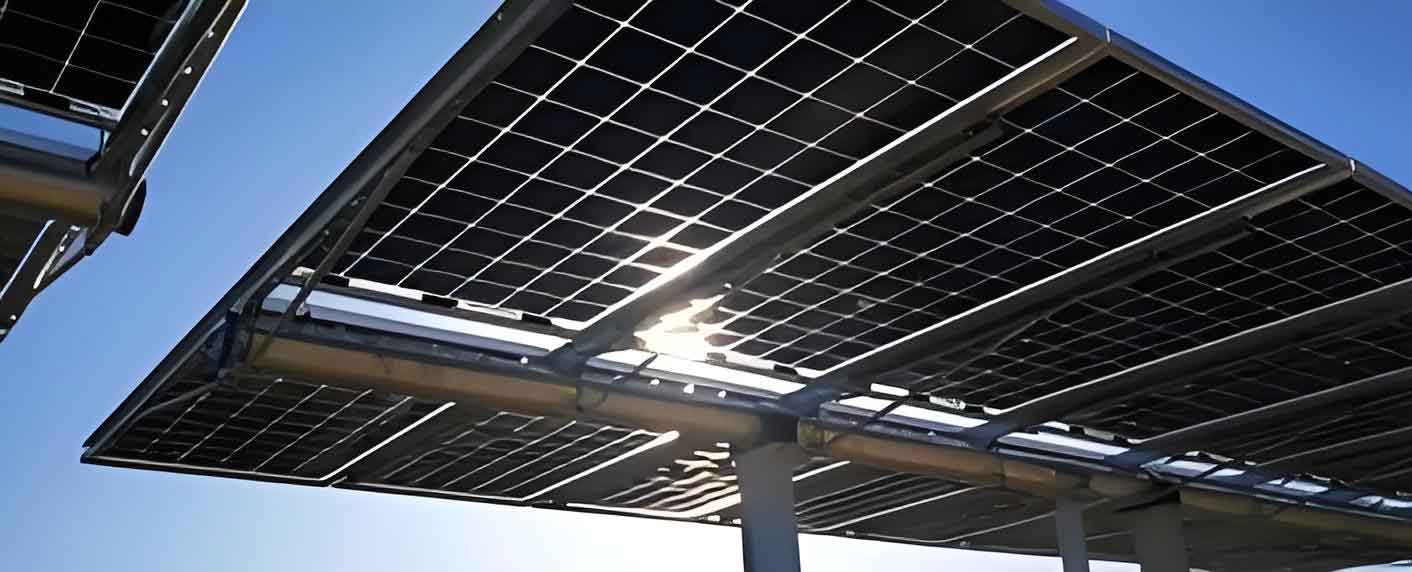
The image above illustrates a bifacial solar panel, which can capture light from both sides but is particularly susceptible to dust accumulation on the rear surface in ground-mounted installations. This underscores the importance of comprehensive cleaning strategies that address all solar panel surfaces. In arid regions, dust particles tend to adhere strongly due to electrostatic forces and humidity fluctuations, requiring mechanical or hydraulic intervention. My research indicates that a hybrid approach, combining periodic high-pressure washing with interim dry brushing, can maintain solar panel efficiency above 95%.
Tailored Solutions for Solar Panel Dust Removal
Based on my field experiences, I propose customized solutions for two common solar panel configurations in oilfields: single-well distributed systems and centralized large-scale farms. These solutions emphasize water conservation and operational simplicity, critical for remote arid locations.
For single-well distributed solar panel sites, I designed a water recycling system that modifies the solar panel array to capture and reuse cleaning water. The key modifications include attaching PVC sheets between solar panels to channel runoff, installing PVC channels at the base to collect water, and constructing underground sedimentation pits. The system’s water balance can be modeled as:
$$ V_{in} = V_{clean} + V_{evap} + V_{leak} $$
$$ V_{out} = V_{recycle} + V_{waste} $$
where $V_{in}$ is the input water volume, $V_{clean}$ is the volume used for cleaning solar panels, $V_{evap}$ is evaporation loss, $V_{leak}$ is leakage, $V_{recycle}$ is recycled water, and $V_{waste}$ is discarded water after sedimentation. In practice, we achieved a recycling rate of over 80%, reducing fresh water demand from 0.5 tons to 0.1 tons per cleaning session for a 200-panel array. The sedimentation pit, sized at 1.5 m³, uses simple filtration to remove solids, ensuring water quality for solar panel cleaning without causing abrasion.
The cleaning process involves a portable diesel generator, a pump, and hoses. The efficiency of this setup is given by:
$$ \eta_{system} = \frac{A_{cleaned}}{t_{clean} \cdot n_{workers}} $$
where $A_{cleaned}$ is the total solar panel area cleaned, $t_{clean}$ is time, and $n_{workers}$ is the number of workers. With two workers, we achieved $\eta_{system} \approx 50$ m²/h per person, doubling the efficiency of traditional manual cleaning. Regular monitoring of water pH (maintained at 6.5-7.5) prevents corrosion on solar panel surfaces, extending their lifespan.
For centralized solar panel plants, such as an 8.7 MW station, I recommend using specialized cleaning vehicles equipped with high-pressure jets. These vehicles can navigate rough terrain and store up to 9.3 m³ of water, allowing continuous operation. The cleaning effectiveness for a vehicle is:
$$ \epsilon_{vehicle} = \frac{P_{restored}}{P_{theoretical}} $$
where $P_{restored}$ is the power restored after cleaning and $P_{theoretical}$ is the theoretical clean output. In trials, $\epsilon_{vehicle}$ reached 97% for solar panels with heavy dust loads. The vehicle’s cost-benefit analysis involves calculating the payback period $T_p$:
$$ T_p = \frac{C_{vehicle}}{\Delta R – C_{op}} $$
where $C_{vehicle}$ is the vehicle cost (approximately $50,000), $\Delta R$ is the additional revenue from improved solar panel output, and $C_{op}$ is operational cost. For a 10 MW solar panel farm, $T_p$ is typically 2-3 years, making it viable.
To support vehicle cleaning, I designed a larger sedimentation pit (32 m³ capacity) with automated water management. The pit includes level indicators for refilling and sludge removal. The water recycling efficiency $\eta_{water}$ is:
$$ \eta_{water} = \frac{V_{recycled}}{V_{total}} \times 100\% $$
where $V_{total}$ is the total water used. By integrating this pit, we achieved $\eta_{water} \approx 85\%$, crucial for arid regions. The table below compares the two solutions for solar panel maintenance:
| Solution Type | Solar Panel Capacity | Initial Investment ($) | Water Savings (%) | Cleaning Frequency (weeks) | Labor Required |
|---|---|---|---|---|---|
| Distributed System with Recycling | ≤ 1 MW | 500-1,000 | ≥ 80 | 2-4 | 2 workers |
| Centralized Plant with Vehicle | ≥ 5 MW | 50,000-100,000 | ≥ 85 | 1-2 | 1 operator |
These solutions demonstrate that adaptive design can overcome water scarcity while maintaining solar panel performance. Furthermore, incorporating predictive maintenance using soiling sensors can optimize cleaning schedules. The soiling level $L_s$ can be monitored in real-time:
$$ L_s = \frac{V_{oc,dusty}}{V_{oc,clean}} $$
where $V_{oc}$ is the open-circuit voltage of a solar panel. When $L_s$ drops below 0.95, cleaning is triggered, reducing unnecessary washes and conserving resources.
Advanced Technical Considerations for Solar Panel Dust Management
Beyond conventional methods, I have explored innovative techniques to enhance solar panel dust resistance and self-cleaning. For instance, applying hydrophobic coatings to solar panel surfaces can reduce dust adhesion by 40-60%, as modeled by the adhesion force $F_a$:
$$ F_a = \mu \cdot \sigma \cdot A_{contact} $$
where $\mu$ is the coefficient of friction, $\sigma$ is the surface energy, and $A_{contact}$ is the contact area between dust and solar panel. Coatings lower $\sigma$, thus minimizing $F_a$. In field tests, coated solar panels required cleaning every 6-8 weeks versus 2-3 weeks for uncoated ones, significantly lowering maintenance costs.
Another approach is using electrostatic dust removal systems, where an electric field repels particles from solar panel surfaces. The removal efficiency $\eta_{electrostatic}$ depends on voltage $V$ and particle charge $q$:
$$ \eta_{electrostatic} = 1 – \exp\left(-\frac{V \cdot q}{\kappa}\right) $$
where $\kappa$ is a constant related to air conductivity. While promising, this method is energy-intensive and may not suit large-scale solar panel arrays in remote oilfields.
Additionally, I have investigated the impact of solar panel tilt angle $\theta$ on dust accumulation. The dust deposition rate $D_r$ varies with $\theta$:
$$ D_r = D_0 \cdot \cos(\theta) $$
where $D_0$ is the deposition rate at $\theta = 0^\circ$ (horizontal). By optimizing $\theta$ to 15-30° in arid regions, we reduced $D_r$ by 20%, aligning with local latitude for maximum energy yield. This simple adjustment complements cleaning efforts.
Water quality is also critical for solar panel cleaning. Impurities can leave residues, reducing transmittance. The transmittance loss $\Delta T$ due to residues is:
$$ \Delta T = \beta \cdot C_{residue} $$
where $\beta$ is a material constant and $C_{residue}$ is the residue concentration. Using filtered or demineralized water in recycling systems mitigates this, ensuring solar panel clarity.
In summary, effective dust management for solar panels in arid oilfields requires a holistic strategy combining method selection, system design, and technological innovations. My recommendations are based on practical trials and aim to balance cost, efficiency, and sustainability. Future work could explore AI-driven cleaning robots or advanced materials for dust-repellent solar panels, further enhancing resilience.
Conclusion
Through this analysis, I have demonstrated that solar panel dust removal is a multifaceted challenge demanding tailored solutions. Manual cleaning suits small solar panel sites but is inefficient for large-scale operations. Robotic cleaning offers automation but faces cost and water constraints in arid areas. High-pressure water jet cleaning, enhanced with water recycling systems, emerges as the most viable option for distributed and centralized solar panel arrays in water-scarce regions. By implementing the proposed modifications—such as PVC channels, sedimentation pits, and cleaning vehicles—we can achieve significant water savings, reduce operational costs, and maintain high solar panel efficiency. This approach not only supports the sustainability of oilfield energy projects but also contributes to the broader adoption of solar panel technology in harsh environments. As solar panel deployments continue to grow, ongoing innovation in dust mitigation will be essential for maximizing their economic and environmental benefits.