
As a flexible energy storage solution, the battery energy storage system plays a crucial role in power grids with high penetration of renewable energy sources. It effectively reduces wind and solar curtailment, mitigates grid voltage fluctuations and network losses, and ensures reliable load supply. However, the diverse service objectives from generation, grid, and user perspectives may present inherent conflicts, posing new challenges for optimal capacity configuration of centralized battery energy storage systems. In this context, I propose a novel optimization framework to address the configuration problem under multi-objective requirements, integrating a scoring system within a two-level planning structure.
The increasing integration of renewable energy sources, such as photovoltaic and wind power, has heightened the need for advanced energy storage solutions. A well-planned battery energy storage system can simultaneously enhance grid stability, improve economic efficiency, and support renewable energy utilization. Traditional approaches often simplify multi-objective optimization by converting it into single-objective problems through weighting or normalization, but these methods may overlook the nuanced trade-offs between objectives. Alternatively, Pareto optimization yields a set of non-dominated solutions, requiring further decision-making. To overcome these limitations, my method establishes a two-layer model—planning and operation—coupled with a scoring system to iteratively guide the optimization process toward a balanced configuration.
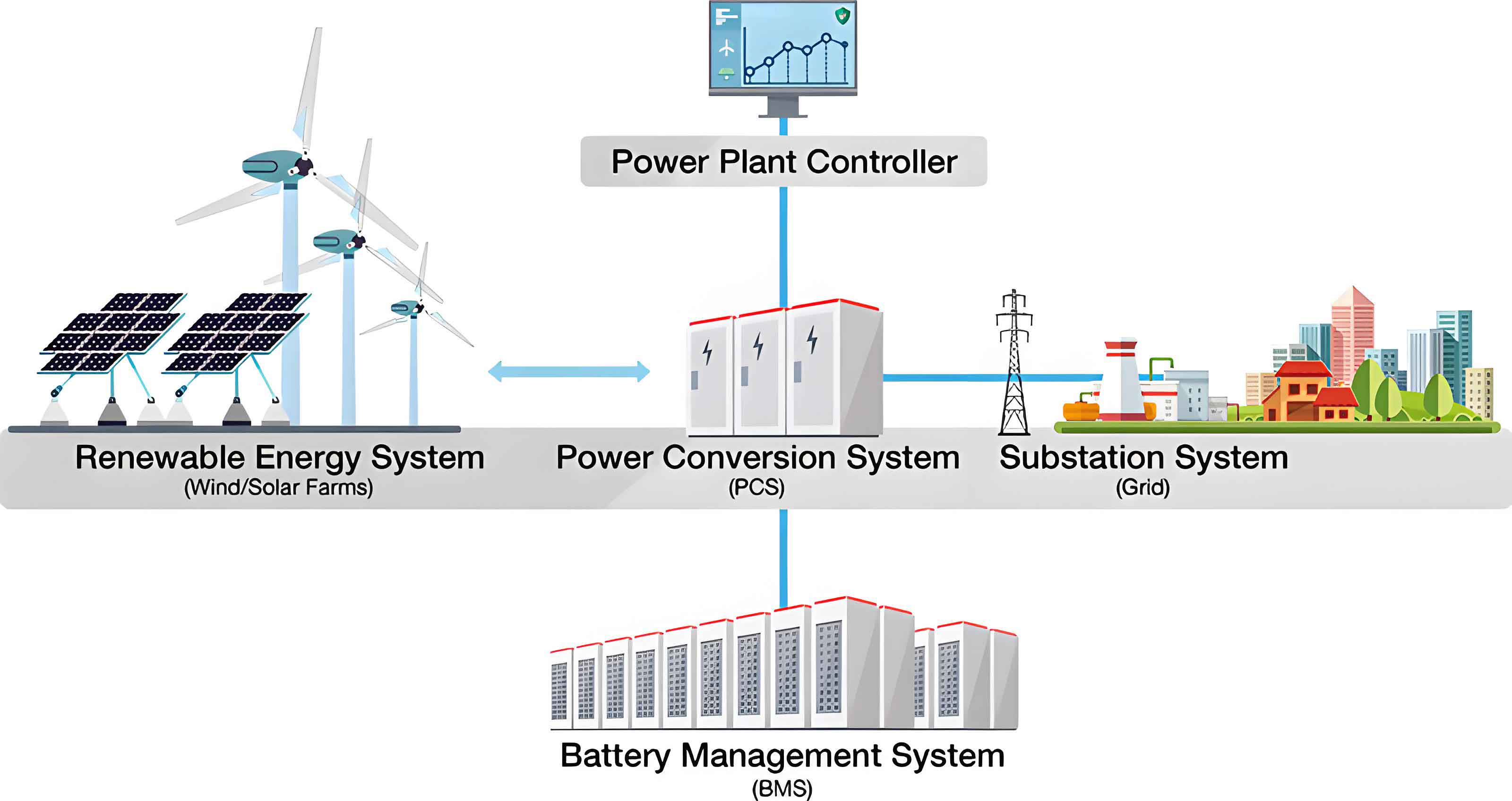
The core of this work lies in developing a comprehensive mixed-integer optimization model that accounts for generator dynamics, renewable energy characteristics, and grid operational constraints. The objectives span multiple service dimensions, including minimizing generator output, reducing renewable curtailment, lowering network losses, improving voltage quality, enhancing dynamic reactive power reserve, optimizing battery energy storage system operation, and ensuring economic viability. Each objective is formulated mathematically, with constraints derived from power flow equations, equipment limits, and battery energy storage system operational rules. For instance, the generator output objective \(J_1\) is defined as:
$$J_1 = \sum_{t=1}^{T} \sum_{i=1}^{N_b} \left[ P_{\text{GEN},i}^2(t) + Q_{\text{GEN},i}^2(t) \right]^{0.5}$$
where \(T\) is the time horizon, \(N_b\) is the number of nodes, and \(P_{\text{GEN},i}(t)\) and \(Q_{\text{GEN},i}(t)\) are the active and reactive power outputs of generators at node \(i\) and time \(t\). Similarly, the renewable curtailment objective \(J_2\) captures the unused energy from photovoltaic and wind sources:
$$J_2 = \sum_{t=1}^{T} \sum_{i=1}^{N_b} \left[ \left( P_{\text{PV},i}^{\text{ref}}(t) – P_{\text{PV},i}(t) \right) + \left( P_{\text{WIND},i}^{\text{ref}}(t) – P_{\text{WIND},i}(t) \right) \right]$$
These objectives reflect the multi-faceted benefits of deploying a battery energy storage system, but they often conflict—for example, maximizing renewable absorption might increase grid losses or require higher battery energy storage system capacity, impacting costs.
To handle the complexity, I design a two-layer optimization architecture. The planning layer determines the configuration variables, such as the rated power and capacity of the battery energy storage system, using a metaheuristic algorithm like genetic algorithm. The operation layer, formulated as a mixed-integer second-order cone programming problem, simulates grid operations under given configurations, optimizing a single objective (e.g., minimizing renewable curtailment) while satisfying all constraints. The results from the operation layer are then evaluated across all objectives, and a scoring system based on the Technique for Order Preference by Similarity to Ideal Solution (TOPSIS) computes a comprehensive score. This score guides the planning layer’s iterative search, effectively balancing multiple service targets without collapsing them into a single aggregate function.
The constraints in the model ensure physical and operational feasibility. For generators and renewables, limits on active and reactive power outputs are enforced:
$$ \left\| P_{\text{GEN},i}(t) \quad Q_{\text{GEN},i}(t) \right\| \leq S_{\text{GEN},i}, \quad P_{\text{GEN},i}^{\min} \leq P_{\text{GEN},i}(t) \leq P_{\text{GEN},i}^{\max}, \quad Q_{\text{GEN},i}^{\min} \leq Q_{\text{GEN},i}(t) \leq Q_{\text{GEN},i}^{\max} $$
For photovoltaic and wind farms:
$$ 0 \leq P_{\text{PV},i}(t) \leq P_{\text{PV},i}^{\text{ref}}(t), \quad 0 \leq P_{\text{WIND},i}(t) \leq P_{\text{WIND},i}^{\text{ref}}(t) $$
Power flow constraints include active and reactive balance at each node:
$$ P_{\text{GEN},i}(t) + P_{\text{ESS},i}(t) + P_{\text{PV},i}(t) + P_{\text{WIND},i}(t) – P_{\text{LOAD},i}(t) = P_i(t) $$
$$ Q_{\text{GEN},i}(t) + Q_{\text{ESS},i}(t) – Q_{\text{LOAD},i}(t) = Q_i(t) $$
Voltage and current limits are also incorporated, with second-order cone relaxation for line flows:
$$ U_i(t) = U_j(t) + I_{i,j}(t) \times (R_{i,j}^2 + X_{i,j}^2) – 2 \times \left[ P_{i,j}(t) \times R_{i,j} + Q_{i,j}(t) \times X_{i,j} \right] $$
$$ \left\| 2P_{i,j}(t) \quad 2Q_{i,j}(t) \quad I_{i,j}(t) – U_i(t) \right\|_2 \leq I_{i,j}(t) + U_i(t) $$
For the battery energy storage system, constraints cover state-of-energy dynamics and power limits:
$$ C_{\text{SOE},i}(t+\Delta t) = C_{\text{SOE},i}(t) – \left( P_{\text{ess},i}^d(t) \eta_{d,i} + P_{\text{ess},i}^c(t) \times \eta_{c,i} \right) \times \Delta t \times 100 / S_{\text{ess},i}^N $$
$$ C_{\text{SOE},i}^{\min} \leq C_{\text{SOE},i}(t) \leq C_{\text{SOE},i}^{\max}, \quad \left\| P_{\text{ESS},i}(t) \quad Q_{\text{ESS},i}(t) \right\| \leq P_{\text{ess},i}^N $$
These constraints ensure that the battery energy storage system operates within safe and efficient bounds, contributing to grid stability.
The economic aspect is captured through a levelized cost of energy (LCOE) model for the battery energy storage system, denoted as \(J_7\):
$$ J_7 = \frac{C_{\text{IN}} + C_{\text{OM}} + C_{\text{L}} + C_{\text{REC}}}{E_{\text{TOTAL}}} $$
where investment cost \(C_{\text{IN}} = c_P \times P_{\text{ess}}^N + c_S \times S_{\text{ess}}^N\), operation and maintenance cost \(C_{\text{OM}} = \sum_{y=1}^{Y} (\text{com} \times c_S \times S_{\text{ess}}^N) / (1+r)^y\), electricity cost \(C_{\text{L}} = \sum_{y=1}^{Y} \left[365 \times S_{\text{ess}}^N \times (1 – 1/\eta_c) \times C_{\text{DOD}} \times c_{\text{Pr}}\right] / (1+r)^y\), recovery cost \(C_{\text{REC}} = (C_{\text{IN}} \times r) / (1+r)^Y\), and total discharge energy \(E_{\text{TOTAL}} = \sum_{y=1}^{Y} \left[365 \times S_{\text{ess}}^N \times \eta_d \times C_{\text{DOD}} \times (1-\phi)^{y-1}\right] / (1+r)^y\). This comprehensive cost model highlights the importance of economic viability in deploying a battery energy storage system.
To validate the proposed method, I conduct a case study on a modified IEEE 33-node distribution system integrated with high proportions of renewable energy. Two photovoltaic plants and two wind farms are connected at nodes 6, 13, 22, and 32, with a centralized battery energy storage system initially placed at node 6. The simulation parameters are summarized in the following table:
| Parameter | Value | Parameter | Value |
|---|---|---|---|
| Rated line voltage | 12.66 kV | Generator rated power | 10 MW |
| Voltage limits | ±10% | PV installed capacity | 4 MW, 2 MW |
| Max line current | 456 A | Wind installed capacity | 3 MW, 2 MW |
| BESS max power | 10 MW | BESS charge/discharge efficiency | 95%, 92% |
| BESS max capacity | 20 MWh | BESS SOE limits | 10%–90% |
| Unit power cost | 320 CNY/kW | Unit capacity cost | 1000 CNY/kWh |
| Lifespan | 20 years | Discount rate | 8% |
The typical daily profiles for load, photovoltaic, and wind power illustrate the variability and mismatch between generation and demand, underscoring the need for a battery energy storage system. The optimization process converges smoothly, as shown by the scoring curve, indicating that the method effectively navigates the trade-offs among objectives. Results compare three scenarios: no battery energy storage system, a fixed configuration (30% of renewable capacity with 4-hour duration), and the optimized configuration from the proposed method.
The optimized battery energy storage system achieves near-zero renewable curtailment, significantly reduces voltage deviations from 1.2485 kV to around 0.07 kV, and enhances dynamic reactive power reserve by over twofold. Key performance indicators are summarized below:
| Metric | No BESS | Fixed BESS | Optimized BESS |
|---|---|---|---|
| Rated power (MW) | 0.0000 | 3.3000 | 7.6460 |
| Rated capacity (MWh) | 0.0000 | 13.2000 | 14.5641 |
| Generator output \(J_1\) (MWh) | 77.7208 | 57.2920 | 37.8634 |
| Renewable curtailment \(J_2\) (MWh) | 11.9881 | 0.0002 | 0.0010 |
| Network loss \(J_3\) (kWh) | 208.0061 | 302.7877 | 182.6994 |
| Voltage deviation \(J_4\) (kV) | 1.2485 | 0.0685 | 0.0747 |
| Reactive reserve \(J_5\) (Mvarh) | 172.4355 | 254.2254 | 388.9002 |
| BESS output \(J_6\) (MWh) | 0.0000 | 37.5596 | 54.0438 |
| LCOE \(J_7\) (CNY/kWh) | 0.0000 | 0.5978 | 0.6354 |
The optimized battery energy storage system configuration not only improves grid performance but also maintains economic feasibility, with a levelized cost of energy around 0.64 CNY/kWh. Further analysis explores the impact of location and battery technology on the optimization outcomes. By testing different node placements for the battery energy storage system, I observe variations in rated power and capacity, with discharge durations consistently above 2 hours, aligning with policy requirements for energy storage integration. For example, configurations at nodes 1, 6, and 32 yield distinct results:
| Location | Power (MW) | Capacity (MWh) | Discharge Time (h) | LCOE (CNY/kWh) |
|---|---|---|---|---|
| Node 1 | 7.9688 | 16.7290 | 2.0993 | 0.6288 |
| Node 6 | 7.6460 | 14.5641 | 1.9048 | 0.6354 |
| Node 32 | 3.4749 | 11.9330 | 3.4340 | 0.6035 |
These findings emphasize that the placement of a battery energy storage system critically influences service objectives, with no single location dominating all metrics. Similarly, evaluating different battery types—such as lithium iron phosphate (LFP), lithium nickel manganese cobalt oxide (NMC), lead-acid, vanadium redox flow, and sodium-sulfur—reveals trade-offs in cost and performance. The LFP battery energy storage system demonstrates the lowest LCOE and superior grid support, making it a favorable choice under the given multi-objective framework. The comparison is quantified as follows:
| Battery Type | Power (MW) | Capacity (MWh) | LCOE (CNY/kWh) | Reactive Reserve \(J_5\) (Mvarh) |
|---|---|---|---|---|
| LFP | 7.6460 | 14.5641 | 0.6354 | 388.9002 |
| NMC | 3.9234 | 10.7237 | 0.7517 | 275.8460 |
| Lead-acid | 4.2414 | 17.2850 | 1.2622 | 294.0720 |
| Vanadium flow | 3.7841 | 16.5922 | 1.1938 | 275.9300 |
| Sodium-sulfur | 3.0900 | 10.5920 | 1.6568 | 255.7400 |
The methodology’s robustness stems from its ability to integrate complex constraints and multiple objectives without relying on subjective weighting. The two-layer structure decouples the configuration planning from operational optimization, allowing efficient computation via genetic algorithms and convex programming. The scoring system, based on TOPSIS, provides a quantitative measure to rank solutions, ensuring that the final battery energy storage system configuration balances diverse service targets. This approach is scalable and can be extended to include additional variables, such as multiple storage units or advanced control strategies.
In conclusion, the proposed optimization framework effectively addresses the challenges of configuring centralized battery energy storage systems for multiple service objectives. By combining a two-layer planning model with a scoring mechanism, it harmonizes goals like renewable energy absorption, grid voltage quality, and economic efficiency. The case study validates that the method yields practical configurations, with battery energy storage system ratings exceeding 30% of renewable capacity in some cases, but always ensuring a minimum discharge duration of 2 hours. Location and technology choices significantly impact outcomes, highlighting the need for tailored planning. Future work could incorporate lifecycle degradation costs and probabilistic renewable forecasts to enhance realism. Overall, this research underscores the pivotal role of battery energy storage systems in modern power grids and offers a systematic tool for their optimal deployment.