
As I delve into the evolving landscape of electric vehicle (EV) technology, one topic consistently captures my attention: the development and implementation of solid-state batteries. For years, the automotive industry has been abuzz with promises of a “battery breakthrough,” yet genuine transformative advancements have been elusive. While incremental improvements in lithium-ion batteries have enhanced safety, capacity, energy density, and cost, the core technology has remained largely unchanged. The much-anticipated shift to solid-state battery systems represents a potential paradigm shift, offering profound implications for performance, safety, and sustainability. In this analysis, I will explore the technical foundations, comparative advantages, prevailing challenges, and strategic roadmaps—particularly focusing on automotive industry timelines—for solid-state battery adoption. Throughout, I will employ statistical models, comparative tables, and engineering formulas to quantify and clarify these complex dynamics. My goal is to provide a comprehensive, first-person perspective on why solid-state batteries are considered the next frontier in electrification.
The fundamental distinction between conventional lithium-ion batteries and solid-state batteries lies in the electrolyte. Traditional systems use a liquid or gel electrolyte to facilitate ion movement between the anode and cathode. In contrast, a solid-state battery replaces this with a solid electrolyte material. This seemingly simple substitution unlocks a cascade of performance benefits. The solid electrolyte can be ceramic, polymer, or a composite, each with unique properties affecting ionic conductivity, mechanical stability, and interfacial compatibility. The promise of solid-state battery technology is not merely incremental; it is foundational, potentially redefining energy storage parameters for mobile applications.
To appreciate the potential, let’s first establish a quantitative framework for battery performance metrics. Key parameters include energy density (volumetric and gravimetric), power density, cycle life, safety coefficients, and cost per kilowatt-hour. Energy density, often the most discussed metric for EVs determining range, can be expressed as:
$$ \text{Gravimetric Energy Density} = \frac{E}{m} \quad \text{(in Wh/kg)} $$
$$ \text{Volumetric Energy Density} = \frac{E}{V} \quad \text{(in Wh/L)} $$
where \( E \) is the total energy capacity, \( m \) is the mass, and \( V \) is the volume. Current state-of-the-art lithium-ion batteries achieve about 250-300 Wh/kg. Projections for mature solid-state battery systems suggest potentials exceeding 500 Wh/kg, effectively doubling the range for a given battery mass. This leap stems from the ability to use high-capacity anode materials like pure lithium metal without the dendrite formation risks prevalent in liquid electrolytes. The fundamental relationship for capacity can be linked to the materials’ electrochemical properties via the formula:
$$ C = nF \frac{x}{M} $$
where \( C \) is the specific capacity, \( n \) is the number of electrons transferred, \( F \) is Faraday’s constant, \( x \) is the stoichiometric coefficient, and \( M \) is the molar mass. Using lithium metal (theoretical capacity ~3860 mAh/g) versus graphite (~372 mAh/g) illustrates the anode material advantage unlocked by solid-state battery stability.
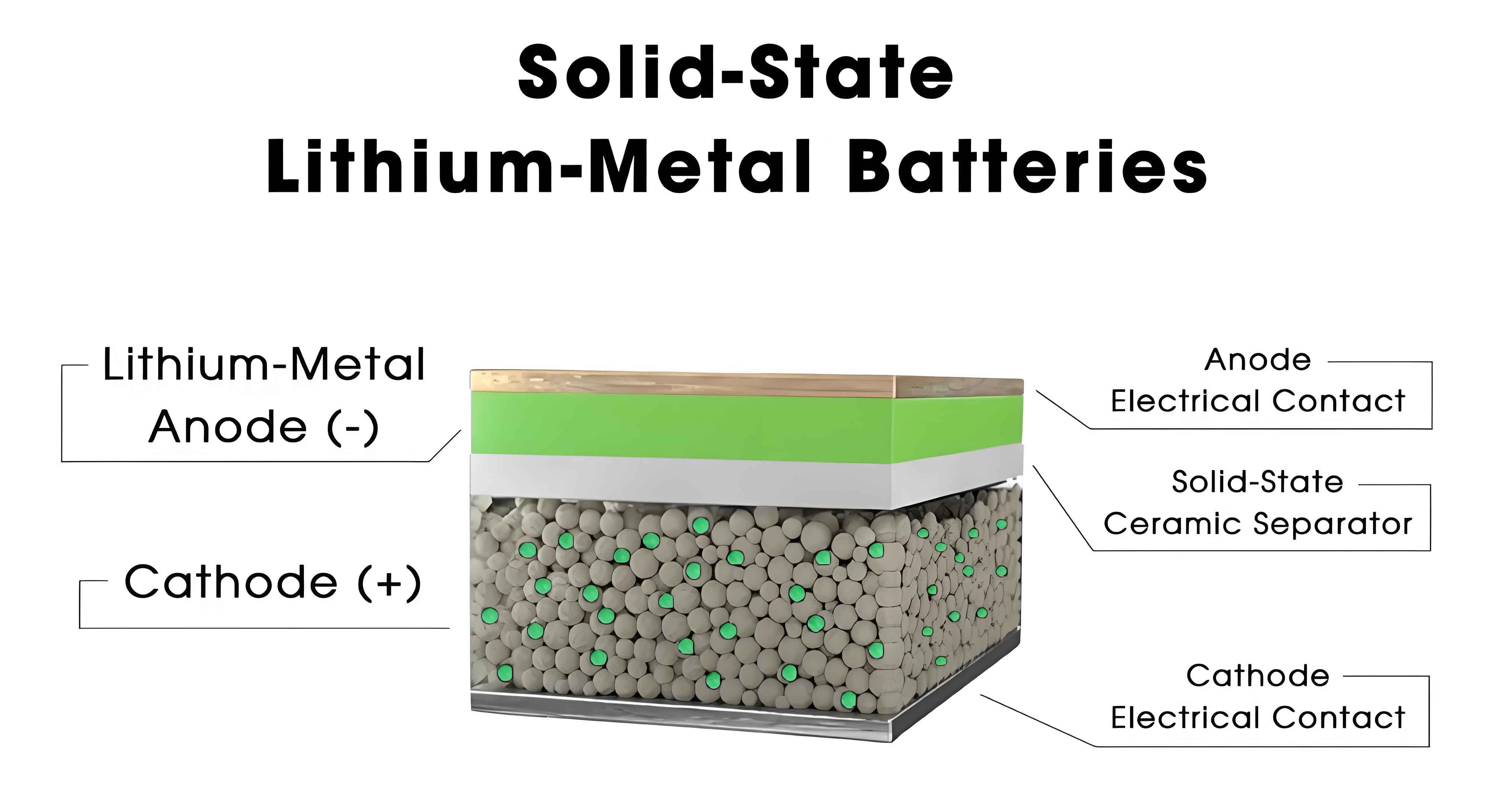
Safety is another paramount advantage. Liquid electrolytes are typically flammable organic solvents, posing a fire risk upon short-circuit or thermal runaway. Solid electrolytes, especially inorganic ceramics, are non-flammable and more thermally stable. The risk probability \( P_{fail} \) can be modeled as a function of temperature \( T \) and stress factors \( \sigma \):
$$ P_{fail}(T, \sigma) = 1 – \exp\left(-\int_0^t \lambda(T(\tau), \sigma(\tau)) \, d\tau\right) $$
where \( \lambda \) is the failure rate. For a solid-state battery, the \( \lambda \) function exhibits a much lower escalation with temperature, drastically reducing \( P_{fail} \). This inherent safety could simplify battery management systems and reduce shielding requirements, indirectly improving energy density further.
However, the path to commercializing solid-state battery technology is fraught with technical hurdles. Key challenges include interfacial impedance between solid components, electrolyte brittleness and manufacturability, and long-term cycling stability. The ionic conductivity \( \sigma_{ion} \) of the solid electrolyte must match or exceed that of liquids (~10⁻² S/cm). While some ceramic sulfides approach this, they may suffer from air sensitivity or poor mechanical properties. The overall cell resistance \( R_{cell} \) is a sum of contributions:
$$ R_{cell} = R_{bulk} + R_{interface} + R_{charge-transfer} $$
Minimizing \( R_{interface} \), which arises from poor contact and chemical incompatibility, is a major research focus. Furthermore, production costs remain high. A simple cost model per kWh can be expressed:
$$ \text{Cost}_{kWh} = \frac{\sum (C_{material} \cdot m) + C_{processing} + C_{assembly}}{\eta \cdot E} $$
where \( C_{material} \) is material cost per kg, \( m \) is mass per component, \( C_{processing} \) and \( C_{assembly} \) are manufacturing costs, \( \eta \) is yield rate, and \( E \) is energy per cell. Currently, solid-state battery costs are prohibitive for mass-market vehicles, but economies of scale and process innovation are expected to drive reductions.
Let’s quantitatively compare solid-state battery characteristics with incumbent lithium-ion and emerging lithium-polymer variants. The following table summarizes key attributes based on current research and industry projections:
| Battery Parameter | Conventional Liquid Li-ion | Lithium Polymer (Gel Electrolyte) | Solid-State Battery (Ceramic Electrolyte) |
|---|---|---|---|
| Electrolyte State | Liquid Organic Solvent | Solid Polymer/Gel | Solid Ceramic/Sulfide |
| Typical Energy Density (Wh/kg) | 250-300 | 150-220 | 400-500 (projected) |
| Operating Temperature Range | -20°C to 60°C | 0°C to 60°C | -30°C to 100°C (potential) |
| Flammability Risk | High | Moderate | Very Low |
| Cycle Life (to 80% capacity) | 1000-1500 cycles | 500-1000 cycles | >1500 cycles (target) |
| Fast-Charge Capability | Moderate (1-2C) | Low | High (potential >4C) |
| Manufacturing Complexity | Mature, Low Cost | Moderate | High (Current) |
| Estimated Cost Trajectory ($/kWh) | ~100-150 (current) | ~150-200 | >300 (current), aiming for <100 |
This table underscores why the solid-state battery is so compelling: it promises simultaneous gains in energy, safety, and operational robustness. However, the manufacturing complexity and cost are significant barriers. The transition to solid-state battery production requires new deposition techniques, quality control for solid-solid interfaces, and supply chains for novel materials. Statistical process control (SPC) methodologies, akin to those used in precision manufacturing, will be critical. For instance, ensuring consistent thickness and porosity of solid electrolyte layers involves monitoring process capability indices. A process capability index \( C_{pk} \) for a critical parameter like layer thickness \( X \) with specification limits \( USL \) and \( LSL \) and standard deviation \( \sigma \) is:
$$ C_{pk} = \min\left( \frac{USL – \mu}{3\sigma}, \frac{\mu – LSL}{3\sigma} \right) $$
Where \( \mu \) is the process mean. Achieving high \( C_{pk} \) (e.g., >1.67) for solid-state battery component manufacturing is essential for yield and performance uniformity. Monte Carlo simulations can model tolerance stack-ups in multilayer cell assemblies to predict final performance distributions, a technique borrowed from other engineering fields.
Turning to automotive industry adoption, several major manufacturers have announced ambitious plans for solid-state battery integration. A prominent example is the commitment to introduce solid-state battery technology in production vehicles by the end of this decade. The strategy involves intermediate steps, such as demonstration vehicles and pilot lines, to de-risk the technology. For instance, a demonstrator vehicle is planned for around 2025, with the goal of achieving automotive-grade solid-state battery systems by 2030. This phased approach acknowledges the technical and supply-chain maturation required. The development focus is on creating a solid-state battery that is not only high-performing but also safe, cost-effective, and recyclable within a circular economy framework. Competing automakers have similar timelines, indicating a collective industry belief that the 2030s will be the decade of the solid-state battery.
The economic implications are vast. If solid-state battery costs can be reduced to parity with internal combustion engines, as targeted, it would remove the last major cost barrier to universal EV adoption. The total cost of ownership (TCO) model for an EV with a solid-state battery would shift dramatically. A simplified TCO over vehicle life \( L \) in years can be expressed:
$$ \text{TCO} = P_{vehicle} + \sum_{t=1}^{L} \left( C_{energy,t} + C_{maintenance,t} \right) – R_{residual} $$
Here, \( P_{vehicle} \) is purchase price, \( C_{energy,t} \) is energy cost, \( C_{maintenance,t} \) is maintenance cost, and \( R_{residual} \) is residual value. A solid-state battery’s longer life, faster charging, and higher energy density would positively impact \( C_{energy,t} \), \( C_{maintenance,t} \), and \( R_{residual} \), potentially making EVs cheaper than ICE vehicles in upfront price as well.
Recycling and sustainability are integral to the solid-state battery value proposition. The solid electrolyte may simplify disassembly and material recovery. A material recovery rate \( \eta_{recycle} \) can be defined for key elements like lithium, cobalt, and nickel:
$$ \eta_{recycle} = \frac{M_{recovered}}{M_{initial}} \times 100\% $$
Targets for closed-loop recycling of solid-state battery components are part of the development ethos, reducing environmental impact and geopolitical supply risks.
From a first-person research perspective, I find the interplay between material science, manufacturing engineering, and economics fascinating. The evolution of the solid-state battery is not a single invention but a system integration challenge. Every component—anode, cathode, electrolyte, current collectors—must be co-optimized. For example, the expansion and contraction of electrodes during cycling must be mechanically accommodated by the solid electrolyte, requiring careful design of composite structures. Stress-strain relationships in the cell stack can be modeled using linear elasticity theory:
$$ \sigma_{ij} = C_{ijkl} \epsilon_{kl} $$
where \( \sigma_{ij} \) is the stress tensor, \( C_{ijkl} \) is the stiffness tensor, and \( \epsilon_{kl} \) is the strain tensor. Managing these mechanical stresses is crucial for cycle life.
Furthermore, thermal management differs for solid-state batteries. While they generate less heat from side reactions, their higher possible power density means efficient heat dissipation is still vital. The heat generation rate \( \dot{q} \) can be approximated from overpotential \( \eta \) and current \( I \):
$$ \dot{q} = I \cdot \eta + I \cdot T \frac{\partial E}{\partial T} $$
Solid-state battery systems may allow for simpler cooling systems due to better thermal stability, further saving weight and cost.
Looking ahead, the roadmap for solid-state battery commercialization involves several technology generations. The first generation might use hybrid or semi-solid electrolytes to mitigate interface issues, gradually moving to all-solid architectures. Investment in gigafactories dedicated to solid-state battery production is increasing globally. The success of these ventures hinges on solving the scalability puzzle. Process yield \( Y \) as a function of defect density \( d \) and process steps \( n \) is often modeled as:
$$ Y = (1 – d)^n $$
For a complex multi-step solid-state battery manufacturing line with many critical steps, even small defect rates per step drastically reduce overall yield. Thus, process innovation is as important as material innovation.
In my assessment, the solid-state battery represents the most promising path to overcoming the range anxiety, charging time, and safety concerns that still linger for some potential EV adopters. Its potential to enable lighter, longer-range, and safer vehicles aligns perfectly with global decarbonization goals. However, patience is required; the technology is in the proverbial “valley of death” between lab-scale success and mass production. The announced industry timelines around 2030 seem realistic given the remaining hurdles.
To further illustrate the performance trajectory, consider the following comparative analysis of key metrics over time, projecting the impact of solid-state battery introduction:
| Year | Dominant Battery Technology | Average EV Range (km) | Fast Charge Time (10-80%) | Battery Cost ($/kWh) | Safety Incident Rate (per GWh) |
|---|---|---|---|---|---|
| 2020 | Liquid NMC Li-ion | 350-400 | 30-40 minutes | ~130 | ~0.5 |
| 2025 (Projected) | Advanced Li-ion / Early Hybrid Solid-State | 500-600 | 20-25 minutes | ~90-100 | ~0.2 |
| 2030 (Projected) | Commercial Solid-State Battery (1st Gen) | 750-900 | 10-15 minutes | ~70-80 | <0.1 |
| 2035+ (Projected) | Mature Solid-State Battery (2nd Gen+) | >1000 | <10 minutes | <60 | ~0.05 |
This projection underscores the transformative potential of the solid-state battery across multiple dimensions. The integration of solid-state battery technology is not an isolated event but part of a broader ecosystem evolution including charging infrastructure, renewable energy integration, and vehicle design. For example, the higher energy density of solid-state battery packs could free up space for other components or allow for more aerodynamic vehicle shapes, further improving efficiency. The vehicle’s energy consumption per kilometer \( E_{km} \) could be reduced through both battery weight savings and improved aerodynamics:
$$ E_{km} = \frac{1}{2} C_d A \rho v^3 t_{km} + mg \sin \theta + mg C_r \cos \theta $$
where \( C_d \) is drag coefficient, \( A \) is frontal area, \( \rho \) is air density, \( v \) is velocity, \( t_{km} \) is time per km, \( m \) is mass, \( g \) is gravity, \( \theta \) is road incline, and \( C_r \) is rolling resistance coefficient. A lighter vehicle due to a solid-state battery reduces the \( mg \) terms significantly.
In conclusion, my exploration into solid-state battery technology convinces me that it is the most credible candidate for the next major leap in electric vehicle energy storage. While challenges in manufacturing, cost, and scalability are substantial, the concerted efforts of automakers, battery producers, and material scientists are steadily overcoming them. The solid-state battery is more than an incremental improvement; it is an enabling technology that could accelerate the global transition to sustainable transportation. As research progresses and pilot projects yield data, our understanding will refine, but the direction is clear: the future of automotive electrification is intrinsically linked to the success of the solid-state battery. The journey from lab to road is complex, but the destination—a safer, longer-range, and more affordable electric vehicle—is undoubtedly worth the pursuit. The next decade will be decisive in determining how swiftly the solid-state battery moves from promise to pervasive reality on our roads.