
In this comprehensive experiment, we explore the design and application of carbon-based perovskite solar cells, focusing on their ability to drive a mini fan as a practical demonstration. The experiment integrates concepts from inorganic chemistry, such as crystal structures, and materials chemistry, including semiconductor properties and energy band theory. Our goal is to reinforce foundational knowledge while developing essential experimental skills and characterization techniques. By simplifying the fabrication process and incorporating component engineering, we enable students to optimize perovskite layers and analyze results using methods like X-ray diffraction (XRD), scanning electron microscopy (SEM), and current density-voltage (J-V) curves. The inclusion of a mini fan assembly not only enhances engagement but also illustrates the real-world applicability of perovskite solar cell technology, aligning with green chemistry principles and sustainable energy goals.
Perovskite solar cells have garnered significant attention due to their high power conversion efficiencies, which now exceed 26.8%, and their low-cost fabrication potential. These devices typically feature an ABX3 crystal structure, where A represents monovalent cations like methylammonium (MA+), formamidinium (FA+), or cesium (Cs+), B is a divalent metal cation such as lead (Pb2+) or tin (Sn2+), and X denotes halide anions like iodide (I-), bromide (Br-), or chloride (Cl-). In our carbon-based perovskite solar cell design, we employ a hole-transport-layer-free configuration, consisting of a fluorine-doped tin oxide (FTO) transparent conductive glass substrate, an electron transport layer (ETL), a perovskite layer, and a carbon electrode. This structure facilitates efficient light absorption and charge carrier separation, leading to photovoltaic effects that can be harnessed for power generation.
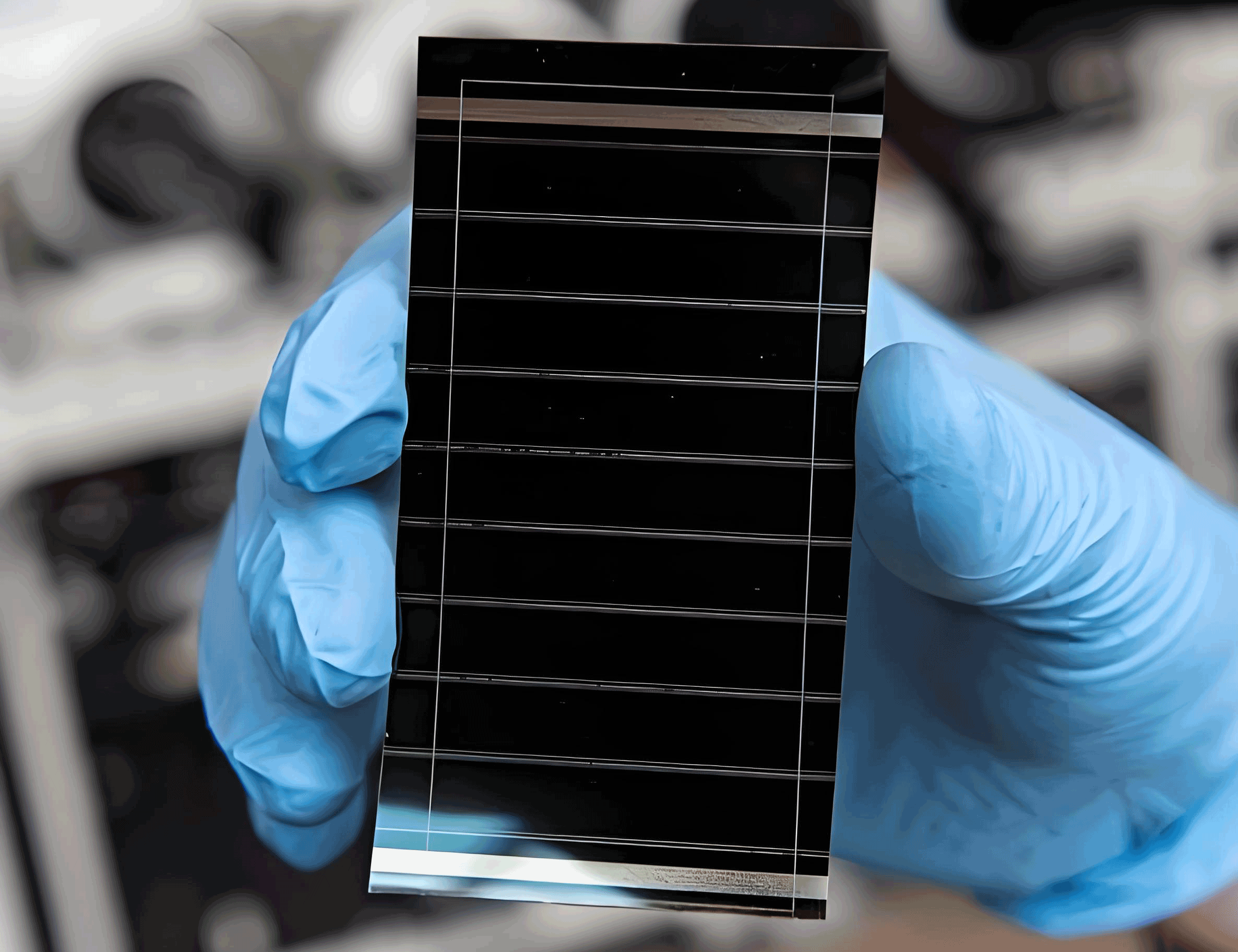
The working principle of perovskite solar cells involves the absorption of photons with energy greater than the bandgap of the perovskite material, exciting electrons from the valence band to the conduction band and generating electron-hole pairs. Electrons are transported through the ETL to the FTO substrate, while holes are collected at the carbon electrode. By connecting an external circuit between the FTO and carbon electrode, a current is generated, enabling power output. Key performance parameters include the short-circuit current density (Jsc), open-circuit voltage (Voc), fill factor (FF), and power conversion efficiency (PCE), which are derived from J-V curves measured under simulated solar illumination. The formulas for FF and PCE are given by:
$$ FF = \frac{P_{max}}{V_{oc} \times J_{sc}} $$
$$ PCE = \frac{P_{max}}{P_{in}} = \frac{V_{oc} \times J_{sc} \times FF}{P_{in}} $$
where \( P_{max} \) is the maximum power output and \( P_{in} \) is the incident light power. These metrics are critical for evaluating the effectiveness of perovskite solar cell devices and optimizing their design.
In this experiment, we focus on component engineering to enhance the performance of perovskite solar cells. Specifically, we investigate the role of lead chloride (PbCl2) additives in improving the crystallinity and coverage of perovskite films. By comparing devices with and without PbCl2, students can observe changes in film morphology, crystal structure, and photovoltaic parameters. This hands-on approach not only deepens understanding of material science but also encourages innovative thinking in solving engineering challenges related to perovskite solar cells.
Experimental Objectives and Principles
The primary objectives of this experiment are to familiarize students with the fabrication and characterization of perovskite solar cells. Students will learn to prepare perovskite layers using a one-step spin-coating method without antisolvent, apply carbon electrodes via blade-coating, and assemble functional devices. They will also gain proficiency in operating advanced instruments such as electrochemical workstations, SEM, and XRD, and interpret data to assess device performance. Through this process, we aim to cultivate critical thinking and problem-solving skills, while highlighting the importance of perovskite solar cells in renewable energy applications.
The fundamental principles underlying perovskite solar cells revolve around their semiconductor properties and photovoltaic effects. The perovskite crystal structure, with its tunable bandgap, allows for efficient light absorption and charge generation. The energy level alignment between the ETL, perovskite layer, and carbon electrode facilitates charge separation and transport, minimizing recombination losses. By manipulating the composition of the perovskite precursor solution, we can influence grain growth, film uniformity, and overall device efficiency. This experiment emphasizes the interplay between chemistry and materials science in advancing perovskite solar cell technology.
Materials and Methods
We used the following reagents and materials for the fabrication of carbon-based perovskite solar cells: fluorine-doped tin oxide conductive glass (FTO), acetone (AC), isopropanol (IPA), lead chloride (PbCl2), cesium iodide (CsI), formamidinium iodide (FAI), lead iodide (PbI2), N-methylpyrrolidone (NMP), N,N-dimethylformamide (DMF), SnO2 colloidal dispersion (12 wt%, Alfa), conductive carbon paste, deionized water, and detergent. All chemicals were handled in a glovebox to maintain controlled conditions.
The experimental instruments included a glovebox, oven, ultrasonic cleaner, EZ4-S spin coater, constant temperature hotplate, CHI electrochemical workstation, solar simulator, field-emission scanning electron microscope (SEM), X-ray powder diffractometer (PXRD), and infrared light tachometer. These tools enabled precise fabrication and comprehensive characterization of the perovskite solar cell devices.
The experimental procedure was divided into several steps, as summarized in the table below:
| Step | Description | Conditions |
|---|---|---|
| 1. Substrate Cleaning | FTO glass was sequentially cleaned in detergent, distilled water, and acetone-IPA mixture (1:1 ratio) via ultrasonication for 5 min each, followed by drying at 70°C. | Ultrasonication, 70°C drying |
| 2. UV-Ozone Treatment | Cleaned FTO substrates underwent UV-ozone treatment for 30 min to remove organic residues and improve wettability. | 30 min UV-ozone |
| 3. ETL Preparation | SnO2 dispersion was diluted with deionized water (1:3 ratio), spin-coated on FTO at 4000 rpm for 30 s, and annealed at 150°C for 30 min. | 4000 rpm, 30 s, 150°C annealing |
| 4. Perovskite Layer Formation | Perovskite precursor solution (2 M FA0.83Cs0.17PbI3 in DMF, with or without 10% PbCl2) was spin-coated on SnO2/FTO at 5000 rpm for 50 s and annealed at 150°C for 10 min. | 5000 rpm, 50 s, 150°C annealing |
| 5. Carbon Electrode Application | Carbon paste was blade-coated on the perovskite layer and annealed at 120°C for 10 min to form the electrode. | Blade-coating, 120°C annealing |
| 6. Characterization | Devices were tested using J-V curves, SEM, and XRD to evaluate performance and morphology. | Solar simulator, SEM, XRD |
| 7. Fan Assembly | Carbon electrodes were connected to wires using carbon paste, and devices were assembled into modules to drive a mini fan. | Circuit assembly, fan connection |
The perovskite precursor solution was prepared by dissolving CsI (44.2 mg), FAI (142.8 mg), PbI2 (461 mg), and PbCl2 (27.8 mg for additive samples) in a mixture of 96 μL NMP and 500 μL DMF, followed by stirring for 1 hour. This formulation allowed for systematic investigation of PbCl2’s impact on perovskite solar cell properties.
Results and Discussion
We observed significant differences in the color evolution of perovskite films during annealing, depending on the presence of PbCl2. Without PbCl2, films turned dark brown within 10 seconds of annealing, indicating rapid crystallization. In contrast, films with PbCl2 exhibited a gradual color transition from brown to black over time, suggesting slower nucleation and enhanced grain growth. This visual change underscores the role of PbCl2 in modulating perovskite crystallization, leading to improved film coverage and reduced pinholes, which are critical for high-performance perovskite solar cells.
SEM analysis revealed distinct morphological differences. Perovskite films without PbCl2 contained numerous pinholes, which could cause direct contact between the carbon electrode and ETL, increasing carrier recombination and degrading device performance. With PbCl2 addition, films showed reduced pinhole density, larger grain sizes, and a more compact structure. PbCl2 particles were visible as white aggregates at grain boundaries, indicating potential defect passivation effects. These findings highlight the importance of component engineering in optimizing perovskite solar cell fabrication.
XRD patterns further confirmed the influence of PbCl2 on crystal structure. Peaks at 2θ values of 14.38°, 28.59°, and 32.07° corresponded to the (100), (200), and (210) planes of the perovskite structure, respectively. With PbCl2, these peaks intensified by approximately fourfold and sharpened, indicating improved crystallinity. An additional peak at 13.05° confirmed the presence of PbCl2, supporting its role in promoting crystalline growth in perovskite solar cells.
J-V curve measurements provided quantitative insights into device performance. The table below compares photovoltaic parameters for devices with and without PbCl2:
| Sample | Jsc (mA/cm²) | Voc (V) | PCE (%) | FF (%) |
|---|---|---|---|---|
| Without PbCl2 | 20.38 | 1.06 | 13.78 | 63.89 |
| With PbCl2 | 22.51 | 1.11 | 17.36 | 69.81 |
The incorporation of PbCl2 led to notable improvements in all parameters: Jsc increased from 20.38 to 22.51 mA/cm², Voc from 1.06 to 1.11 V, PCE from 13.78% to 17.36%, and FF from 63.89% to 69.81%. These enhancements demonstrate PbCl2’s positive effects on light absorption, charge transport, and carrier collection efficiency in perovskite solar cells. The higher FF and PCE values indicate reduced recombination losses, emphasizing the value of additive engineering for advancing perovskite solar cell technology.
In the fan assembly phase, students successfully powered a mini fan using carbon-based perovskite solar cell modules. Under illumination, the fan operated smoothly, with rotational speed measured by an infrared tachometer. This practical application allowed students to correlate device performance metrics with real-world outcomes, fostering a deeper appreciation for the capabilities of perovskite solar cells. The experiment also reinforced concepts of energy conversion and sustainability, as students observed how solar energy could drive mechanical devices.
Teaching Implementation and Outcomes
This comprehensive experiment was integrated into a “Comprehensive Experiment (New Energy)” course for third-year undergraduate students, replacing previous modules on silicon-based solar cells. The teaching schedule was organized over three sessions to accommodate the extensive procedures, as detailed in the table below:
| Session | Content | Duration (hours) | Learning Outcomes |
|---|---|---|---|
| 1 | Fabrication of carbon-based perovskite solar cells under different conditions (4 devices per group). | 4 | Students mastered basic techniques and successfully fabricated functional perovskite solar cells, though some faced challenges in carbon electrode application. |
| 2 | Characterization using J-V curves, SEM, and XRD. | 4 | Students gained proficiency in operating advanced instruments, analyzing data, and interpreting results with logical rigor. |
| 3 | Assembly of solar cell modules to drive a mini fan and measure speed with an infrared tachometer. | 4 | High engagement and teamwork were observed; students linked device performance to fan operation, enhancing understanding of solar energy applications. |
Throughout the experiment, safety protocols were strictly enforced, including the use of protective gear, ventilation, and proper waste disposal. Student feedback was overwhelmingly positive, with participants expressing increased interest in perovskite solar cells and appreciation for the hands-on experience. The fan assembly环节 was particularly popular, as it transformed abstract concepts into tangible results. Statistical analysis of student-fabricated devices showed consistent PCE values within expected ranges, confirming the experiment’s reproducibility and reliability. This success underscores the potential of such innovative approaches in inspiring future scientists and engineers in the field of perovskite solar cells.
Conclusion
This comprehensive experiment on carbon-based perovskite solar cells effectively bridges theoretical knowledge and practical application, providing students with a holistic learning experience. By simplifying fabrication processes, such as using antisolvent-free spin-coating and carbon electrodes, we reduced equipment demands and environmental risks while maintaining high success rates. The incorporation of component engineering, through PbCl2 additives, allowed students to explore optimization strategies and understand structure-property relationships in perovskite solar cells. The mini fan demonstration added an element of fun and relevance, illustrating the practical potential of perovskite solar cells in renewable energy systems.
Overall, this experiment enriches chemistry education by introducing cutting-edge research topics into the undergraduate curriculum. It fosters innovation, critical thinking, and teamwork, while promoting sustainable practices through green chemistry principles. As perovskite solar cells continue to evolve, such educational initiatives will play a crucial role in preparing the next generation of scientists to tackle global energy challenges. We encourage further adaptation and expansion of this experiment to inspire broader interest in perovskite solar cell technology and its applications.