
In recent years, inverted inorganic perovskite solar cells (IPSCs) have garnered significant attention due to their exceptional thermal and light stability, making them promising candidates for next-generation photovoltaic applications. With a bandgap of approximately 1.7 eV, these perovskite solar cells are particularly suitable as top cells in tandem configurations with silicon-based bottom cells. However, the performance of IPSCs often lags behind that of organic-inorganic hybrid perovskite solar cells, primarily due to high defect state densities at interfaces and energy level mismatches, leading to substantial non-radiative recombination losses. To address these challenges, interface engineering strategies have been employed to modify the surface of the light-absorbing layer, thereby enhancing the overall efficiency and stability of perovskite solar cells.
In this study, we focus on the use of tetrabutylammonium iodide (TBAI) as an interfacial modifier for air-processed inverted inorganic perovskite solar cells. The TBAI treatment aims to reduce defect states, suppress non-radiative recombination, and improve carrier extraction. We demonstrate that this approach significantly boosts the power conversion efficiency (PCE) from 17.10% to 19.76%, with a notable improvement in open-circuit voltage (VOC) from 1.066 V to 1.200 V. Furthermore, the stability of the perovskite solar cells under thermal and humidity stress is markedly enhanced, underscoring the potential of TBAI-based interface engineering for practical applications.
The fabrication of IPSCs was carried out in ambient air conditions to simulate industrially relevant processes. The device structure consists of fluorine-doped tin oxide (FTO) glass as the substrate, followed by sequential layers of NiOx, P3CT-N, CsPbI2.85Br0.15 perovskite, TBAI (for treated devices), MgF2, PC61BM, BCP, and an Ag electrode. The perovskite precursor solution was prepared by dissolving CsI, HPbI3, and PbBr2 in a mixed solvent of DMF and DMSO, with a molar ratio of 3.00:2.85:0.15. After spin-coating and annealing, the TBAI solution (2.0 mg/mL in isopropanol) was dynamically spin-coated onto the perovskite surface, followed by thermal annealing at 80°C for 5 minutes. This post-treatment step is critical for passivating surface defects and optimizing the interface properties.
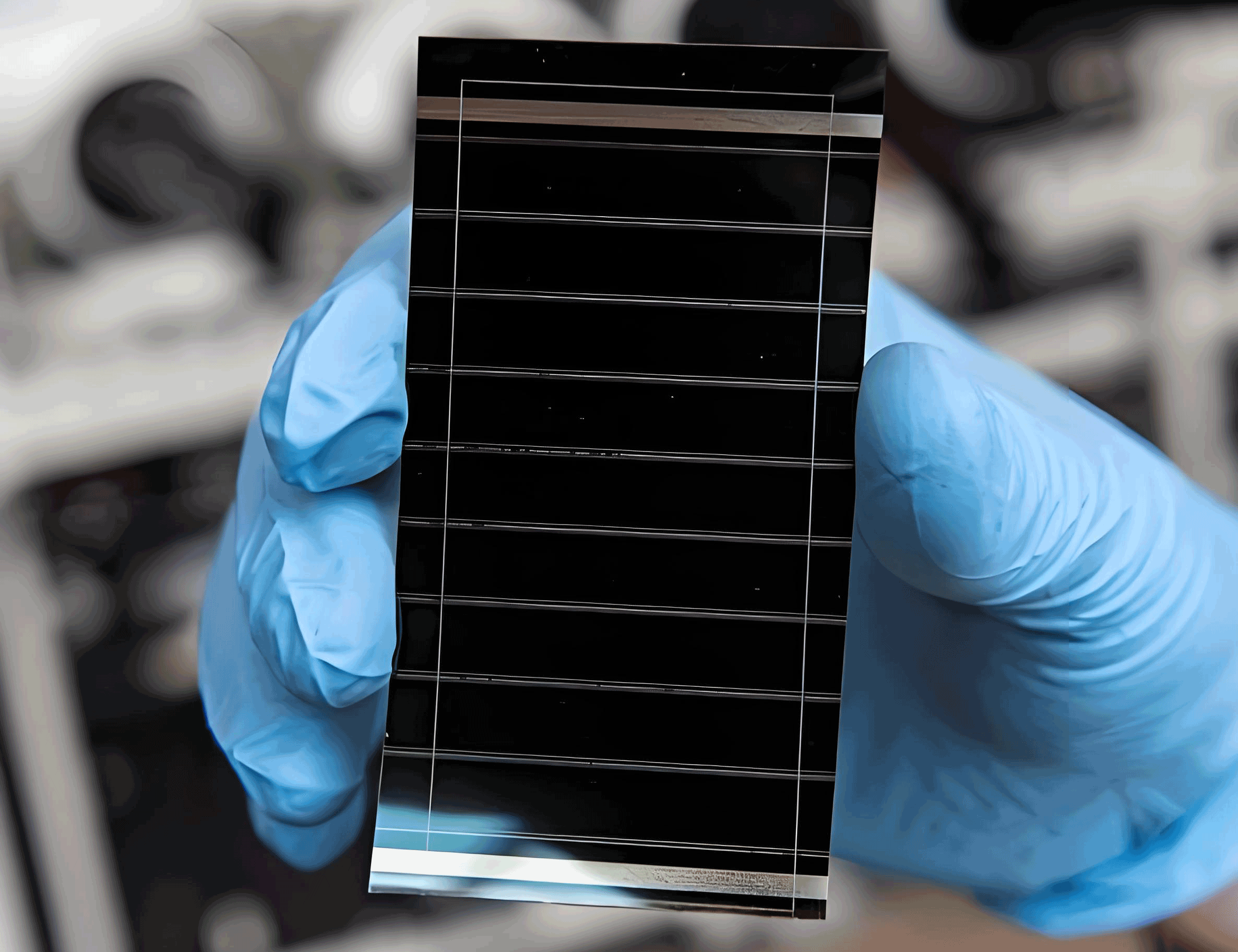
To evaluate the impact of TBAI treatment on the perovskite film morphology, we performed scanning electron microscopy (SEM) analysis. The TBAI-treated films exhibited a more uniform and compact morphology with reduced pinholes compared to the control films. This improvement is crucial for minimizing non-radiative recombination centers in perovskite solar cells. Additionally, UV-visible absorption spectroscopy confirmed that the bandgap of the CsPbI2.85Br0.15 perovskite remained unchanged after TBAI treatment, indicating that the modification primarily affects the surface properties rather than the bulk material. Time-resolved photoluminescence (TRPL) measurements revealed a longer carrier lifetime for the TBAI-treated films, suggesting suppressed non-radiative recombination and enhanced charge carrier dynamics in the perovskite solar cells.
The photovoltaic performance of the inverted inorganic perovskite solar cells was characterized through current-density-voltage (J-V) measurements under AM 1.5G illumination. The key parameters, including PCE, VOC, short-circuit current density (JSC), and fill factor (FF), are summarized in Table 1. The TBAI-treated devices achieved a champion PCE of 19.76%, with a VOC of 1.200 V, JSC of 19.88 mA/cm2, and FF of 82.76%. In contrast, the control devices without TBAI treatment showed a lower PCE of 17.10%, VOC of 1.066 V, JSC of 19.57 mA/cm2, and FF of 81.93%. The significant improvement in VOC is attributed to the reduced non-radiative recombination and enhanced built-in potential, as confirmed by Mott-Schottky analysis.
| Sample | PCE (%) | VOC (V) | JSC (mA/cm2) | FF (%) |
|---|---|---|---|---|
| Control | 17.10 | 1.066 | 19.57 | 81.93 |
| TBAI-treated | 19.76 | 1.200 | 19.88 | 82.76 |
To further understand the mechanism behind the performance enhancement, we conducted transient photocurrent (TPC) and transient photovoltage (TPV) measurements. The TPC decay curves indicated faster electron extraction in TBAI-treated devices, reducing charge accumulation at the interface. The TPV results showed a longer carrier recombination lifetime and lower defect state density for the TBAI-treated perovskite solar cells. The defect state density (Nt) was quantified using space-charge-limited current (SCLC) measurements on hole-only devices. The trap-filling limit voltage (VTFL) is related to Nt by the formula:
$$V_{TFL} = \frac{e N_t L^2}{2 \epsilon \epsilon_0}$$
where e is the elementary charge, L is the film thickness, ε is the relative permittivity, and ε0 is the vacuum permittivity. For control devices, VTFL was 1.00 V, corresponding to Nt = 1.68 × 1016 cm−3, while for TBAI-treated devices, VTFL decreased to 0.95 V, yielding Nt = 1.56 × 1016 cm−3. This reduction in defect state density directly contributes to the suppression of non-radiative recombination in perovskite solar cells.
Additionally, dark J-V measurements revealed lower leakage currents in TBAI-treated devices, consistent with improved interface quality. The total density of states (tDOS) analysis further confirmed a overall reduction in defect states across the energy spectrum for TBAI-treated perovskite solar cells. These findings highlight the role of TBAI in passivating surface defects and optimizing energy level alignment, which are critical for high-performance perovskite solar cells.
The stability of the perovskite solar cells was evaluated under both thermal and humidity stress conditions. For thermal stability testing, devices were stored in a N2 atmosphere at 65°C for 500 hours. The TBAI-treated devices retained 90.41% of their initial PCE, whereas the control devices retained only 58.82%. For humidity stability, unencapsulated devices were exposed to 30–40% relative humidity for 500 hours. The TBAI-treated devices maintained 83.59% of their initial PCE, while the control devices dropped below 80% retention after just 243 hours. The enhanced stability is attributed to the hydrophobic nature of the TBAI layer, as evidenced by water contact angle measurements. The contact angle increased from 55.69° for control films to 80.33° for TBAI-treated films, indicating improved moisture resistance. This hydrophobic barrier protects the perovskite layer from degradation, thereby extending the lifespan of the perovskite solar cells.
In conclusion, our study demonstrates that interface engineering with TBAI effectively addresses the challenges of high defect state density and non-radiative recombination in inverted inorganic perovskite solar cells. The TBAI treatment passivates surface defects, reduces charge accumulation, and enhances carrier extraction, leading to a significant improvement in PCE and VOC. Moreover, the treated devices exhibit superior thermal and humidity stability, making them suitable for air-processed fabrication and potential commercialization. This work provides a straightforward and efficient strategy for optimizing the performance and durability of perovskite solar cells, paving the way for their integration into advanced photovoltaic systems.
To further quantify the benefits of TBAI treatment, we analyzed the recombination dynamics using the diode ideality factor (n) derived from the dark J-V characteristics. The ideality factor can be expressed as:
$$n = \frac{q}{kT} \frac{dV}{d(\ln J)}$$
where q is the electron charge, k is Boltzmann’s constant, and T is the temperature. For ideal perovskite solar cells, n approaches 1, indicating dominant bimolecular recombination. In our case, the TBAI-treated devices showed an ideality factor closer to 1 compared to control devices, suggesting reduced trap-assisted recombination. This aligns with the observed enhancement in VOC and overall efficiency of the perovskite solar cells.
Another key aspect is the charge extraction efficiency, which we evaluated using the photogenerated carrier density (Δn) and the recombination rate (R). The recombination rate can be described by:
$$R = k_1 \Delta n + k_2 \Delta n^2 + k_3 \Delta n^3$$
where k1, k2, and k3 represent the rate constants for Shockley-Read-Hall, bimolecular, and Auger recombination, respectively. The TBAI treatment predominantly reduces k1 by passivating trap states, thereby decreasing non-radiative losses in the perovskite solar cells. This is consistent with the longer carrier lifetimes observed in TRPL measurements.
In terms of energy level alignment, the TBAI layer facilitates better band bending at the perovskite/electron transport layer interface, as evidenced by the increased built-in potential from Mott-Schottky analysis. The built-in potential (Vbi) is given by:
$$V_{bi} = \frac{1}{2} \left( \frac{d(1/C^2)}{dV} \right)^{-1}$$
where C is the capacitance and V is the applied voltage. The higher Vbi in TBAI-treated devices (1.196 V vs. 1.038 V for control) enhances the electric field across the junction, promoting efficient charge separation and collection in the perovskite solar cells.
Overall, the integration of TBAI as an interfacial modifier offers a versatile approach to improving the performance and stability of inverted inorganic perovskite solar cells. By reducing defect states and optimizing interface properties, this method enables the realization of high-efficiency devices fabricated in air, which is a significant step toward the large-scale production of perovskite solar cells. Future work will focus on extending this strategy to other perovskite compositions and tandem configurations to further advance the field of photovoltaics.