
In our ongoing commitment to advancing sustainable energy solutions, we have implemented a range of energy-efficient technologies in industrial processes and made significant breakthroughs in perovskite solar cell research. This article provides a detailed overview of these efforts, emphasizing how they contribute to reducing carbon emissions and enhancing operational efficiency. We will explore various initiatives, supported by data, tables, and mathematical models, to illustrate the impact of these innovations. Throughout, we focus on the critical role of perovskite solar cells in the renewable energy landscape, highlighting their potential for commercialization and widespread adoption.
Our industrial operations have undergone substantial upgrades to minimize energy consumption and environmental footprint. One key area involves the chlor-alkali process, where we transitioned to advanced ion-exchange membranes. These sixth-generation membranes exhibit extended operational lifetimes and reduced energy demands, leading to cost savings and lower emissions. Based on long-term data collection, we have optimized replacement schedules, resulting in measurable improvements in efficiency. The energy savings can be expressed using the formula for energy efficiency: $$ \eta = \frac{E_{output}}{E_{input}} \times 100\% $$ where $E_{output}$ represents the useful energy output, and $E_{input}$ is the total energy input. This approach has enabled us to achieve a more sustainable production cycle.
Another initiative centers on hydrogen production through water electrolysis. We integrated solar and wind energy sources with proton exchange membrane (PEM) technology to create a coupled system that enhances green hydrogen generation. This project addresses issues like equipment corrosion and performance degradation in conventional electrolyzers. The hydrogen production rate can be modeled as: $$ V_{H_2} = \frac{I \times \eta_{F} \times F}{2 \times V_m} $$ where $I$ is the current, $\eta_{F}$ is the Faradaic efficiency, $F$ is Faraday’s constant, and $V_m$ is the molar volume. For a capacity of 100 m³/h, the electricity consumption is approximately 450 kW, leading to annual savings of around 3.6 million kWh. The table below summarizes key energy-saving measures and their impacts:
| Initiative | Annual Energy Saved | Reduction in Resource Use | Efficiency Gain |
|---|---|---|---|
| Ion Membrane Upgrade | Based on operational data | 10-15% lower energy | $\eta$ increase by 5-10% |
| Renewable Hydrogen Production | 3.6 million kWh | 450 kW per 100 m³/h | Enhanced $\eta_{F}$ up to 95% |
| Oxygen-Enriched Air Reuse | Equivalent to 32,400 m³ natural gas | 1.0-2.0 m³/ton sulfuric acid | Combustion $\eta$ rise by 10-20% |
Furthermore, we implemented a system to recover oxygen-enriched air from nitrogen generation units, which was previously vented into the atmosphere. By redirecting this stream to support combustion in sulfuric acid crackling furnaces, we improved burning efficiency and reduced natural gas consumption. The combustion efficiency can be described by: $$ \eta_{comb} = \frac{[O_2]_{actual}}{[O_2]_{stoich}} \times 100\% $$ where $[O_2]_{actual}$ is the actual oxygen concentration, and $[O_2]_{stoich}$ is the stoichiometric requirement. With oxygen levels around 28%, we achieved significant fuel savings, contributing to overall carbon reduction goals.
In the realm of renewable energy, our research has focused on perovskite solar cells, which have garnered attention for their high efficiency but face challenges in long-term stability. Perovskite solar cells have demonstrated power conversion efficiencies exceeding 26%, yet their performance under real-world conditions—such as alternating light and dark cycles—remains a critical issue. Traditional stability tests, conducted under constant illumination or darkness, do not adequately replicate these conditions, leading to overlooked degradation mechanisms. Our investigations revealed that lithium ion migration from the hole transport layer to the perovskite layer under cyclic conditions causes phase transitions and efficiency loss. This process can be represented as: $$ Li^+ + e^- \rightarrow Li^0 $$ which promotes a shift from the photoactive α-phase to the non-active δ-phase, accelerating decay in perovskite solar cells.
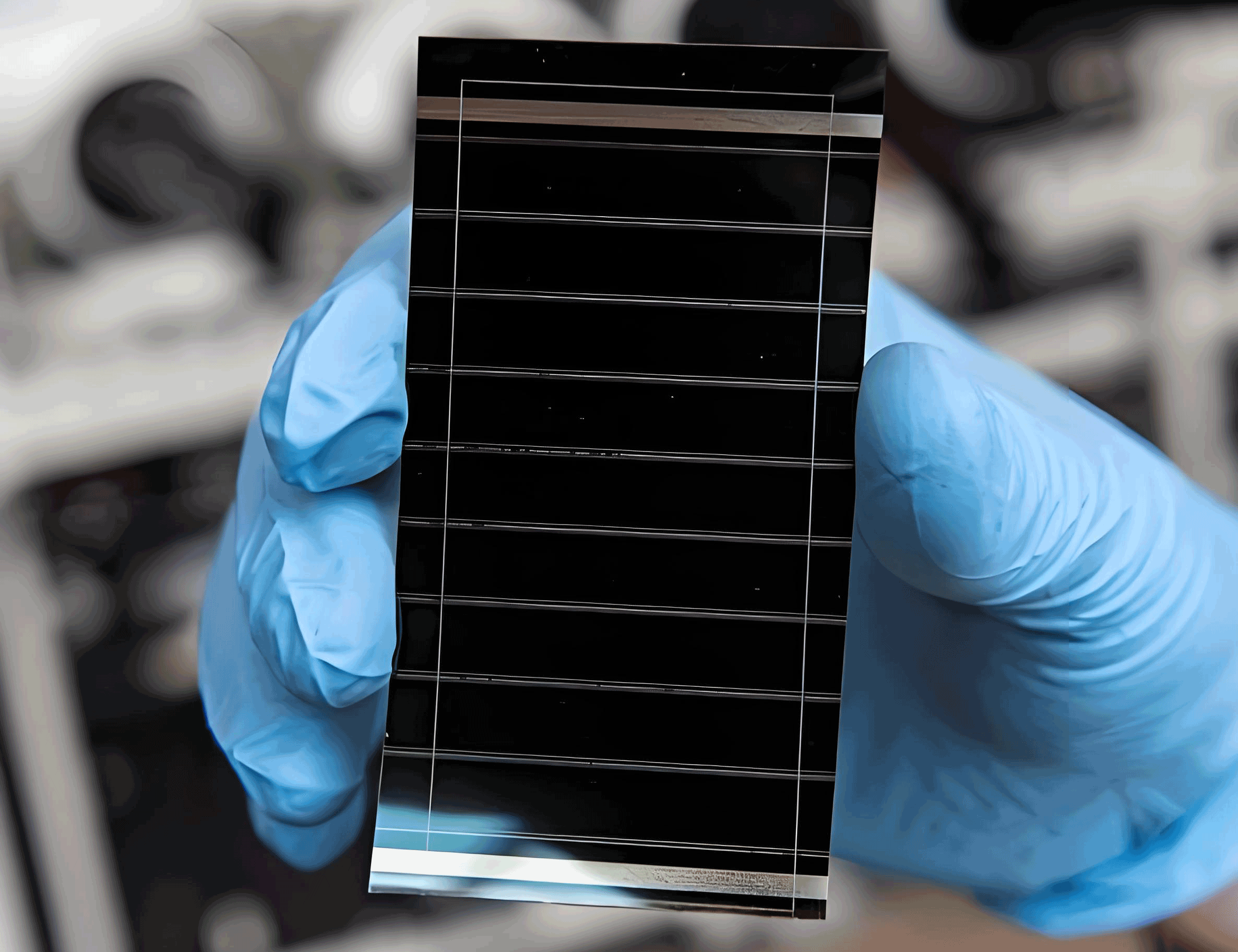
To address this, we developed a lithium-free doping strategy using methylammonium bis(trifluoromethanesulfonyl)imide (MATFSI) as an alternative to conventional lithium salts. This innovation enhances the hole transport properties and stability of perovskite solar cells. The power conversion efficiency of a perovskite solar cell is given by: $$ \eta = \frac{J_{sc} \times V_{oc} \times FF}{P_{in}} $$ where $J_{sc}$ is the short-circuit current density, $V_{oc}$ is the open-circuit voltage, $FF$ is the fill factor, and $P_{in}$ is the incident light power density. Our MATFSI-based devices achieved an efficiency of 26.1% (certified 25.6%), with improved hole mobility and charge extraction capabilities. The following table compares the performance of standard and our advanced perovskite solar cells under various conditions:
| Parameter | Standard Li-doped Perovskite Solar Cell | MATFSI-doped Perovskite Solar Cell |
|---|---|---|
| Efficiency ($\eta$) | ~25% | 26.1% |
| Stability in Light-Dark Cycles | Rapid decay (>20% loss in 100 cycles) | |
| Hole Mobility ($\mu_h$) | ~0.1 cm²/V·s | ~0.3 cm²/V·s |
| Open-Circuit Voltage ($V_{oc}$) | 1.1 V | 1.2 V |
| Fill Factor ($FF$) | 0.75 | 0.80 |
The enhanced performance of perovskite solar cells with MATFSI doping is attributed to reduced ion migration and better interface stability. We conducted extensive simulations to model the degradation kinetics, using equations like: $$ \frac{d[δ]}{dt} = k [Li] [α] $$ where $[δ]$ is the concentration of the δ-phase, $[Li]$ is the lithium concentration, $[α]$ is the α-phase concentration, and $k$ is the rate constant. Our results confirm that the lithium-free approach significantly slows this reaction, prolonging the lifespan of perovskite solar cells. This breakthrough not only improves efficiency but also paves the way for commercial applications, as perovskite solar cells become more reliable in diverse environments.
In addition to material innovations, we explored the integration of perovskite solar cells with industrial energy systems. For instance, coupling perovskite solar cells with hydrogen production units could further optimize renewable energy use. The overall system efficiency can be calculated as: $$ \eta_{system} = \eta_{PV} \times \eta_{electrolysis} $$ where $\eta_{PV}$ is the efficiency of the perovskite solar cell, and $\eta_{electrolysis}$ is the efficiency of the electrolysis process. By achieving higher $\eta_{PV}$ values, we can reduce the levelized cost of energy and enhance sustainability. Our ongoing projects aim to scale up these integrations, leveraging the advantages of perovskite solar cells in real-world settings.
Beyond technical aspects, we have implemented comprehensive monitoring and data analytics to track the performance of these innovations. Using statistical models, we assess the impact on carbon emissions and economic benefits. For example, the reduction in CO₂ emissions from energy savings can be estimated as: $$ \Delta CO_2 = E_{saved} \times EF $$ where $E_{saved}$ is the saved energy, and $EF$ is the emission factor. Our initiatives have collectively contributed to a significant decrease in our carbon footprint, aligning with global climate goals. The table below provides an overview of environmental and economic metrics:
| Metric | Value | Formula |
|---|---|---|
| Annual CO₂ Reduction | ~10,000 tons | $\Delta CO_2 = \sum E_{saved} \times EF$ |
| Cost Savings | Millions of dollars annually | $Savings = \Delta Energy \times Price$ |
| Energy Efficiency Improvement | 15-25% overall | $\eta_{overall} = \prod \eta_i$ |
Looking ahead, we are committed to further refining these technologies. For perovskite solar cells, we are investigating novel compositions and encapsulation methods to enhance durability under varying climatic conditions. The potential for perovskite solar cells to achieve efficiencies beyond 30% is within reach, driven by advances in material science and engineering. We are also exploring synergies between industrial energy efficiency and renewable energy sources, such as using perovskite solar cells to power electrolyzers directly. This holistic approach underscores the importance of innovation in achieving a sustainable energy future.
In summary, our efforts in industrial energy management and perovskite solar cell research demonstrate a multifaceted strategy to address energy and environmental challenges. By leveraging data-driven insights and cutting-edge technologies, we have made tangible progress in reducing能耗 and advancing renewable energy. The continued evolution of perovskite solar cells will play a pivotal role in this journey, offering a pathway to cleaner, more efficient energy systems worldwide. We remain dedicated to pushing the boundaries of what is possible, inspiring further innovations in the field.