
In recent years, single-junction perovskite solar cells have achieved remarkable progress, with power conversion efficiencies approaching the Shockley-Queisser theoretical limit. This advancement is largely attributed to strategies minimizing energy losses in functional layers. Among these, optical losses due to reflection at interfaces remain a significant challenge. Antireflection coatings (ARCs) are critical components in light-management strategies, designed to enhance light transmission and reduce parasitic absorption. However, developing multifunctional ARCs that combine high visible-light transmittance, ultraviolet (UV) light suppression, and robust mechanical properties like adhesion and wear resistance is an ongoing research focus. In this work, we propose a machine learning-guided approach to design and optimize multilayer oxide-based ARCs, specifically a SiO2-TiO2-SiO2 (STS) stack, for perovskite solar cells. By integrating Bayesian optimization with physical simulations, we identify an optimal ARC configuration that significantly improves device performance and stability. Additionally, we employ interface modification using 3-amidinopyridinium iodide (3-PyADI) to passivate surface defects, further enhancing the efficiency and longevity of perovskite solar cells. This synergistic combination of optical management and defect engineering offers a promising pathway toward high-efficiency and stable perovskite solar cells.
The core of our methodology involves a machine learning framework based on Bayesian optimization to efficiently explore the parameter space of multilayer ARC structures. We parameterize the ARC design by varying the thicknesses of SiO2 and TiO2 layers within a range of 10 to 200 nm, with a step size of 5 nm, resulting in a total of 59,319 candidate configurations. For each configuration, we compute the optical transmittance, reflectance, and absorbance using the Transfer Matrix Method (TMM), which solves Maxwell’s equations for layered structures. The average transmittance over the 400–800 nm wavelength range, corresponding to the characteristic absorption of the perovskite layer, is defined as the figure of merit (FOM) for optimization. The Bayesian optimization algorithm leverages a Gaussian process model to iteratively select promising candidate parameters, maximizing the FOM while minimizing computational cost. The Gaussian process models the unknown function f(x) as a joint Gaussian distribution, where for a new observation point x∗, the predictive distribution is given by:
$$ P(f(x^*)|f(X)) = \mathcal{N}(K(x^*, X)K(X, X)^{-1}f(X), K(x^*, x^*) – K(x^*, X)K(X, X)^{-1}K(X, x^*)) $$
Here, X represents the matrix of input parameters (layer thicknesses), f(X) is the vector of corresponding FOM values, and K denotes the covariance matrix computed using a kernel function. We employ a radial basis function kernel and use Thompson sampling with Cholesky decomposition to accelerate the optimization process. Through this approach, we rapidly converge to an optimal STS ARC structure with layer thicknesses of 100 nm SiO2, 10 nm TiO2, and 10 nm SiO2, achieving a simulated average transmittance of 0.986 in the target wavelength range. This represents a significant improvement over uncoated substrates and demonstrates the efficacy of machine learning in materials design for perovskite solar cells.
| Configuration ID | Layer Thicknesses (SiO2-TiO2-SiO2, nm) | Average Transmittance (400–800 nm) |
|---|---|---|
| 1 (Optimal) | 100-10-10 | 0.986 |
| 2 | 100-135-10 | 0.975 |
| 3 | 120-20-190 | 0.955 |
| 4 | 75-25-10 | 0.938 |
| 5 | 85-10-190 | 0.931 |
| 6 | 50-135-155 | 0.903 |
The optimized STS ARC was fabricated using magnetron sputtering, and its properties were comprehensively characterized. Cross-sectional scanning electron microscopy (SEM) images reveal a well-defined layered structure, while atomic force microscopy (AFM) surface analysis shows a uniform morphology with protrusion-like microstructures that impart hydrophobic characteristics, as evidenced by an increase in water contact angle by approximately 25°. This “lotus effect” enhances self-cleaning capabilities, which is beneficial for outdoor applications of perovskite solar cells. X-ray photoelectron spectroscopy (XPS) confirms the chemical composition of the TiO2 and SiO2 layers, with characteristic peaks for Ti 2p at 458.5 eV and 464.1 eV, and Si 2p at 103.8 eV, indicating successful deposition. The mechanical robustness of the ARC was evaluated through pencil hardness and adhesion tests. The coating exceeds 9H on the pencil hardness scale and achieves ISO class 0/ASTM class 5B adhesion, meeting stringent requirements for photovoltaic module durability.
Optical characterization via spectroscopic ellipsometry provides the refractive index (n) and extinction coefficient (k) for each layer. The SiO2 layer exhibits a refractive index of approximately 1.5 with near-zero extinction across the visible spectrum, while the TiO2 layer shows a higher refractive index decreasing from 3.33 at 300 nm to 2.33 at 900 nm, and a significant extinction coefficient in the UV region (300–400 nm). The experimental transmittance of the FTO glass with STS ARC increases from below 80% to over 83% in the 400–800 nm range, with an average transmittance improvement of 9.2%. Reflectance is substantially reduced, particularly between 575–800 nm, and the ARC exhibits high absorption in the UV region, which helps mitigate UV-induced degradation in perovskite solar cells. The transmittance (T), reflectance (R), and absorbance (A) can be modeled using TMM, and the performance aligns closely with simulations, validating the machine learning predictions.
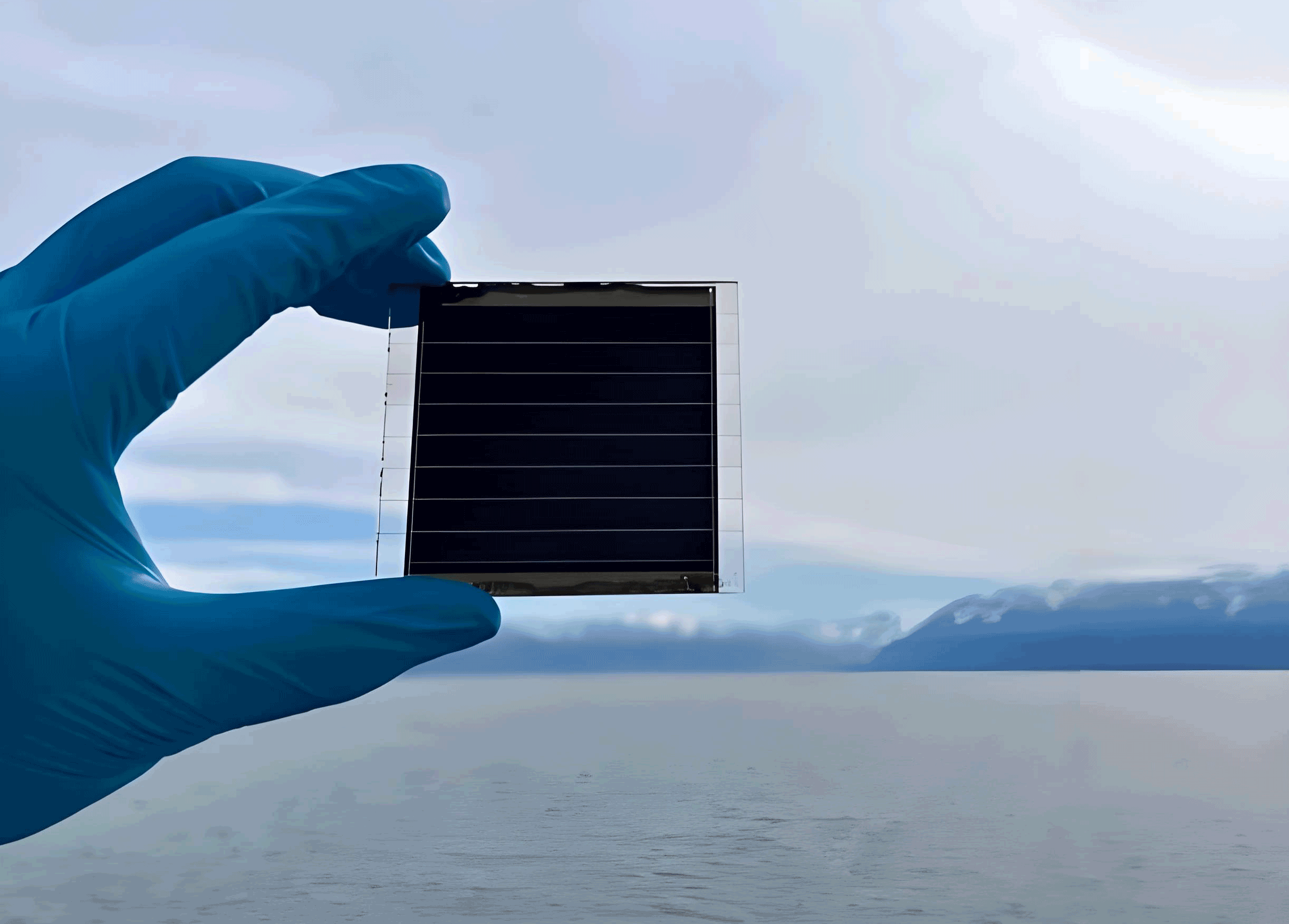
To assess the impact of STS ARC on device performance, we fabricated planar n-i-p perovskite solar cells with a structure of ARC|FTO|SnO2|perovskite|spiro-OMeTAD|Au. The perovskite layer, composed of (FAPbI3)0.83(CsPbI3)0.17, was deposited via a solvent-free method. Steady-state photoluminescence (PL) and time-resolved photoluminescence (TRPL) measurements indicate enhanced carrier generation and prolonged carrier lifetime in devices with STS ARC, attributed to increased photon absorption. Current density-voltage (J-V) characteristics under AM1.5G illumination show that the champion device with STS ARC achieves a power conversion efficiency (PCE) of 23.45%, compared to 22.52% for the control device. This improvement is primarily driven by a boost in short-circuit current density (JSC) from 24.53 mA/cm² to 25.15 mA/cm², while open-circuit voltage (VOC) and fill factor (FF) remain relatively stable. External quantum efficiency (EQE) spectra reveal a maximum incident photon-to-electron conversion efficiency (IPCE) exceeding 96% in the 400–800 nm range for ARC-equipped devices, versus 92% for controls, with integrated JSC values consistent with J-V measurements. The enhancement in EQE is particularly pronounced at longer wavelengths (730–800 nm), where transmittance gains are highest. Furthermore, the UV-blocking capability of the TiO2 interlayer contributes to improved photostability; under continuous UV illumination for 300 hours, devices with STS ARC retain 81.2% of their initial PCE, while control devices degrade to approximately 69%.
Despite these advancements, interfacial defects in the perovskite layer remain a source of non-radiative recombination and lattice degradation. To address this, we applied 3-amidinopyridinium iodide (3-PyADI) as a passivation agent. Density functional theory calculations indicate strong interaction energies of -89.267 kJ/mol for 3-PyAD+ with PbI2 and -417.455 kJ/mol with I−, suggesting effective passivation of undercoordinated Pb²⁺ and I− defects. Surface treatment with a 1 mg/mL solution of 3-PyADI reduces the root-mean-square roughness from 26.47 nm to 22.92 nm, as measured by AFM, and minimizes lattice strain, as analyzed through Williamson-Hall plots of X-ray diffraction (XRD) data. This leads to a lower trap density, quantified using the space-charge-limited current (SCLC) method in electron-only devices (FTO|SnO2|perovskite|PCBM|Ag). The trap-filling limit voltage (VTFL) decreases from 0.198 V to 0.122 V after passivation, corresponding to a reduction in defect density (Nt) from 5.15 × 10¹⁵ cm⁻³ to 3.17 × 10¹⁵ cm⁻³, as calculated by:
$$ N_t = \frac{2 \epsilon_0 \epsilon V_{\text{TFL}}}{e L^2} $$
where ε0 is the vacuum permittivity, ε is the relative permittivity of perovskite, L is the film thickness, and e is the electron charge. Steady-state PL and TRPL spectra show increased intensity and prolonged carrier lifetimes post-passivation, confirming suppressed non-radiative recombination. When integrated into full devices, 3-PyADI modification synergizes with STS ARC to yield a champion PCE of 24.44%, with a VOC of 1.150 V, JSC of 25.77 mA/cm², and FF of 0.825. The ideality factor (nid), derived from the slope of VOC versus light intensity (Φ) plots using:
$$ V_{\text{OC}} = \frac{n_{\text{id}} k_B T}{q} \ln \Phi + b $$
decreases from 1.9875 kBT/q to 1.7294 kBT/q, indicating reduced trap-assisted Shockley-Read-Hall recombination. Unencapsulated devices with 3-PyADI treatment retain over 93% of their initial PCE after 1000 hours in ambient conditions (20% ± 5% relative humidity, room temperature), compared to 86% for untreated devices, highlighting the role of interface passivation in enhancing environmental stability.
| Device Type | VOC (V) | JSC (mA/cm²) | FF | PCE (%) | Stability (PCE Retention) |
|---|---|---|---|---|---|
| Control (No ARC, No Passivation) | 1.132 | 24.53 | 0.811 | 22.52 | 69% after 300 h UV |
| With STS ARC Only | 1.134 | 25.15 | 0.813 | 23.45 | 81.2% after 300 h UV |
| With 3-PyADI Passivation Only | 1.145 | 25.60 | 0.820 | 24.10 | 90% after 1000 h ambient |
| With STS ARC and 3-PyADI | 1.150 | 25.77 | 0.825 | 24.44 | 93% after 1000 h ambient |
The combination of machine learning-optimized ARCs and interface defect passivation represents a holistic approach to minimizing energy losses in perovskite solar cells. The STS ARC enhances light harvesting by reducing reflection and filtering harmful UV radiation, while 3-PyADI passivation mitigates non-radiative recombination and improves interfacial properties. This synergy results in high-efficiency devices with robust stability, addressing key challenges in the commercialization of perovskite solar cells. Future work could extend this machine learning framework to optimize other multilayer structures or material combinations, further pushing the boundaries of perovskite solar cell performance. The integration of data-driven design with experimental validation offers a scalable and efficient strategy for advancing photovoltaic technologies.
In conclusion, we have demonstrated a comprehensive strategy for enhancing the efficiency and stability of perovskite solar cells through machine learning-guided antireflection coatings and molecular interface engineering. The optimized STS ARC, with a configuration of 100 nm SiO2, 10 nm TiO2, and 10 nm SiO2, achieves a high average transmittance of 98.6% in the visible spectrum, leading to a 4% improvement in JSC and PCE. Its excellent mechanical properties ensure durability for outdoor applications. Complementarily, 3-PyADI passivation reduces surface defects and strain, boosting VOC and FF. The combined approach yields a champion PCE of 24.44% and superior stability under UV and ambient conditions. This work underscores the potential of interdisciplinary methods, combining machine learning, optics, and materials science, to overcome limitations in perovskite solar cells and accelerate their adoption in renewable energy systems.