
In recent years, the integration of distributed generation systems, particularly those based on photovoltaic sources, has gained significant attention. Solar inverters play a crucial role in converting DC power from solar panels to AC power for grid connection or local loads. However, conventional multilevel solar inverters often face limitations in boost capability due to device stress and exhibit poor performance at high modulation indices. To address these challenges, we propose a novel solar inverter topology that integrates a hybrid quasi-switching impedance source network with a step-down switching single-phase multilevel inverter. This design aims to achieve high voltage gain conversion under low device stress and high modulation index conditions, making it highly suitable for distributed solar applications.
The proposed solar inverter topology, as illustrated in the following analysis, combines a switched-inductor (SL) unit and a switched-capacitor (SC) unit within the impedance network. The SL unit comprises an inductor and three diodes, while the SC unit consists of a capacitor and a diode. This configuration enables the generation of a five-level output voltage through appropriate switching control. The key advantage of this solar inverter lies in its ability to maintain high gain without compromising device reliability, which is essential for long-term operation in solar energy systems.
We begin by modeling the different operating modes of the solar inverter. The system operates in two primary states: the shoot-through (ST) state and the non-ST state. In the ST state, all active switches in the full-bridge inverter and the boost network are closed, allowing inductors to store energy and capacitors to charge or discharge. The equivalent circuit for the ST state can be represented as follows:
$$ L \frac{di_L}{dt} = U_g, \quad U_{m} = U_g + U_{C_{X0}} + U_{C_{Y0}} $$
$$ U_{C_{X0}} = U_{C_{X1}}, \quad U_{C_{Y0}} = U_{C_{Y1}}, \quad U_{ac} = 0 $$
In the non-ST state, the inverter delivers power to the load, and the boost network facilitates energy transfer from the DC source to the circuit. The equivalent equations for this state are:
$$ L \frac{di_L}{dt} = U_g – U_{C_{X0}} – U_{C_{Y0}}, \quad U_{m} = U_{ac} + U_{C_{X1}} = -U_{C_{Y0}} + U_{C_{Y1}} $$
$$ I_g = I_m, \quad C_{X1} \frac{dU_{C_{X1}}}{dt} = -I_m, \quad C_{Y1} \frac{dU_{C_{Y1}}}{dt} = -I_m $$
Applying the volt-second balance principle to the inductors and charge balance to the capacitors, we derive the steady-state voltages and currents. The boost factor B and voltage gain G are critical parameters for evaluating the solar inverter’s performance. The boost factor is given by:
$$ B = \frac{U_m}{U_g} = \frac{2(1 + T_s / T_{st})}{1 – 3 T_s / T_{st}} $$
where \( T_s \) is the switching period and \( T_{st} \) is the shoot-through time interval. The voltage gain G, which relates the output AC voltage to the input DC voltage, is expressed as:
$$ G = \frac{U_{AB}}{U_g} = \frac{2(2M – 1)^2}{6M – 5} $$
where M is the modulation index. This equation highlights the solar inverter’s ability to achieve high gain even at high modulation indices, a significant improvement over traditional designs.
To further illustrate the operating states, we summarize the switch configurations and output voltages in Table 1. This table provides a clear overview of how the solar inverter transitions between different states to generate the desired output levels.
| Operating State | Switch States | Output Voltage |
|---|---|---|
| Non-ST Active | 100100 | \( B U_g \) |
| Non-ST Zero | 000110 / 011000 | 0 |
| ST State | 0111111 | 0 |
The control strategy for the solar inverter is based on a pulse width modulation (PWM) scheme that utilizes four fundamental modulation waveforms, a constant ST signal, and a high-frequency carrier signal. This approach ensures seamless transitions between grid-connected, islanded, and standalone modes, which is essential for reliable operation in solar power systems. The PWM control generates ST pulses by comparing the carrier waveform with the ST signal, enabling inherent boost functionality. The modulation index M and ST duty cycle are constrained by:
$$ M + \frac{T_{st}}{T_s} \leq 1 $$
This constraint ensures high-quality output voltage waveforms while maintaining the solar inverter’s stability. For closed-loop control, we implement a dual-loop strategy that regulates the DC link voltage and AC current in grid-connected mode. In islanded mode, the solar inverter switches to voltage control to maintain local load requirements. A small-signal model is developed to verify system stability, with transfer functions derived for key parameters such as inductor currents and capacitor voltages.
Experimental validation is conducted using a 500 W prototype solar inverter. The parameters of the prototype are summarized in Table 2, which includes component values and operating conditions. The solar inverter’s performance is evaluated under steady-state and transient conditions, demonstrating its ability to handle input voltage variations and load changes effectively.
| Parameter | Value |
|---|---|
| Rated Output Power | 500 W |
| Input Voltage Range | 40-60 V |
| Output Voltage (RMS) | 110 V |
| Inductors (L₀, L₁) | 3 mH |
| Capacitors (Cₓ₀, Cᵧ₀, Cₓ₁, Cᵧ₁) | 1000 μF |
| Switching Frequency | 10 kHz |
In steady-state tests, the solar inverter achieves a voltage gain of approximately 5.5 at an input voltage of 40 V, with ST duty cycle around 17%. The capacitor voltages balance automatically, as predicted by the theoretical analysis. The peak voltage stress on active devices is limited to 50 V, while the DC link voltage reaches 220 V, confirming the high gain capability of the solar inverter. Transient responses show rapid recovery to input voltage changes, such as from 60 V to 40 V, with minimal impact on output voltage and current quality.
For grid-connected operation, the solar inverter supplies local loads and feeds surplus power to the grid. The harmonic spectrum of the output voltage and current complies with IEEE 519 standards, with total harmonic distortion below 5%. Mode transitions between grid-connected and islanded operations are seamless, facilitated by solid-state relays and adaptive control algorithms. The solar inverter maintains stable operation in all modes, underscoring its robustness for distributed solar applications.
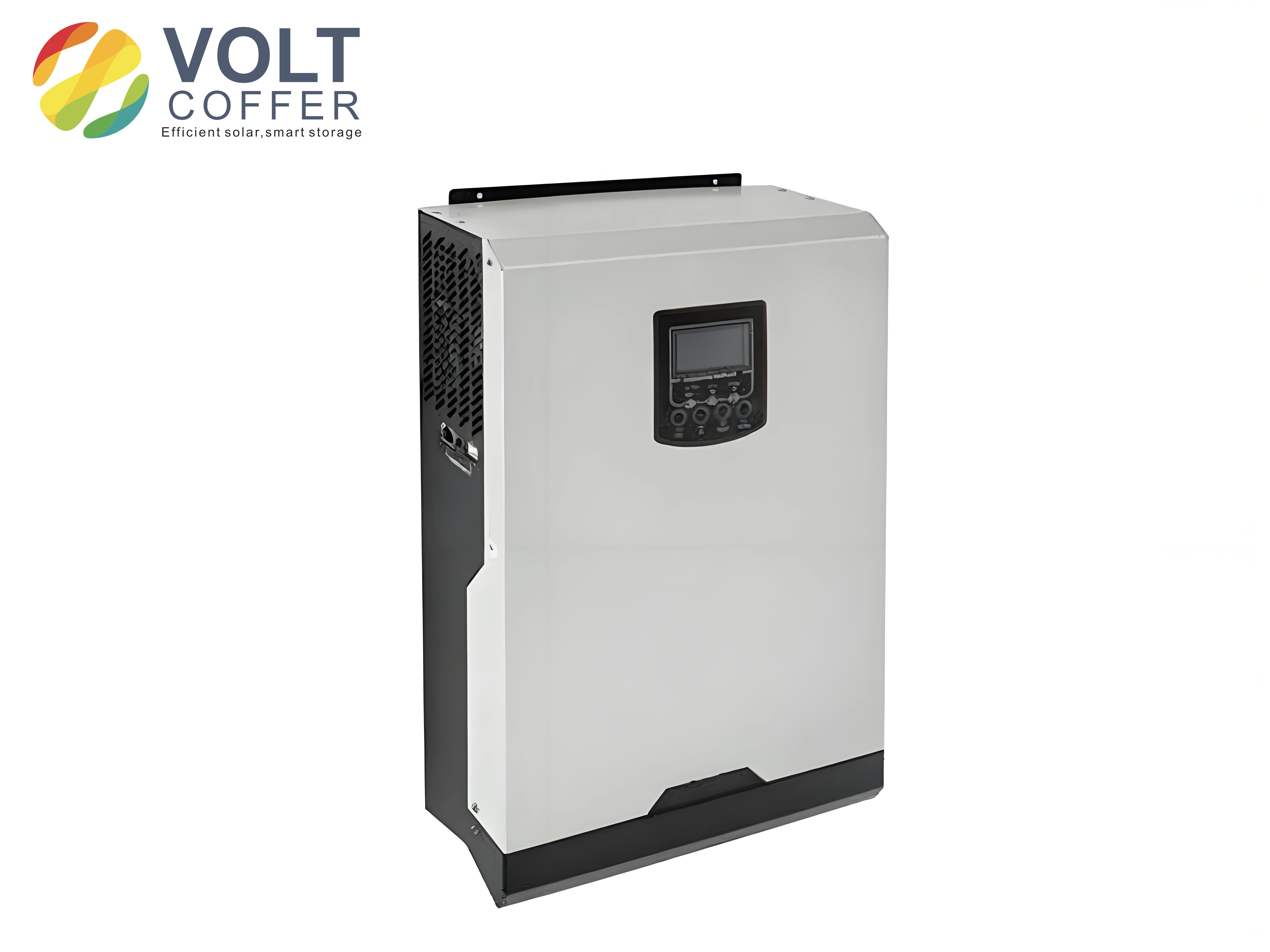
To quantify the performance advantages, we compare the proposed solar inverter with conventional topologies in terms of voltage gain and device stress. The voltage gain G as a function of modulation index M is plotted using the derived equation, showing superior performance at higher M values. Additionally, the inductor current ripple and capacitor voltage ripple are analyzed to guide component selection. The peak-to-peak inductor current ripple is given by:
$$ \Delta I_L = \frac{U_g T_{st}}{L} $$
Similarly, the capacitor voltage ripple for Cₓ₁ is expressed as:
$$ \Delta U_{C_{X1}} = \frac{I_m T_{st}}{C_{X1}} $$
These equations ensure that the solar inverter operates within safe limits, enhancing its longevity and reliability. The small-signal model, derived from state-space averaging, confirms stability across operating points. The transfer function from duty cycle to output voltage exhibits sufficient phase margin, preventing oscillations in practical scenarios.
In conclusion, the proposed solar inverter topology addresses key limitations in distributed generation systems by offering high voltage gain, low device stress, and excellent breakdown immunity. The integration of a hybrid quasi-switching impedance source with a multilevel inverter enables efficient power conversion under varying conditions. Experimental results validate the theoretical analysis, demonstrating the solar inverter’s capability to maintain performance in grid-connected, islanded, and standalone modes. This makes it a promising solution for modern solar energy systems, where reliability and efficiency are paramount. Future work will focus on optimizing the control algorithms for larger-scale solar inverters and exploring applications in hybrid renewable energy systems.