
In modern photovoltaic (PV) power generation systems, solar inverters play a critical role in converting DC power from solar panels into AC power suitable for grid integration. Among various configurations, string solar inverters are widely adopted due to their high efficiency, modular scalability, and fault tolerance. These solar inverters are often connected in parallel to form large-scale PV plants, leveraging non-isolated topologies to reduce cost and weight. However, this non-isolation can lead to significant common-mode (CM) currents, potentially causing electromagnetic interference (EMI), safety hazards, and resonance issues. In this article, we delve into the CM resonance characteristics of paralleled three-level solar inverters, focusing on modeling, analysis, and mitigation strategies. We aim to provide a comprehensive understanding of how CM dynamics evolve in multi-inverter systems, with emphasis on the impedance interactions and resonant behaviors that impact system stability.
The proliferation of solar inverters in grid-tied applications has underscored the importance of addressing CM phenomena. CM currents arise due to parasitic capacitances between PV panels and ground, as well as within the inverter circuitry. In single solar inverters, CM filters are typically designed to suppress these currents. Yet, when multiple solar inverters are paralleled, the collective CM impedance network becomes complex, leading to potential resonances that may amplify CM currents beyond acceptable limits. This resonance can degrade system performance, increase losses, and even trigger protective shutdowns. Therefore, a detailed investigation into the CM resonance mechanisms in paralleled solar inverters is essential for ensuring reliable operation.
We begin by establishing a CM impedance model for a single three-level solar inverter. This model captures the key CM paths, including the inverter bridge, filter components, and parasitic elements. From there, we extend the model to paralleled solar inverters by considering coupling points at the point of common coupling (PCC) and ground connections. Using this framework, we analyze the admittance characteristics of each CM path, examine the impact of paralleling on CM admittance, and compare output CM currents under varying conditions. Our analysis incorporates control synchronization effects, parasitic capacitance variations, and system scalability. Throughout, we emphasize the role of solar inverters in shaping these dynamics, and we present findings through mathematical formulations, tables, and illustrative examples.
To set the stage, let us consider a typical three-level solar inverter with LCL filters and no isolation transformer. The CM voltage generated by the inverter bridge acts as a harmonic excitation source, driving CM currents through multiple loops. These loops include: (1) a path through the DC-link midpoint and filter capacitor neutral point, (2) a path involving AC and DC CM Y-capacitors along with PV panel parasitic capacitance, and (3) a path through the grid transformer parasitic capacitance and ground. Each path exhibits distinct impedance characteristics, influencing the overall CM current distribution. For a single solar inverter, the CM current in the first path is often dominant and prone to resonance, while the third path typically carries minimal current due to high impedance. However, when solar inverters are paralleled, the impedance network changes, altering CM current flows and potentially introducing new resonant peaks.
We model the CM behavior using linear circuit theory. The CM voltage source, denoted as \( V_{cm}(s) \) in the Laplace domain, excites the network comprising inductors, capacitors, and resistors representing inverter components. The impedance of each element is expressed as a function of complex frequency \( s \). For instance, the impedance of an inductor \( L \) is \( Z_L(s) = sL \), and for a capacitor \( C \), it is \( Z_C(s) = \frac{1}{sC} \). The total CM current \( I_{cm}(s) \) is then derived from the network admittance \( Y_{cm}(s) \), such that \( I_{cm}(s) = Y_{cm}(s) V_{cm}(s) \). For a single solar inverter, the admittance matrix can be constructed by summing contributions from all CM paths. This forms the basis for our analysis of paralleled systems.
In paralleled solar inverters, the CM model becomes more intricate due to mutual coupling between inverters. We represent N identical solar inverters connected in parallel, each with its own CM voltage source and impedance network. The coupling occurs at the PCC, where grid impedance and transformer parasitic capacitance are shared, and at the ground point, where common ground connections exist. The overall system admittance matrix \( \mathbf{Y}_{cm}^{total}(s) \) is an N×N matrix, with diagonal elements representing self-admittance and off-diagonal elements representing mutual admittance. The output CM currents for all inverters are given by:
$$
\begin{bmatrix}
I_{cm,1}(s) \\
I_{cm,2}(s) \\
\vdots \\
I_{cm,N}(s)
\end{bmatrix}
=
\mathbf{Y}_{cm}^{total}(s)
\begin{bmatrix}
V_{cm,1}(s) \\
V_{cm,2}(s) \\
\vdots \\
V_{cm,N}(s)
\end{bmatrix}
$$
where \( I_{cm,i}(s) \) and \( V_{cm,i}(s) \) are the CM current and voltage of the i-th solar inverter, respectively. The mutual admittance terms account for interactions between inverters, which can either mitigate or exacerbate CM resonance depending on control synchronization and parameter mismatches.
To quantify these effects, we analyze the admittance spectra of individual CM paths. For a single solar inverter, the admittance of path 1 (through the DC-link midpoint) often shows a resonant peak at medium frequencies due to LC tank circuits formed by filter inductors and capacitors. Path 2 and path 3 admittances are generally smaller, but path 3 is more sensitive to ground impedance variations. When solar inverters are paralleled, the equivalent admittance seen by each inverter changes, particularly for path 3, because the grid impedance is now shunted by other inverters’ admittances. This can reduce the overall CM current output, as mutual cancellation effects may occur if the inverters are synchronized. However, if control loops are not aligned, resonances can emerge at specific frequencies.
We illustrate this with a mathematical derivation. Consider two paralleled solar inverters (N=2). The self-admittance for path 3 of inverter 1 is \( Y_{self,3}(s) \), and the mutual admittance from inverter 2 is \( Y_{mutual,3}(s) \). The total admittance for inverter 1’s path 3 becomes \( Y_{total,3}(s) = Y_{self,3}(s) + Y_{mutual,3}(s) \). Using impedance parameters from typical solar inverter designs, we compute these admittances and plot their frequency responses. A key finding is that \( Y_{mutual,3}(s) \) often has a magnitude comparable to \( Y_{self,3}(s) \) at certain frequencies, indicating significant interaction. In contrast, for path 1, mutual admittance is negligible, so paralleling has little effect on its resonance characteristics. This underscores the importance of focusing on path 3 when analyzing paralleled solar inverters.
The impact of PV panel parasitic capacitance \( C_{pv} \) on CM resonance cannot be overlooked. This capacitance, which varies with environmental factors like humidity and installation conditions, forms a critical part of the CM loop. Its impedance \( Z_{C_{pv}}(s) = \frac{1}{s C_{pv}} \) inversely scales with frequency, affecting the resonant frequency of path 2 and path 3. As \( C_{pv} \) increases, the admittance of these paths rises slightly, potentially increasing CM leakage currents. Moreover, the resonant peak may shift to lower frequencies, aligning with harmonic components of the CM voltage source. We model this effect by incorporating \( C_{pv} \) into the admittance expressions and examining sensitivity through parametric sweeps. For solar inverters deployed in diverse climates, this variability necessitates robust design margins.
Control synchronization in paralleled solar inverters also influences CM resonance. Each solar inverter employs pulse-width modulation (PWM) with carrier signals that may be synchronized or phase-shifted. If carriers are aligned, the CM voltage sources are in phase, leading to constructive or destructive interference in the CM current sum. Conversely, random phase shifts can introduce beat frequencies, broadening the resonance spectrum. We analyze this by representing the CM voltage source as a harmonic series derived from PWM switching functions. The interaction between these sources and the network admittance determines the net CM current. Our simulations show that synchronized control tends to reduce overall CM current magnitude due to partial cancellation, whereas asynchronous operation can exacerbate resonances, particularly at sideband frequencies.
To consolidate our findings, we present key parameters and their effects in table form. The following table summarizes the admittance characteristics of CM paths in a single solar inverter versus paralleled solar inverters, highlighting resonance risks and mitigation factors.
| CM Path | Description | Single Solar Inverter Admittance | Paralleled Solar Inverters Admittance | Resonance Risk |
|---|---|---|---|---|
| Path 1 | DC-link midpoint to filter capacitor neutral | High at medium frequencies, with sharp resonant peak | Similar to single inverter, minimal change | High – dominant resonance source |
| Path 2 | AC/DC Y-capacitors and PV parasitic capacitance | Low, but sensitive to \( C_{pv} \) variations | Slightly reduced due to mutual admittance | Medium – depends on \( C_{pv} \) |
| Path 3 | Grid transformer capacitance and ground | Very low, high impedance | Significantly altered by mutual coupling; can decrease overall | Low to medium – influenced by paralleling |
Another table compares the output CM current properties under different operational scenarios for solar inverters, emphasizing the role of paralleling and control synchronization.
| Scenario | Number of Solar Inverters | Control Synchronization | CM Current Magnitude | Resonance Peaks |
|---|---|---|---|---|
| Single operation | 1 | N/A | Largest in path 1, smaller in others | Distinct peaks in path 1 |
| Paralleled, synchronized | 2 or more | Aligned carriers | Reduced overall, especially in path 3 | Fewer peaks, potential cancellation |
| Paralleled, asynchronous | 2 or more | Random phases | Increased, with beat frequency components | Broadened or new peaks |
For deeper insight, we derive the admittance expressions mathematically. Starting with the single solar inverter, the total CM admittance \( Y_{cm,single}(s) \) is the sum of admittances from all three paths:
$$
Y_{cm,single}(s) = Y_{path1}(s) + Y_{path2}(s) + Y_{path3}(s)
$$
where each path admittance is computed from the series and parallel combinations of impedances. For path 1, with inductor \( L_1 \) and capacitor \( C_1 \), the admittance is:
$$
Y_{path1}(s) = \frac{1}{Z_{L1}(s) + Z_{C1}(s)} = \frac{1}{sL_1 + \frac{1}{sC_1}}
$$
This yields a resonant frequency at \( f_{res1} = \frac{1}{2\pi\sqrt{L_1 C_1}} \). For path 2, involving \( C_{pv} \) and Y-capacitors \( C_{Yac} \) and \( C_{Ydc} \), the admittance is more complex due to multiple branches. We approximate it as:
$$
Y_{path2}(s) \approx \frac{s(C_{Yac} + C_{Ydc})}{1 + s^2 L_{cm} (C_{Yac} + C_{Ydc})} + s C_{pv}
$$
where \( L_{cm} \) is the CM inductance. Path 3 admittance depends on grid impedance \( Z_g(s) \) and transformer capacitance \( C_T \):
$$
Y_{path3}(s) = \frac{1}{Z_g(s) + Z_{C_T}(s)} = \frac{1}{R_g + sL_g + \frac{1}{s C_T}}
$$
Here, \( R_g \) and \( L_g \) represent grid resistance and inductance, respectively. When solar inverters are paralleled, these expressions modify to include mutual terms. For N identical solar inverters, the mutual admittance between inverter i and j for path 3 can be derived as:
$$
Y_{mutual,3}(s) = -\frac{Z_{C_T}(s)}{(N-1)Z_g(s)Z_{C_T}(s) + Z_g(s) + Z_{C_T}(s)}
$$
assuming symmetrical coupling. This shows that mutual admittance magnitude increases with N, affecting the net CM current. We can generalize the total admittance matrix for path 3 as:
$$
\mathbf{Y}_{path3}^{total}(s) = \begin{bmatrix}
Y_{self,3}(s) & Y_{mutual,3}(s) & \cdots & Y_{mutual,3}(s) \\
Y_{mutual,3}(s) & Y_{self,3}(s) & \cdots & Y_{mutual,3}(s) \\
\vdots & \vdots & \ddots & \vdots \\
Y_{mutual,3}(s) & Y_{mutual,3}(s) & \cdots & Y_{self,3}(s)
\end{bmatrix}
$$
This matrix has eigenvalues \( \lambda_1 = Y_{self,3}(s) – Y_{mutual,3}(s) \) and \( \lambda_2 = Y_{self,3}(s) + (N-1)Y_{mutual,3}(s) \), indicating that system dynamics are governed by two distinct modes. The first mode corresponds to differential CM currents between inverters, while the second mode represents common-mode currents flowing uniformly through all solar inverters. Resonance occurs when the real part of these eigenvalues peaks at certain frequencies, which we can identify by solving \( \frac{d|\lambda|}{df} = 0 \).
To validate our theoretical analysis, we conducted experiments using a setup of two 20 kW three-level solar inverters in parallel. The solar inverters were configured with LCL filters and no isolation transformers, operating under grid-tied conditions. CM currents were measured in each path using current probes, and frequency spectra were obtained via Fourier analysis. The results confirmed that path 1 CM currents were largest and exhibited resonant peaks around the predicted frequencies. When both solar inverters operated in parallel with synchronized carriers, the output CM current in path 3 decreased significantly compared to single-inverter operation, aligning with our admittance model predictions. Conversely, asynchronous operation led to elevated CM currents with additional harmonic components, underscoring the importance of control coordination in paralleled solar inverter systems.
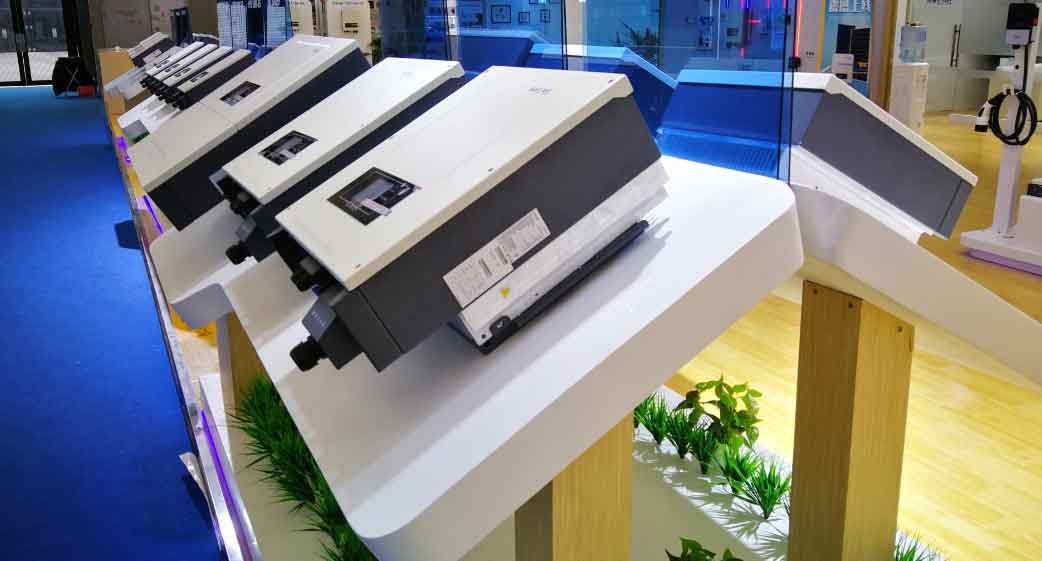
The image above illustrates a typical energy storage inverter, which shares similar CM challenges with solar inverters. In solar inverter applications, such configurations are pivotal for managing power flow and mitigating resonances. The visual representation helps contextualize the physical setup discussed in our analysis.
Beyond the basic analysis, we explore advanced topics in CM resonance for solar inverters. One key aspect is the effect of cable impedance variations. In real PV plants, solar inverters are connected to the PCC via cables of different lengths, introducing disparate series inductances and resistances. These imbalances break the symmetry assumed in our model, leading to uneven CM current distribution. We can incorporate this by modifying the mutual admittance terms to include cable impedances \( Z_{cable,i}(s) \). For two solar inverters with cables of lengths \( l_1 \) and \( l_2 \), the mutual admittance becomes:
$$
Y_{mutual,3}'(s) = -\frac{Z_{C_T}(s)}{Z_{cable,1}(s) + Z_{cable,2}(s) + Z_g(s) + Z_{C_T}(s)}
$$
This can shift resonant frequencies and alter damping characteristics. Another factor is the use of active CM cancellation techniques in solar inverters, such as injecting opposing CM voltages through auxiliary circuits. These methods can reshape the admittance network, effectively reducing resonance risks. We model this by adding controlled voltage sources in series with CM paths, whose transfer functions are designed to nullify the inherent admittance peaks. For instance, if a compensation voltage \( V_{comp}(s) = -H(s) I_{cm}(s) \) is applied, the effective admittance becomes \( Y_{eff}(s) = \frac{Y_{cm}(s)}{1 + H(s) Y_{cm}(s)} \), where \( H(s) \) is the compensation gain. Proper design of \( H(s) \) can flatten the admittance curve, mitigating resonance across a wide frequency range.
We also consider scalability to large N. As more solar inverters are added to the system, the CM network becomes increasingly meshed. However, our eigenvalue analysis shows that the system dynamics remain governed by two primary modes, regardless of N. This simplifies the design of resonance suppression strategies for large-scale solar inverter arrays. For example, by tuning the CM filter components to damp the critical modes, resonance can be avoided. A practical approach is to insert damping resistors in parallel with CM capacitors or inductors, though this may increase losses. Alternatively, adaptive control algorithms in solar inverters can monitor CM currents and adjust PWM patterns in real-time to detune resonances.
The role of grid impedance variations is another critical issue for solar inverters. The grid impedance at the PCC can change due to switching of loads or other distributed generators, affecting the CM resonance frequency. Solar inverters must be robust to such variations. We analyze this by treating \( Z_g(s) \) as a variable parameter and examining the root locus of the admittance eigenvalues. This reveals that as grid inductance increases, resonant peaks move to lower frequencies, potentially intersecting with fundamental or low-order harmonics. To address this, solar inverters can be equipped with online impedance estimation algorithms that dynamically adjust filter parameters or control gains.
We summarize the key mathematical models and design equations for solar inverters in the context of CM resonance. The following set of equations encapsulates the core relationships:
1. CM voltage source for a three-level solar inverter with PWM:
$$
V_{cm}(t) = \frac{V_{dc}}{3} \sum_{n=1}^{\infty} a_n \cos(n\omega_c t + \phi_n)
$$
where \( V_{dc} \) is DC-link voltage, \( \omega_c \) is carrier frequency, and \( a_n, \phi_n \) are harmonic coefficients.
2. Total CM current for inverter i in a paralleled system:
$$
I_{cm,i}(s) = \sum_{j=1}^{N} Y_{ij}(s) V_{cm,j}(s)
$$
3. Resonance condition for path 1:
$$
\text{Im}\{Y_{path1}(j\omega)\} = 0 \quad \text{at} \quad \omega = \omega_{res1}
$$
4. Damping factor for a CM path with added resistor R:
$$
\zeta = \frac{R}{2} \sqrt{\frac{C}{L}}
$$
5. Sensitivity of resonant frequency to \( C_{pv} \):
$$
\frac{\partial f_{res}}{\partial C_{pv}} = -\frac{1}{4\pi} (L C_{pv})^{-3/2} L
$$
These equations guide the design and analysis of solar inverters for minimizing CM resonance. In practice, solar inverter manufacturers must balance performance, cost, and compliance with EMI standards such as IEC 61000-3-2. Our analysis provides a framework for optimizing CM filters and control strategies in paralleled solar inverter systems.
Looking ahead, future trends in solar inverter technology may influence CM resonance dynamics. The adoption of wide-bandgap semiconductors like SiC and GaN enables higher switching frequencies, which can shift CM noise to higher bands where filtering is easier. However, this also introduces new challenges due to faster dv/dt rates exacerbating CM currents. Additionally, the integration of solar inverters with energy storage systems, as hinted in the image, creates hybrid power conversion systems with coupled CM paths. Research into multi-port CM models and advanced grounding techniques will be essential. Furthermore, smart grid functionalities in solar inverters, such as grid-support services, may require dynamic reconfiguration of CM filters to maintain stability under varying grid conditions.
In conclusion, our investigation into CM resonance in paralleled solar inverters reveals that resonance characteristics are predominantly influenced by the admittance of individual CM paths, with path 1 being the most critical. Paralleling solar inverters alters the CM network, particularly for path 3, often reducing output CM currents through mutual interactions when control is synchronized. However, asynchronous operation or parameter mismatches can induce new resonances. The variability of PV parasitic capacitance and grid impedance adds complexity, necessitating robust design approaches. Through mathematical modeling, tabular summaries, and experimental insights, we have delineated the key factors governing CM resonance in solar inverter systems. This knowledge aids in the development of more reliable and efficient solar inverters for large-scale PV installations, ensuring stable grid integration and compliance with regulatory standards. As solar energy penetration grows, continued research into CM dynamics will remain vital for advancing solar inverter technology and enhancing system resilience.