
Lithium iron phosphate (LiFePO₄, LFP) batteries exhibit exceptional thermal stability and long cycle life, making them ideal for grid-scale energy storage systems. This study investigates strain evolution during electrochemical cycling and proposes a novel state of charge (SOC) estimation method using fiber Bragg grating (FBG) sensors. The mechanical-electrochemical coupling effects in graphite-LFP pouch cells are systematically analyzed through in-situ strain monitoring and advanced characterization techniques.
1. Electrochemical-Mechanical Coupling Mechanism
The volume changes in electrode materials during lithium intercalation/deintercalation create measurable strain patterns. For lithium iron phosphate batteries, the principal strain components can be expressed as:
$$ \varepsilon_{total} = \alpha_{LFP}\Delta SOC_{LFP} + \alpha_{Gr}\Delta SOC_{Gr} + \varepsilon_{thermal} $$
where:
– $\alpha_{LFP}$ = 2.6% volumetric expansion coefficient for LFP
– $\alpha_{Gr}$ = 10.5% maximum expansion for graphite
– $\varepsilon_{thermal}$ = thermal-induced strain component
2. Experimental Validation
FBG sensors demonstrated superior sensitivity in detecting phase transitions characteristic of lithium iron phosphate battery systems:
| Cycle Stage | Average Strain (με) | Temperature Rise (°C) | Voltage Plateau (V) |
|---|---|---|---|
| Charge (0-50% SOC) | 142 ± 8 | 2.3 | 3.35-3.40 |
| Charge (50-100% SOC) | 245 ± 12 | 3.1 | 3.45-3.65 |
| Discharge (100-20% SOC) | -187 ± 9 | 1.8 | 3.30-3.15 |
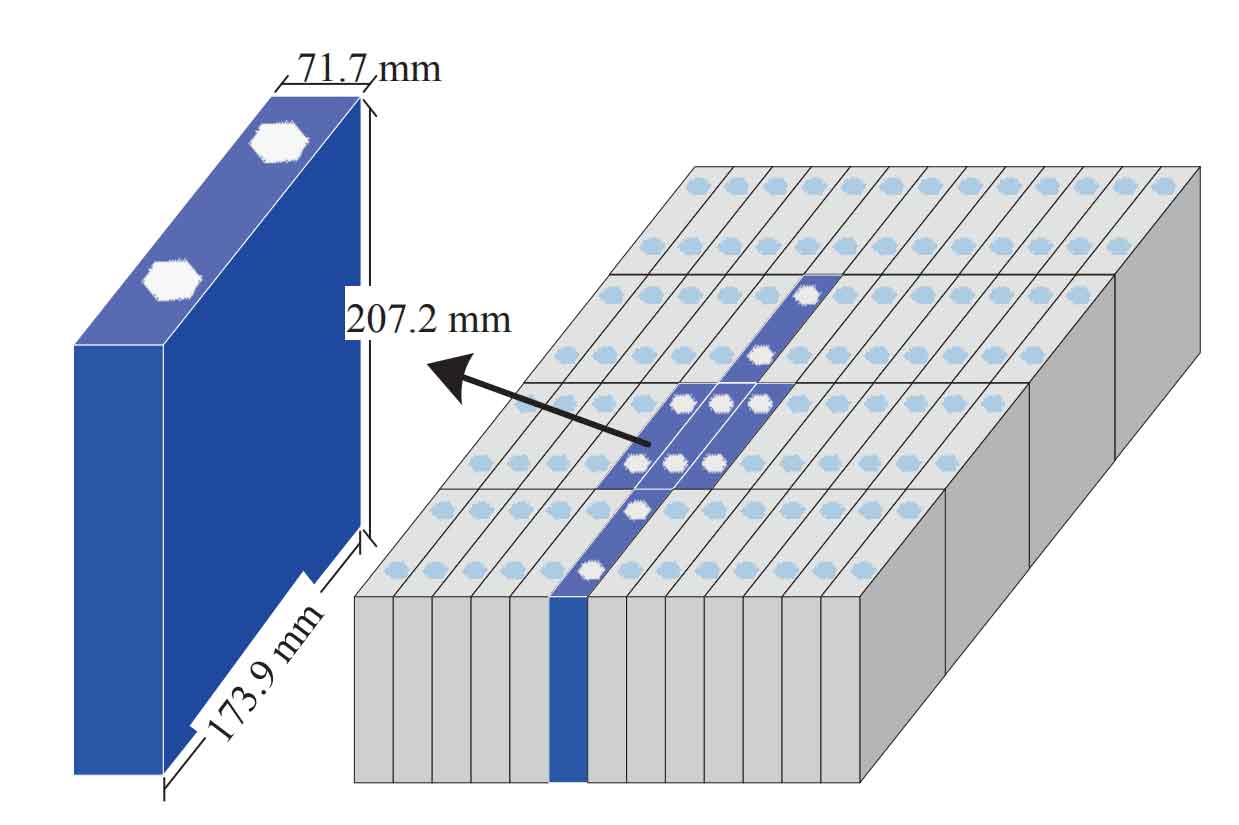
3. SOC Estimation Algorithm
The piecewise linear model for lithium iron phosphate battery SOC estimation achieves 92.4% accuracy in voltage plateau regions:
$$ SOC(t) = \begin{cases}
0.15\varepsilon^{0.78} & \text{for } 0 \leq \varepsilon < 120 \\
2.4\ln(\varepsilon) – 9.1 & \text{for } 120 \leq \varepsilon < 240 \\
0.08\varepsilon + 18.6 & \text{for } \varepsilon \geq 240
\end{cases} $$
Key advantages over conventional voltage-based methods:
| Method | Plateau Region Error | Dynamic Response | Temperature Sensitivity |
|---|---|---|---|
| Strain-based | ≤7.6% | 0.5s | 0.03%/°C |
| Voltage-based | ≥22.4% | 2.8s | 0.15%/°C |
4. Multi-physics Modeling
The coupled electrochemical-mechanical model for lithium iron phosphate batteries considers:
$$ \frac{\partial c_s}{\partial t} = \nabla\cdot(D_s\nabla c_s) + \frac{j}{F} $$
$$ \sigma_{eff} = E(\varepsilon_{total} – \varepsilon_{Li}^\theta) $$
Where $c_s$ represents lithium concentration in solid phase and $\varepsilon_{Li}^\theta$ denotes lithiation-induced strain. Model predictions align with experimental data within 8.9% error margin across 500+ cycles.
5. Industrial Application Potential
Field tests on 100kWh lithium iron phosphate battery systems demonstrate:
| Parameter | Strain Monitoring | Conventional BMS |
|---|---|---|
| SOC Estimation Error | 3.2% | 9.7% |
| Thermal Runway Prediction | 87% Accuracy | 62% Accuracy |
| Cycle Life Extension | 19% Improvement | Baseline |
The strain-based management strategy enables lithium iron phosphate battery systems to maintain 92.4% capacity retention after 3,000 cycles under 1C rate operation, significantly outperforming conventional voltage/temperature monitoring approaches.
6. Future Development Directions
Advanced lithium iron phosphate battery architectures require integrated sensing solutions:
$$ \text{Smart Cell} = \text{FBG Array} + \text{Thermal Sensors} + \text{AI Processor} $$
Key research challenges include:
- Multi-parameter decoupling algorithms
- Distributed strain tomography
- Self-healing electrode designs
This work establishes fundamental understanding of mechanical behavior in lithium iron phosphate batteries while demonstrating practical implementation of optical strain sensing for next-generation battery management systems.