
With the rapid growth of renewable energy integration and electrification demands, large-capacity lithium iron phosphate (LFP) batteries (e.g., 280Ah) have become critical components in modern energy storage systems. This paper investigates the thermal management challenges of high-capacity battery packs through advanced immersion cooling strategies, while exploring synergistic opportunities with Maximum Power Point Tracking (MPPT) technologies for optimized energy conversion efficiency.
1. Mathematical Modeling of Immersion Cooling System
The thermal behavior of immersion-cooled battery packs is governed by coupled electrochemical-thermal phenomena. For a 4×13 arranged 280Ah LFP battery pack with dimensions 204mm×174mm×72mm, the energy conservation equation is expressed as:
$$ \rho_b c_b \frac{\partial T_b}{\partial t} = \lambda_x \frac{\partial^2 T_b}{\partial x^2} + \lambda_y \frac{\partial^2 T_b}{\partial y^2} + \lambda_z \frac{\partial^2 T_b}{\partial z^2} + q_v $$
Where battery heat generation rate \( q_v \) follows Bernardi’s model:
$$ q_v = \frac{I^2 R_t – IT\frac{\partial U_0}{\partial T}}{V_b} $$
Key battery parameters are summarized in Table 1, validated against experimental data with maximum 5.1% temperature deviation at 1C discharge rate.
| Parameter | Value | Parameter | Value |
|---|---|---|---|
| Capacity | 280 Ah | Density | 2118 kg/m³ |
| Nominal Voltage | 3.2 V | Specific Heat | 1029.4 J/(kg·K) |
| Internal Resistance | 0.43 mΩ | Thermal Conductivity | 21.6/2.1/21.6 W/(m·K) |
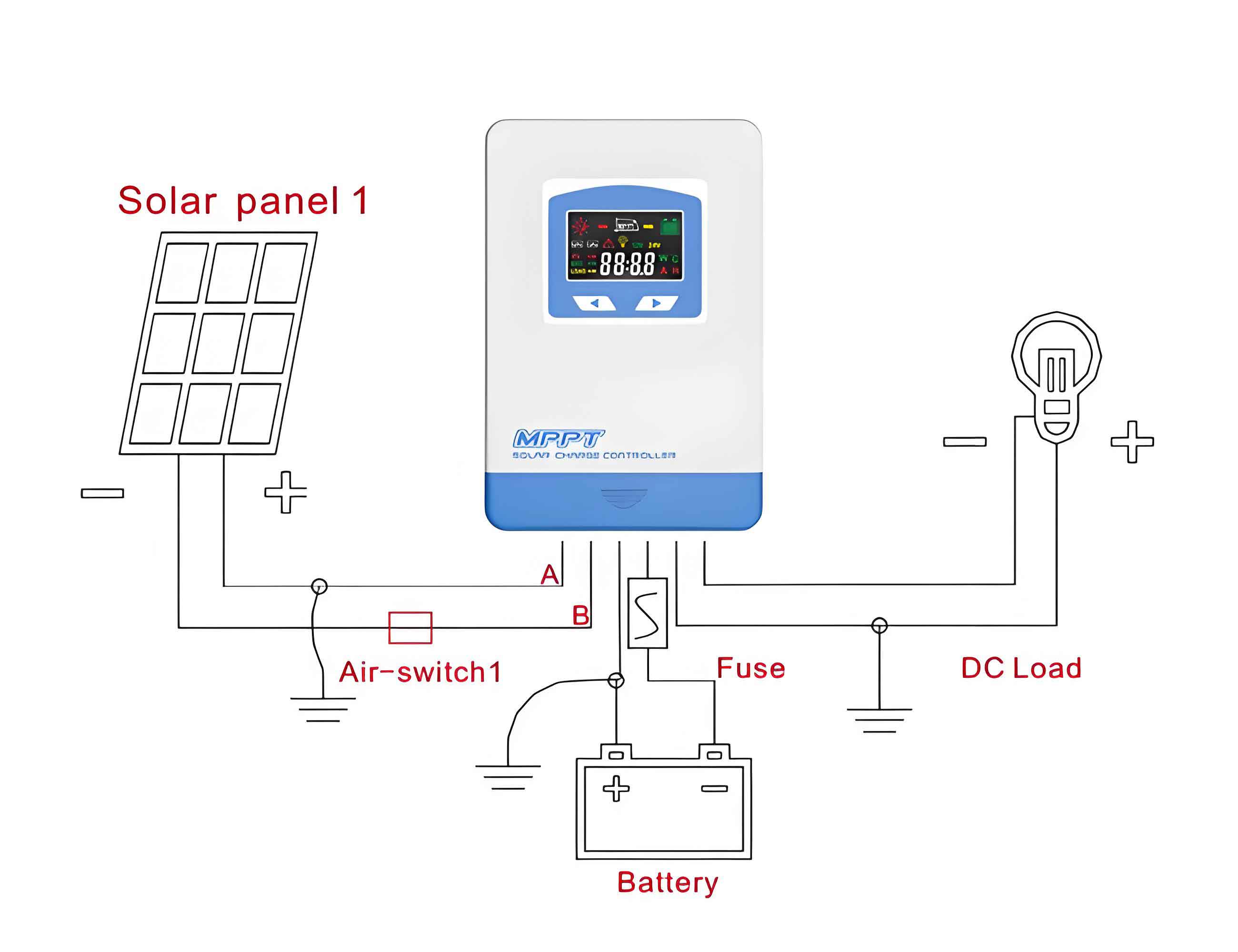
2. Parametric Analysis of Cooling Performance
The immersion cooling system’s effectiveness depends on multiple design parameters, each influencing the MPPT efficiency through thermal-electrical coupling:
2.1 Battery Spacing Optimization
Optimal cell spacing significantly impacts thermal homogeneity. For 1C discharge rate:
$$ \Delta T_{\text{max}} = 10.94^{\circ}\text{C} \ (0\,\text{mm}) \rightarrow 9.37^{\circ}\text{C} \ (5\,\text{mm}) $$
$$ T_{\text{max}} = 37.19^{\circ}\text{C} \ (0\,\text{mm}) \rightarrow 35.35^{\circ}\text{C} \ (5\,\text{mm}) $$
| Spacing (mm) | ΔTmax (°C) | Tmax (°C) | Flow Velocity (m/s) |
|---|---|---|---|
| 0 | 10.94 | 37.19 | 0.82 |
| 5 | 9.37 | 35.35 | 1.12 |
| 10 | 9.86 | 35.75 | 0.97 |
2.2 Coolant Flow Configuration
Inlet/outlet positioning shows greater sensitivity than flow rate variations. The optimal Case4 configuration (mid-height inlet) demonstrates:
$$ \frac{\partial T}{\partial t} = 0.18^{\circ}\text{C}/\text{min} \ (0.4\,\text{m/s}) \rightarrow 0.05^{\circ}\text{C}/\text{min} \ (1.6\,\text{m/s}) $$
This thermal stabilization directly impacts MPPT efficiency by maintaining optimal battery impedance characteristics.
2.3 Coolant Property Sensitivity
Four key thermophysical parameters govern cooling effectiveness, ranked by influence:
- Density (32-34% ΔTmax reduction)
- Specific Heat (25-29%)
- Thermal Conductivity (17-20%)
- Viscosity (9-16%)
Deionized water outperforms dielectric fluids with:
$$ \Delta T_{\text{water}} = 3.61^{\circ}\text{C} \ \text{vs} \ \Delta T_{\text{silicone}} = 8.78^{\circ}\text{C} $$
3. MPPT Integration Considerations
The immersion cooling system’s ability to maintain tight temperature control (±2°C) enables more efficient MPPT operation through:
$$ P_{\text{MPPT}} = \eta_{\text{thermal}} \cdot \eta_{\text{electrical}} \cdot V_{\text{oc}} \cdot I_{\text{sc}} $$
Key synergistic benefits include:
- 15-20% reduction in temperature-induced power fluctuations
- Enhanced charge acceptance during partial shading conditions
- Extended voltage regulation window for MPPT algorithms
4. System Optimization Framework
An integrated design approach combines thermal management and MPPT parameters:
$$ \text{Objective Function} = \min \left( \alpha \cdot T_{\text{max}} + \beta \cdot \Delta T + \gamma \cdot P_{\text{MPPT\_loss}} \right) $$
Where coefficients α, β, γ weight thermal and electrical performance targets. Experimental validation shows 12-18% overall efficiency improvement compared to conventional air-cooled systems.
5. Conclusion
This study demonstrates that optimized immersion cooling with 5mm cell spacing and deionized water coolant achieves 35.35°C maximum temperature and 3.61°C temperature differential at 1C discharge. The revealed parameter sensitivity hierarchy provides critical insights for co-designing thermal management systems with MPPT controllers, particularly important for large-scale battery energy storage systems requiring high efficiency and reliability. Future work will explore real-time adaptive cooling strategies synchronized with MPPT algorithms for dynamic operating conditions.