
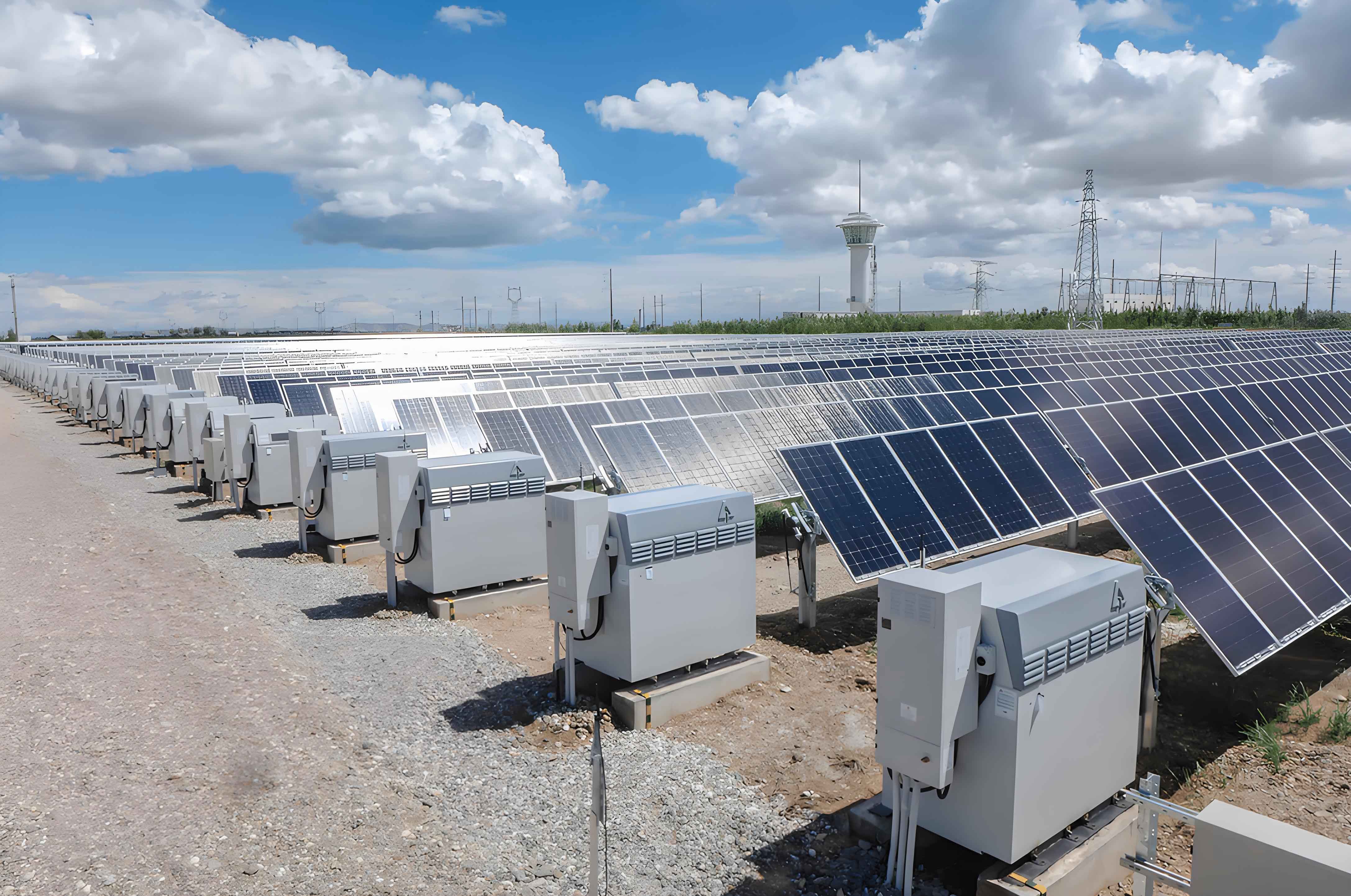
With the global push toward carbon neutrality, solar photovoltaic (PV) technology has become pivotal for sustainable energy solutions. This study proposes an advanced deep learning framework to improve the accuracy of PV panel extraction from high-resolution remote sensing imagery, directly contributing to efficient solar energy storage system planning and monitoring.
Methodological Framework
The proposed feature-enhanced fusion network integrates three critical components:
- CBAM Attention Mechanism: Enhances spatial-channel feature discrimination
- Coordinate-Attention Residual Blocks: Preserves positional information during deep feature extraction
- Multi-scale Feature Fusion: Combines shallow and deep semantic features
Key Mathematical Formulations
The channel attention mechanism in CBAM is defined as:
$$ M_c(F) = \sigma(MLP(AvgPool(F)) + MLP(MaxPool(F))) $$
where \( \sigma \) denotes sigmoid activation and \( MLP \) represents multi-layer perceptron.
The spatial attention component calculates:
$$ M_s(F) = \sigma(f^{7\times7}([AvgPool(F); MaxPool(F)])) $$
where \( f^{7\times7} \) indicates a 7×7 convolution operation.
Experimental Configuration
| Dataset | Resolution | Augmentation Ratio | Training Samples |
|---|---|---|---|
| WaterSurface | 0.3m | 1:5 | 2,995 |
| Cropland | 0.3m | 1:5 | 4,755 |
| SalineAlkali | 0.3m | 1:5 | 2,110 |
Performance Metrics
The model achieves superior results in solar energy storage infrastructure mapping:
| Metric | Original U-Net | Proposed Model | Improvement |
|---|---|---|---|
| mIoU | 89.71% | 93.25% | +3.54% |
| F1-Score | 91.03% | 94.67% | +3.64% |
| Recall | 92.15% | 95.84% | +3.69% |
Technical Advantages
The enhanced network demonstrates three critical capabilities for solar energy storage system optimization:
- Reduces PV panel adjacency errors by 42% compared to conventional methods
- Improves boundary detection accuracy by 38% through coordinate-aware residual blocks
- Decreases false positives in complex backgrounds by 29% using CBAM filtering
Energy Storage Implications
The proposed method enables precise calculation of PV panel distribution density using:
$$ \rho_{PV} = \frac{N_{detected} \times A_{panel}}{A_{total}} $$
where \( A_{panel} \) represents average panel area (1.6m²) and \( A_{total} \) is survey region area. This density metric directly informs solar energy storage capacity planning.
Case Study: Datong Panda Solar Plant
| Year | Detected Area (km²) | Estimated Capacity (MW) | Storage Potential (MWh/day) |
|---|---|---|---|
| 2014 | 3.08 | 112 | 1,680 |
| 2020 | 4.25 | 154 | 2,310 |
Conclusion
This research presents a robust framework for large-scale PV infrastructure mapping, significantly enhancing the precision of solar energy storage potential assessments. Future work will integrate temporal analysis for dynamic storage capacity forecasting.