
Solid-state batteries (SSBs) are poised to revolutionize the energy storage landscape by addressing critical limitations of conventional lithium-ion batteries, such as safety risks and energy density bottlenecks. Experts predict that SSBs could enable small-scale production by 2027 and achieve mass commercialization by 2030, driven by breakthroughs in materials science, manufacturing processes, and artificial intelligence (AI)-accelerated research.
Advantages of Solid-State Batteries
Compared to liquid electrolyte-based batteries, SSBs offer:
- Enhanced Safety: Elimination of flammable liquid electrolytes reduces thermal runaway risks.
- Higher Energy Density: Theoretical energy density exceeding 400 Wh/kg, enabling longer-range electric vehicles (EVs).
- Longer Cycle Life: Potential for over 1,000 charge-discharge cycles with minimal degradation.
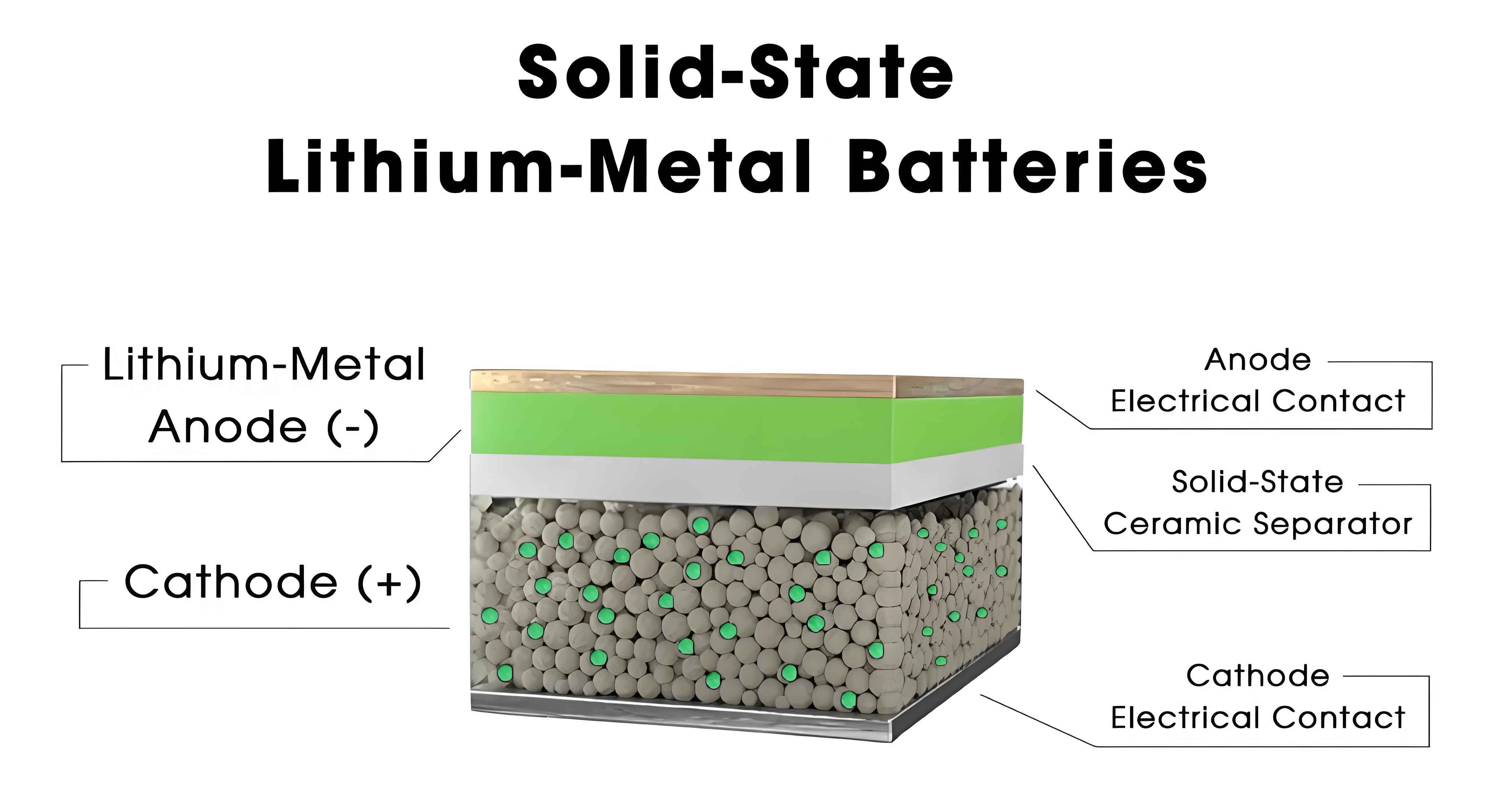
Material Innovations in Solid-State Batteries
The performance of SSBs hinges on three core components:
| Component | Current Focus | Key Metrics |
|---|---|---|
| Electrolyte | Sulfide-based (e.g., Li10GeP2S12) | Ionic conductivity > 10-2 S/cm |
| Cathode | High-nickel ternary (NMC811) | Capacity > 200 mAh/g |
| Anode | Silicon-carbon composite | Capacity > 1500 mAh/g |
The ionic conductivity ($\sigma$) of solid electrolytes follows the Arrhenius equation:
$$
\sigma = \sigma_0 \exp\left(-\frac{E_a}{k_B T}\right)
$$
where $E_a$ is activation energy, $k_B$ is Boltzmann’s constant, and $T$ is temperature.
Technical Challenges and Solutions
Key hurdles in SSB development include:
| Challenge | Impact | Mitigation Strategy |
|---|---|---|
| Electrode-electrolyte interface resistance | Increases internal impedance | Nanoscale surface engineering |
| Material stability | Degrades cycle life | Doping with stabilizing elements (e.g., Al, Ti) |
| Manufacturing costs | Limits scalability | Roll-to-roll processing optimization |
AI-Driven Development Platforms
Emerging AI for Science (AI4S) frameworks accelerate SSB innovation by:
- Predicting material properties via quantum mechanical simulations
- Optimizing electrode architectures using generative design
- Reducing experimental iterations by 40-60%
A collaborative platform led by Prof. Ouyang Minggao integrates 30+ enterprises to develop SSB-specific large language models (LLMs), enabling rapid screening of 105 material combinations annually.
Industry Roadmaps and Projections
Leading automakers and battery producers have outlined aggressive timelines:
| Company | Milestone | Target Year |
|---|---|---|
| BYD | Pilot production | 2027 |
| FAW Group | Prototype validation | 2026 |
| Panasonic | GWh-scale manufacturing | 2030 |
The energy density ($E_d$) of SSBs is projected to follow:
$$
E_d = \frac{C_{cathode} \times V_{cell} \times \eta}{m_{total}}
$$
where $C_{cathode}$ is cathode capacity, $V_{cell}$ is cell voltage, $\eta$ is efficiency, and $m_{total}$ is total mass.
Economic and Environmental Impact
SSB adoption could reduce EV battery pack costs by 30-50% by 2035 while enabling 800+ km ranges. A lifecycle analysis model estimates:
$$
\text{CO}_2 \text{ reduction} = 0.25 \times \text{SSB market penetration} \times \text{EV fleet size}
$$
With 50% market penetration, annual CO2 emissions could decrease by 1.2 Gt by 2040.
Conclusion
Solid-state batteries represent a paradigm shift in energy storage technology. While challenges remain in material interfaces and manufacturing scalability, cross-industry collaborations and AI-powered innovation are paving the way for commercialization. As Prof. Sun Shigang emphasized, “The next five years will determine whether SSBs transition from laboratory breakthroughs to industrial reality.” With sustained investment and policy support, the 400 Wh/kg SSB could become the cornerstone of next-generation electrification.