
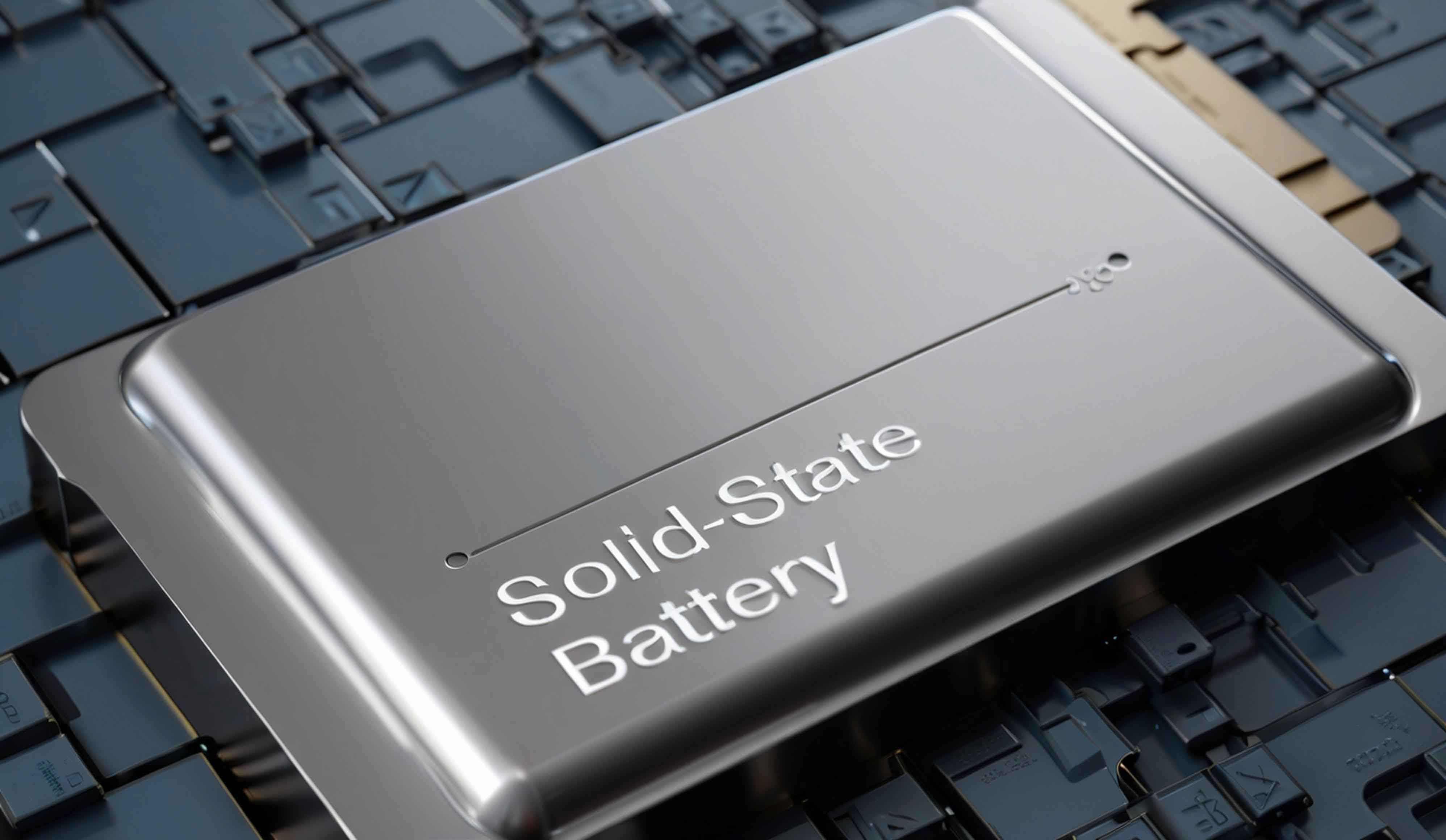
The energy revolution driven by “energy + artificial intelligence” is reshaping global industries, with solid-state batteries emerging as a transformative technology. This article explores recent advancements in material innovation, production scaling, and cost reduction strategies for solid-state batteries through interdisciplinary perspectives.
1. Technological Convergence in Electrolyte Development
Current research focuses on four primary electrolyte systems for solid-state batteries:
| Electrolyte Type | Ionic Conductivity (S/cm) | Thermal Stability (°C) | Manufacturing Cost ($/kg) |
|---|---|---|---|
| Sulfide | 10-2-10-3 | 200-300 | 150-300 |
| Oxide | 10-3-10-4 | 600-800 | 50-100 |
| Polymer | 10-4-10-5 | 100-150 | 80-120 |
| Halide | 10-3-10-4 | 400-500 | 200-400 |
The interfacial resistance between electrodes and electrolyte remains a critical challenge, described by:
$$R_{interface} = \frac{\sigma_{SE}}{A} \cdot \frac{1}{\sqrt{D_{Li^+} \cdot t}}$$
Where σSE represents solid electrolyte conductivity, A is contact area, DLi+ is lithium diffusion coefficient, and t denotes cycling time.
2. Roadmap for Mass Production
The industry has established phased commercialization targets:
| Stage | Timeframe | Energy Density (Wh/kg) | Cost Target ($/kWh) |
|---|---|---|---|
| Semi-solid | 2024-2026 | 350-400 | 120-150 |
| Hybrid solid-state | 2026-2028 | 400-500 | 80-120 |
| Full solid-state | 2028+ | 500-700 | <50 |
Key players are adopting differentiated strategies:
$$\text{Production Scale Factor} = \frac{C_{\text{current}}}{C_{\text{target}}} \cdot e^{-k(t-t_0)}$$
Where C represents component costs, k is the learning rate coefficient (0.15-0.25 for solid-state batteries), and t-t0 denotes time since commercialization.
3. Cost Reduction Pathways
The total cost structure of solid-state batteries can be modeled as:
$$TCO = C_{\text{material}} + C_{\text{manufacturing}} + C_{R\&D} + C_{\text{recycling}}$$
Material cost breakdown analysis reveals:
| Component | Current Cost Share | 2030 Projection |
|---|---|---|
| Solid Electrolyte | 45-55% | 25-30% |
| Lithium Metal Anode | 20-25% | 15-18% |
| High-Ni Cathode | 15-20% | 25-30% |
| Manufacturing | 10-15% | 5-8% |
Dry electrode processing demonstrates particular promise for cost reduction:
$$Efficiency_{\text{dry}} = \frac{\eta_{\text{coating}} \cdot P_{\text{max}}}{E_{\text{consumed}}} \cdot \left(1 – \frac{t_{\text{solvent}}}{t_{\text{total}}}\right)$$
Where ηcoating is coating efficiency, Pmax is maximum power density, and tsolvent/ttotal represents solvent-free processing time ratio.
4. Emerging Application Markets
Adoption rates across sectors show significant variation:
| Application | 2025 Penetration | 2030 Projection | Key Requirements |
|---|---|---|---|
| EVs | 2-3% | 15-20% | Cycle life > 2000 |
| eVTOL | 0.5% | 8-12% | Energy density > 500 Wh/kg |
| Robotics | 1% | 10-15% | Fast charge < 15min |
| Grid Storage | <0.1% | 5-8% | Cost < $80/kWh |
The market growth follows an S-curve model:
$$Adoption(t) = \frac{L}{1 + e^{-k(t – t_0)}}$$
Where L is maximum market potential (estimated at $120B by 2035 for solid-state batteries), k is growth rate (0.3-0.5 annually), and t0 is inflection point (projected 2027-2028).
5. Challenges and Collaborative Solutions
Technical hurdles require cross-industry cooperation:
| Challenge | Current Status | 2030 Target | Innovation Required |
|---|---|---|---|
| Interface Resistance | 25-50 Ω·cm² | <10 Ω·cm² | Atomic layer deposition |
| Electrolyte Thickness | 50-100 μm | <20 μm | Ultra-precision coating |
| Production Speed | 2-5 m/min | >20 m/min | Dry process optimization |
| Cycle Life | 800-1200 | >2000 | Stress-tolerant architectures |
The solid-state battery ecosystem requires synchronized progress across the value chain:
$$T_{\text{commercialization}} = \sum_{i=1}^{n} \left(T_{\text{material}}^i \cdot W_i + T_{\text{equipment}}^i \cdot W_i\right)$$
Where T represents technology readiness levels and W denotes weight factors for different components.
As solid-state battery technology matures, its success will depend on continuous material innovation, manufacturing breakthroughs, and collaborative standardization efforts across industries. The next five years will prove critical in determining whether this promising technology can deliver on its theoretical potential and revolutionize energy storage systems worldwide.