
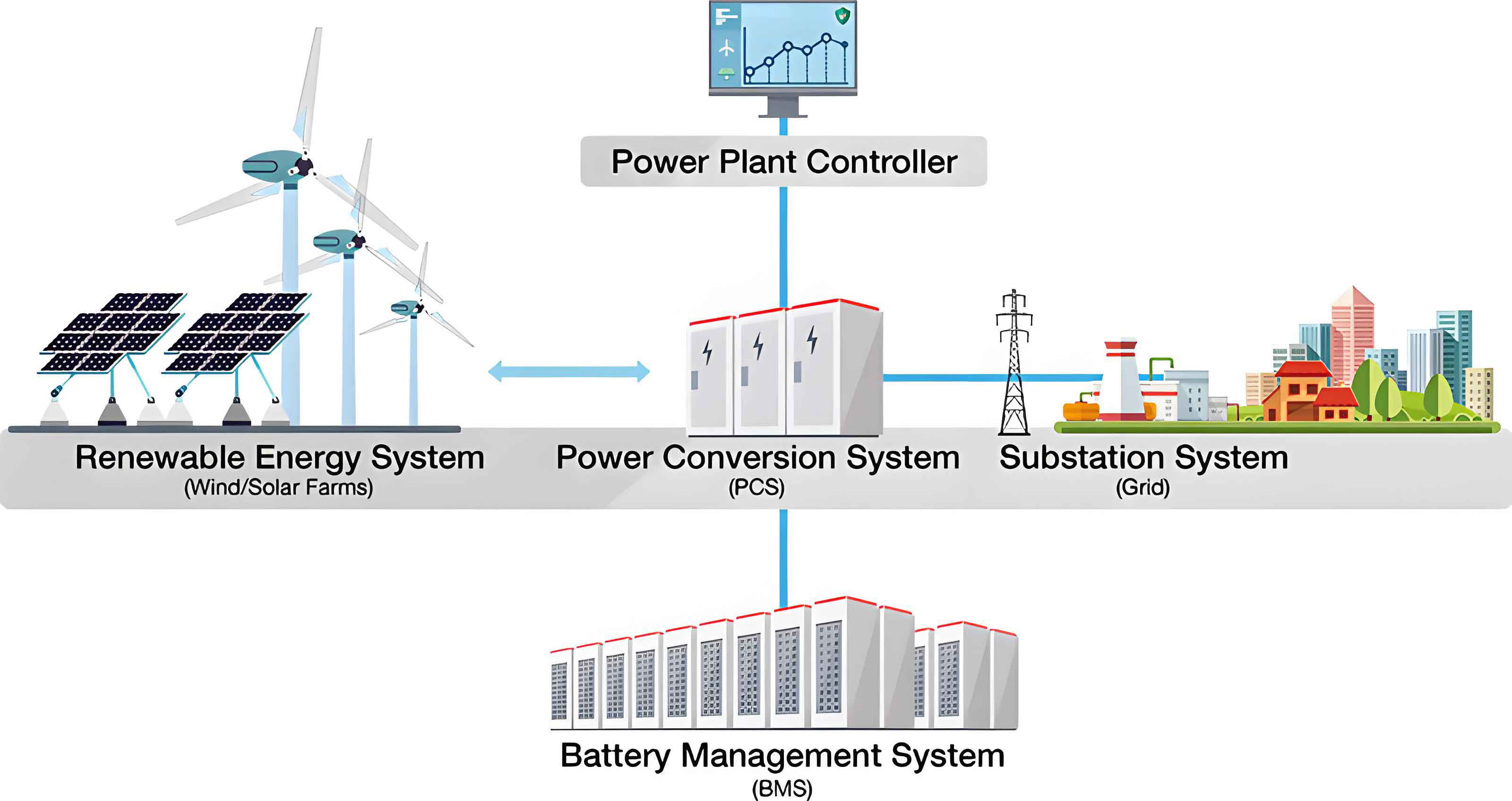
Thermal management is critical for ensuring the long-term efficiency, safety, and stability of container-type battery energy storage systems. This study focuses on a 1.2 MWh lithium-ion battery energy storage system deployed in a large-scale demonstration project. The system integrates battery modules, a battery management system (BMS), power conversion devices, thermal management components, and fire suppression systems within a standard 40-foot container (12.192 m × 2.438 m × 2.896 m). The thermal management design, including airflow duct optimization, air conditioning, and fan configuration, is analyzed to maintain optimal operating temperatures for lithium iron phosphate (LiFePO4) batteries under varying load conditions.
Thermal Management System Design
1. Airflow Duct Configuration
The airflow duct structure ensures uniform cooling across battery modules. Key components include:
- Main duct: Distributes conditioned air from the HVAC unit to sub-ducts.
- Adjustable baffles: Balance airflow distribution at each outlet.
- Battery rack baffles: Prevent air leakage between racks and container walls.
The airflow path follows:
$$Q_{\text{module}} = \frac{\dot{m} \cdot c_p \cdot \Delta T_{\text{in-out}}}{\rho}$$
where \( Q_{\text{module}} \) is heat dissipation per module (W), \( \dot{m} \) is mass flow rate (kg/s), \( c_p \) is specific heat capacity (J/kg·K), and \( \Delta T_{\text{in-out}} \) is temperature difference between inlet and outlet.
2. HVAC Cooling Capacity Calculation
The total cooling load \( P_{\text{total}} \) for the energy storage system comprises battery heat generation and container envelope heat transfer:
$$P_{\text{total}} = P_{\text{battery}} + P_{\text{envelope}}$$
$$P_{\text{battery}} = \frac{n \cdot E \cdot (1-\eta)}{t_{\text{charge}}}$$
$$P_{\text{envelope}} = K \cdot A \cdot \Delta T_{\text{in-out}}$$
where \( K = \frac{1}{\frac{1}{h_w} + \sum \frac{\delta_i}{\lambda_i} + \frac{1}{h_n}} \) represents the container’s composite heat transfer coefficient.
| Parameter | Value |
|---|---|
| Battery cells | 2,880 (3.2 V/86 Ah) |
| Module configuration | 2P24S (48 cells/module) |
| System voltage | 768 V DC |
| Charge/discharge efficiency (η) | 95% |
| Container surface area (A) | 126.5 m² |
3. Battery Module Fan Design
Axial fans (209 m³/h flow rate) are integrated into battery module front panels. Required airflow per module is calculated as:
$$Q_f = \mu \cdot \frac{0.05P_{\text{module}}}{\Delta T_{\text{allow}}}$$
where \( \mu = 1.1–1.2 \) accounts for airflow resistance, and \( \Delta T_{\text{allow}} \) is the maximum permitted temperature rise (≤8°C).
Thermal Control Strategy
The hierarchical temperature management protocol combines HVAC operation and localized fan control:
| Condition | Action |
|---|---|
| Tcontainer ≤12°C | Activate HVAC heating |
| Tcontainer ≥28°C | Activate HVAC cooling |
| Tmodule ≥33°C | Enable local fans |
| Tmodule ≤31°C | Disable local fans |
Experimental Validation
Temperature distribution tests at 35°C ambient conditions demonstrate the energy storage system’s thermal performance:
| Charge Rate | Initial Tmin | Final Tmax | ΔTmax |
|---|---|---|---|
| 0.5C | 24°C | 34°C | 5°C |
| 1C | 24°C | 40°C | 8°C |
The thermal management system maintains battery temperatures within optimal ranges (25–35°C) for 0.5C operation and prevents critical overheating (≤40°C) during 1C cycling. The maximum inter-module temperature differential remains below 8°C, ensuring balanced aging across the energy storage system.
Conclusion
The proposed thermal management design effectively addresses the challenges of high-density battery packing in containerized energy storage systems. Through optimized airflow distribution, hierarchical temperature control, and modular cooling components, the system achieves:
- Battery temperature stabilization within 40°C at 1C operation
- Maximum temperature differential <8°C across modules
- Energy efficiency improvement through adaptive fan control
This thermal management framework provides a scalable solution for megawatt-scale energy storage systems, ensuring both operational reliability and long-term battery health in diverse climatic conditions.