
This study proposes a hybrid energy storage system capacity optimization method that addresses the bidirectional demands of wind power utilization and user electricity consumption. By integrating demand response mechanisms and a hybrid energy storage architecture, the model effectively balances economic efficiency, renewable energy absorption, and user satisfaction.
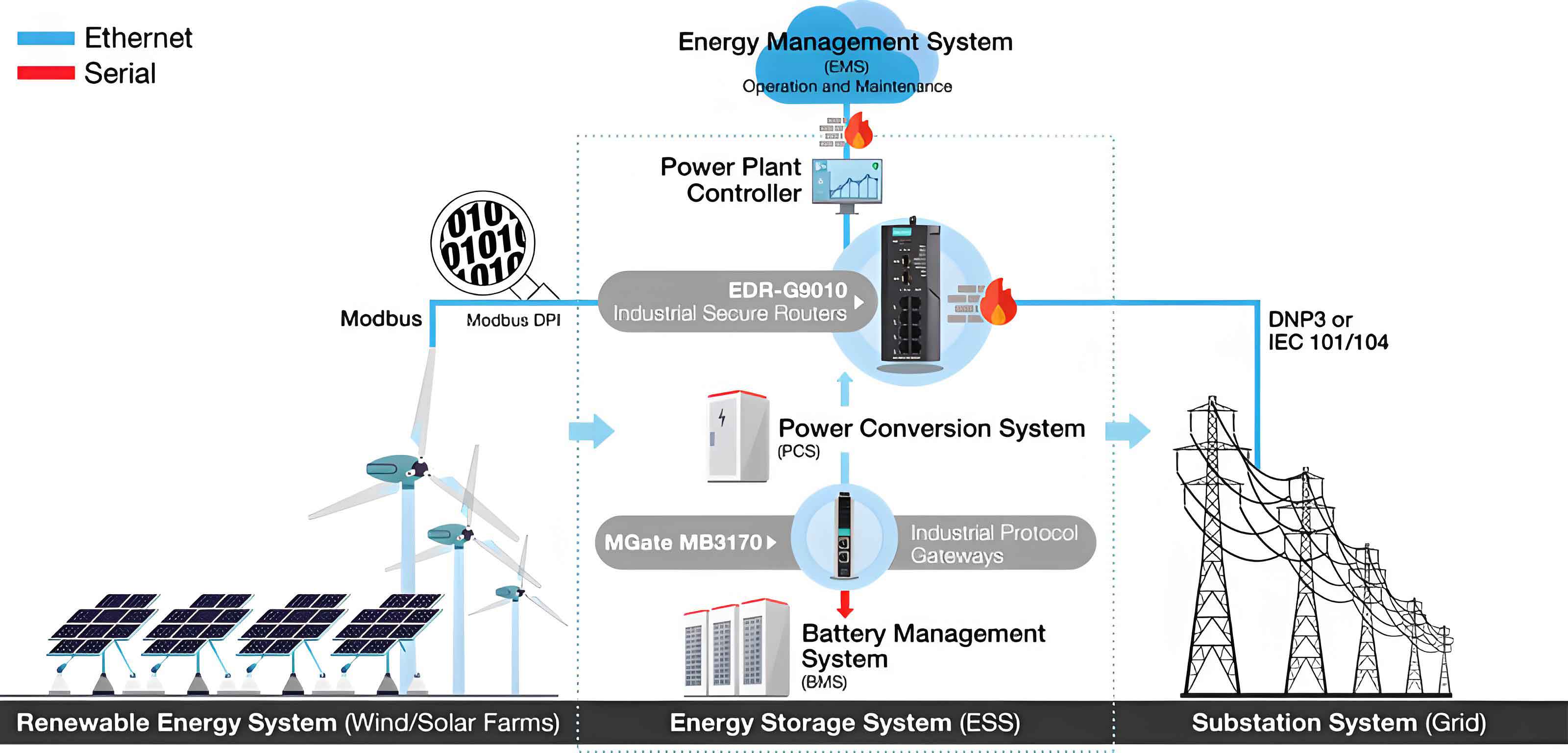
1. System Architecture and Mathematical Models
1.1 Demand Response Modeling
The flexible load model incorporates shiftable loads and reducible loads:
Shiftable Load Constraints:
$$ t_d = \sum_{t=\tau}^{\tau+t_d-1} a_t $$
where \( t_d \) represents duration, \( \tau \) the start time, and \( a_t \) the binary state variable.
Reducible Load Equation:
$$ P_{L-cut-after} = P_{L-cut-before} – \gamma_t b_t P_{L-cut-before} $$
with \( \gamma_t \) as reduction coefficient (0.7) and \( b_t \) the decision variable.
1.2 Hybrid Energy Storage System Components
| Parameter | Battery | Supercapacitor |
|---|---|---|
| Capacity Formula | \( E_b = N_b C_b U_b/10^3 \) | \( E_{cmax} = 0.5N_c C_c U_{cmax}^2/(3.6 \times 10^6) \) |
| Power Formula | \( P_b = N_b C_b U_b/10^4 \) | \( P_{cmax} = N_c U_{max} I_{cmax}/10^3 \) |
| Efficiency | Charge: 80%, Discharge: 40% | Charge/Discharge: 98% |
2. Operational Strategy and Optimization
2.1 Charge-Discharge Logic
The imbalance power \( \Delta P(t) \) drives the energy storage system operation:
$$ \Delta P(t) = P_W(t) – P_L(t) $$
Operational modes include:
- Overproduction (\( \Delta P > 0 \)): Prioritize battery charging at rated power
- Deficit (\( \Delta P < 0 \)): Utilize supercapacitor for high-frequency compensation
2.2 Multi-Objective Optimization Model
Objective Functions:
- Minimize total cost:
$$ f_1 = \min(C_{HESS} + C_{move} + C_{cut}) $$ - Minimize curtailment rate:
$$ f_2 = \min\left(1 – \frac{E_L + E_{HESS}}{\sum_{t} P_W(t)}\right) $$ - Maximize user satisfaction:
$$ f_3 = \max\left(1 – \frac{\sum\left|P_0(t) – P_L(t)\right|}{\sum P_0(t)}\right) $$
| Parameter | Value |
|---|---|
| Population Size | 100 |
| Iterations | 100 |
| Learning Factors | 0.5 (individual/social) |
| Inertia Weight | 0.5→0.1 |
3. Case Study and Results
3.1 Scenario Comparison
| Scenario | Storage Capacity (kWh) | Cost (USD) | Curtailment Rate |
|---|---|---|---|
| No DR/Storage | 0 | – | 24.37% |
| Storage Only | 1533+835 | 447,008 | 0.41% |
| Proposed | 1372+805 | 330,595 | 0.38% |
3.2 Algorithm Performance
The multi-objective particle swarm optimization demonstrates superior convergence:
$$ v_{i}^{k+1} = \omega v_i^k + c_1 r_1(pbest_i – x_i^k) + c_2 r_2(gbest – x_i^k) $$
Comparative results with NSGA-II and MOEA:
| Algorithm | Cost (USD) | Convergence Time (s) |
|---|---|---|
| MOPSO | 330,595 | 42.7 |
| NSGA-II | 344,974 | 58.3 |
| MOEA | 350,694 | 63.1 |
4. Sensitivity Analysis
Key findings from parametric studies:
- Weight allocation significantly impacts optimization results (20% cost variation observed)
- 10C battery discharge rate achieves optimal cost-reliability balance
- Population size 100 provides optimal exploration-exploitation tradeoff
5. Conclusion
The proposed hybrid energy storage system configuration method reduces wind curtailment to 0.38% while maintaining 89.85% user satisfaction. The optimized system decreases storage capacity requirements by 10.5% compared to conventional designs, demonstrating significant economic advantages. This approach provides a viable solution for coordinating renewable energy utilization and demand-side management through intelligent energy storage system design.