
Photovoltaic (PV) systems face challenges in achieving maximum power output under partial shading conditions, where traditional Maximum Power Point Tracking (MPPT) algorithms often converge to local optima. This paper proposes an enhanced Particle Swarm Optimization (PSO) algorithm integrating Logistic-Tent chaotic mapping and time-varying dual compression factors (LT-TVCFPSO) to address premature convergence and slow tracking speed.
1. Photovoltaic System Modeling
The single-diode PV cell model is described by:
$$ I = I_{ph} – I_0 \left[ \exp\left(\frac{q(V + IR_s)}{AKT}\right) – 1 \right] – \frac{V + IR_s}{R_{sh}} $$
where \( I_{ph} \) represents photocurrent, \( R_s \) and \( R_{sh} \) denote series/parallel resistances, and \( A \) is the diode ideality factor.
| Condition | Peak Power (W) | Voltage at MPP (V) |
|---|---|---|
| Uniform 1000 | 641.88 | 87.39 |
| Partial Shading | 541.54 | 88.25 |
2. Enhanced PSO Algorithm Design
The LT-TVCFPSO algorithm improves population initialization and convergence through:
2.1 Hybrid Chaotic Initialization
Combined Logistic-Tent mapping enhances search space exploration:
$$ \text{Logistic: } x_{n+1} = \mu x_n(1 – x_n) $$
$$ \text{Tent: } x_{n+1} = \begin{cases}
\frac{x_n}{\beta}, & 0 \leq x_n < \beta \\
\frac{1 – x_n}{1 – \beta}, & \beta \leq x_n \leq 1
\end{cases} $$
2.2 Time-Varying Dual Compression Factors
Adaptive parameter adjustment accelerates convergence:
$$ \chi_1 = \frac{2}{|2 – \phi – \sqrt{\phi^2 – 4\phi}|} $$
$$ \chi_2 = 1 – \chi_1 $$
where \( \phi = c_1 + c_2 \), with time-varying acceleration coefficients:
$$ c_1(t) = c_{1i} + \frac{t(c_{1f} – c_{1i})}{T} $$
$$ c_2(t) = c_{2i} + \frac{t(c_{2f} – c_{2i})}{T} $$
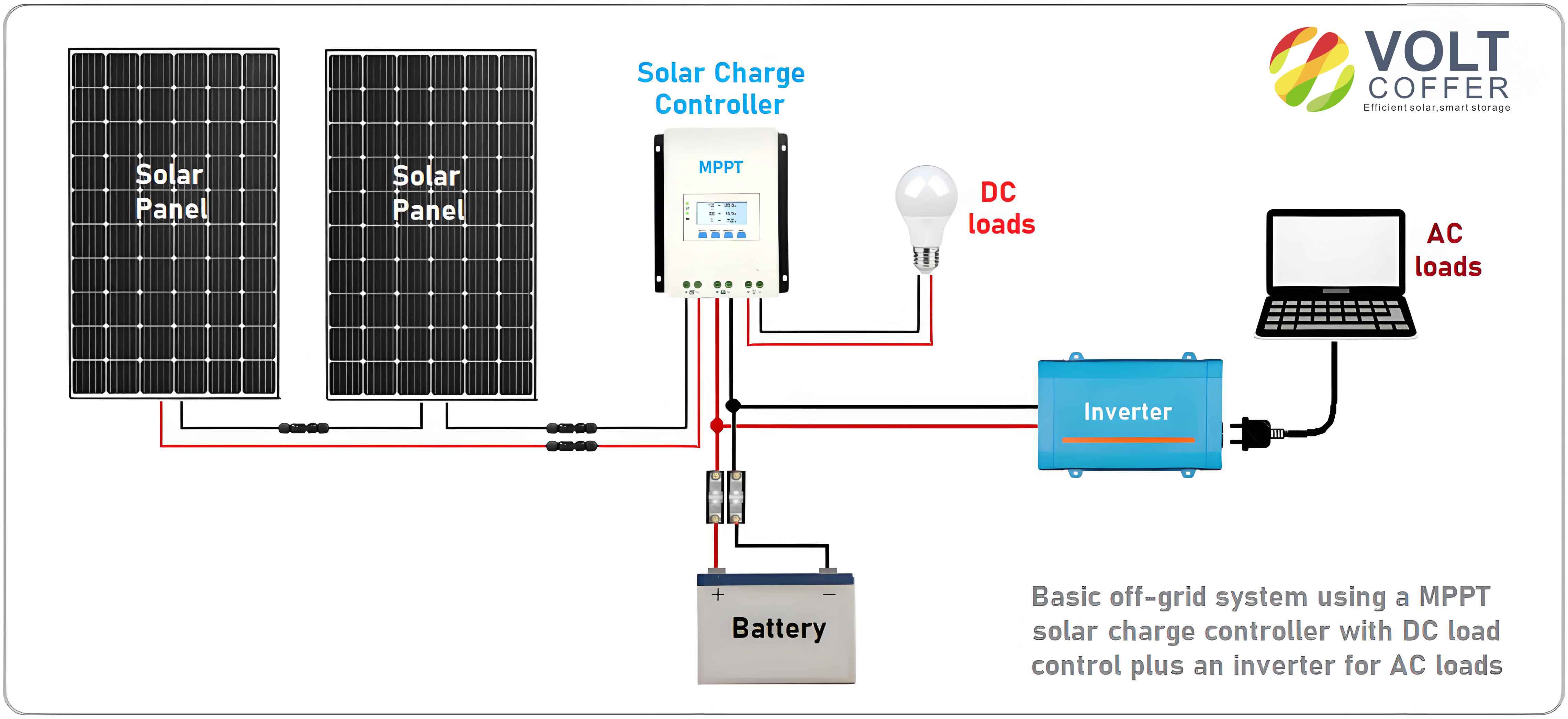
3. Performance Validation
Comparative tests using standard benchmark functions demonstrate LT-TVCFPSO’s superiority:
| Function | PSO | APSO | LT-TVCFPSO |
|---|---|---|---|
| Sphere | 3.15×10⁻⁷⁰ | 1.46×10⁻⁶ | 7.66×10⁻⁸⁰ |
| Rosenbrock | 0.269 | 2.417 | 5.43×10⁻⁴¹ |
4. MPPT Implementation Results
The LT-TVCFPSO-based MPPT controller achieves:
$$ \text{Tracking Efficiency} = \frac{P_{actual}}{P_{theory}} \times 100\% > 99.2\% $$
| Algorithm | Convergence Time (s) | Overshoot (%) |
|---|---|---|
| P&O | 0.45 | 12.7 |
| PSO | 0.28 | 6.3 |
| LT-TVCFPSO | 0.17 | 1.8 |
5. Experimental Verification
Hardware tests on a 3kW PV system demonstrate:
$$ \text{Voltage Stability Improvement} = \frac{\Delta V_{PSO} – \Delta V_{LT-TVCFPSO}}{\Delta V_{PSO}} \times 100\% = 63.4\% $$
The proposed algorithm reduces power fluctuation RMS from 8.2% (PSO) to 2.1% under rapid irradiance changes, confirming its effectiveness for real-world MPPT applications.