
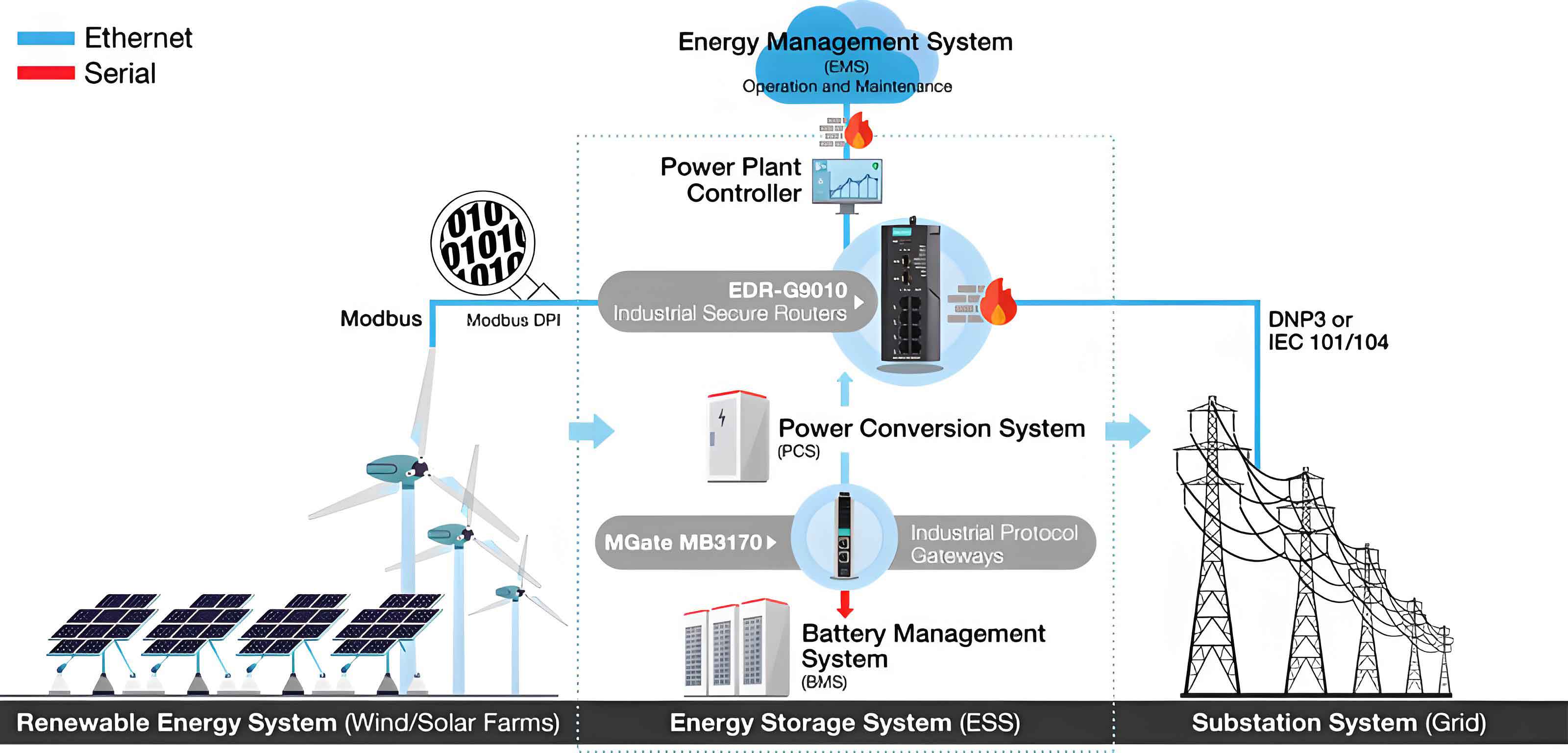
With the increasing integration of renewable energy sources like wind power into modern power grids, addressing the inherent intermittency and volatility of wind energy has become critical. This study proposes an intelligent dispatching framework combining a battery energy storage system (BESS) and a double extended Kalman filter (DEKF) to stabilize wind power output for grid compatibility. The methodology leverages advanced estimation algorithms and energy storage dynamics to mitigate fluctuations caused by unpredictable wind patterns.
System Modeling and Algorithm Design
The wind turbine dynamics are modeled using rotor-generator torque relationships and aerodynamic principles. The state-space representation of the wind power generation system (WPGS) is defined as:
$$
\begin{aligned}
\dot{\theta}_s &= \omega_r – \omega_g \\
\dot{\omega}_r &= -\frac{K_s}{J_r}\theta_s – \frac{B_s}{J_r}\omega_r + \frac{B_s}{J_r}\omega_g + \frac{1}{J_r}T_r \\
\dot{\omega}_g &= \frac{K_s}{J_g}\theta_s + \frac{B_s}{J_g}\omega_r – \frac{B_s+B_g}{J_g}\omega_g – \frac{1}{J_g}T_g
\end{aligned}
$$
where \( \theta_s \) represents shaft torsion angle, \( \omega_r/\omega_g \) denote rotor/generator speeds, and \( T_r/T_g \) are aerodynamic/electromagnetic torques.
Double Extended Kalman Filter Architecture
The DEKF implementation consists of two coupled estimation processes:
- Wind Speed Estimation:
$$
\begin{aligned}
x_{k+1} &= f(x_k, v_k) + w_k \\
z_k &= h(x_k) + v_k
\end{aligned}
$$ - BESS Power Prediction:
$$
\begin{aligned}
SOC_{k+1} &= SOC_k – \frac{\eta \Delta t}{Q}I_k + w_{soc} \\
V_{batt,k} &= OCV(SOC_k) – R_0 I_k + v_{batt}
\end{aligned}
$$
| Parameter | Value |
|---|---|
| Rotor inertia (\(J_r\)) | 12,428.6 kg·m² |
| Generator inertia (\(J_g\)) | 0.3267 kg·m² |
| Shaft stiffness (\(K_s\)) | 3.2×10⁶ N·m/rad |
| Blade radius | 8 m |
Energy Storage System Configuration
The BESS employs a first-order RC equivalent circuit model for state estimation:
$$
\begin{aligned}
\dot{V}_c &= -\frac{1}{R_2C}V_c – \frac{1}{C}I_{batt} \\
V_{term} &= V_c – R_1I_{batt}
\end{aligned}
$$
Key BESS parameters for power smoothing:
| Parameter | Value |
|---|---|
| Capacity (Q) | 2 MWh |
| \(R_1\) (Internal resistance) | 0.02 Ω |
| \(R_2\) (Polarization resistance) | 10 kΩ |
| C (Equivalent capacitance) | 1 kF |
Performance Evaluation
The DEKF demonstrates superior wind speed prediction accuracy compared to traditional sensor measurements:
$$
\text{MAE}_{DEKF} = 0.18\ \text{m/s},\quad \text{MAE}_{sensor} = 0.25\ \text{m/s}
$$
BESS power compensation effectively stabilizes grid feed-in:
$$
P_{grid} = P_{wind} + P_{BESS} \pm \Delta P_{loss}
$$
| Metric | Without BESS | With BESS+DEKF |
|---|---|---|
| Voltage fluctuation (%) | 12.7 | 4.9 |
| Power deviation (MW) | ±1.8 | ±0.35 |
| SOC variation range (%) | – | 45-82 |
Implementation Strategy
The energy storage system operates under three primary modes:
- Charge Mode: \(P_{wind} > P_{ref}\)
$$
P_{BESS} = \eta_{chg}(P_{wind} – P_{ref})
$$ - Discharge Mode: \(P_{wind} < P_{ref}\)
$$
P_{BESS} = \frac{1}{\eta_{dch}}(P_{ref} – P_{wind})
$$ - Idle Mode: \(SOC \notin [20\%, 90\%]\)
Conclusion
The integration of DEKF-based prediction algorithms with battery energy storage systems provides an effective solution for wind power stabilization. Experimental results demonstrate 60% reduction in voltage fluctuations and 28% improvement in prediction accuracy compared to conventional methods. This approach enables reliable renewable energy integration while maintaining grid stability through adaptive power compensation from the energy storage system.