
The integration of distributed photovoltaic (PV) systems into distribution networks has introduced significant challenges, particularly concerning voltage stability in distribution transformer areas. As PV penetration increases, the bidirectional power flow caused by PV generation can lead to voltage violations, including both overvoltage and undervoltage conditions. This paper addresses these issues by analyzing the voltage impact mechanisms and proposing a control strategy leveraging solar inverter power regulation. Solar inverters play a critical role in managing active and reactive power output to maintain voltage within acceptable limits. The study focuses on the operational characteristics of solar inverters and their potential for real-time voltage control in distribution networks.
Voltage violations in distribution transformer areas often arise due to the intermittent nature of PV generation and varying load demands. During periods of high PV output and low load, reverse power flow can cause voltage rise, exceeding the upper limit. Conversely, during nighttime or low PV generation with high load, voltage drop may occur, falling below the lower limit. Traditional methods, such as transformer tap changing, are inadequate for dynamic voltage regulation due to their slow response and requirement for power interruption. Therefore, utilizing the capabilities of solar inverters for active and reactive power control offers a promising solution. This research explores the dual-loop control of solar inverters and their power output characteristics to develop an effective voltage regulation strategy.
The analysis begins with the voltage impact of PV integration on distribution lines and transformer areas. A simplified model of a distribution network with multiple nodes is considered, where each node may have connected PV systems and loads. The voltage difference at any node k from the source can be expressed as:
$$ \Delta U_k = \frac{1}{U_N} \sum_{j=1}^{k} \left( R_j \sum_{i=j}^{n} (P_{Lj} – P_{PVi}) + X_j \sum_{i=j}^{n} (Q_{Lj} – Q_{PVi}) \right) $$
where \( U_N \) is the rated voltage, \( R_j \) and \( X_j \) are the resistance and reactance from the source to node j, \( P_{Lj} \) and \( Q_{Lj} \) are the load active and reactive power at node j, and \( P_{PVi} \) and \( Q_{PVi} \) are the PV active and reactive power at node i. When PV generation exceeds load demand, the voltage difference may become negative, leading to overvoltage conditions. For distribution transformer areas, the voltage at the transformer outlet can be modeled as:
$$ V_1 = \frac{1}{K} \left( U_0 – \Delta U_k \right) + \frac{1}{V_2} \left( (P_{PV} – P_L) R + (Q_{PV} – Q_L) X \right) $$
where \( V_1 \) is the transformer outlet voltage, \( K \) is the transformer ratio, \( U_0 \) is the source voltage, and \( R \) and \( X \) are the resistance and reactance of the low-voltage line. The voltage rise due to PV integration can be approximated for practical engineering as:
$$ \Delta U = \frac{P R}{U_N} $$
For instance, a 100 kW PV system connected via a 200-meter low-voltage cable with a resistance of 0.153 Ω/km results in a voltage rise of approximately 7.65 V. This can push the voltage beyond the upper limit of 235.4 V if not controlled.
The control mechanism of solar inverters is based on a dual-loop structure, involving voltage and current control in the dq-reference frame. The dynamics of the inverter can be described by:
$$ L_0 \frac{di_d(t)}{dt} – L_0 \omega i_q(t) = V_d(t) – e_d(t) – R_0 i_d(t) $$
$$ L_0 \frac{di_q(t)}{dt} + L_0 \omega i_d(t) = V_q(t) – e_q(t) – R_0 i_q(t) $$
Transforming to the s-domain:
$$ V_d(s) = (s L_0 + R_0) i_d(s) – L_0 \omega i_q(s) + e_d(s) $$
$$ V_q(s) = (s L_0 + R_0) i_q(s) + L_0 \omega i_d(s) + e_q(s) $$
The active and reactive power outputs are governed by:
$$ P = U_d I_d + U_q I_q $$
$$ Q = U_d I_q – U_q I_d $$
Thus, the reactive power \( Q \) can be controlled via the q-axis current \( I_q \), allowing the solar inverter to provide voltage support. The capability curve of a solar inverter defines the relationship between active and reactive power:
$$ Q_{PV} = \pm \sqrt{ S_{PV}^2 – P_{PV}^2 } $$
where \( S_{PV} \) is the inverter’s rated capacity. This equation indicates that when the solar inverter operates at maximum power point tracking (MPPT), the reactive power capacity is limited. However, by reducing active power output, the inverter can enhance its reactive power capability for voltage regulation.
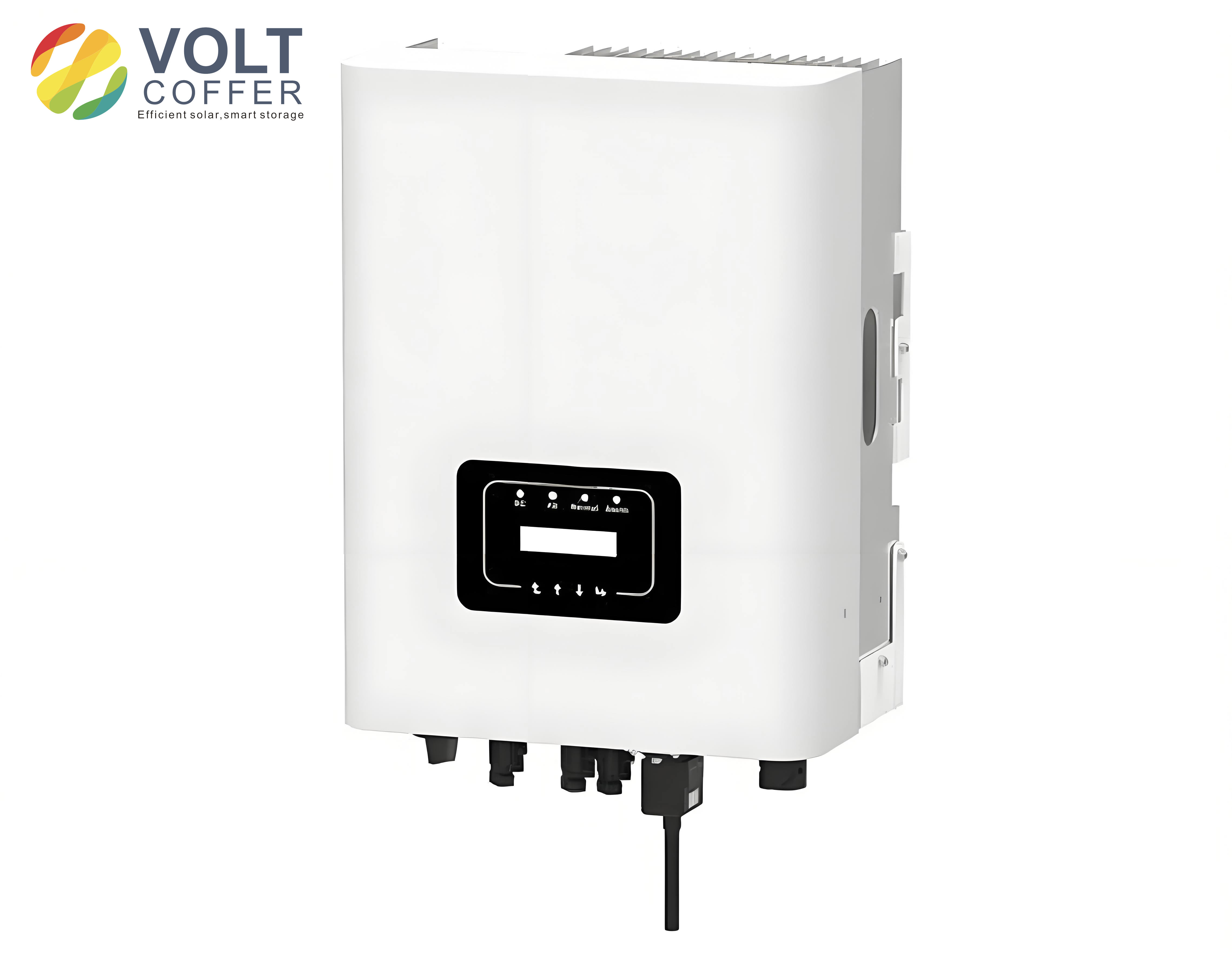
The proposed voltage regulation strategy for distribution transformer areas involves a hierarchical approach using solar inverter power control. The target voltage range is set to [210 V, 235 V]. If the voltage exceeds the upper limit, the solar inverter absorbs reactive power to lower the voltage. If reactive power control is insufficient, active power curtailment is applied. Conversely, if the voltage falls below the lower limit, the solar inverter injects reactive power to boost the voltage. The control process is as follows:
1. Monitor the voltage at the distribution transformer outlet.
2. If voltage is within [210 V, 235 V], maintain current operation.
3. If voltage exceeds 235 V, calculate the required reactive power absorption using:
$$ \Delta U = \frac{Q X}{U_N} $$
and adjust \( I_q \) accordingly. If needed, reduce active power based on:
$$ P_{PV} = \sqrt{ S_{PV}^2 – Q_{PV}^2 } $$
4. If voltage drops below 210 V, calculate the reactive power injection and adjust \( I_q \).
This strategy ensures that solar inverters dynamically regulate voltage without requiring transformer tap changes, thus providing a real-time solution.
To validate the strategy, a simulation model was developed in MATLAB/Simulink, representing a 30-node distribution line with a total length of 30 km. The system parameters are summarized in Table 1.
| Parameter | Value |
|---|---|
| Distribution Transformer Capacity | 120 kVA |
| Distribution Network Voltage | 10 kV / 0.4 kV |
| Line Impedance | 0.712 + j0.284 Ω/km |
| Inverter Maximum Capacity | 100 kVA |
| Target Voltage Range | [210, 235] V |
The simulation scenarios include constant irradiance with load variation and no irradiance with load increase. In the first scenario, with high PV output and reduced load, voltage rise occurs. Without control, the voltage at the PV-connected node rises to 236.8 V, exceeding the limit. With the proposed solar inverter control, the voltage is maintained at 230.3 V. The reactive power absorption and active power curtailment by the solar inverter effectively mitigate the overvoltage.
In the second scenario, with no PV generation and increased load, voltage drop is observed. Without control, the voltage drops to 206.5 V, below the limit. By utilizing the solar inverter’s reactive power injection capability, the voltage is raised to 210.4 V, within the acceptable range. The solar inverter’s capacity to provide reactive power, even when active power is zero, is leveraged for voltage support.
The simulation results demonstrate the effectiveness of the solar inverter-based control strategy in maintaining voltage stability under varying conditions. The use of solar inverters for both active and reactive power control provides a flexible and efficient solution for distribution network operators. The integration of such strategies can enhance the hosting capacity of distribution networks for PV systems while ensuring power quality.
In conclusion, the integration of distributed PV systems poses voltage regulation challenges in distribution transformer areas. The proposed strategy, based on solar inverter power control, effectively addresses these challenges by leveraging the inverters’ active and reactive power capabilities. The analysis of voltage impact, combined with the dual-loop control of solar inverters, provides a foundation for real-time voltage management. Simulation results confirm that the strategy maintains voltage within the desired range, highlighting the importance of solar inverters in modern distribution networks. Future work could explore the coordination of multiple solar inverters and advanced forecasting techniques to further optimize voltage control.