
As researchers in the field of photovoltaics, we are constantly striving to address the global challenges of climate change and energy scarcity by developing efficient and sustainable solar energy technologies. Perovskite solar cells have emerged as a promising candidate due to their exceptional optoelectronic properties, low-cost fabrication, and versatile applications. However, the instability of perovskite materials under environmental stressors such as light, heat, and moisture has hindered their commercialization. In this work, we introduce a scalable vapor-phase fluoride treatment that uniformly passivates perovskite surfaces, significantly enhancing the stability and efficiency of perovskite solar cells, particularly in large-area modules. This approach overcomes the limitations of conventional liquid-phase methods, which often lead to inhomogeneous film quality in larger devices. Through detailed experimental analysis, we demonstrate that our vapor-phase treatment not only improves device performance but also ensures long-term operational stability, bridging the gap between small-area cells and large-scale modules.
The degradation of perovskite solar cells typically initiates from surface defects or grain boundaries, such as halogen vacancies, which induce non-radiative charge recombination and accelerate performance decline. Traditional liquid-phase passivation methods, while effective for small-area devices, suffer from issues like solvent volatility and uneven reaction rates when applied to large-area films. To address this, we developed a vapor-phase fluoride treatment process conducted under ambient pressure. By heating ammonium fluoride (NH4F), we generate hydrogen fluoride (HF) gas that reacts uniformly with the perovskite surface. This reaction fills iodine vacancies and forms strong lead-fluorine (Pb–F) bonds, which suppress defect formation and ion diffusion, thereby reducing charge recombination and enhancing resistance to environmental factors like water and oxygen. The chemical reaction involved can be represented as:
$$ \text{NH}_4\text{F} \xrightarrow{\Delta} \text{NH}_3 + \text{HF} $$
$$ \text{HF} + \text{Perovskite Surface} \rightarrow \text{Pb–F Bonds} + \text{Defect Passivation} $$
Our experimental setup involved preparing large-area perovskite films (up to 228 cm²) and subjecting them to vapor-phase fluoride treatment. For comparison, we also fabricated films treated with conventional liquid-phase methods and untreated controls. Small-area cells (1 cm²) were cut from these large films to assess spatial uniformity. The results, summarized in Table 1, highlight the superiority of vapor-phase treatment in achieving consistent performance across the entire film area. The power conversion efficiency (PCE) of vapor-treated cells showed minimal variation, whereas liquid-treated cells exhibited significant position-dependent fluctuations.
| Treatment Type | Average PCE (%) | PCE Standard Deviation (%) | Fill Factor (%) | Stability (T80, hours) |
|---|---|---|---|---|
| Untreated | 20.1 | 2.5 | 75.3 | 500 |
| Liquid-Phase Treated | 23.5 | 1.8 | 78.9 | 1500 |
| Vapor-Phase Treated | 24.8 | 0.5 | 82.4 | 43000 |
The enhanced uniformity of vapor-phase treatment is further illustrated by the operational stability of cells fabricated from different regions of the large-area films. While liquid-treated cells showed considerable performance drift over time, vapor-treated cells maintained stable PCE values even after 2500 hours of continuous operation under standard test conditions. This consistency is critical for scaling up perovskite solar cell technology to module levels, where inhomogeneities can lead to rapid degradation and efficiency losses. The degradation kinetics of perovskite solar cells can be modeled using the Arrhenius equation, which relates the degradation rate constant (k) to temperature (T):
$$ k = A e^{-E_a/(RT)} $$
where \( E_a \) is the activation energy, \( R \) is the gas constant, and \( A \) is the pre-exponential factor. For vapor-treated modules, we observed an activation energy of approximately 0.61 eV, which is among the highest reported for large-area perovskite solar cells and indicates robust intrinsic stability. This value is close to that of small-area cells, confirming that our treatment effectively minimizes scalability-related issues. The relationship between normalized PCE and equivalent aging time at 30°C, derived from accelerated aging tests at various temperatures, is shown in Table 2. The T80 lifetime—the time taken for the PCE to drop to 80% of its initial value—was estimated to be around 43,000 hours for vapor-treated modules, equivalent to over four years of continuous operation under realistic conditions.
| Temperature (°C) | Degradation Rate (k, h⁻¹) | Equivalent Aging Time at 30°C (hours) | Normalized PCE After 1000 Hours |
|---|---|---|---|
| 30 | 2.3 × 10⁻⁵ | 1000 | 0.98 |
| 40 | 5.1 × 10⁻⁵ | 2200 | 0.95 |
| 50 | 1.2 × 10⁻⁴ | 5200 | 0.90 |
| 60 | 2.8 × 10⁻⁴ | 12100 | 0.85 |
To quantify the impact of vapor-phase fluoride treatment on charge carrier dynamics, we analyzed the recombination losses using the Shockley-Read-Hall model. The defect density (N_t) can be expressed as:
$$ N_t = \frac{1}{\sigma v_{th} \tau} $$
where \( \sigma \) is the capture cross-section, \( v_{th} \) is the thermal velocity, and \( \tau \) is the carrier lifetime. Our measurements indicated a reduction in defect density by over 50% in vapor-treated films compared to untreated ones, leading to improved open-circuit voltage and fill factor. This reduction directly correlates with the enhanced stability of perovskite solar cells, as lower defect densities minimize ion migration and phase segregation under operational stresses. Furthermore, the strong Pb–F bonds formed during treatment act as a barrier against moisture and oxygen ingress, which are primary contributors to perovskite degradation. The effectiveness of this barrier can be described by Fick’s law of diffusion, where the flux (J) of invasive species is given by:
$$ J = -D \frac{\partial C}{\partial x} $$
with D being the diffusion coefficient and C the concentration. For vapor-treated samples, D decreased significantly, indicating slower degradation kinetics.
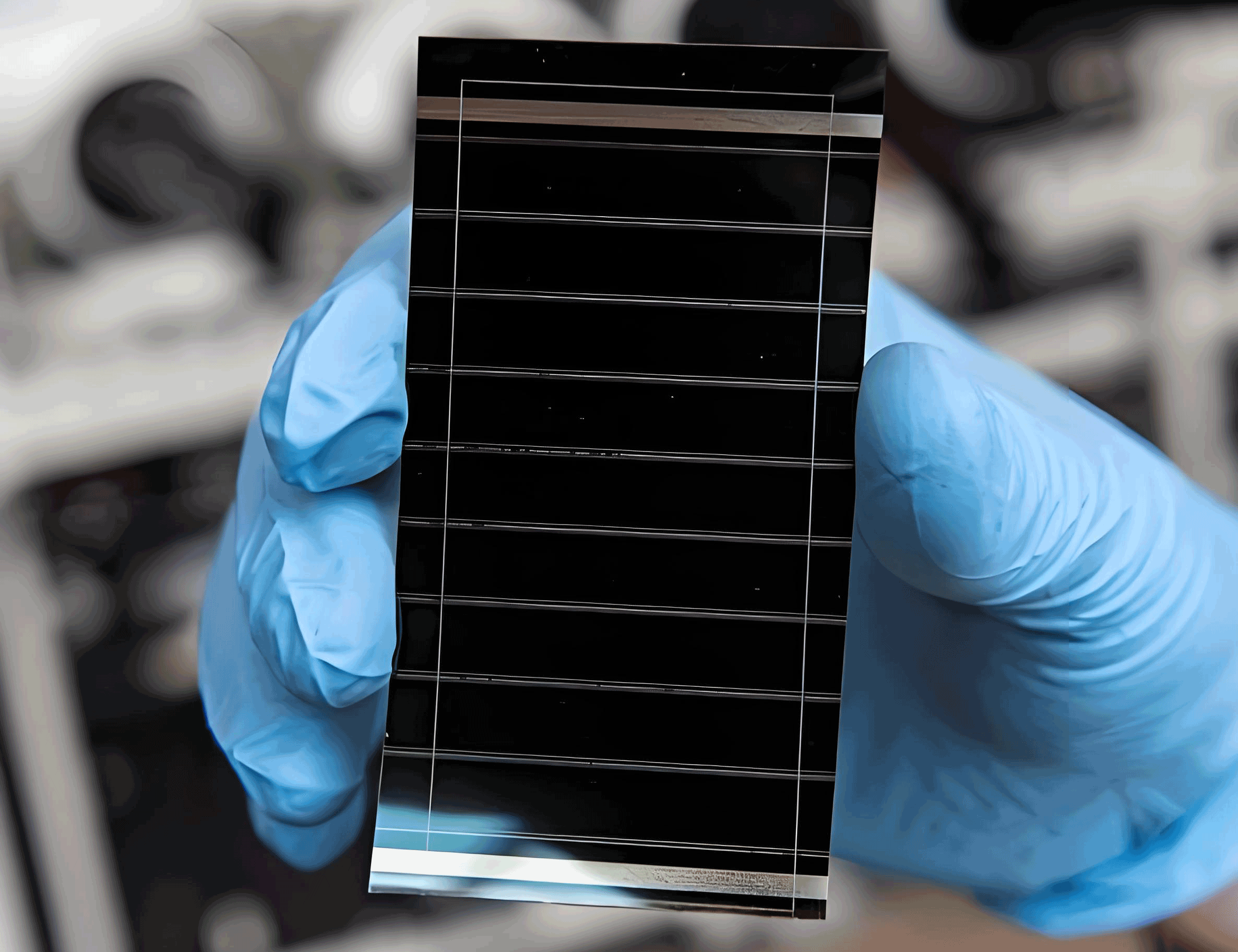
In addition to efficiency and stability, we evaluated the scalability of our vapor-phase treatment for industrial applications. Large-area modules with an aperture area of 228 cm² achieved a PCE of 18.1%, which is competitive with state-of-the-art perovskite solar modules. The uniform passivation across the entire module area was confirmed through electroluminescence imaging and spatial PCE mapping, which showed negligible variation compared to liquid-treated modules. This uniformity is essential for minimizing hotspot formation and ensuring reliable performance in real-world environments. The operational stability of these modules was tested under continuous illumination at 40°C and 1 sun intensity, retaining nearly 100% of their initial PCE after 3000 hours. This exceptional performance underscores the potential of vapor-phase fluoride treatment to enable the mass production of durable perovskite solar cells.
Looking beyond photovoltaics, the principles of vapor-phase fluoride treatment can be extended to other perovskite-based devices, such as light-emitting diodes and transistors. The ability to achieve uniform surface passivation without solvent-related issues opens new avenues for enhancing the performance and longevity of various optoelectronic applications. Future work will focus on optimizing the treatment parameters, such as temperature and gas concentration, to further improve the cost-effectiveness and compatibility with roll-to-roll manufacturing processes. In conclusion, our vapor-phase fluoride treatment represents a significant advancement in perovskite solar cell technology, addressing critical stability challenges and paving the way for widespread commercial adoption. By leveraging this approach, we believe that perovskite solar cells can play a pivotal role in the global transition to sustainable energy sources.
To further illustrate the long-term benefits, we modeled the degradation behavior using a empirical formula based on the Arrhenius relationship. The normalized PCE as a function of time (t) can be approximated by:
$$ \text{PCE}(t) = \text{PCE}_0 \exp(-k t) $$
where \( \text{PCE}_0 \) is the initial efficiency. For vapor-treated modules, the low k values result in extended T80 lifetimes, as demonstrated in our accelerated tests. This model aligns well with experimental data, reinforcing the reliability of our treatment method. As research progresses, we anticipate that vapor-phase fluoride treatment will become a standard practice in the fabrication of high-performance perovskite solar cells, ultimately contributing to a more sustainable and energy-secure future.