
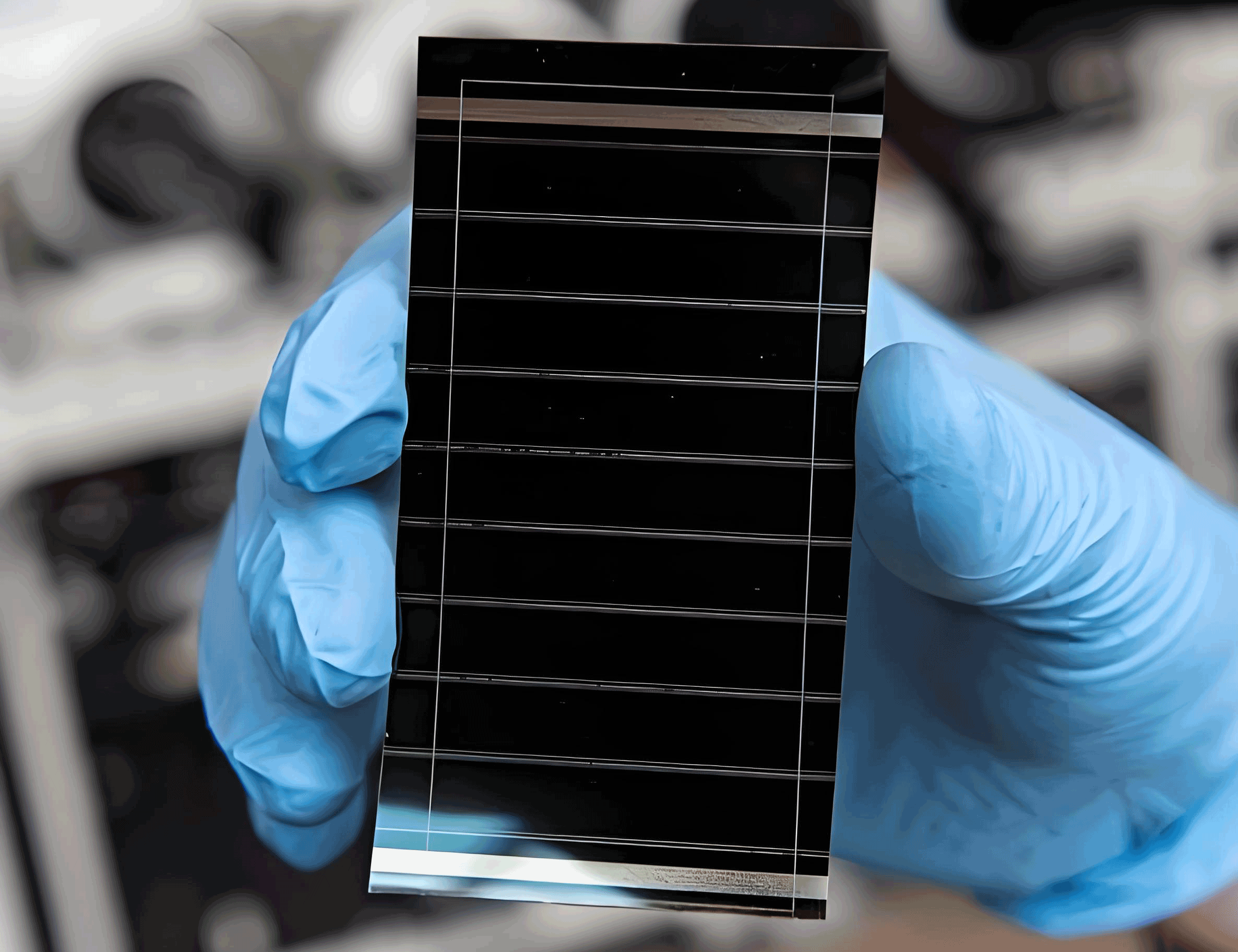
In recent years, the global energy landscape has been shifting from fossil fuels to clean energy sources due to pressing environmental issues, such as record-breaking temperatures in Antarctica, methane release from thawing Arctic permafrost, and predictions of ice-free Arctic summers by 2040. Perovskite solar cells have emerged as a promising technology for direct solar energy conversion, owing to their simple fabrication processes, low cost, and high power conversion efficiencies exceeding 25%. However, the operational stability of perovskite solar cells remains a critical challenge, as their lifespan falls short of requirements for outdoor applications. Addressing this instability, particularly at interfaces, is essential for advancing perovskite solar cell technology.
Perovskite solar cells typically feature an n-i-p structure, where the TiO2/perovskite interface plays a vital role in exciton separation and electron extraction. Unfortunately, TiO2 surfaces contain oxygen vacancies (Ti3+ defects) that, under UV illumination, transform into deep-level defects (Ti4+-V(o)). These defects oxidize halide ions in the perovskite layer, leading to degradation. Thus, achieving UV stability at the TiO2/perovskite interface is a key research focus. Strategies such as incorporating down-conversion materials, doping TiO2, or inserting passivation layers have been explored. Among these, introducing a passivation barrier is highly promising due to its broad applicability across the UV spectrum, material versatility, and potential to enhance charge extraction and transfer.
One-step solution methods offer a low-cost and scalable approach for depositing passivation films in perovskite solar cells. However, films produced by this method often suffer from incomplete coverage and excessive thinness, resulting in direct contact between TiO2 and the perovskite layer. This issue is particularly pronounced in inorganic salt passivation films, such as CsBr, where island-like distributions are observed. Researchers have attempted to improve coverage by increasing precursor concentration or extending immersion times, but this often thickens the film, raising interface resistance and reducing the efficiency of perovskite solar cells. For instance, increasing the CaTiO3 precursor concentration from 0.0125 M to 0.05 M can decrease efficiency by approximately 35%, while raising SiO2 precursor concentration from 0.5 wt% to 2 wt% may reduce efficiency by about 21%. Therefore, achieving simultaneously ultra-thin and full-coverage passivation films via one-step solution methods is challenging.
The crystallization behavior in one-step solution methods is influenced by factors such as liquid surface tension and internal crystallization processes (e.g., supersaturation, nucleation, and growth). While surface tension affects wetting, it does not solely determine film coverage. Instead, controlling crystallization behavior within the liquid film is crucial. Studies have shown that enhancing nucleation density or suppressing excessive growth can improve coverage. For example, adding small molecules like BmPyPhB to the precursor solution increases nucleation sites, while incorporating 1,8-diiodooctane inhibits crystal growth. Synergistic control of nucleation and growth, driven by evaporation from the liquid film surface, has led to advancements. Techniques like anti-solvent methods rapidly increase supersaturation, promoting the formation of full-coverage films. However, ultra-fast crystallization alone may result in microstructures composed of small grains, which are inadequate for full coverage. Factors such as temperature and concentration fields within the micro-liquid film must be integrated with nucleation and growth control to achieve optimal film microstructure.
To address these challenges, I propose a strategy focused on using CsBr, an inexpensive and effective inorganic salt, to passivate the TiO2 surface in perovskite solar cells. This involves preparing an ultra-thin and full-coverage CsBr film through an ultra-fast crystallization process. Key aspects include analyzing temperature and concentration fields within the CsBr micro-liquid film, understanding the synergistic mechanisms of nucleation and growth parallel to the substrate, and characterizing the film’s microstructure. Additionally, I suggest employing slow positron annihilation technology to monitor the degradation process of the perovskite layer at the interface, providing atomic-scale insights into stability.
Research Progress in One-Step Solution Methods for Passivation Films
Various materials, including oxides, inorganic salts, and multicomponent compounds, have been investigated for passivating the TiO2/perovskite interface in perovskite solar cells. For example, SnO2, CsBr, and ZnTiO3 have demonstrated passivation effects. However, techniques like atomic layer deposition or self-assembly, which produce ultra-thin and full-coverage films, are complex or costly. One-step solution methods, such as spin-coating or dip-coating, offer a simpler alternative but often yield films with poor coverage. The table below summarizes the passivation effects and methods for one-step solution-derived films:
| Passivation Material | Optimal Passivation Effect | Method to Achieve Optimal Effect |
|---|---|---|
| CsBr | No change in light absorption under UV-365 nm for 100 min | Increase precursor concentration |
| Silane coupling agent | No phase change under UV-234 nm for 12 h | Increase precursor concentration |
| SrO | Nearly unchanged fluorescence intensity under UV-365 nm for 84 h | Extend immersion time |
| CaTiO3 | No phase change under UV-373 nm for 6 h | Increase precursor concentration |
| SiO2 | Minimal degradation under UV-373 nm for 30 min | Increase precursor concentration |
The one-step solution process typically involves two workflows: (1) dripping precursor solution onto the substrate, spin-coating to remove excess solution, and drying to form the film; or (2) immersing the substrate in the precursor solution, retrieving it after a set time, and drying. Both methods face challenges in controlling film microstructure. Crystallization models indicate that evaporation drives supersaturation, nucleation, and growth. The nucleation rate N can be expressed as:
$$ N = A \cdot \exp\left(-\frac{B}{\ln^2 S}\right) $$
where S is the supersaturation ratio, and A and B are constants dependent on the solution’s crystallization properties. The solute diffusion flux M_A is given by:
$$ M_A = 0.646 \frac{\rho u x}{\eta} \left( \frac{\eta}{\rho D} \right)^{1/3} (C_{As} – C_{Ac}) $$
Here, ρ is the solution density, u is the solution velocity, x is the distance from the boundary layer, η is the solvent viscosity, D is the solute diffusion coefficient, and C_As and C_Ac are the solute concentrations at infinity and the boundary layer, respectively. Controlling these parameters is essential for achieving full coverage without increasing thickness.
Strategy for Preparing and Characterizing Ultra-Thin Full-Coverage CsBr Films
My approach involves depositing a TiO2 porous layer on fluorine-doped tin oxide (FTO) substrates using hydrolysis and doctor-blade methods, followed by annealing at 450°C for 30 minutes. The CsBr passivation film is then applied via one-step solution method with ultra-fast crystallization in a low-pressure chamber. This chamber, equipped with drying, vacuum, gas replenishment, pressure monitoring, and control systems, allows precise regulation of solvent evaporation by adjusting pressure from atmospheric to 1 Pa. Key steps include:
- Analyzing temperature and concentration fields in the CsBr micro-liquid film using Fluent software to model heat and mass transfer, crystallization heats, and solute forms.
- Investigating synergistic nucleation and growth mechanisms parallel to the substrate by calculating nucleation density N and diffusion flux M_A, based on TiO2 surface area and total solute mass.
- Preparing CsBr films by spin-coating precursor solution onto TiO2 and transferring to the low-pressure chamber for controlled crystallization. Characterization involves high-resolution SEM and TEM to assess microstructure and coverage.
This strategy aims to achieve a balance between ultra-thinness and full coverage by decoupling crystallization behavior control. Vertical thinness is achieved through rapid liquid height reduction, while parallel coverage is ensured by synchronized nucleation and growth.
Strategies for Monitoring Perovskite Degradation and Interface Properties
To protect the CsBr film from dissolution during perovskite deposition, I propose adsorbing a layer of mercaptobenzene via dip-coating, creating an immiscible surface. The CH3NH3PbI3 perovskite layer is then rapidly formed within 30 seconds using the low-pressure chamber to minimize浸泡. Degradation monitoring under UV light (365 nm, 523 mW·cm⁻²) involves slow positron annihilation technology. By increasing the positron acceleration voltage, the incident depth varies, allowing depth-dependent electron momentum measurements. Differences in core and shell electron momenta between CH3NH3PbI3 and its degradation product PbI2 enable tracking of interfacial degradation.
Interface structure is characterized using HR-SEM and HR-TEM to examine CsBr-TiO2 bonding and perovskite microstructure. Interface performance is evaluated via XRD and UV-vis for phase and absorption changes, photoluminescence (PL) for exciton yield and separation, and time-resolved PL (TRPL) for exciton lifetime and injection dynamics. These methods provide comprehensive insights into the passivated interface’s UV stability.
Characterizing Output Stability and Charge Transport in Perovskite Solar Cells
Perovskite solar cells are assembled by spin-coating hole transport material (e.g., Spiro-OMeTAD) onto the perovskite layer and evaporating Au electrodes. Output stability is assessed by periodically measuring current-voltage curves under AM1.5 illumination in a dry air glovebox. Interface defect density is determined from thermal admittance spectroscopy, measuring capacitance C versus frequency ω at different temperatures. The defect density N_d is calculated as:
$$ N_d = -\frac{2}{q \varepsilon A^2} \frac{dC^{-2}}{dV} $$
where q is the electron charge, ε is the permittivity, A is the area, and V is the bias voltage. The depletion width w is given by:
$$ w = \sqrt{\frac{2 \varepsilon (V_{bi} – V_{bias})}{q N_d}} $$
where V_bi is the built-in potential. Electrochemical impedance spectroscopy (EIS) under biases from 0 to V_oc yields recombination resistance. By correlating EIS data with w, the spatial location of charge transport and recombination processes is identified, revealing their dependence on bias voltage. This comprehensive analysis elucidates the UV resistance mechanisms in passivated perovskite solar cells.
Conclusion
In summary, achieving UV stability at the TiO2/perovskite interface in perovskite solar cells requires advanced passivation strategies. By leveraging crystallization control theory in micro-liquid films, I have outlined a method for preparing ultra-thin and full-coverage CsBr films via one-step solution processes. The integration of slow positron annihilation technology enables precise monitoring of interfacial degradation. These approaches provide both theoretical and practical guidance for enhancing the longevity and performance of perovskite solar cells, ensuring their reliability in real-world applications. Future work will focus on optimizing crystallization parameters and expanding these strategies to other passivation materials, further advancing the field of perovskite solar cells.