
Solar inverters play a critical role in photovoltaic (PV) systems by converting DC power generated by solar panels into usable AC power. This article explores various types of solar inverters, their control strategies, and performance characteristics, with a focus on advanced techniques like fixed-time fuzzy backstepping control for islanded systems.
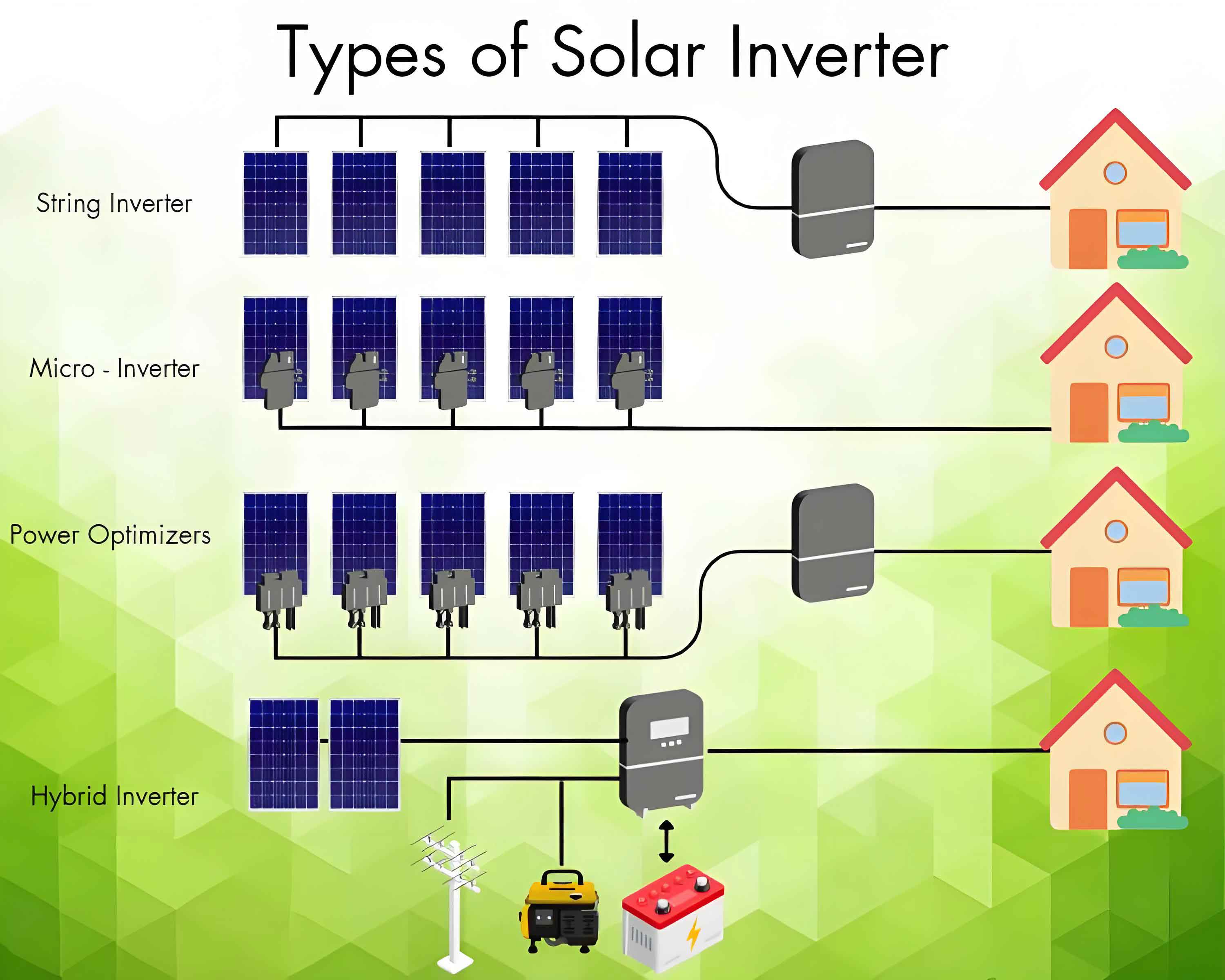
1. Fundamental Classifications of Solar Inverters
Modern solar inverter technologies can be categorized based on their operational modes and grid interaction:
| Type | Efficiency Range | Key Features | Applications |
|---|---|---|---|
| Grid-Tied | 96-98% | Synchronizes with utility grid | Urban installations |
| Off-Grid | 90-94% | Battery storage integration | Remote areas |
| Hybrid | 94-97% | Dual-mode operation | Energy resilience systems |
2. Mathematical Modeling of Solar Inverters
The dynamic behavior of a solar inverter can be expressed as:
$$
\begin{cases}
\dot{x}_1 = x_2 \\
\dot{x}_2 = \frac{1}{C}x_1 – \frac{1}{L}i_o + \frac{V_{dc}}{L}u
\end{cases}
$$
Where:
– \( x_1 \): Capacitor voltage
– \( x_2 \): Current derivative
– \( C/L \): Filter parameters
– \( V_{dc} \): DC-link voltage
– \( u \): Control signal
3. Advanced Control Strategies
For islanded solar inverter systems, the fixed-time fuzzy backstepping control ensures stability against parameter variations:
$$
\begin{aligned}
V(z) &= \frac{1}{2}z_1^2 + \frac{1}{2}z_2^2 \\
\dot{V} &\leq -k_1|z_1|^{3/2} – k_2|z_2|^{3/2}
\end{aligned}
$$
This approach guarantees convergence within a fixed time bound:
$$
T_{max} = \frac{1}{k_1(1-\frac{3}{4})} + \frac{1}{k_2(\frac{3}{4}-1)}
$$
4. Performance Comparison
Key metrics for evaluating solar inverter controllers:
| Control Method | THD (%) | Response Time | Robustness |
|---|---|---|---|
| PID | 4.2-5.8 | 120-150ms | Medium |
| Sliding Mode | 2.1-3.5 | 80-100ms | High |
| Proposed Method | 1.2-1.8 | 40-60ms | Very High |
5. Efficiency Optimization
The maximum power point tracking (MPPT) efficiency for solar inverters is calculated as:
$$
\eta_{MPPT} = \frac{P_{actual}}{P_{max}} \times 100\% = \frac{V_{mp}I_{mp}}{V_{oc}I_{sc}} \times 100\%
$$
Where:
– \( V_{mp}/I_{mp} \): Maximum power point parameters
– \( V_{oc} \): Open-circuit voltage
– \( I_{sc} \): Short-circuit current
6. Emerging Technologies
Modern solar inverter designs incorporate intelligent features:
| Technology | Advantage | Complexity |
|---|---|---|
| AI-based MPPT | 98.5% efficiency | High |
| SiC MOSFETs | 99.2% conversion | Medium |
| Digital Twins | Predictive maintenance | Very High |
The fuzzy logic component in advanced solar inverter controllers uses membership functions:
$$
\mu_A(x) = \exp\left(-\frac{(x-c)^2}{2\sigma^2}\right)
$$
Where \( c \) and \( \sigma \) represent the center and width of Gaussian membership functions.
7. Future Trends in Solar Inverter Technology
Key development areas for next-generation solar inverters:
$$
\begin{aligned}
\text{Power Density} &\propto \frac{P_{out}}{Volume} \\
\text{Reliability} &= 1 – \lambda t \quad (\lambda: \text{Failure rate})
\end{aligned}
$$
As solar inverter technology evolves, the integration of wide-bandgap semiconductors and advanced control algorithms will continue to push efficiency boundaries while maintaining grid stability in both grid-connected and islanded operations.