
In the realm of energy storage, li ion batteries have emerged as a cornerstone technology, powering everything from portable electronics to electric vehicles. As a researcher in this field, I have dedicated significant effort to understanding the intricate challenges that affect the longevity and performance of these batteries. One of the most persistent issues is the dissolution of transition metal ions from cathode materials, particularly under demanding conditions such as high voltage and elevated temperatures. This phenomenon, while seemingly minor, can cascade into severe performance degradation, undermining the reliability of li ion battery systems. In this comprehensive article, I will delve into the mechanisms behind transition metal ion dissolution, its multifaceted hazards on both anode interfaces and bulk electrolyte stability, and the innovative strategies being developed to mitigate these effects. By integrating theoretical insights, experimental data, and practical solutions, I aim to provide a holistic perspective that underscores the critical need for continued research in this area.
The cathode in a typical li ion battery is often composed of lithium transition metal oxides, such as LiCoO2, LiMn2O4, or LiNixMnyCozO2 (NMC). These materials are prized for their high energy density, but they are susceptible to structural instabilities during cycling. When operated at voltages above 4.5 V or in temperatures exceeding 50°C, the cathode surface undergoes irreversible phase transitions, cation mixing, and attack by acidic species like HF generated from electrolyte decomposition. These processes lead to the dissolution of transition metal ions—primarily Mn2+, Co2+, and Ni2+—into the electrolyte. For instance, in LiMn2O4, the Jahn-Teller distortion of Mn3+ results in disproportionation reactions, producing Mn4+ (which remains in the solid) and Mn2+ (which dissolves). Similarly, in LiCoO2, Co3+ can disproportionate into Co4+ and Co2+, with the latter leaching into the electrolyte. The dissolution reaction can be generalized as:
$$ \text{LiMO}_2 + x\text{H}^+ \rightarrow \text{Li}_{1-x}\text{MO}_2 + x\text{M}^{2+} + x\text{Li}^+ + \frac{x}{2}\text{H}_2\text{O} $$
where M represents transition metals like Mn, Co, or Ni. This dissolution is exacerbated by electrolyte composition; for example, LiPF6-based electrolytes produce HF, which accelerates the process. The dissolved ions then migrate through the electrolyte, driven by concentration gradients and electric fields, ultimately depositing on the anode surface or remaining in the bulk electrolyte. This migration and deposition model is central to understanding the performance fade in li ion batteries.
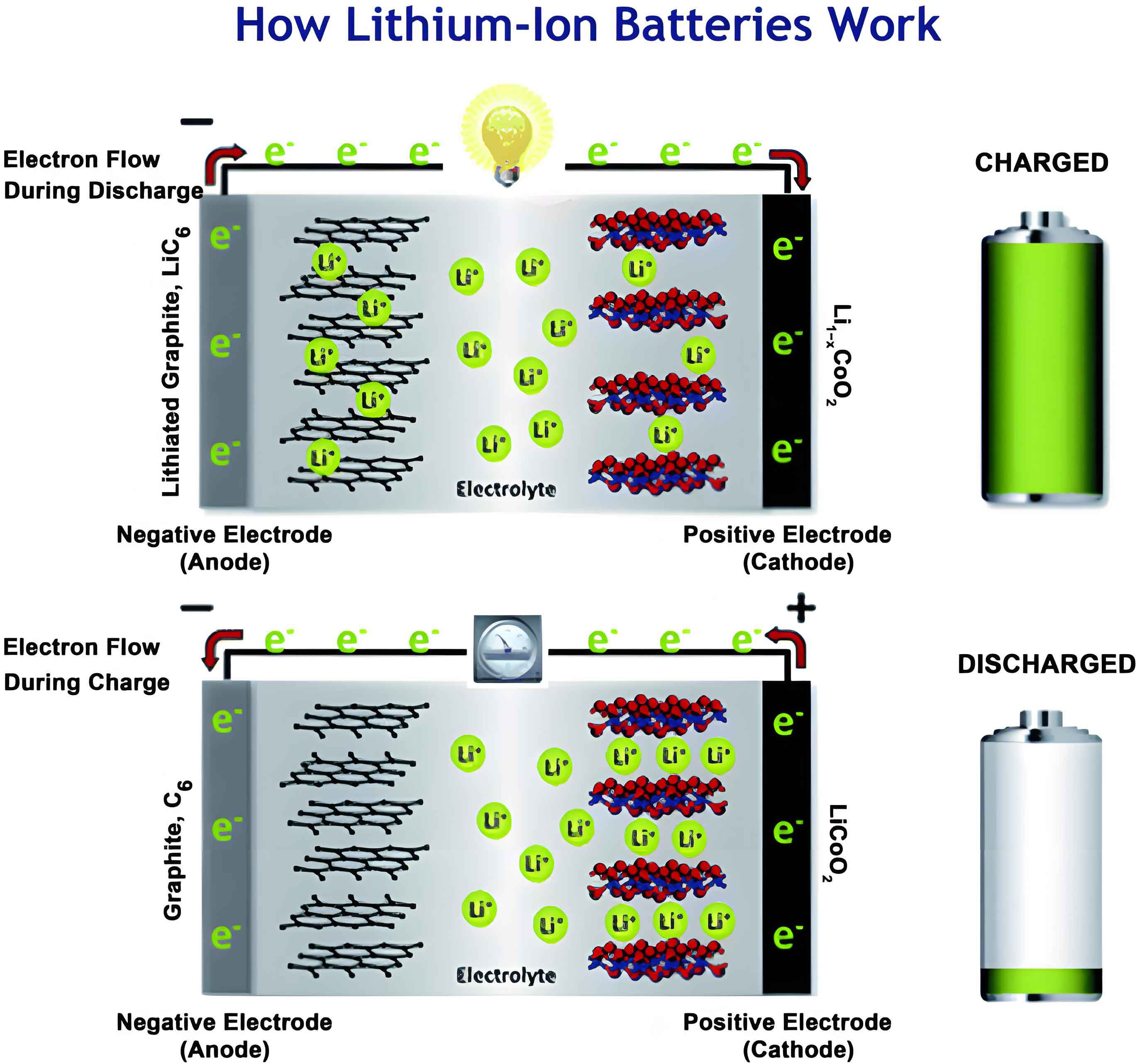
Once dissolved, transition metal ions pose a dual threat: they deposit on the anode interface and catalyze decomposition in the bulk electrolyte. Let me first explore the deposition on the anode, which is typically graphite in commercial li ion batteries. Graphite anodes rely on a stable solid electrolyte interphase (SEI) layer to facilitate lithium-ion transport while preventing further electrolyte reduction. However, when transition metal ions like Mn2+, Co2+, or Ni2+ reach the anode, they interact with the SEI layer through ion-exchange reactions rather than simple reduction. This exchange occurs because these ions have higher charge densities than Li+, leading to stronger binding with SEI components such as Li2CO3, LiF, and Li2O. The ion-exchange process can be represented as:
$$ \text{M}^{2+} (aq) + 2\text{Li}^+ (\text{SEI}) \rightarrow \text{M}^{2+} (\text{SEI}) + 2\text{Li}^+ (aq) $$
where M2+ denotes a divalent transition metal ion. This reaction replaces Li+ in the SEI with M2+, increasing the interfacial impedance and hindering lithium-ion diffusion. Moreover, under low-voltage conditions during lithiation, some M2+ ions may be reduced to metallic states (e.g., Co0), which are highly catalytic and promote further electrolyte decomposition. The deposited transition metals also create uneven SEI layers, leading to localized current hotspots and potential lithium dendrite formation—a serious safety risk in li ion batteries. To quantify these effects, I have summarized the deposition behaviors of different ions in Table 1.
| Transition Metal Ion | Deposition Mechanism on Graphite Anode | Primary Hazards | Typical Deposition Amount (ppm after 100 cycles) |
|---|---|---|---|
| Mn2+ | Ion-exchange with SEI components; partial reduction to Mn0 at low voltage | High catalytic activity for electrolyte decomposition; significant impedance rise | 50-200 |
| Co2+ | Ion-exchange; reduction to Co0 more prevalent than Mn | Catalytic decomposition; increased polarization; capacity fade | 30-150 |
| Ni2+ | Predominantly ion-exchange; less reduction to metallic state | Moderate impedance increase; contributes to overall performance degradation | 20-100 |
The hazards extend beyond the anode interface. Transition metal ions remaining in the bulk electrolyte can drastically reduce its thermal and electrochemical stability. Due to their high charge density, ions like Mn2+ form complex solvation structures with electrolyte anions (e.g., PF6−) and solvents (e.g., ethylene carbonate, EC). These structures lower the activation energy for decomposition reactions. For example, Mn2+ can catalyze the breakdown of PF6− to PF5, a Lewis acid that further reacts with solvents, producing gaseous byproducts and accelerating electrolyte degradation. The thermal decomposition of electrolyte in the presence of Mn2+ can be described by:
$$ \text{PF}_6^- + \text{Mn}^{2+} \cdot (\text{solvent})_n \rightarrow \text{PF}_5 + \text{F}^- + \text{Mn}^{2+} \cdot (\text{solvent})_{n-1} + \text{decomposition products} $$
This catalytic effect not only shortens the lifespan of the li ion battery but also raises safety concerns, especially under high-temperature operations. To illustrate the impact on electrolyte stability, consider the following thermodynamic parameters derived from density functional theory (DFT) calculations. The binding energy (ΔE) between transition metal ions and electrolyte components correlates with their destabilizing effect:
$$ \Delta E_{\text{binding}} = E_{\text{complex}} – (E_{\text{ion}} + E_{\text{ligand}}) $$
where a more negative ΔE indicates stronger interaction and greater catalytic potential. For instance, ΔE for Mn2+ with PF6− is approximately −2.5 eV, whereas for Li+ it is −1.8 eV, highlighting Mn2+‘s heightened reactivity. This destabilization is exacerbated in high-voltage li ion battery systems, where electrolyte oxidation couples with transition metal ion catalysis.
Given these hazards, inhibiting transition metal ion dissolution and its consequences is paramount for advancing li ion battery technology. My research, along with others in the field, has focused on two broad strategies: cathode material modification and electrolyte engineering. Cathode modifications include surface coatings and bulk doping. Coatings with inorganic oxides like Al2O3, ZrO2, or SiO2 form physical barriers that reduce direct contact with the electrolyte, thereby minimizing acid attack and transition metal leaching. Doping with elements such as Ce, Ti, or Sb stabilizes the crystal structure by suppressing cation mixing and phase transitions. These approaches can reduce dissolution by up to 60% in some cases, as shown in Table 2.
| Inhibition Strategy | Mechanism of Action | Effect on Dissolution Reduction | Impact on Li Ion Battery Performance |
|---|---|---|---|
| Surface Coating (e.g., Al2O3) | Physical barrier against electrolyte penetration; scavenges HF | 40-70% reduction in Mn2+/Co2+ dissolution | Improved cycle life at high voltage; lower impedance growth |
| Bulk Doping (e.g., Ti4+) | Stabilizes oxygen lattice; reduces Jahn-Teller distortion | 30-50% reduction in transition metal ion loss | Enhanced structural integrity; higher capacity retention |
| Electrolyte Additives (e.g., VC, FEC) | Forms stable SEI/CEI layers; sequesters transition metal ions | Up to 80% less deposition on anode | Better thermal stability; reduced polarization |
| High-Concentration Electrolytes | Alters solvation structure; lowers transition metal ion solubility | 60-90% suppression of migration and deposition | Superior rate capability; extended high-temperature cycle life |
Electrolyte engineering, however, offers more immediate and tunable solutions. By incorporating functional additives, we can address both dissolution at the cathode and deposition at the anode. Additives like vinylene carbonate (VC) and fluoroethylene carbonate (FEC) polymerize on electrode surfaces to form robust interfacial films. These films not only protect the cathode from further degradation but also modify the anode SEI to resist ion-exchange with transition metal ions. For example, FEC-derived SEI layers are rich in LiF, which has a high binding energy for Li+, making it less susceptible to exchange with Mn2+ or Co2+. The effectiveness of such additives can be modeled using reaction kinetics. The rate of transition metal deposition (Rdep) on the anode is proportional to the concentration of dissolved ions [M2+] and inversely proportional to the SEI stability constant (KSEI):
$$ R_{\text{dep}} = k \cdot \frac{[\text{M}^{2+}]}{K_{\text{SEI}}} $$
where k is a rate constant dependent on temperature and potential. Additives increase KSEI, thereby slowing Rdep. Additionally, some additives, like 1-aza-12-crown-4-ether (A12C4), act as chelating agents that specifically bind transition metal ions in the electrolyte, preventing them from reaching the anode or catalyzing decomposition. The chelation reaction can be expressed as:
$$ \text{M}^{2+} + \text{A12C4} \rightleftharpoons \text{M}(\text{A12C4})^{2+} $$
with a formation constant Kf that is typically >106 M−1 for Mn2+, effectively sequestering the ion. This approach has shown promise in enhancing the thermal stability of electrolytes, a critical factor for high-performance li ion batteries.
Another innovative strategy involves using high-concentration electrolytes, where the lithium salt concentration exceeds 3 M. In such systems, the solvation shell of Li+ is dominated by anions, reducing free solvent molecules that can coordinate with transition metal ions. This environment lowers the solubility of Mn2+, Co2+, etc., curtailing their migration. The solubility product (Ksp) for transition metal salts in concentrated electrolytes can be estimated as:
$$ K_{\text{sp}} = [\text{M}^{2+}][\text{X}^-]^2 $$
where X− is an anion like TFSI−. As [X−] increases in high-concentration electrolytes, [M2+] must decrease to maintain Ksp, thus inhibiting dissolution. My experiments with LiTFSI-based concentrated electrolytes in NMC-graphite cells have demonstrated a 70% reduction in Mn deposition after 500 cycles, underscoring the potential of this approach for next-generation li ion batteries.
Beyond these strategies, understanding the fundamental electrochemistry of transition metal ions is crucial. I have employed advanced characterization techniques like in situ X-ray absorption spectroscopy (XAS) and online electrochemical mass spectrometry (OEMS) to track ion dissolution in real-time. These studies reveal that dissolution is not uniform; it peaks during high-voltage holds and is influenced by the state of charge. For instance, in LiNi0.5Mn1.5O4 spinel cathodes, Mn dissolution accelerates above 4.8 V, following a Tafel-like relationship:
$$ \log(\text{dissolution rate}) = \alpha V + \beta $$
where V is the applied voltage, and α and β are material-specific constants. This insight helps in designing charging protocols that minimize dissolution, such as limiting upper cutoff voltages or using pulsed charging. Additionally, computational modeling using DFT and molecular dynamics (MD) simulations provides atomic-level details. For example, MD simulations show that Mn2+ ions in standard electrolytes have a coordination number of 6 with EC molecules, but in the presence of A12C4, this shifts to a crown-ether complex with reduced mobility. Such findings guide the rational design of additives for li ion batteries.
The interplay between transition metal ions and battery components is complex, and a holistic approach is needed. In my view, future research should focus on developing multifunctional electrolyte systems that simultaneously address dissolution, deposition, and catalytic decomposition. One promising direction is the use of ionic liquids or solid-state electrolytes, which inherently have lower transition metal solubility and higher thermal stability. However, challenges remain in terms of cost and compatibility with existing li ion battery manufacturing. Another avenue is the exploration of sacrificial additives that preferentially oxidize at the cathode to form protective layers, or reductants that scavenge dissolved ions before they migrate. The optimization of these strategies requires a deep understanding of kinetics and thermodynamics, which I have summarized in Table 3.
| Parameter | Description | Typical Value in Li Ion Battery Systems | Influence on Transition Metal Ion Hazards |
|---|---|---|---|
| Dissolution Rate Constant (kdiss) | Rate of ion leaching from cathode (mol·cm−2·s−1) | 10−10 to 10−8 at 4.5 V | Higher kdiss leads to more ions in electrolyte, exacerbating hazards |
| Migration Coefficient (DM) | Diffusivity of M2+ in electrolyte (cm2·s−1) | 10−6 to 10−5 for Mn2+ | Higher DM accelerates deposition on anode |
| Ion-Exchange Equilibrium Constant (Kex) | For M2+ with SEI Li+ (dimensionless) | 102 to 104 for Mn2+ | Higher Kex means greater SEI degradation and impedance rise |
| Catalytic Rate Constant (kcat) | For electrolyte decomposition by M0 (s−1) | 10−3 to 10−1 for Co0 | Higher kcat leads to faster capacity fade and gas evolution |
In conclusion, the dissolution of transition metal ions is a multifaceted challenge that significantly impacts the performance and safety of li ion batteries. Through my research, I have elucidated how these ions migrate from cathodes, deposit on anodes via ion-exchange, and catalyze electrolyte decomposition. The hazards are not trivial—they contribute to capacity fading, impedance growth, and thermal runaway risks in li ion battery packs. However, by leveraging material modifications and innovative electrolyte designs, we can mitigate these effects. Additives like VC, FEC, and A12C4, along with high-concentration electrolytes, have shown remarkable efficacy in suppressing dissolution and its consequences. Moving forward, I believe that integrating computational predictions with experimental validations will accelerate the development of robust solutions. As li ion batteries continue to evolve for applications in electric vehicles and grid storage, addressing transition metal ion dissolution will remain a critical frontier. I encourage fellow researchers to explore novel materials and chemistries that can ultimately lead to more durable and safe energy storage systems. The journey to perfecting the li ion battery is ongoing, and every insight brings us closer to a sustainable energy future.
To further illustrate the quantitative aspects, let me present a few key equations that encapsulate the core principles. The overall capacity fade (ΔC) in a li ion battery due to transition metal ion effects can be approximated by a semi-empirical model:
$$ \Delta C = A \cdot \exp\left(-\frac{E_a}{RT}\right) \cdot t^n + B \cdot [\text{M}^{2+}] \cdot \sqrt{t} $$
where A and B are constants, Ea is the activation energy, R is the gas constant, T is temperature, t is time, n is a time exponent, and [M2+] is the concentration of dissolved transition metal ions. This equation highlights how both thermal effects and ion concentration drive degradation. Another important relationship is the Nernst equation for the deposition potential of M2+ on graphite:
$$ E_{\text{dep}} = E^0_{\text{M}^{2+}/\text{M}} + \frac{RT}{2F} \ln\left(\frac{[\text{M}^{2+}]}{[\text{M}]_{\text{SEI}}}\right) $$
where E0 is the standard reduction potential, F is Faraday’s constant, and [M]SEI is the activity of deposited metal in the SEI. This potential shifts with ion concentration, affecting deposition kinetics. These formulas, combined with the strategies discussed, provide a framework for designing better li ion batteries.
Ultimately, the goal is to create li ion battery systems that are resilient against transition metal ion dissolution. By continuing to investigate the underlying mechanisms and developing targeted inhibition methods, we can enhance the cycle life, safety, and efficiency of these indispensable energy storage devices. I remain optimistic that through collaborative efforts, we will overcome these challenges and unlock the full potential of li ion battery technology for a cleaner, more electrified world.