
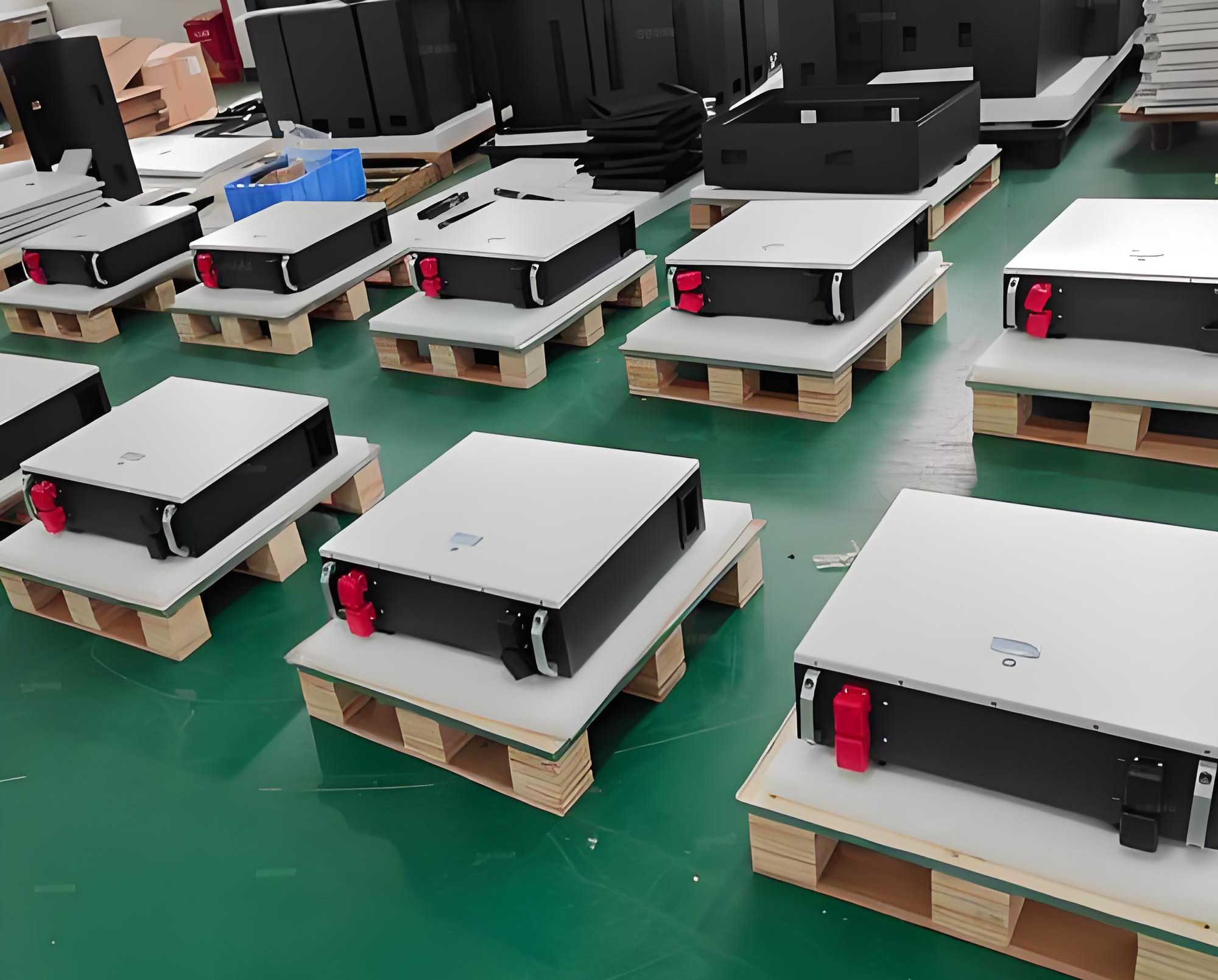
In the context of modern energy systems, the integration of renewable energy sources has accelerated the adoption of energy storage lithium battery units due to their high energy density, long lifespan, and low self-discharge rates. However, the reliability of these systems in applications such as microgrid demand response, containerized energy storage, and grid peak shaving is heavily dependent on effective thermal management. The temperature control and uniformity of energy storage lithium battery units, along with the energy consumption of their thermal management systems, are critical factors influencing safety, durability, and overall system performance. This study focuses on optimizing liquid cooling plates to enhance temperature uniformity and reduce energy consumption, thereby improving the reliability of new energy power systems.
The operational principles of energy storage lithium battery involve complex electrochemical reactions during charging and discharging cycles. For instance, the positive electrode reaction can be represented as: $$ \text{LiFePO}_4 \rightleftharpoons \text{Li}_{1-x}\text{FePO}_4 + x\text{Li}^+ + x\text{e}^- $$ and the negative electrode as: $$ x\text{Li} + x\text{e}^- + 6\text{C} \rightleftharpoons \text{Li}_x\text{C}_6 $$. The overall reaction is: $$ \text{LiFePO}_4 + 6\text{C} \rightleftharpoons \text{Li}_{1-x}\text{FePO}_4 + \text{Li}_x\text{C}_6 $$. These reactions generate heat, which must be managed to prevent thermal runaway and ensure longevity.
The heat generation in energy storage lithium battery is primarily composed of reversible and irreversible components. The total heat power \( Q \) is given by: $$ Q = Q_r + Q_p + Q_j + Q_s $$ where \( Q_r \) is the reaction heat power, \( Q_p \) the polarization heat power, \( Q_j \) the Joule heat power, and \( Q_s \) the side reaction heat power (often negligible below 343.15 K). The reversible heat power is expressed as: $$ Q_r = IT \frac{dE}{dT} $$ and the irreversible components as: $$ Q_j = I^2 R_j $$ and $$ Q_p = I^2 R_p $$, leading to the comprehensive equation: $$ Q = I^2 (R_j + R_p) + IT \frac{dE}{dT} $$. Heat conduction follows Fourier’s law: $$ \rho_1 c_p \frac{\partial T}{\partial t} = \nabla \cdot (k \nabla T) + Q $$, while convection is described by Newton’s law: $$ q_2 = h_f (T_2 – T_1) $$.
To validate the thermal models, a single energy storage lithium battery was simulated under a 5C discharge rate and 303.15 K ambient temperature. The battery parameters are summarized in Table 1.
| Parameter | Value |
|---|---|
| Rated Capacity (Ah) | 8 |
| Nominal Voltage (V) | 3.2 |
| Charge Cut-off Voltage (V) | 3.65 |
| Discharge Cut-off Voltage (V) | 2.0 |
| Mass (g) | 328 |
| Dimensions (mm) | 17 × 79 × 124 |
| Core Thermal Conductivity (W/m·K) | λ_x = 0.54, λ_y = λ_z = 21.9 |
| Specific Heat Capacity (J/kg·K) | 1267 |
| Density (kg/m³) | 2181 |
The simulation results showed good agreement with experimental data, with a maximum relative error of 4.9% in temperature rise, attributed to simplifications in the model. This validation underscores the importance of accurate thermal modeling for energy storage lithium battery systems.
For thermal management, a side-concave liquid cooling plate was designed to improve temperature uniformity and reduce energy consumption. The plate dimensions are 5 mm × 79 mm × 124 mm, with channel thickness of 3 mm and varying widths across three tiers. The computational fluid dynamics (CFD) model was established using ANSYS Fluent, with governing equations including the continuity equation: $$ \frac{\partial \rho_w}{\partial t} + \nabla \cdot (\rho_w \mathbf{v}) = 0 $$, momentum conservation: $$ \rho_w \left( \frac{\partial \mathbf{v}}{\partial t} + (\nabla \mathbf{v}) \mathbf{v} \right) = -\nabla p + \mu \nabla^2 \mathbf{v} $$, and energy conservation for liquid and plate: $$ \frac{\partial}{\partial t} (\rho_w c_{pw} T_w) + \nabla (\rho_w c_{pw} \mathbf{v} T_w) = \nabla (k_w \nabla T_w) $$ and $$ \frac{\partial}{\partial t} (\rho_c c_{pc} T_c) = \nabla (k_c \nabla T_c) $$. The liquid properties include density \( \rho_w = 1000 \, \text{kg/m}^3 \), dynamic viscosity \( \mu = 0.001003 \, \text{Pa·s} \), specific heat \( c_{pw} = 4200 \, \text{J/(kg·K)} \), and thermal conductivity \( k_w = 0.6 \, \text{W/(m·K)} \). The cooling plate material has density \( \rho_c = 2719 \, \text{kg/m}^3 \), specific heat \( c_{pc} = 871 \, \text{J/(kg·K)} \), and thermal conductivity \( k_c = 202.4 \, \text{W/(m·K)} \).
Grid independence was verified by comparing battery maximum temperature and temperature difference across mesh sizes ranging from 259,780 to 762,732 elements. As shown in Table 2, results remained consistent, confirming the adequacy of 259,780 elements for further simulations.
| Number of Elements | Maximum Temperature (K) | Temperature Difference (K) |
|---|---|---|
| 259,780 | 307.7 | 2.8 |
| 456,832 | 307.7 | 2.8 |
| 695,108 | 307.7 | 2.8 |
| 762,732 | 307.7 | 2.8 |
The impact of flow direction on the thermal performance of the energy storage lithium battery was analyzed under double-forward, double-reverse, and mixed flow conditions. While maximum temperature and difference remained around 307 K and 2 K respectively, temperature uniformity varied significantly. Double-forward flow exhibited smooth gradients, whereas double-reverse flow showed deep concave isotherms due to liquid reflux at channel turns, reducing local velocity. Mixed flow led to dispersed gradients and larger high-temperature areas. Thus, double-forward flow was selected for its superior uniformity.
Flow velocity effects were studied from \( 1 \times 10^{-3} \) to \( 1.2 \times 10^{-1} \) m/s. As velocity increased, maximum temperature decreased from 312.3 K to 304.3 K, following an inverse relationship. Temperature difference remained below 3 K across all velocities, with lower differences at very low velocities due to minimal liquid temperature change. However, pressure drop and average pressure increased quadratically with velocity, as summarized in Table 3. For instance, at \( 3 \times 10^{-2} \) m/s, pressure drop was 4.13 Pa and average pressure 1.60 Pa, representing a balance between cooling efficiency and energy consumption.
| Flow Velocity (m/s) | Pressure Drop (Pa) | Average Pressure (Pa) |
|---|---|---|
| 0.001 | 0.002 | 0.0006 |
| 0.005 | 0.02 | 0.008 |
| 0.01 | 0.08 | 0.03 |
| 0.03 | 4.13 | 1.60 |
| 0.06 | 12.5 | 4.8 |
| 0.09 | 20.1 | 7.9 |
| 0.12 | 26.8 | 11.488 |
The inlet vertical flow area was varied by changing the inlet length from 5 mm to 13 mm. Longer inlets reduced high-temperature regions but compromised uniformity, as excessive vertical area led to inadequate cooling in upper sections. An inlet length of 9 mm was optimal, providing balanced performance for the energy storage lithium battery.
Lateral flow area in channels was adjusted by modifying side-concave angles, with smaller angles corresponding to larger lateral areas. Four configurations were tested, as detailed in Table 4. Smaller angles (e.g., 63.43°) resulted in flatter isotherms and faster flow at turns, addressing liquid concentration issues in narrow channels. Pressure drop and average pressure decreased by 11.1% compared to larger angles, highlighting the benefits of expanded lateral flow area for energy efficiency and temperature uniformity in energy storage lithium battery systems.
| W Lengths (mm) | Tier 1 Angle (°) | Tier 2 Angle (°) | Tier 3 Angle (°) | Pressure Drop (Pa) | Average Pressure (Pa) |
|---|---|---|---|---|---|
| 1, 1, 1 | 63.43 | 63.43 | 80.53 | 4.13 | 1.60 |
| 3, 3, 2 | 69.86 | 69.86 | 83.66 | 4.5 | 1.75 |
| 5, 5, 3 | 76.87 | 76.87 | 86.92 | 4.8 | 1.85 |
| 7, 7, 4 | 84.29 | 84.29 | 90.00 | 5.50 | 2.08 |
Comparative analysis of different liquid cooling plate designs—side-concave, three-tier farmland, and side-channel—revealed that the side-concave plate offered the best overall performance for energy storage lithium battery applications. The side-concave design reduced pressure drop and average pressure by 24.9% and 23%, respectively, compared to the three-tier farmland type. Temperature differences were below 3 K for both, but the side-concave plate exhibited smoother isotherms and smaller high-temperature areas (13.95% of surface above 307.1 K vs. 18.9% for three-tier farmland). The side-channel type had a temperature difference exceeding 5 K and larger high-temperature zones, making it less suitable. These findings emphasize the importance of optimized channel geometry in enhancing the thermal management of energy storage lithium battery units.
In conclusion, this study demonstrates that flow direction, velocity, and channel geometry significantly influence the thermal uniformity and energy consumption of energy storage lithium battery thermal management systems. The side-concave liquid cooling plate, with its enlarged lateral flow area and double-forward flow, achieves superior temperature distribution and reduced energy usage. By minimizing pressure losses and ensuring even cooling, this design enhances the safety and durability of energy storage lithium battery systems, thereby supporting the reliability of renewable energy-integrated power networks. Future work could explore multi-objective optimization and real-world validation to further advance energy storage lithium battery technologies.