
The widespread adoption of lithium-ion batteries for energy storage and electric vehicles is driven by their high energy density and long cycle life. However, the inherent chemical activity within their material systems poses significant safety risks, primarily thermal runaway—a self-sustaining, uncontrolled increase in temperature that can lead to fire or explosion. This phenomenon is often sudden and challenging to mitigate, making a thorough investigation of the characteristic behaviors and the underlying energy transfer mechanisms during thermal runaway crucial for developing effective safety strategies. In this work, we present a comprehensive experimental and analytical study focused on a large-format lithium iron phosphate (LFP) lithium-ion battery. We analyze the evolution of surface temperatures, jet flame characteristics, mass loss, and the distinct heat generation from both the battery body and the vented gases. The core of our investigation lies in quantifying and contrasting these two primary energy flows to elucidate the dominant heat sources at different stages of the failure process. Our findings aim to provide a detailed theoretical framework for the energy transmission dynamics during thermal runaway, offering valuable insights for the design of safer lithium-ion battery systems and the implementation of passive protection measures.
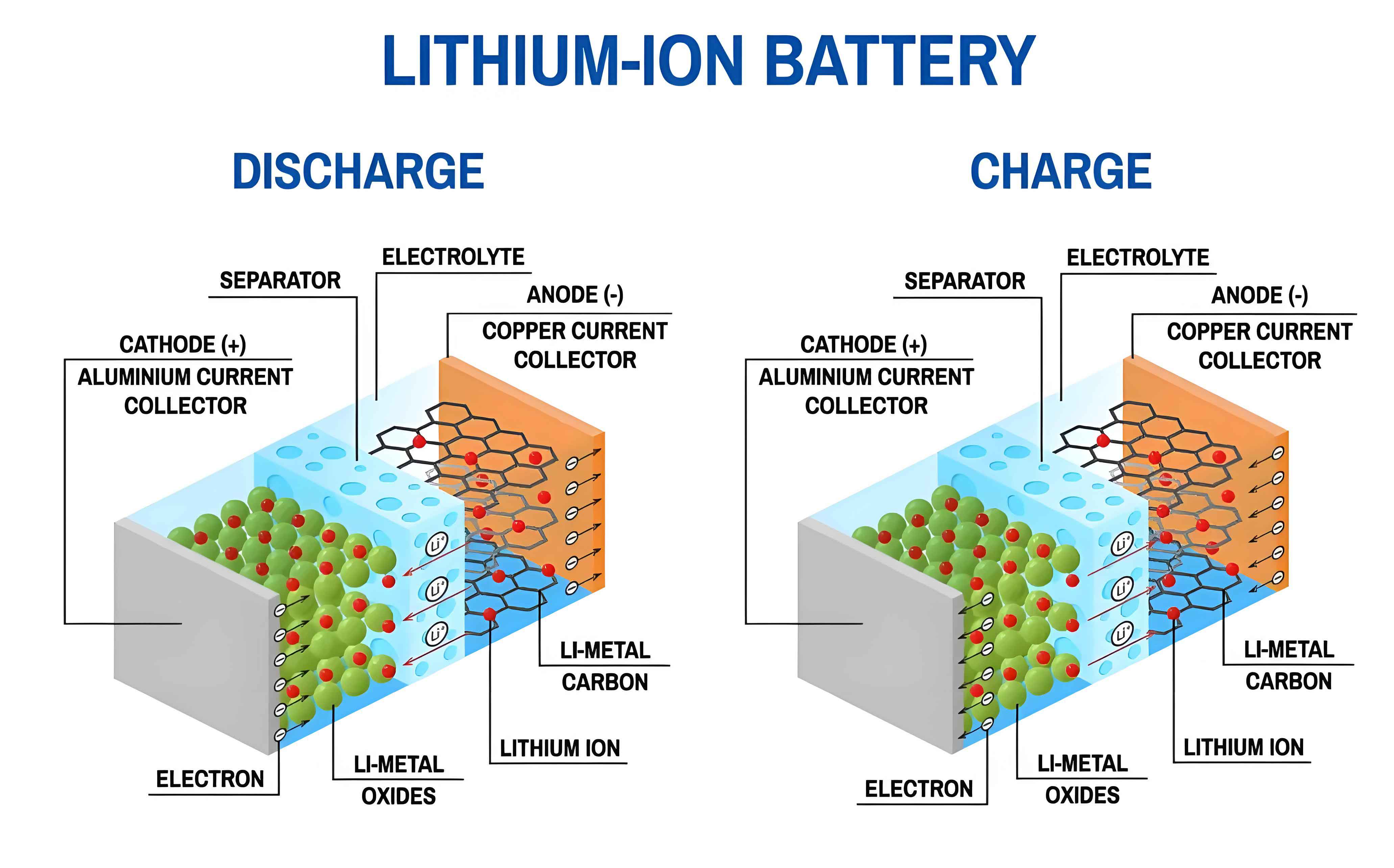
To investigate the thermal runaway process, we conducted a side-heating experiment on a commercially available 50 Ah prismatic lithium iron phosphate lithium-ion battery. The fresh battery had an initial mass of 1285 g and was tested at 100% State of Charge (SOC). The key specifications of the lithium-ion battery are summarized in Table 1.
| Parameter | Value |
|---|---|
| Nominal Capacity | 50 Ah |
| Nominal Voltage | 3.3 V |
| Mass | 1285 g |
| Internal Resistance | 0.655 mΩ |
| Dimensions (L×W×H) | 140.60 mm × 23.91 mm × 160.47 mm |
| Specific Heat Capacity | 2200 J/(kg·°C) |
The experimental platform was established in a semi-open environment. The lithium-ion battery was clamped between two plates lined with mica sheets and heated from one side using a heating pad with a constant power output of 942 W. An array of K-type thermocouples was attached to the battery surface at critical locations: the geometric center (T_I), the positive tab (T_II), the negative tab (T_III), the side near the negative terminal (T_IV), and the safety vent (T_V). To characterize the jet flame, a thermocouple tree was positioned above the safety vent at heights of 10 cm, 20 cm, 30 cm, and 60 cm. The mass loss of the lithium-ion battery was monitored in real-time using a precision balance. The entire process was recorded by a high-speed camera and an infrared thermal imager. Data from all sensors was collected at a frequency of 1 Hz.
The thermal runaway process for the lithium-ion battery, as triggered by external heating, can be delineated into four distinct stages based on characteristic temperatures and rates. The key parameters defining these stages are the battery surface temperature at the geometric center (T_I) and its rate of change (δ). The stages are defined as follows:
1. Initial Heating Stage (0–105 s): The temperature rise is governed solely by the external heater. The internal chemistry of the lithium-ion battery remains largely inactive.
2. Self-heating Initiation Stage (105–368 s): This stage begins when the temperature rise rate δ exceeds 0.02 °C/s, marking the onset of exothermic side reactions within the lithium-ion battery, such as Solid Electrolyte Interphase (SEI) decomposition.
3. Thermal Runaway Triggering Stage (368–739 s): This critical phase is initiated when δ surpasses 1 °C/s. The exothermic reactions become self-sustaining and uncontrollable, leading to a rapid escalation in temperature, venting, and often combustion.
4. Peak and Decline Stage (739–2200 s): After reaching its maximum temperature, the lithium-ion battery temperature begins to decrease, signifying the conclusion of the major exothermic processes.
The temperatures at the five monitored locations on the lithium-ion battery body are plotted against time. The vent temperature (T_V) exhibits the most complex behavior, reaching an initial peak of 644.5°C at 410 s, followed by a decline and a subsequent rise to the global maximum of 693.1°C at 739 s (T_3). The other locations (center, tabs, side) show single, sharp peaks between 450°C and 540°C occurring shortly after the thermal runaway trigger. The average surface temperature of the lithium-ion battery, \(\bar{T}\), and the central temperature rise rate, \(\delta\), are calculated as:
$$ \bar{T} = \frac{T_I + T_{II} + T_{III} + T_{IV} + T_V}{5} $$
$$ \delta = \frac{dT_I}{dt} $$
The plot of these derived quantities reveals the intense dynamics. The average temperature rises steadily during self-heating, exhibits fluctuations around 430°C during active venting, and peaks at 459.3°C. The temperature rise rate \(\delta\) shows a dramatic spike, reaching its maximum value of 22.7 °C/s at 385 s (t_max), which is 17 seconds after the formal trigger point (T_2 at 368 s). This peak is short-lived, lasting approximately 63 seconds before decaying.
The expulsion of gases and particulates during venting leads to a significant reduction in the mass of the lithium-ion battery. The total mass loss was measured to be 235 g, representing over 18% of the initial mass. The mass loss rate, \(\alpha\), is defined as:
$$ \alpha = \frac{dm}{dt} $$
The temporal evolution of mass (m) and mass loss rate (\(\alpha\)) shows that the vast majority of mass loss (approximately 87%) occurred during the intense venting period between the safety vent opening (t_vent = 296 s) and approximately 590 s. The mass loss rate peaked at 4.22 g/s at 359 s, which corresponds closely with the period of maximum internal reaction activity. A smaller secondary peak in \(\alpha\) was observed later, coinciding with the ignition of the battery casing itself.
The temperature profile within the jet flame above the safety vent provides insight into the combustion intensity of the vented gases. Temperatures at all four measured heights (10, 20, 30, 60 cm) surged immediately following vent opening, reaching their respective peaks within 34 seconds. The maximum temperature of 865.4°C was recorded at the 10 cm height. Peak temperatures decreased with increasing height, measuring 837.5°C, 804.5°C, and 690.2°C at 20, 30, and 60 cm, respectively. To analyze the flame structure, the temperature gradient, \(\gamma\), between measurement points was calculated:
$$ \gamma = \frac{\Delta T}{\Delta L} $$
We examine the gradient at three critical times: thermal runaway initiation (t_1), trigger (t_2), and peak temperature (t_3). The calculated gradients at midpoints (5, 15, 25, 45 cm) are presented in Table 2.
| Height (cm) | Gradient at t1 (°C/cm) | Gradient at t2 (°C/cm) | Gradient at t3 (°C/cm) |
|---|---|---|---|
| 5 | 0.67 | 10.44 | 61.33 |
| 15 | 0.01 | 8.43 | 4.27 |
| 25 | 0.01 | 6.42 | 0.80 |
| 45 | 0.00 | 5.90 | 0.06 |
The data shows that at the peak battery temperature time (t_3), the gradient is extremely steep near the vent (61.33 °C/cm at 5 cm) but drops rapidly with height. This indicates a short, intense flame close to the battery surface at this late stage, likely fueled by the burning battery casing itself, whereas at the thermal runaway trigger (t_2), the gradients are significant up to 45 cm, indicating a taller, more sustained jet flame from the combustion of vented gases.
A critical aspect of understanding lithium-ion battery failure is distinguishing between heat generated internally by chemical reactions and heat released externally by the combustion of ejected gases. We quantified both streams.
Battery Internal Heat Generation: The heat release rate from the lithium-ion battery body (HRR_b) is modeled based on the Arrhenius kinetics of key exothermic side reactions. The total volumetric heat generation rate \(Q\) is the sum of contributions from SEI decomposition (\(Q_{sei}\)), negative electrode reaction with electrolyte (\(Q_{an}\)), electrolyte decomposition (\(Q_e\)), and binder decomposition (\(Q_{pvdf}\)):
$$ Q = \sum Q_i = Q_{sei} + Q_{an} + Q_e + Q_{pvdf} $$
The rate for each reaction \(i\) is given by:
$$ Q_i = -W_i H_i \frac{dc_i}{dt} $$
where \(W_i\) is the reactant density, \(H_i\) is the reaction enthalpy, and \(dc_i/dt\) is the reaction rate. The reaction rates follow Arrhenius expressions. For example, the SEI decomposition rate is:
$$ \frac{dc_{sei}}{dt} = -A_{sei} c_{sei} e^{-E_{a,sei}/(RT)} $$
The kinetic parameters used for the lithium iron phosphate lithium-ion battery are listed in Table 3.
| Reaction Stage | Enthalpy Hi (J/kg) | Density Wi (kg/m³) | Prefactor Ai (s⁻¹) | Activation Energy Ea,i (J/mol) |
|---|---|---|---|---|
| SEI Decomposition | 2.57×10⁵ | 6.104×10² | 1.667×10¹⁵ | 1.3508×10⁵ |
| Anode-Electrolyte | 1.714×10⁶ | 6.104×10² | 2.5×10¹³ | 1.3508×10⁵ |
| Electrolyte Decomp. | 1.55×10⁵ | 4.069×10² | 5.14×10²⁵ | 2.74×10⁵ |
| Binder Decomp. | 1.5×10⁶ | 8.14×10⁴ | 1.917×10²⁵ | 2.86×10⁵ |
The battery body Heat Release Rate (HRR_b) and Total Heat Released (THR_b) are then:
$$ HRR_b = Q \cdot V $$
$$ THR_b = \int_0^t HRR_b(t) dt $$
where \(V\) is the volume of reactive material. The calculated HRR_b for the lithium-ion battery shows two prominent peaks: 12.95 kW shortly after venting and a maximum of 17.3 kW at 384 s. The integrated THR_b over the entire event was 2.59 MJ.
Vented Gas Combustion Heat Release: The heat release from the combustion of gases ejected by the lithium-ion battery was calculated using oxygen consumption calorimetry. The Heat Release Rate (HRR_g) is given by:
$$ HRR_g = \left[ E\Phi – (E_{CO} – E) \frac{1-\Phi}{2} \cdot \frac{X_{CO}}{X_{O_2}} \right] \cdot \frac{\dot{m}_a}{1+\Phi(\alpha -1)} \cdot \frac{M_{O_2}}{M_a} \cdot \frac{(1-X^0_{H_2O})}{X^0_{O_2}} $$
where \(E\) is the heat release per kg of O₂ consumed, \(\Phi\) is the oxygen depletion factor, \(X\) terms are mole fractions of gases, \(\dot{m}_a\) is the mass flow rate of air, and \(\alpha\) is the expansion factor. The Total Heat Released (THR_g) is:
$$ THR_g = \int_0^t HRR_g(t) dt $$
The HRR_g trace is dominated by an intense, sharp peak of 49.55 kW at 384 s, coinciding with the peak battery HRR. A second, broader peak of 30.2 kW occurs later. The total heat released from gas combustion was 4.14 MJ, which is approximately 60% higher than the heat generated internally by the lithium-ion battery body.
The interplay between these two energy flows defines the progression of the hazard. Figure 12 (conceptual description) plots THR_b and THR_g against time. The curves intersect at a critical time t_sep = 411 s. Before t_sep, the dominant source of energy is the internal exothermic reactions of the lithium-ion battery (SEI decomposition, anode reactions, etc.). After t_sep, the dominant source shifts to the external combustion of vented gases (e.g., H₂, CO, C₂H₄). This transition is a key feature of the thermal runaway energy transmission. The total energy released (THR_b + THR_g) was approximately 6.73 MJ. The evolution of the failure can be linked to specific events and the shifting energy balance, as summarized in Table 4.
| Event / Time (s) | Description | Dominant Energy Source (Pre/Post tsep=411 s) |
|---|---|---|
| Vent Opening (tvent=296) | Safety valve ruptures; release of white smoke. | Battery Internal Reactions (Pre-tsep) |
| Gas Ignition (~304) | Vented gases ignite, forming a stable jet flame. | Battery Internal Reactions (Pre-tsep) |
| Max dT/dt (tmax=385) | Battery temperature rise rate peaks at 22.7 °C/s. | Transition Period (Near tsep) |
| Energy Crossover (tsep=411) | Gas combustion heat release surpasses battery internal heat release. | Transition Point |
| Case Ignition (tfire=500) | Battery casing material ignites. | Gas Combustion (Post-tsep) |
| Peak Temp (t3=739) | Battery vent reaches peak temperature (693.1°C). | Gas Combustion (Post-tsep) |
In conclusion, this detailed experimental study on a large-format lithium iron phosphate lithium-ion battery has elucidated the characteristic behaviors and, more importantly, the coupled energy flow transmission during thermal runaway. The lithium-ion battery exhibited violent exothermic behavior, with surface temperatures exceeding 690°C, a peak temperature rise rate of 22.7 °C/s, and a mass loss exceeding 18%. The jet flame from vented gases reached temperatures above 865°C. Quantitative analysis revealed that the total heat released from the combustion of vented gases (4.14 MJ) was significantly greater than the heat generated internally by the battery’s chemical reactions (2.59 MJ). A pivotal finding is the identification of a distinct transition point at approximately 411 seconds. Prior to this, the thermal hazard is primarily driven by the internal exothermic reactions of the lithium-ion battery. After this point, the hazard is dominated and sustained by the external combustion of ejected flammable gases. This refined understanding of the sequential and competing energy flows—from within the lithium-ion battery to its surroundings—is fundamental for advancing predictive models, designing effective battery management systems that can detect early warning signs, and engineering containment or suppression systems targeted at the most consequential phase of the failure. Future work should investigate the dependence of this energy flow transition on factors such as state of charge, cell format, and cathode chemistry to build a more comprehensive safety framework for lithium-ion battery technologies.