
The ubiquitous deployment of lithium-ion batteries across electric vehicles, grid storage, and portable electronics underscores their technological dominance. However, this widespread adoption brings into sharp focus the paramount importance of safety. Among all safety concerns, thermal runaway (TR) represents the most severe and hazardous failure mode. It is a complex, multi-stage process where internal exothermic reactions become self-sustaining, leading to catastrophic temperature rise, venting of flammable and toxic gases, and often fire or explosion. Understanding the intricate coupling of thermal, electrical, and chemical phenomena during this process is critical for developing effective safety management systems and preventive designs.
This analysis delves into the thermal runaway behavior triggered by a convective heat transfer scenario, a common thermal abuse condition. By integrating the principles of reaction kinetics, heat transfer, and gas evolution, we construct a multi-dimensional framework to unravel the evolution characteristics of the li ion battery from a normal state to complete failure. The discussion synthesizes theoretical modeling, finite element simulation insights, and experimental validation to paint a comprehensive picture of the TR sequence.
Mechanistic Analysis of Thermal Runaway
The journey of a li ion battery into thermal runaway begins when its internal temperature exceeds a critical threshold, initiating a cascade of irreversible exothermic side reactions. The total heat generation within the cell (Qtotal) under normal operation is governed by reversible reaction heat, Ohmic (Joule) heating, and polarization losses. However, during abuse conditions, the heat from parasitic side reactions (Stot) dominates and triggers the runaway.
The primary exothermic side reactions proceed in a characteristic sequence, each with distinct onset temperatures and kinetics. These reactions are summarized below:
| Reaction Stage | Typical Onset Temp. | Key Chemical Process | Major Heat Contribution |
|---|---|---|---|
| 1. SEI Decomposition | ~80-120 °C | Breakdown of the Solid Electrolyte Interphase layer on the anode. | Initial heat pulse, releases flammable gases (e.g., C2H4). |
| 2. Anode-Electrolyte Reaction | ~120-150 °C | Direct reaction between lithiated graphite (or Si) and electrolyte solvent. | Significant heat, major source of H2, CO, CH4. |
| 3. Electrolyte Decomposition | ~200-250 °C | Decomposition of LiPF6 salt and organic carbonates. | Heat and gas generation, primary source of HF and POF3. |
| 4. Cathode Decomposition | ~150-250 °C (material dependent) | Release of oxygen from cathode lattice (e.g., NMC, LCO). | Intense heat, provides oxidant for subsequent combustion reactions. |
| 5. Binder Reaction (PVDF) | >200 °C | Reaction of polyvinylidene fluoride binder with Li or other components. | Additional heat, can produce HF if reacting with LiPF6. |
The total heat generation rate from these side reactions can be expressed as the sum of individual reaction heats:
$$ S_{tot} = S_{sei} + S_{ne} + S_{pe} + S_{ele} + S_{binder} $$
Each reaction follows Arrhenius-type kinetics. For instance, the rate of SEI decomposition (Rsei) and its associated heat generation (Ssei) are given by:
$$ R_{sei}(T, C_{sei}) = A_{sei} \exp\left(-\frac{E_{a,sei}}{RT}\right) C_{sei}^{m_{sei}} $$
$$ S_{sei} = H_{sei} \cdot W_{c} \cdot R_{sei} $$
where Asei is the pre-exponential factor, Ea,sei is the activation energy, R is the universal gas constant, T is the absolute temperature, Csei is the normalized concentration of the SEI component, msei is the reaction order, Hsei is the reaction enthalpy, and Wc is the carbon content. Similar kinetic equations govern the anode, cathode, and electrolyte reactions. The coupled nature of these reactions means the heat from one stage (e.g., SEI breakdown) accelerates the temperature rise, triggering the next, more energetic reaction, creating a positive feedback loop that culminates in thermal runaway.
Multi-Physics Modeling of Thermal Runaway
To predict the thermal behavior of a li ion battery under abuse, a coupled thermal-electrical-chemical model is essential. Finite Element Analysis (FEA) is a powerful tool for this purpose, allowing for the simulation of temperature distribution, reaction progression, and their interdependence in complex geometries.
The core of the model is the energy balance equation, which accounts for heat generation, conduction, and convection:
$$ \rho C_p \frac{\partial T}{\partial t} = \nabla \cdot (k \nabla T) + \dot{Q}_{gen} $$
Here, ρ is density, Cp is specific heat capacity, k is thermal conductivity (which can be anisotropic in a cell), and \dot{Q}_{gen} is the volumetric heat generation rate. \dot{Q}_{gen} is the critical link, comprising both operational heat (Qtotal) and the abuse reaction heat (Stot). For a convective heating scenario, the boundary condition is given by Newton’s law of cooling:
$$ q_c = h (T_{source} – T_{surface}) $$
where h is the convective heat transfer coefficient and Tsource is the external heat source temperature. Simulations reveal a strong dependence of TR onset time and severity on Tsource. For a standard 18650-format li ion battery, a source at 327°C (600.15 K) can induce TR approximately 300 seconds earlier than a source at 177°C (450.15 K), with a peak heating rate up to 47% higher. The temperature profile evolves from the externally heated surface inwards, with the core becoming the hottest zone once internal reactions dominate.
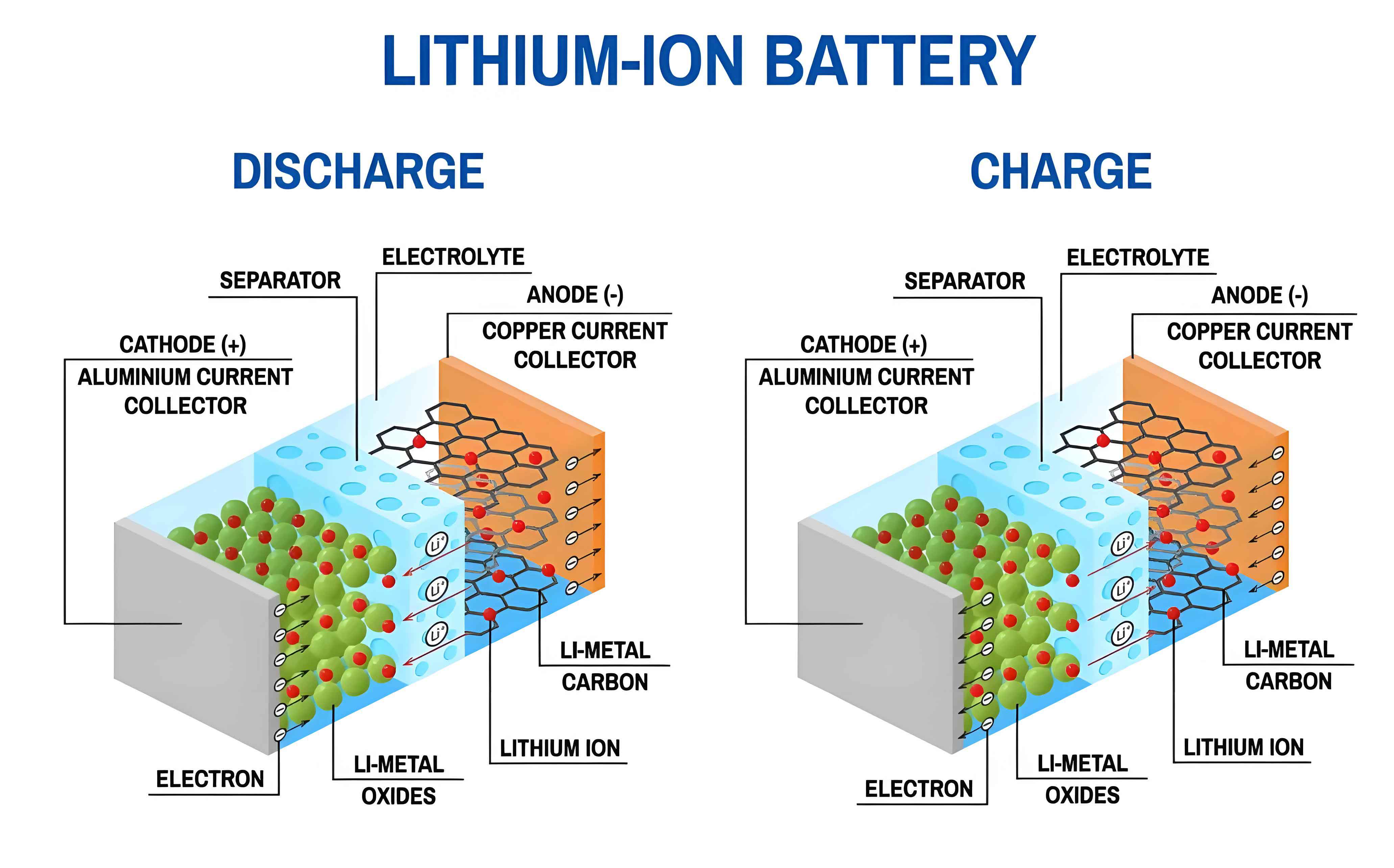
The simulation also tracks the consumption of key cell components. The SEI layer depletes first, followed by the active lithium in the anode reacting with the electrolyte. The cathode decomposition and electrolyte breakdown often occur nearly simultaneously in the final, violent stage of TR. This modeled sequence provides critical insights into the “point of no return” during the thermal abuse of a li ion battery.
Gas Generation Behavior and Early Warning Signals
The chemical reactions during thermal runaway of a li ion battery produce a complex mixture of gases. Monitoring this gas evolution is not only crucial for understanding the failure but also offers the most promising avenue for early warning before catastrophic temperature rise occurs.
The gas species are directly tied to the reaction stages. Key generation pathways include:
– H2: Primarily from the reaction of lithiated anode with electrolyte solvents (e.g., EC, DMC).
– CO, CO2, CH4, C2H4: From the decomposition of organic carbonate solvents (EC, DEC, DMC) during SEI breakdown and anode-electrolyte reactions.
– HF: A highly toxic and corrosive gas generated from the hydrolysis of LiPF6 salt: $$ \text{LiPF}_6 + \text{H}_2\text{O} \rightarrow \text{LiF} + \text{POF}_3 + 2\text{HF} $$. Water can be present from trace moisture or produced by other reactions.
– O2: Released from the decomposition of oxide-based cathode materials (e.g., NMC, LCO).
Experimental studies using gas sensors and Fourier-Transform Infrared (FTIR) spectroscopy on a thermally abused li ion battery module reveal distinct gas release profiles with critical temporal information:
| Gas Species | First Detection (Relative to TR) | Peak Concentration Period | Primary Source Reaction | Warning Potential |
|---|---|---|---|---|
| Hydrogen (H2) | ~29 minutes BEFORE TR | During anode-electrolyte reaction phase | Anode + Solvent | High – Earliest detectable indicator |
| Carbon Monoxide (CO) | ~1 minute BEFORE TR | During major electrolyte decomposition | Solvent Decomposition | Medium – Precedes thermal spike |
| Methane (CH4) | ~1 minute BEFORE TR | During major electrolyte decomposition | Solvent Decomposition | Medium – Precedes thermal spike |
| Carbon Dioxide (CO2) | ~1 minute BEFORE TR | During/after TR event | Solvent Combustion/Decomposition | Medium |
| Hydrogen Fluoride (HF) | DURING/after TR | Post-venting, combustion phase | LiPF6 Hydrolysis | Low – Indicates severe degradation and hazard |
The early detection of H2, nearly half an hour before the rapid temperature ascent, is of particular significance. It corresponds to the initial breakdown of the SEI and the onset of sustained anode-electrolyte reactions. This provides a crucial time window for safety systems to intervene, such as initiating cooling, isolating the li ion battery pack, or triggering alarms. In contrast, the surge of HF is typically associated with the final, most destructive stages of TR, marking the point of severe cell rupture and electrolyte decomposition.
Electrically, the thermal runaway event is marked by a sudden and irreversible voltage collapse. For a fully charged cell, the voltage can plummet from its nominal value (e.g., 3.65 V for LFP) to near zero within seconds. This voltage drop is strongly temporally correlated with the sharp temperature spike at the cell terminals, as the internal short circuits and material degradation destroy the cell’s electrochemical integrity.
Conclusion
Thermal runaway in a li ion battery is a deterministic process governed by sequential, thermally-activated chemical reactions. The external thermal abuse condition, such as convective heating, directly controls the onset timing and violence of the event. Higher heat source temperatures dramatically shorten the time to failure and increase the peak reaction rates. The internal physics is a tight coupling of heat transfer, reaction kinetics, and gas generation.
Finite element modeling, incorporating detailed reaction mechanisms, successfully predicts the temperature evolution and component consumption during this process. Experimentally, the evolution of characteristic gases provides a definitive fingerprint of the TR progression. Critically, hydrogen gas emerges as a premier early warning signal, detectable during the initial exothermic stages long before thermal acceleration becomes uncontrollable. The voltage of the li ion battery serves as a final, confirmatory signature of catastrophic failure.
This integrated understanding of the multi-physics behavior—from initial heat input to final gas venting—is fundamental for advancing the safety of li ion battery systems. It informs the design of more robust battery management systems (BMS) with multi-parameter monitoring (temperature, voltage, gas), guides the development of novel materials with higher thermal stability, and validates safety standards and protocols for thermal propagation mitigation. Ultimately, mastering these complex interactions is key to ensuring the safe and reliable operation of the energy storage technology that powers our modern world.