
The global push towards electrification of transportation has placed lithium-ion batteries at the forefront of energy storage technology. As market demands for longer driving ranges intensify, the energy density of batteries for electric vehicles (EVs) has seen continuous and rapid improvement. However, this pursuit of higher specific energy often entails the use of electrochemically active materials with greater inherent chemical energy. Consequently, these high-specific-energy lithium-ion batteries may exhibit increased susceptibility to thermal runaway under abusive conditions, releasing significantly more energy with greater destructive potential. Understanding the precise relationship between a battery’s stored energy—quantified by its State of Charge (SOC)—and its thermal runaway behavior is therefore critical for enhancing safety in design, transportation, and storage. This study investigates the thermal runaway characteristics of a commercial high-energy-density ternary (NMC) lithium-ion battery cell under different SOCs, triggered by external heating in a sealed environment. We provide a detailed quantitative analysis of failure temperatures, gas generation, and pressure dynamics, offering empirical data to inform safety protocols and risk assessments.
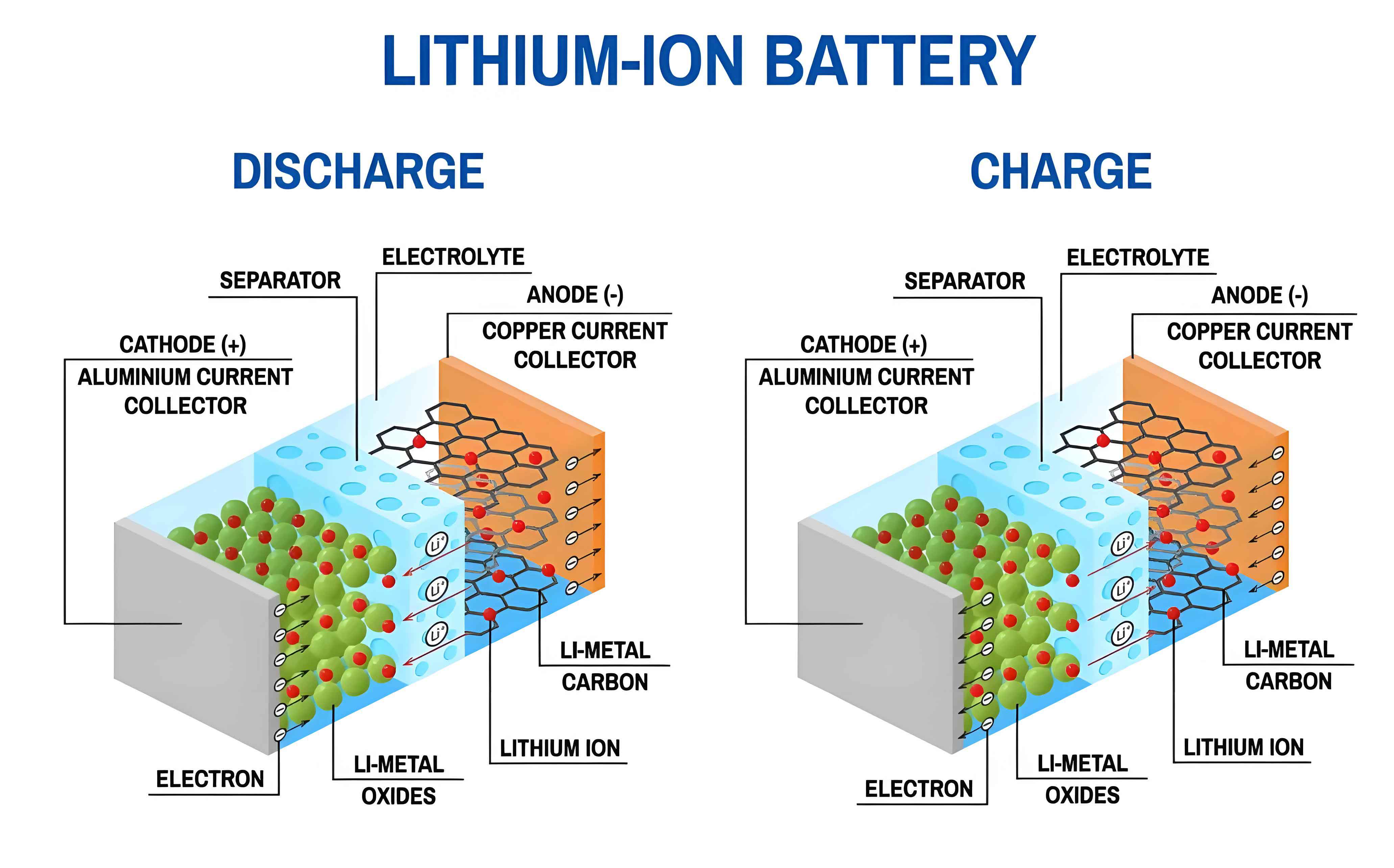
The thermal runaway of a lithium-ion battery is a complex, self-accelerating exothermic process that becomes uncontrollable once initiated. Extensive research has been conducted to unravel its underlying mechanisms. Fundamentally, thermal runaway is initiated when internal heat generation surpasses the cell’s ability to dissipate that heat, leading to a rapid temperature increase. This can be triggered by three primary abuse conditions: thermal abuse (external overheating), electrical abuse (overcharge, short circuit), and mechanical abuse (crush, penetration). The runaway process itself involves a sequence of decompositions and reactions. Key stages include the breakdown of the Solid-Electrolyte Interphase (SEI) on the anode, the reaction between the intercalated lithium and the electrolyte, the melting of the separator leading to internal short circuit, and the decomposition of the cathode material and electrolyte. Each stage releases heat, further propelling the temperature upward in a vicious cycle until catastrophic failure occurs.
The State of Charge is a pivotal parameter in this context. A fully charged lithium-ion battery contains not only more electrochemical energy but also has its anode in a lithiated state and its cathode in a delithiated, highly oxidized state. This condition influences the onset temperatures and the intensity of the exothermic reactions. For instance, a higher SOC typically means more lithium is intercalated in the graphite anode, which can react more vigorously with the electrolyte upon SEI breakdown. Similarly, the thermal stability of cathode materials like NMC decreases as the lithium content is reduced (i.e., at high SOC). Previous studies have established a correlation between SOC and the total heat release or gas volume during failure. This work aims to expand on that understanding by systematically measuring multiple failure signatures—temperature spikes, pressure transients, and gas flow—for a modern, high-capacity pouch-format lithium-ion battery across a wide SOC range, from 0% to 100%.
Experimental Methodology
The experimental setup was designed to safely contain a single lithium-ion battery cell during a thermally-induced runaway while precisely measuring key parameters. The core apparatus was a sealed, reinforced chamber equipped with various sensors. A high-energy-density commercial pouch cell with a nominal capacity of 200 Ah and a Nickel-Manganese-Cobalt (NMC) cathode chemistry was selected as the test specimen, representative of current advanced EV batteries.
Six identical cells were prepared at different States of Charge: 0%, 30%, 50%, 80%, 90%, and 100% SOC. This was achieved using a controlled charging/discharging protocol at a C/3 rate. Each cell was then instrumented with multiple K-type thermocouples attached to critical locations: on the heating surface (T_heater), on the cell surface opposite the heater (T_opposite), and near the pressure relief valve (T_valve). The cell’s voltage was also continuously monitored. The instrumented cell was placed inside the sealed chamber. Thermal runaway was induced by a 500 W electric heating pad attached to the largest face of the cell. Upon powering the heater, it rapidly increased in temperature, transferring heat into the cell and initiating the internal chain of exothermic reactions leading to failure. The chamber was fitted with a high-frequency pressure sensor to record the internal pressure burst and a mass flow meter at the exhaust to measure the volume and flow rate of ejected gases.
Experimental Results and Data Summary
The experiments revealed a stark progression in the violence and characteristics of thermal runaway as the SOC increased. The time-to-failure (from heater start to voltage collapse/temperature spike), maximum recorded temperatures, peak chamber pressure, and total gas volume were extracted from each test. The results are consolidated in the table below.
| State of Charge (SOC) | Time to Failure (s) | Max Temp. at Valve, T_valve (°C) | Max Temp. on Surface, T_opposite (°C) | Peak Pressure (bar, absolute) | Total Gas Volume (m³) | Observed Phenomenon |
|---|---|---|---|---|---|---|
| 0% | ~2500 (No sharp TR) | < 200 | < 200 | 0.162 | Negligible | No violent runaway; slow heating. |
| 30% | ~1980 | 306.2 | 576.6 | 0.124 | Negligible | Venting without violent jet fire. |
| 50% | ~1514 | 609.2 | 634.4 | 3.29 | 0.691 | Violent venting and jet fire. |
| 80% | ~1153 | ~750* | 750.6 | 2.435 | 1.170 | Violent venting and sustained combustion. |
| 90% | ~439 | 844.6 | ~600* | 1.978 | 1.194 | Extremely violent jet fire and explosion. |
| 100% | ~374 | 1296.5 | ~900* | 2.478 | 1.554 | Most violent explosion; casing melted. |
The data illustrates several clear trends. First, the time required to trigger thermal runaway decreases exponentially with increasing SOC. This indicates that a battery with higher stored energy requires less external energy input to cross the threshold into uncontrolled self-heating. The relationship can be approximated by a power-law decay:
$$ t_{fail} \propto SOC^{-\alpha} $$
where $\alpha > 0$.
Second, the maximum temperatures recorded, particularly at the vent location, show a strong positive correlation with SOC. The 100% SOC test produced a jet fire exceeding 1300°C, hot enough to melt the aluminum battery casing, while the 30% SOC test produced temperatures barely over 300°C. The total gas volume generated follows a similar trend, increasing monotonically with SOC. This gas is primarily a mixture of electrolyte solvent vapor, decomposition products (like CO, CO₂, H₂, and various hydrocarbons), and particles from the electrode materials. The total mass of ejected material, measured by weighing the cell before and after the test, also increased with SOC, confirming more complete consumption of the cell’s internal components.
The pressure data presents a more nuanced picture. While the 100% SOC test produced the highest peak pressure among the high-SOC groups, the 50% SOC test registered the absolute highest pressure. This can be attributed to the longer heating time at 50% SOC, allowing more gas to accumulate inside the sealed cell before the pressure relief valve (PRV) ruptured or the casing failed. The pressure dynamics involve the competition between gas generation rate, venting onset, and combustion. The instantaneous pressure peak $P_{peak}$ can be modeled as a function of the gas generation rate $\dot{V}_{gas}$, the vent opening pressure $P_{vent}$, and the combustion energy release $Q_{comb}$:
$$ P_{peak} = f(P_{vent}, \int \dot{V}_{gas} dt, Q_{comb}) $$
For high-SOC cells, $Q_{comb}$ is large, often leading to a rapid pressure spike from combustion almost simultaneously with venting. For mid-SOC cells, a larger volume of non-combusted gas may build up before venting, leading to a significant mechanical pressure burst.
Analysis of Failure Mechanisms and Energetics
The experimental trends can be interpreted through the lens of the lithium-ion battery’s internal energy state and reaction pathways. The total energy released during thermal runaway ($E_{total}$) comprises the stored electrochemical energy ($E_{elec}$) and the chemical energy from the decomposition of materials ($E_{chem}$). The electrochemical energy is directly proportional to the SOC:
$$ E_{elec} \approx C \cdot V_{nom} \cdot SOC $$
where $C$ is the capacity and $V_{nom}$ is the nominal voltage. The chemical energy from reactions like electrolyte oxidation and binder decomposition is less dependent on SOC but can be catalyzed by the released oxygen from the cathode at high temperatures.
At low SOC (0%, 30%), the anode contains little intercalated lithium, and the cathode is in a more thermally stable, lithiated state. The external heat primarily causes the breakdown of the SEI and some electrolyte evaporation. The reactions are not vigorous enough to create a self-sustaining thermal avalanche. The main hazard is the venting of flammable gas, which may or may not ignite.
As SOC increases, the scenario changes dramatically. The sequence of exothermic reactions intensifies:
- SEI Decomposition (~90-120°C): This reaction is relatively independent of SOC.
- Anode-Electrolyte Reaction (>120°C): This critical reaction between intercalated lithium and the electrolyte is highly SOC-dependent. The heat release rate $\dot{q}_{anode}$ can be expressed as:
$$ \dot{q}_{anode} = A_{anode} \cdot \exp\left(\frac{-E_{a,anode}}{RT}\right) \cdot (SOC)^n $$
where $A_{anode}$ is a pre-exponential factor, $E_{a,anode}$ is the activation energy, R is the gas constant, T is temperature, and $n$ is a reaction order related to lithium concentration. - Separator Melt & Internal Short (~130-180°C): The massive internal short circuit dumps the remaining electrical energy as heat ($E_{elec}$), causing a sharp temperature jump.
- Cathode Decomposition (>200°C): The NMC cathode releases oxygen when heated. The onset temperature decreases with decreasing lithium content (i.e., increasing SOC). This oxygen fuels the combustion of the ejected electrolyte and carbonaceous materials, leading to the violent jet fire observed. The heat release from this combustion is a major contributor to the extreme temperatures seen at high SOC.
Thus, the transition from a benign venting event to a catastrophic explosive fire is governed by the SOC-dependent kinetics of the anode reaction and the availability of oxidants (from the cathode) for combustion. The total heat release $Q_{total}$ can be conceptualized as:
$$ Q_{total}(SOC) = Q_{intrinsic} + \beta \cdot SOC + \gamma \cdot I(SOC > SOC_{crit}) $$
where $Q_{intrinsic}$ is the heat from material decompositions independent of SOC, $\beta \cdot SOC$ represents the contribution from the electrochemical energy and related reactions, and the last term represents a step-change increase due to sustained combustion which only occurs above a critical SOC threshold ($SOC_{crit}$), estimated from our data to be between 30% and 50% for this specific lithium-ion battery.
Discussion and Implications for Safety
The findings have direct implications for the safe handling, transportation, and storage of high-energy-density lithium-ion batteries. The non-linear increase in hazard severity with SOC suggests that mandating lower SOC levels for transport can drastically reduce risk. Regulatory bodies like the International Air Transport Association (IATA) typically require lithium-ion batteries to be shipped at a state of charge not exceeding 30%. Our data strongly supports this threshold for this class of lithium-ion battery, as the 30% SOC cell did not produce a violent, self-propagating fire. For stationary storage systems, designing battery management systems (BMS) to maintain a conservative upper SOC limit during operation could be a trade-off between available capacity and inherent safety margin.
From a safety engineering perspective, the data informs the design of containment and mitigation systems. The measured pressure peaks (up to ~3.3 bar) and gas volumes (up to ~1.55 m³ from a single cell) provide critical inputs for designing venting ducts, explosion-proof enclosures, and fire suppression systems for battery packs. The knowledge that the pressure hazard may peak at a mid-SOC level due to delayed venting is particularly important for abuse scenarios like slow internal heating.
Furthermore, this study highlights the importance of developing advanced materials to decouple energy density from thermal instability. Strategies include using thermally stable cathode materials (e.g., LFPs modified high-nickel NMC), solid-state electrolytes to eliminate flammable organic solvents, and robust separators with high melt integrity. The ultimate goal for the next generation of lithium-ion battery technology is to achieve high specific energy without the concomitant increase in thermal runaway severity.
Conclusion
This comprehensive experimental study systematically characterized the thermal runaway behavior of a high-energy-density lithium-ion battery across a full range of States of Charge. The results unequivocally demonstrate that SOC is a primary determinant of the severity of failure. Key quantified findings include:
- The trigger time for thermal runaway decreases significantly with increasing SOC, following a non-linear relationship.
- The maximum temperature of the ejecta plume increases dramatically with SOC, exceeding 1300°C for a fully charged cell, compared to less than 600°C for a cell at 50% SOC.
- The total volume of gas generated during runaway increases monotonically with SOC, indicating more complete consumption of the cell’s internal components.
- The violence of the event, encompassing jet fire, explosion, and casing melt-through, escalates sharply above a critical SOC threshold (between 30% and 50% for this cell).
The analysis links these observations to the fundamental electrochemistry and reaction kinetics of the lithium-ion battery, where higher SOC provides more fuel (intercalated lithium) and a less stable cathode that releases oxidants. These findings provide essential quantitative data for risk assessment, informing safe SOC limits for transportation and storage, and guiding the design of safer battery systems and effective mitigation strategies for the next generation of high-performance lithium-ion batteries.