
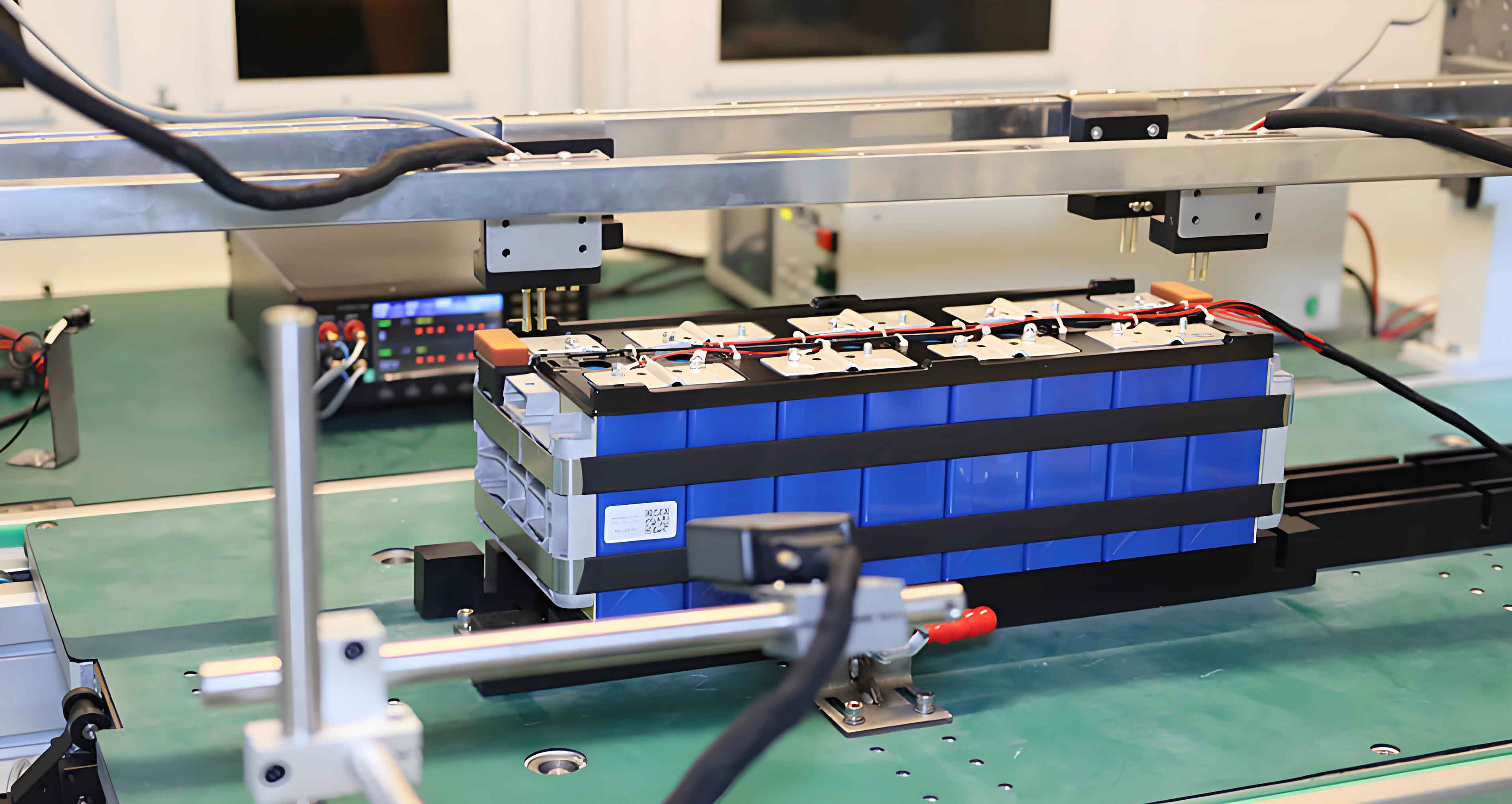
This study systematically investigates the thermal runaway mechanisms and gas evolution patterns in 100Ah LiFePO4 pouch batteries under various states of charge (SOC). Through comprehensive experiments involving side-heating triggering methods and advanced characterization techniques, we reveal critical insights into energy release characteristics and safety implications.
1. Thermal Runaway Dynamics
The thermal runaway process in LiFePO4 batteries exhibits four distinct phases:
$$T_{\text{onset}} = T(k),\ \text{when}\ T(k+1) – T(k) > 1^{\circ}\text{C},\ (k=1,2,3…)$$
Key thermal parameters demonstrate SOC-dependent behavior:
| SOC | Tonset (°C) | Tmax (°C) | Peak dT/dt (°C/s) |
|---|---|---|---|
| 40% | 166.2 ± 4.3 | 236.1 ± 12.7 | 2.2 ± 0.3 |
| 60% | 162.9 ± 3.8 | 291.3 ± 15.2 | 8.3 ± 1.1 |
| 80% | 174.2 ± 5.1 | 387.3 ± 18.6 | 64.9 ± 7.4 |
| 100% | 162.8 ± 4.7 | 422.8 ± 20.3 | 78.9 ± 8.9 |
2. Energy Release Characteristics
The heat generation dynamics of LiFePO4 batteries follow:
$$P_b = c_b m_b \frac{dT}{dt}$$
$$Q_{\text{TR}} = \int_{t_{\text{onset}}}^{t_{\text{max}}} P_b dt$$
TNT equivalence calculations reveal significant safety implications:
| SOC | Peak Power (kW) | Total Energy (kJ) | TNT Equivalent (g) | Blast Radius (m) |
|---|---|---|---|---|
| 40% | 3.91 ± 0.42 | 121.31 ± 15.8 | 27.33 ± 3.2 | 3.59 ± 0.17 |
| 60% | 14.76 ± 1.65 | 229.81 ± 28.4 | 51.79 ± 5.9 | 4.87 ± 0.23 |
| 80% | 115.44 ± 12.3 | 373.35 ± 41.2 | 84.14 ± 8.7 | 5.42 ± 0.31 |
| 100% | 140.34 ± 14.9 | 464.24 ± 49.5 | 104.63 ± 10.5 | 5.90 ± 0.35 |
3. Gas Generation Mechanisms
LiFePO4 battery venting gases show distinct SOC-dependent composition:
$$\text{H}_2\% = 26.38 + 0.78\text{SOC}\quad (R^2=0.98)$$
$$\text{CO}_2\% = 60.36 – 0.51\text{SOC}\quad (R^2=0.95)$$
Explosion limits calculation using Le-Chatelier’s principle:
$$L_{\text{mix}} = \frac{100}{\sum \frac{V_i}{L_i}}$$
| SOC | LEL (%) | UEL (%) | Explosive Range |
|---|---|---|---|
| 40% | 10.60 | 60.03 | 49.43% |
| 60% | 7.12 | 59.34 | 52.22% |
| 80% | 5.41 | 50.44 | 45.03% |
| 100% | 5.40 | 57.71 | 52.31% |
4. Structural Degradation Analysis
Post-thermal runaway analysis reveals significant material transformations in LiFePO4 batteries:
$$\text{Graphite Layer Disruption Index} = 0.15\text{SOC} + 2.4\quad (R^2=0.93)$$
$$\text{Cathode Spherulization Factor} = 0.08\text{SOC}^2 – 0.6\text{SOC} + 5.2\quad (R^2=0.96)$$
5. Safety Implications
The study establishes critical safety thresholds for LiFePO4 battery management systems:
$$\text{Critical Hazard Index} = 0.25(T_{\text{max}}) + 0.35\left(\frac{dT}{dt}_{\text{max}}\right) + 0.4(\text{Gas}_{\text{UEL}})$$
Practical safety guidelines derived from experimental data:
- Maintain SOC <80% for high-risk applications
- Implement gas detection at 5% LEL threshold
- Design safety buffers ≥6m for 100% SOC configurations
This comprehensive analysis provides essential data for developing safer LiFePO4 battery systems, particularly for large-scale energy storage applications. The revealed SOC-dependent thermal runaway characteristics and gas generation patterns enable optimized safety protocols and thermal management system design.