
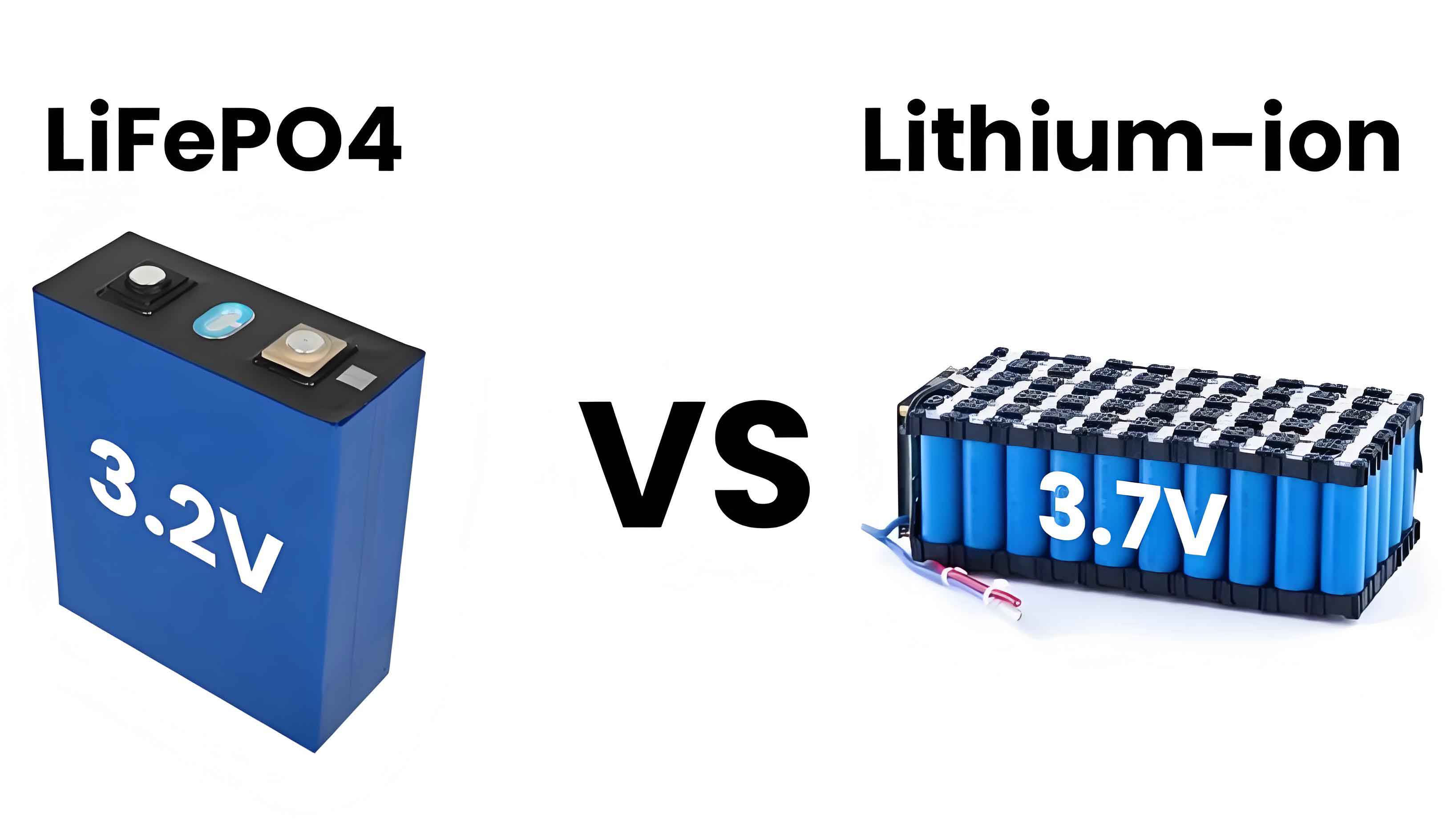
Understanding the thermal runaway characteristics of LiFePO4 battery and ternary Li-ion battery is critical for advancing energy storage safety. This study investigates the distinct behaviors of these two cathode systems under external heating abuse, focusing on temperature dynamics, heat release profiles, gas emissions, and voltage evolution. The results highlight significant differences in thermal stability, energy release, and failure mechanisms, offering insights for early warning systems and safety design.
Experimental Methodology
Two commercial battery types were analyzed: a 3.2 V 100 Ah LiFePO4 battery (LFP) and a 3.6 V 90 Ah ternary LiNi₀.₅Co₀.₂Mn₀.₃O₂ (NCM523) Li-ion battery. Both were preconditioned to 100% state-of-charge (SOC) using standardized protocols:
- LFP Battery: Cycled between 2.0 V and 3.6 V.
- NCM Battery: Cycled between 3.0 V and 4.2 V.
Thermal runaway was induced via 500 W external heating. Temperature, voltage, gas composition, heat release rate (HRR), and smoke release rate (SRR) were monitored using thermocouples, electrochemical sensors, Fourier-transform infrared spectroscopy (FTIR), and oxygen consumption calorimetry.
Thermal Runaway Dynamics
Temperature Profiles
The LiFePO4 battery exhibited gradual heating with no combustion, reaching a peak temperature of 534.2°C after 43 minutes. In contrast, the Li-ion battery (NCM523) experienced rapid temperature escalation, peaking at 1,052.4°C within seconds of venting, accompanied by violent jet flames. Key temperature metrics are summarized in Table 1.
Table 1: Thermal Runaway Temperature Metrics
| Parameter | LiFePO4 Battery | NCM Li-ion Battery |
|---|---|---|
| Peak Temperature (°C) | 534.2 | 1,052.4 |
| Time to Peak (s) | 2,895 | 1,964 |
| Avg. Heating Rate (°C/s) | 0.79 | 10.52 |
The NCM battery’s rapid temperature rise (~13× faster than LFP) underscores its higher reactivity under thermal abuse.
Heat and Smoke Release
Heat release rate (HRR) and total heat release (THR) were calculated using oxygen consumption principles:
PHRR=E⋅(m˙O20−m˙O2)
where E=13.1kJ/g (energy per unit oxygen consumed). Smoke release rate (SRR) was derived from light attenuation:
εSRR=2.303⋅(DV)log(II0)
Table 2: Heat and Smoke Release Metrics
| Metric | LiFePO4 Battery | NCM Li-ion Battery |
|---|---|---|
| Total Heat Release (MJ) | 0.162 | 3.147 |
| Peak HRR (kW) | 1.81 | 134.85 |
| Total Smoke Release (m²) | 395.0 | 38.8 |
| Peak SRR (m²/s) | 7.5377 | 2.2802 |
The LiFePO4 battery released dense white smoke but no flames, resulting in higher cumulative smoke release. The Li-ion battery’s intense combustion generated 20× more heat, emphasizing its fire hazard potential.
Gas Composition
Both systems emitted similar gases: H₂, CO₂, CO, and hydrocarbons (Figure 1). Key reactions include:
- SEI Decomposition:
(CH2OCO2Li)2→Li2CO3+C2H4+CO2+0.5O2 - Electrolyte Reduction:
Li+EC/DMC→Li2CO3+CH4/C2H6 - Binder Reactions:
PVDF+Li→LiF+H2
Table 3: Gas Volume Fractions
| Gas | LiFePO4 Battery (%) | NCM Li-ion Battery (%) |
|---|---|---|
| H₂ | 28.5 | 22.7 |
| CO₂ | 34.2 | 48.9 |
| CO | 19.8 | 16.3 |
| Hydrocarbons | 17.5 | 12.1 |
CO₂ dominated in the NCM system due to combustion, while H₂ levels were higher in the LiFePO4 battery from binder degradation.
Voltage Response
Both battery exhibited two-stage voltage drops (Figure 2):
- Initial Drop: Caused by electrode dissolution at elevated temperatures.
- Final Drop: Triggered by separator melt-short circuits.
For the LiFePO4 battery, voltage fell from 3.388 V to 1.998 V (Stage 1) and then to 0 V (Stage 2). The NCM battery dropped from 4.154 V to 3.629 V (Stage 1) and abruptly to 0 V (Stage 2).
Mechanistic Insights
- LiFePO4 Battery Stability:
The olivine structure of LiFePO4 inhibits oxygen release, preventing combustion. Heat generation is limited to solid-phase reactions (e.g., SEI decomposition, electrolyte evaporation). - NCM Li-ion Battery Reactivity:
Layered NCM cathodes release oxygen at ~200°C, fueling exothermic electrolyte combustion:
NCM→Ni/Co/Mn oxides+O2
O2+Electrolyte→CO2+H2O+Heat
Safety Implications
- Early Warning Signals:
- Voltage Drops: Secondary voltage decline correlates with separator failure, serving as a late-stage warning.
- Gas Detection: H₂ and CO surges indicate early thermal runaway.
- Mitigation Strategies:
- LiFePO4 Battery: Focus on smoke ventilation and thermal barriers.
- Li-ion Battery: Require flame suppression and advanced cooling.
Conclusion
The LiFePO4 battery demonstrates superior thermal stability, with no combustion and lower heat release, making it safer for stationary storage. In contrast, the NCM Li-ion battery poses significant fire risks due to rapid energy release and oxygen-driven combustion. Gas composition and voltage trends provide actionable metrics for early warning systems. Future work should optimize cathode materials and separator designs to enhance thermal resilience across battery chemistries.