
This study investigates the thermal runaway characteristics of 120 Ah lithium iron phosphate (LiFePO4) batteries under inert (nitrogen) and air atmospheres. Experimental measurements include temperature profiles, gas composition analysis, and pressure dynamics to evaluate safety risks associated with thermal runaway propagation.
1. Experimental Methodology
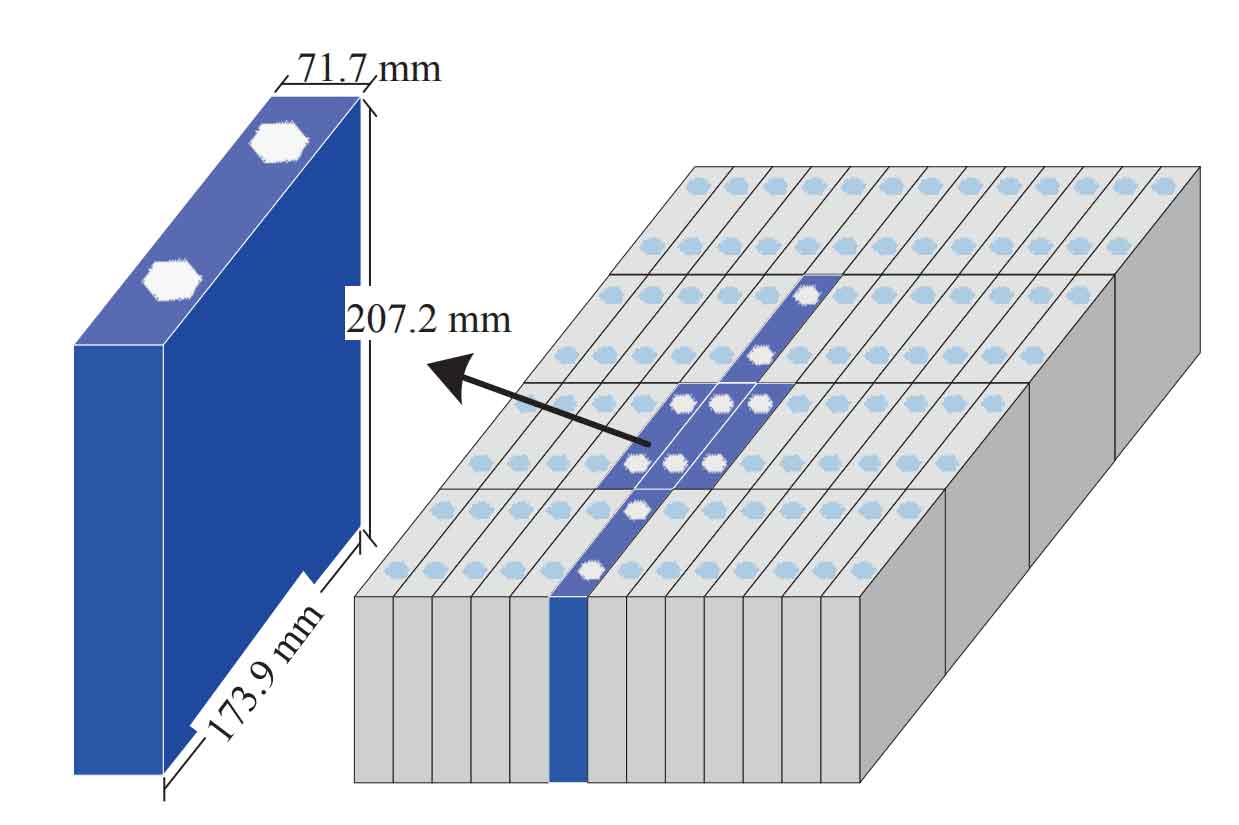
The 82 L sealed pressure chamber housed a 120 Ah prismatic LiFePO4 battery (2,860 g mass, 3.2 V nominal voltage) subjected to lateral heating (952 W). Key parameters were monitored using k-type thermocouples and gas chromatography (GC). Two atmospheric conditions were tested:
- Inert atmosphere: Pure nitrogen environment
- Air atmosphere: Ambient air composition
2. Thermal Runaway Characteristics
The thermal runaway process exhibited four distinct phases:
- Heating phase (0–904 s): Linear temperature rise (0.6°C/s average)
- Vent opening (904–1,290 s): Initial gas release at 117.5°C
- Thermal runaway (1,290–1,750 s): Exponential temperature spike (3.9°C/s peak rate)
- Cooling phase (>1,750 s): Gradual temperature decay
Key temperature metrics under inert atmosphere:
| Parameter | Value |
|---|---|
| Maximum surface temperature | 218.0°C |
| Peak ambient temperature (20 cm lateral) | 131.7°C |
| Vertical temperature gradient | 46°C/m (10–20 cm height) |
3. Gas Evolution Dynamics
The ideal gas law quantified gas production:
$$ p_0V_{\text{chamber}} = n_0R\theta_0 $$
$$ p_xV_{\text{chamber}} = n_xR\theta_x $$
$$ \Delta n = n_x – n_0 $$
Key gas metrics under inert atmosphere:
| Parameter | Value |
|---|---|
| Total gas volume | 35.5 L |
| Peak venting rate | 19.7 L/s |
| Maximum chamber pressure | 215.2 kPa |
Gas composition analysis revealed:
| Component | Volume % | Flammability Limit |
|---|---|---|
| H2 | 52.8% | 4–75% |
| CO2 | 26.5% | Non-flammable |
| CO | 7.4% | 12.5–74% |
| CH4 | 6.2% | 5–15% |
| C2H4 | 5.0% | 2.7–36% |
The composite flammability limit (Le Chatelier’s principle):
$$ L_{\text{mix}} = \frac{1}{\sum_{i=1}^{n} \frac{x_i}{L_i}} \times 100\% = 6.3\%–67.9\% $$
4. Atmospheric Effects Analysis
Comparative analysis revealed significant atmospheric influences:
| Parameter | Inert | Air | Δ |
|---|---|---|---|
| Peak temperature | 218.0°C | 256.3°C | +17.6% |
| Thermal runaway duration | 460 s | 524 s | +14% |
| Total gas volume | 35.5 L | 38.4 L | +8.2% |
| H2 concentration | 52.8% | 48.1% | -9% |
The enhanced reactivity in air atmosphere originates from:
$$ \text{Li} + \text{O}_2 \rightarrow \text{Li}_2\text{O} \quad (\Delta H = -598.7 \, \text{kJ/mol}) $$
$$ \text{C} + \text{O}_2 \rightarrow \text{CO}_2 \quad (\Delta H = -393.5 \, \text{kJ/mol}) $$
5. Safety Implications
Lithium iron phosphate batteries demonstrate distinct thermal behavior compared to nickel-rich counterparts:
| Metric | LiFePO4 | NMC 811 |
|---|---|---|
| TR onset temperature | 170–200°C | 140–160°C |
| Peak gas pressure | 200–250 kPa | 300–400 kPa |
| Flammability index | 0.63 | 0.89 |
Critical safety parameters for lithium iron phosphate battery systems:
$$ \tau_{\text{response}} = \frac{T_{\text{TR}} – T_{\text{vent}}}{dT/dt} = \frac{218 – 117.5}{3.9} \approx 25.8 \, \text{s} $$
$$ Q_{\text{critical}} = \rho_{\text{gas}}c_pV_{\text{gas}}(T_{\text{ignition}} – T_{\text{ambient}}) $$
6. Conclusion
This investigation establishes fundamental correlations between atmospheric conditions and thermal runaway severity in lithium iron phosphate batteries. Air atmosphere exacerbates thermal runaway through:
- 17.6% higher peak temperatures
- 14% longer reaction duration
- 8.2% increased gas production
The results emphasize the necessity for atmosphere-specific safety protocols in lithium iron phosphate battery storage and thermal management systems. Future work should investigate mitigation strategies for oxygen-assisted combustion in large-scale battery arrays.