
Energy storage lithium batteries have gained widespread adoption in modern energy systems due to their high energy density, long cycle life, and environmental benefits. Containerized energy storage systems, which offer high integration and mobility, have become a mainstream solution for electrochemical energy storage power stations. However, safety incidents, particularly those involving thermal runaway of energy storage lithium batteries, have raised concerns, with temperature being a critical factor influencing battery safety, performance, and longevity. In cold regions, external environmental conditions, such as temperature fluctuations and solar radiation, can significantly affect the thermal behavior of energy storage lithium batteries. This study investigates the comprehensive thermal effects of ambient temperature variations and radiation on energy storage lithium batteries within a container, focusing on both operational and non-operational states. We analyze heat infiltration and its implications for battery thermal management, providing insights for designing efficient thermal control strategies.
The thermal characteristics of energy storage lithium batteries are governed by internal heat generation and external environmental interactions. To model this, we employ the Bernardi heat generation rate model, which accounts for reversible and irreversible heat during battery operation. The energy conservation equation for lithium battery heat transfer is expressed as:
$$ \frac{\partial}{\partial \tau} (\rho c_p T) = \frac{\partial}{\partial x} \left( \lambda_x \frac{\partial T}{\partial x} \right) + \frac{\partial}{\partial y} \left( \lambda_y \frac{\partial T}{\partial y} \right) + \frac{\partial}{\partial z} \left( \lambda_z \frac{\partial T}{\partial z} \right) + q $$
where \( \rho \) is the density, \( c_p \) is the specific heat capacity, \( \lambda_x, \lambda_y, \lambda_z \) are the thermal conductivities in the x, y, and z directions, respectively, \( T \) is the temperature, and \( q \) is the heat generation rate per unit volume. The heat generation rate \( q \) is given by:
$$ q = \frac{1}{V_b} \left[ I (U_{ocv} – U) – I T \frac{dU_{ocv}}{dT} \right] = \frac{1}{V_b} \left[ I^2 R – I T \frac{dU_{ocv}}{dT} \right] $$
Here, \( I \) is the discharge current, \( V_b \) is the battery volume, \( U_{ocv} \) is the open-circuit voltage, \( U \) is the operating voltage, \( R \) is the internal resistance, and \( T \frac{dU_{ocv}}{dT} \) is taken as a constant value of 0.011 V. For this study, we assume uniform material distribution within the battery, homogeneous heat generation, anisotropic thermal conductivity that varies with temperature, and negligible contact resistance between adjacent batteries.
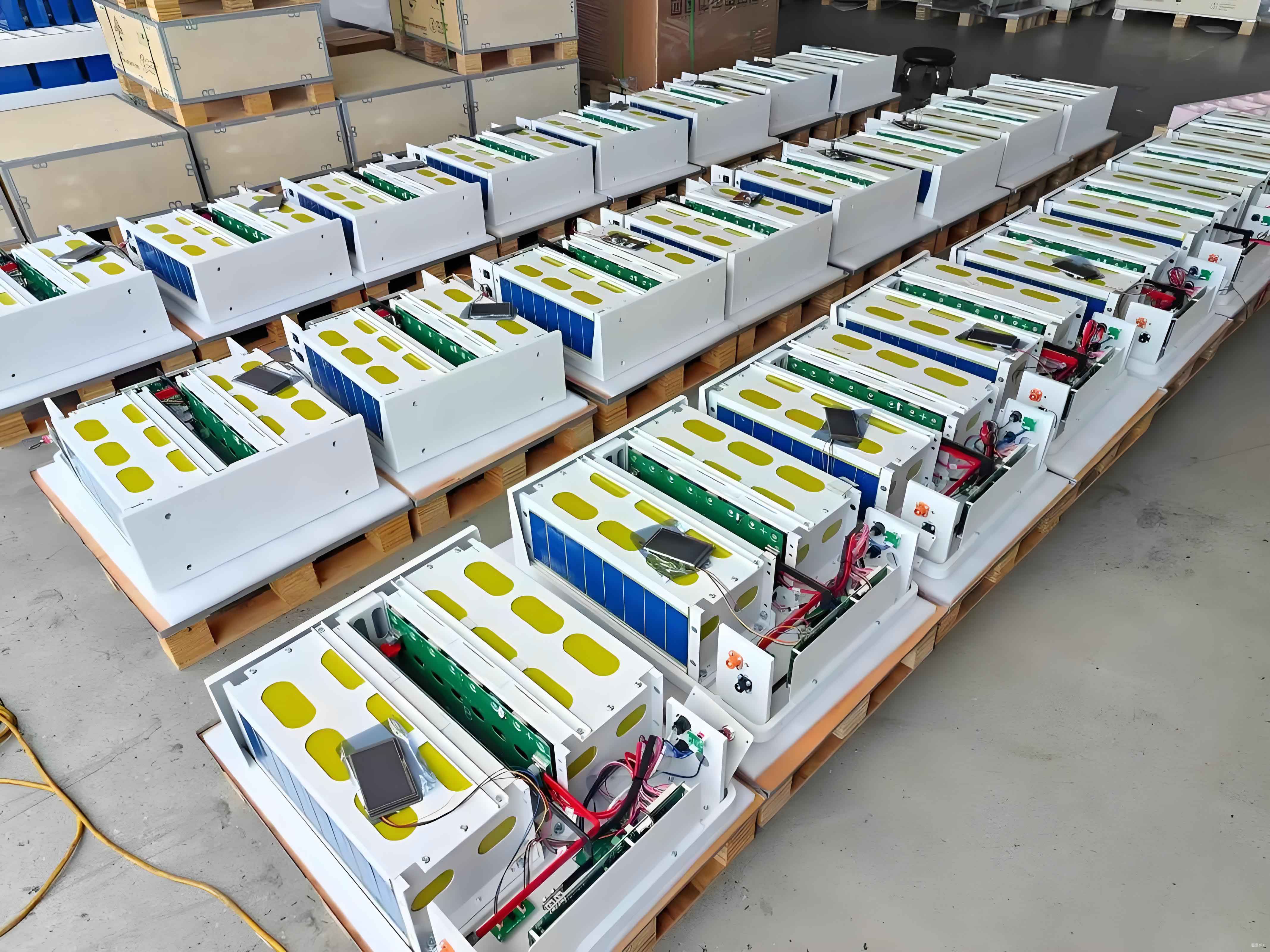
To determine the thermal properties of the energy storage lithium battery, we conducted experiments measuring specific heat capacity and anisotropic thermal conductivity. The battery under investigation is a 200 Ah lithium iron phosphate (LFP) battery with the following specifications:
| Parameter | Value |
|---|---|
| Dimensions (Length × Width × Height) / mm | 175 × 55 × 208 |
| Mass / kg | 4.12 |
| Rated Capacity / Ah | 200 |
| Rated Voltage / V | 3.2 |
| Discharge Cut-off Voltage / V | 2.5 |
| Charge Cut-off Voltage / V | 3.65 |
| Operating Temperature (Charge) / °C | 0 to 60 |
| Operating Temperature (Discharge) / °C | −30 to 60 |
| Density / kg/m³ | 2057.94 |
The specific heat capacity \( c_p \) was calculated using:
$$ c_p \cdot m \cdot \Delta t_c = \int_{\tau=0}^{\tau=\tau_1} P \, d\tau $$
where \( m \) is the battery mass, \( \Delta t_c \) is the temperature change, and \( P \) is the heating power. The anisotropic thermal conductivity was determined using the one-dimensional transient plane source method:
$$ \lambda = \frac{2 q_0}{T_{0,\tau}} \sqrt{\frac{\alpha \tau}{\pi}} $$
with \( q_0 = \frac{P}{2A} \), where \( A \) is the heating area, and \( \alpha \) is the thermal diffusivity. The thermal properties as functions of temperature were fitted to experimental data, resulting in the following equations:
$$ c_p = 33.53 t_c + 424.98 $$
$$ \lambda_x = 227.58 t_c – 16.23 t_c^2 + 0.58 t_c^3 – 0.01 t_c^4 + 0.00007 t_c^5 – 1253.47 $$
$$ \lambda_y = 40.47 t_c – 2.96 t_c^2 + 0.11 t_c^3 – 0.002 t_c^4 + 0.00001 t_c^5 – 218.85 $$
$$ \lambda_z = 224.68 t_c – 15.47 t_c^2 + 0.53 t_c^3 – 0.009 t_c^4 + 0.00006 t_c^5 – 1284.98 $$
where \( t_c \) is the battery temperature in °C. These relationships ensure accurate modeling of the energy storage lithium battery’s thermal behavior under varying conditions.
Discharge experiments were conducted at rates of 0.1 C, 0.2 C, 0.3 C, 0.4 C, and 0.5 C to characterize the internal resistance and validate the heat generation model. The internal resistance \( R \) was measured using the Hybrid Pulse Power Characterization (HPPC) method:
$$ R = \frac{U_1 – U_2}{I} $$
where \( U_1 \) and \( U_2 \) are voltages before and during the pulse discharge, and \( I \) is the current. The internal resistance varied with discharge rate, as summarized below:
| Discharge Rate | Internal Resistance Range / Ω |
|---|---|
| 0.1 C | 0.008 – 0.012 |
| 0.2 C | 0.007 – 0.011 |
| 0.3 C | 0.006 – 0.010 |
| 0.4 C | 0.005 – 0.009 |
| 0.5 C | 0.004 – 0.008 |
Validation of the heat generation model showed that simulation results closely matched experimental data, with relative errors below 5% across all discharge rates. This confirms the model’s reliability for predicting the thermal characteristics of energy storage lithium batteries.
Next, we analyze heat infiltration into the container from the external environment. The container is a 45-foot high-cabinet type with the following specifications:
| Component | Dimensions (Length × Width × Height) / m | Area / m² | Overall Thermal Conductivity / W/(m·K) | Thickness / m |
|---|---|---|---|---|
| Side | 13.546 × 2.350 × 2.693 | 85.62 | 0.04 | 0.10 |
| Top | 13.546 × 2.350 | 31.83 | 0.04 | 0.10 |
| Bottom | 13.546 × 2.350 | 31.83 | 0.031 | 0.24 |
The net heat infiltration power \( P_{\text{net}} \) into the container is composed of three components: heat transfer due to temperature difference across the enclosure \( P_{e-i} \), solar radiation heat gain \( P_{\text{sol}} \), and sky radiation heat loss \( P_{\text{sky}} \). It is calculated as:
$$ P_{\text{net}} = K_{\text{eff}} S \Delta t $$
where \( K_{\text{eff}} \) is the effective heat transfer coefficient, \( S \) is the surface area, and \( \Delta t \) is the temperature difference between inside and outside. The effective heat transfer coefficient is given by:
$$ K_{\text{eff}} = \varepsilon_R K $$
$$ K = \frac{1}{\frac{1}{\alpha_i} + \frac{1}{\alpha_e} + \frac{h}{\lambda}} $$
$$ \varepsilon_R = 1 + \frac{t_{\text{sky,eq}} – t_{\text{sol,eq}}}{t_i – t_e} $$
$$ t_{\text{sol,eq}} = \frac{\rho_0 I_H}{\alpha_e} $$
Here, \( \alpha_i \) and \( \alpha_e \) are the inner and outer convective heat transfer coefficients, \( h \) is the thickness, \( \lambda \) is the overall thermal conductivity, \( t_{\text{sky,eq}} \) is the sky equivalent temperature (0°C), \( t_{\text{sol,eq}} \) is the solar radiation equivalent temperature, \( \rho_0 \) is the solar absorption coefficient (0.25 for white surface), and \( I_H \) is the solar radiation intensity. The heat flux density \( q_{\text{net}} \) is:
$$ q_{\text{net}} = \frac{P_{\text{net}}}{S} $$
For a cold region like Baotou, winter and summer conditions are considered. The parameters are as follows:
| Parameter | Winter Value | Summer Value |
|---|---|---|
| External Temperature \( t_e \) / °C | −16.6 | 31.7 |
| External Convective Coefficient \( \alpha_e \) / W/(m²·K) | 23 | 19 |
| Effective Heat Transfer Coefficient \( K_{\text{eff}} \) / W/(m·K) | 0.376 (sides + top), 0.127 (bottom) | 0.739 (sides + top), 0.248 (bottom) |
| Net Infiltration Power \( P_{\text{net}} \) / W | −2005 | 635 |
| Heat Flux Density \( q_{\text{net}} \) / W/m² | −13.43 | 4.25 |
In simulations, this heat flux is applied to the battery surfaces, representing the external environmental impact on the energy storage lithium battery.
We now examine the effects of external environment on the energy storage lithium battery during operation. The battery cluster consists of multiple modules, and simulations are performed for discharge rates from 0.1 C to 0.5 C under winter and summer conditions. The initial temperatures for different discharge rates are:
| Discharge Rate | Initial Temperature / °C |
|---|---|
| 0.1 C | 20.28 |
| 0.2 C | 20.14 |
| 0.3 C | 22.97 |
| 0.4 C | 23.13 |
| 0.5 C | 22.90 |
Under winter conditions, the maximum temperatures of the energy storage lithium battery cluster increase with discharge rate: 27.61°C at 0.1 C, 30.33°C at 0.2 C, 34.43°C at 0.3 C, 36.37°C at 0.4 C, and 37.66°C at 0.5 C. For discharge rates of 0.4 C and above, temperatures exceed 35°C, indicating potential thermal risks. In summer, the maximum temperatures are higher: 30.31°C at 0.1 C, 31.59°C at 0.2 C, 35.16°C at 0.3 C, 37.21°C at 0.4 C, and 38.03°C at 0.5 C. At 0.3 C and above, temperatures surpass 35°C. The temperature distribution differs between seasons due to the direction of heat flux: in winter, the container interior is warmer, leading to heat loss from batteries, while in summer, the exterior is hotter, causing heat gain.
The influence of external environment on the maximum temperature during operation is analyzed. As the discharge rate increases, the maximum temperatures under winter and summer conditions converge, indicating that self-heating dominates over external effects at higher rates. The temperature rise due to self-heating and external effects is summarized below:
| Discharge Rate | Self-Heating Temperature Rise / °C | Winter Temperature Rise / °C | Summer Temperature Rise / °C | Winter Influence / % | Summer Influence / % |
|---|---|---|---|---|---|
| 0.1 C | 9.27 | 7.33 | 10.03 | 20.93 | 8.20 |
| 0.2 C | 11.02 | 10.19 | 11.45 | 7.53 | 3.90 |
| 0.3 C | 11.89 | 11.46 | 12.19 | 3.62 | 2.52 |
| 0.4 C | 13.82 | 13.54 | 14.08 | 2.03 | 1.88 |
| 0.5 C | 14.96 | 14.76 | 15.13 | 1.34 | 1.14 |
Winter has a more pronounced impact on temperature rise, with influence degrees ranging from 1.34% to 20.93%, while summer influences range from 1.14% to 8.20%. This is attributed to the larger temperature difference between the container interior and exterior in winter. At higher discharge rates, the effect of external environment diminishes as internal heat generation becomes the primary factor.
For the non-operational state, we consider a 24-hour period with constant external temperatures: −16.6°C in winter and 31.7°C in summer, and an initial battery temperature of 25°C. After 24 hours, in winter, the energy storage lithium battery cluster reaches an average temperature of 14.1°C, with a maximum of 14.45°C and a minimum of 13.75°C, resulting in a temperature drop of 10.9°C (43.6% of initial temperature). The temperature difference between batteries is 0.7°C. In summer, the average temperature is 27.85°C, with a maximum of 27.94°C and a minimum of 27.76°C, leading to a rise of 2.85°C (11.4% of initial temperature). The temperature uniformity is better in summer, with a difference of 0.18°C.
The relationship between environmental exposure time and temperature change is linear over 24 hours. In winter, after 6 and 12 hours, the temperature decreases to 22.19°C and 19.57°C, respectively, corresponding to reductions of 11.24% and 21.72%. In summer, after 6 and 12 hours, temperatures increase to 25.83°C and 26.55°C, representing rises of 3.33% and 6.19%. The influence degree per unit temperature difference is linear. Without radiation, the temperature change per hour is described by:
$$ t_c = t_0 \pm t_0 (0.04378 t + 0.00708) $$
With radiation, the relationship is:
$$ t_c = t_0 \pm t_0 (0.07095 t + 0.06255) $$
where \( t_c \) is the battery temperature, \( t_0 \) is the initial temperature, and \( t \) is the exposure time in hours. Radiation amplifies the temperature change, highlighting its significant role in affecting energy storage lithium battery thermal behavior.
In conclusion, the external environment profoundly influences the thermal characteristics of energy storage lithium batteries in containerized systems. During operation, higher discharge rates reduce the relative impact of external conditions, as self-heating dominates. In non-operational states, temperature changes are linear with time, and radiation significantly enhances these effects. These findings emphasize the need for dynamic thermal management strategies that account for seasonal variations and operational states to maintain optimal performance and safety of energy storage lithium batteries. This study provides a foundation for designing efficient thermal control systems in cold regions.