
This paper proposes a fuzzy reasoning-based method to evaluate the thermal diffusion probability of lithium-ion battery modules (LIBMs) in energy storage systems. Through systematic simulations and optimization techniques, we establish a reliable framework for predicting thermal runaway risks under time-varying operational conditions.
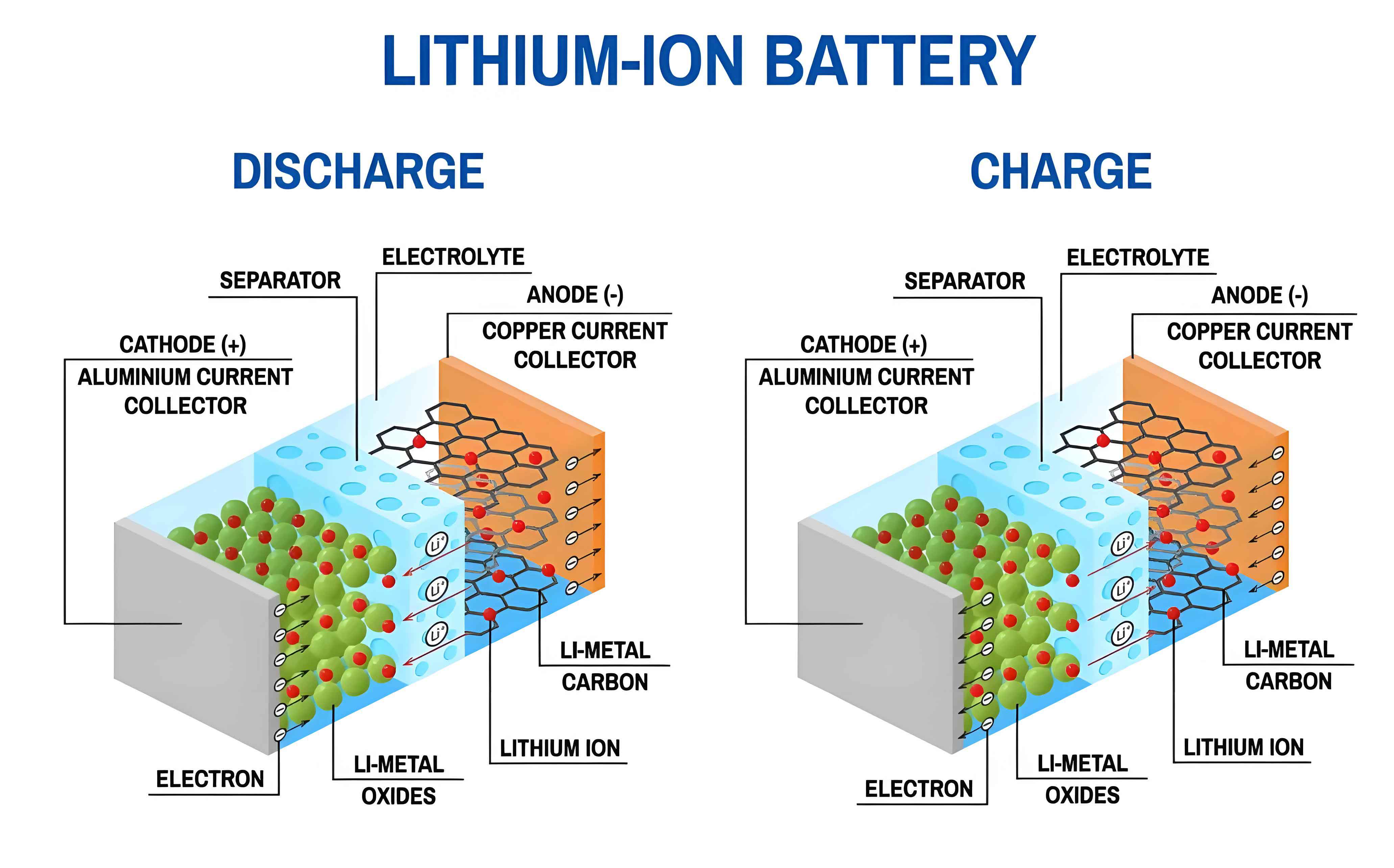
1. Thermal Behavior Modeling of Lithium-Ion Batteries
The thermal runaway mechanism in lithium-ion batteries involves coupled electrochemical-thermal processes described by:
$$ \rho C_p \frac{\partial T}{\partial t} = \nabla \cdot (k_{\text{bat}} \nabla T) + Q_{\text{total}} $$
Where the total heat generation $Q_{\text{total}}$ combines multiple sources:
$$ Q_{\text{total}} = q_s + q_{\text{isc}} + q_h $$
$$ q_s = \sum_{i=1}^5 H_i W_i A_i [c_i(t)]^{\gamma_i} [1-c_i(t)]^{\delta_i} \exp\left(-\frac{E_i}{R_a T(t)}\right) $$
| Component | Density (kg/m³) | Specific Heat (J/g·K) | Thermal Conductivity (W/m·K) |
|---|---|---|---|
| Electrode Core | 1367 | 2867 | $k_x = k_y = 13.8$, $k_z = 1.38$ |
| Positive Tab | 2700 | 900 | 160 |
| Negative Tab | 8960 | 385 | 146 |
2. Thermal Diffusion Characteristics Analysis
Key factors influencing thermal propagation in lithium-ion battery modules include:
| Arrangement | Max Temp (°C) | Propagation Time (s) |
|---|---|---|
| Compact Stacking | 992 | 1672 |
| Partial Contact | 999 | 1720 |
| Reduced Interface | 1016 | 3546 |
The state of charge (SOC) significantly affects thermal stability:
$$ \frac{\partial T_{\text{max}}}{\partial \text{SOC}} = 2.34^{\circ}\text{C}/\% \quad (\text{SOC} > 75\%) $$
3. Fuzzy Inference System Architecture
Our fuzzy reasoning system uses three critical inputs for lithium-ion battery safety evaluation:
$$ \text{Inputs} = \{T_{\text{self}}, D_N, T_{\text{env}}\} $$
$$ \text{Output} = P_{\text{tr}} \in [0,1] $$
| Variable | Fuzzy Sets | Domain |
|---|---|---|
| $T_{\text{self}}$ | {Low, Medium, High} | [0,1] |
| $D_N$ | {Very Near, Near, Medium, Far} | [0,3] |
| $T_{\text{env}}$ | {Low, Medium, High} | [0,1] |
4. Improved Dung Beetle Optimization
The enhanced algorithm features dynamic parameter adaptation:
$$ \beta = e^{zr} \cdot \cos(2\pi r) $$
$$ z = e^{m \cdot \cos(\pi l)} $$
Where $l$ represents the normalized iteration progress. The optimization constraints ensure valid membership function configurations:
$$ 0 < \mu_5 < \mu_6 < \mu_7 < 1 $$
5. Validation and Performance Comparison
The proposed method demonstrates superior correlation with actual lithium-ion battery thermal behavior:
| Algorithm | PCC Score | Convergence Iterations |
|---|---|---|
| IDBO | 0.978 | 42 |
| Standard DBO | 0.902 | 58 |
| PSO | 0.937 | 67 |
| SSA | 0.931 | 73 |
Experimental validation under random conditions confirms the model’s reliability:
$$ P_{\text{tr}} = 0.984 \Rightarrow T_{\text{max}} = 945^{\circ}\text{C} \quad (\text{Experimental}) $$
$$ |P_{\text{tr}}^{\text{pred}} – P_{\text{tr}}^{\text{exp}}| < 0.05 \quad (95\% \text{ Confidence}) $$
6. Implementation Considerations
Practical applications in lithium-ion battery energy storage systems require:
- Real-time temperature monitoring with ±1°C accuracy
- Modular spacing optimization based on $D_N$ calculations
- Adaptive cooling strategies triggered at $P_{\text{tr}} > 0.8$
This methodology enables proactive thermal management of lithium-ion battery modules, significantly enhancing the safety and reliability of modern energy storage systems. The integration of physical modeling with intelligent optimization provides a robust framework for predicting and preventing thermal runaway propagation.