
The management and optimal utilization of modern electrochemical energy storage systems hinge upon a deep understanding of their intrinsic properties. Among these systems, the lithium-ion battery stands as a cornerstone technology. While empirical equivalent circuit models and dynamic electrochemical models are invaluable for simulation and real-time management, they often lack a fundamental description of the battery’s equilibrium state—a condition where no external current flows, yet a definitive relationship between its potential, stored charge, and temperature exists. This article explores the derivation of a thermodynamic state equation for a lithium-ion battery, providing a foundational framework to calculate critical internal parameters and inform system design for longevity and efficiency.
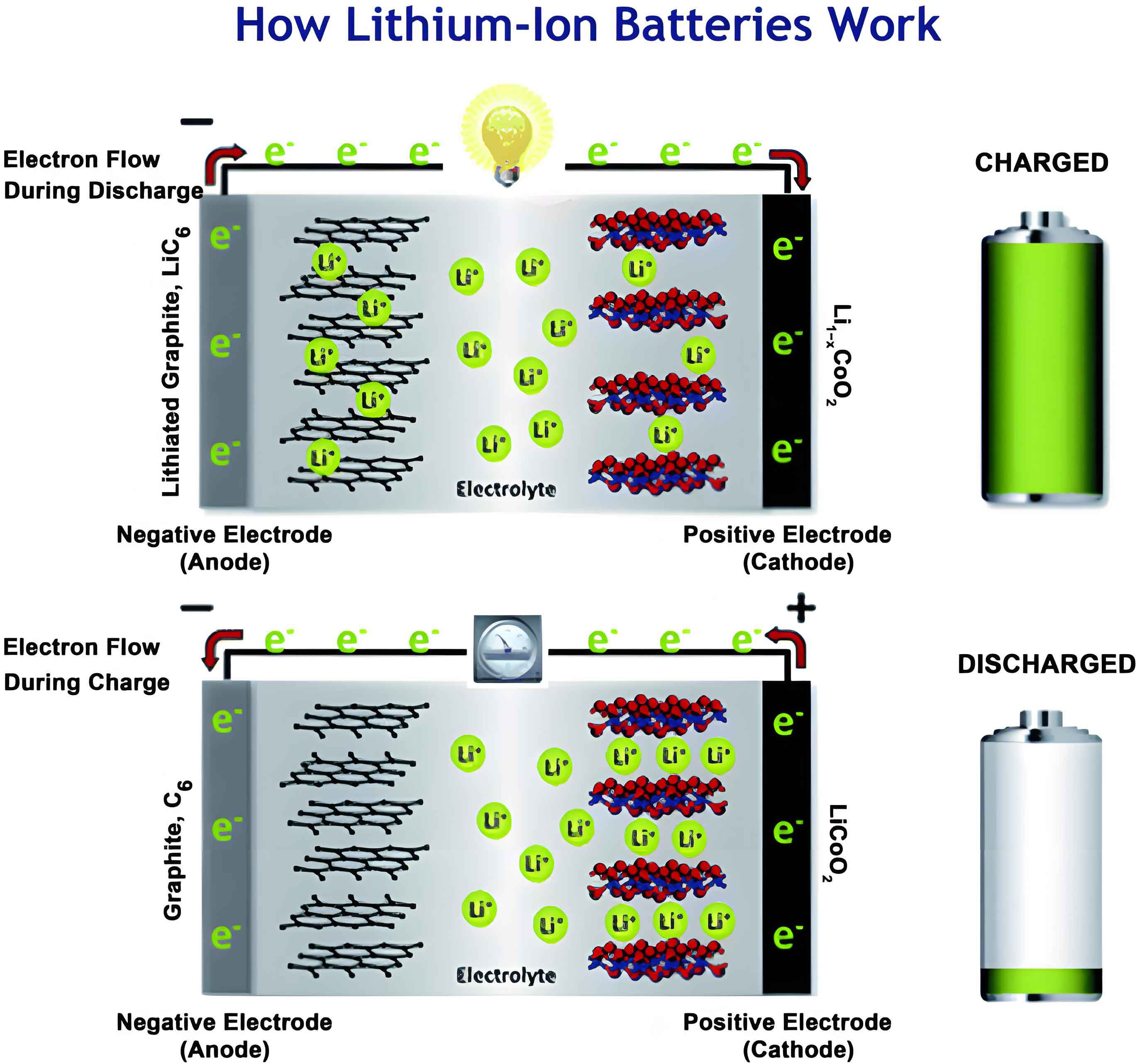
When a lithium-ion battery is at equilibrium (open circuit), internal dissipative processes can be neglected, allowing its behavior to be treated as a reversible thermodynamic process. For such a simple system with electrical work as the primary mode of energy exchange, the combined first and second laws of thermodynamics yield the fundamental differential for the internal energy \( U \):
$$ dU = T dS + E dQ $$
Here, \( T \) is the absolute temperature, \( S \) is the entropy, \( E \) is the equilibrium electromotive force (EMF) or open-circuit voltage, and \( Q \) is the electric charge stored (directly related to the moles of lithium transferred). To obtain a more convenient thermodynamic potential, we introduce the Helmholtz free energy \( A \), defined as:
$$ A = U – TS $$
Taking its differential and substituting the expression for \( dU \), we arrive at the central thermodynamic relation for the battery system:
$$ dA = -S dT + E dQ $$
This equation identifies \( A(T, Q) \) as a characteristic function. From it, the battery EMF can be derived as a partial derivative at constant temperature:
$$ E = \left( \frac{\partial A}{\partial Q} \right)_T $$
This inherently defines a functional relationship of the form:
$$ E = E(T, Q) $$
Equation (5) is the general state equation for an electrochemical cell in equilibrium. It compactly describes how the open-circuit voltage depends on both its state of charge (SOC) and its temperature. In principle, if the free energy function \( A(T, Q) \) is known from experimental data or theoretical modeling, the state equation is determined.
To progress from the general formulation to a specific model for a lithium-ion battery, we analyze the underlying process. The charge-discharge cycle involves the shuttling of lithium between the anode and cathode, accompanied by electron transfer through the external circuit. This can be conceptualized as an adsorption/desorption process of lithium species onto the electrode materials. We represent this schematically as:
$$ (\text{Li})_{\text{Re}} \ \underset{\text{charging}}{\overset{\text{discharging}}{\rightleftharpoons}} \ (\text{Li})_{\text{Pr}} $$
where \( (\text{Li})_{\text{Re}} \) denotes lithium in the anode (reactant side) and \( (\text{Li})_{\text{Pr}} \) denotes lithium in the cathode (product side) during discharge. The electrical work performed by the system during a reversible discharge involving the transfer of \( Q \) moles of lithium is equal to the negative change in the Gibbs free energy (closely related to Helmholtz free energy for condensed phases with negligible volume change) of the reaction:
$$ W = -\Delta A_r $$
The free energy change \( \Delta A_r \) can be expressed in terms of standard free energy and activities:
$$ \Delta A_r = \Delta A_r^0 + RT \ln\left( \frac{a_{\text{Pr}}}{a_{\text{Re}}} \right) $$
The activities \( a \) represent the effective “concentration” or availability of lithium at each electrode. Assuming ideal mixing or simple concentration dependence, we can model them as proportional to the mole fractions of lithium in the respective electrodes. Let the initial moles of active lithium in the cathode and anode be \( a \) and \( b \), respectively. After transferring \( Q \) moles from anode to cathode during discharge, the activities can be approximated as:
$$ a_{\text{Pr}} \propto \frac{a + Q}{V_{\text{Pr}}}, \quad a_{\text{Re}} \propto \frac{b – Q}{V_{\text{Re}}} $$
where \( V \) denotes a representative volume. Substituting into the free energy expression gives:
$$ \Delta A_r = \Delta A_r^0 + RT \ln\left( \frac{a + Q}{b – Q} \cdot \frac{V_{\text{Re}}}{V_{\text{Pr}}} \right) = \Delta A_r’^0 + RT \ln\left( \frac{a + Q}{b – Q} \right) $$
Here, \( \Delta A_r’^0 = \Delta A_r^0 + RT \ln(V_{\text{Re}}/V_{\text{Pr}}) \) is primarily a function of temperature, as volume changes are typically minor. The electrical work per mole of electrons (or per Faraday, \( F \)) is the EMF. For the discharge process, this yields:
$$ E_{\text{discharge}}’ = \frac{W}{F} = -\frac{\Delta A_r}{F} = -\frac{\Delta A_r’^0}{F} – \frac{RT}{F} \ln\left( \frac{a + Q}{b – Q} \right) $$
For the charging process, the reaction direction is reversed, and the battery acts as a load, exhibiting a counter-EMF. The corresponding equation is:
$$ E_{\text{charge}} = \frac{\Delta A_r}{F} = \frac{\Delta A_r’^0}{F} + \frac{RT}{F} \ln\left( \frac{a + Q}{b – Q} \right) $$
This is the more conventional form for describing the potential during charging. We can define \( E_0(T) = \Delta A_r’^0 / F \) as a standard potential dependent on temperature. Therefore, the general state equation for a lithium-ion battery during charge takes the familiar Nernst-like form:
$$ E(T, Q) = E_0(T) + \frac{RT}{F} \ln\left( \frac{a + Q}{b – Q} \right) $$
To account for non-idealities, deviations from simple logarithmic dependence, and the temperature variation of \( E_0 \), a more flexible empirical form consistent with the thermodynamic framework can be proposed:
$$ E(T, Q) = c + mT + \frac{d}{T^n} \ln\left( \frac{a + Q}{b – Q} \right) $$
where \( c, m, d, n, a, \) and \( b \) are constants specific to the battery chemistry and design, obtainable by fitting experimental equilibrium data. This equation explicitly manifests the functional relationship \( E = E(T, Q) \) mandated by thermodynamics.
The power of a well-defined state equation lies in its ability to derive crucial secondary parameters that are not directly measurable but offer profound insight into the internal state of the lithium-ion battery. One such parameter is the differential capacitance \( C_b \), defined as:
$$ C_b(T, Q) = \left( \frac{\partial Q}{\partial E} \right)_T $$
This coefficient is the inverse of the slope of the equilibrium voltage curve at a fixed temperature and state of charge. It is not a physical capacitor but a thermodynamic response function indicating how “stiff” or “compliant” the battery voltage is with respect to charge addition. A small \( C_b \) implies a large change in voltage for a small change in charge, signifying high internal electrochemical stress or potential, often associated with electrode material limits (e.g., nearing full lithiation or delithiation). Conversely, a large \( C_b \) indicates a flat voltage profile where charge can be added or removed with minimal change in potential, corresponding to a lower-stress, more stable operating region.
Using published charge curve data for a specific lithium-ion battery at a constant temperature (approximately 298 K), the parameters for Equation (12) can be fitted. The resulting model shows excellent agreement with the experimental voltage versus state-of-charge (SOC) profile, validating the thermodynamic approach. From this fitted state equation, the differential capacitance \( C_b \) can be calculated analytically or numerically across the entire SOC range. The following table presents calculated \( C_b \) values at various SOC points, derived from the model.
| State of Charge (SOC), Q | Open-Circuit Voltage, E (V) [Data] | Calculated Differential Capacitance, C_b (Ah/V) |
|---|---|---|
| 0.0 | 3.43 | 0.18 |
| 0.1 | 3.59 | 0.45 |
| 0.2 | 3.65 | 0.83 |
| 0.3 | 3.75 | 0.95 |
| 0.4 | 3.83 | 1.25 |
| 0.5 | 3.87 | 1.67 |
| 0.6 | 3.92 | 2.50 |
| 0.7 | 3.98 | 2.50 |
| 0.8 | 4.03 | 2.00 |
| 0.9 | 4.06 | 1.25 |
| 1.0 | 4.15 | 0.20 |
The data reveals a clear trend: the differential capacitance is lowest at the extremes of SOC (0 and 1.0) and peaks in the mid-SOC range (around 0.6-0.7). This quantifies the intuitive understanding that operating a lithium-ion battery at very high or very low states of charge subjects it to higher internal stresses, which can accelerate degradation mechanisms like solid electrolyte interphase (SEI) growth, lithium plating, or mechanical strain in electrode materials. Therefore, for applications where cycle life is paramount, the operational voltage window (and corresponding SOC window) should be constrained to regions where \( C_b \) remains relatively high and stable. An optimal strategy for symmetric cycling to minimize stress asymmetry would be to select charge and discharge cutoff voltages such that the \( C_b \) values at both endpoints are equal. This ensures that the battery experiences similar levels of electrochemical “pressure” at the termini of both charge and discharge, promoting homogeneous aging. The thermodynamic state equation provides the precise tool needed to identify these voltage thresholds.
Beyond differential capacitance, other important coefficients can be derived. The temperature coefficient of voltage at constant charge, a key parameter for thermal management, is:
$$ \alpha(Q) = \left( \frac{\partial E}{\partial T} \right)_Q = m + \frac{\partial}{\partial T}\left[\frac{d}{T^n} \ln\left( \frac{a+Q}{b-Q} \right)\right] $$
The entropy change of the cell reaction, which governs reversible heat generation, is related to this coefficient by the Maxwell relation derived from Equation (3):
$$ \left( \frac{\partial S}{\partial Q} \right)_T = -\left( \frac{\partial E}{\partial T} \right)_Q = -\alpha(Q) $$
Thus, measuring or modeling the state equation allows for the calculation of the reversible heat flow during charging or discharging, which is crucial for accurate thermal modeling of battery packs. Furthermore, the derivative \( \beta(T) = (\partial E / \partial Q)_T = 1/C_b \) directly informs the design of voltage-based SOC estimation algorithms, providing the fundamental link between a measured open-circuit voltage and the stored charge.
In conclusion, the application of classical thermodynamics to the equilibrium state of a lithium-ion battery yields a powerful and general framework—the battery state equation \( E(T, Q) \). This equation is not merely an empirical fit but is rooted in the fundamental energy principles governing the electrochemical reactions within the cell. Through theoretical analysis of the lithium shuttling process, a specific Nernst-like form of this equation can be constructed and validated against experimental data. The true utility of this model extends beyond curve fitting. It serves as a generative function for critical, internally consistent thermodynamic coefficients like the differential capacitance \( C_b \), the temperature coefficient \( \alpha \), and the reaction entropy change. These parameters are indispensable for advanced battery management system (BMS) design, enabling strategies for stress-minimized cycling to enhance longevity, improving SOC estimation accuracy, and refining thermal management protocols. Ultimately, embracing this thermodynamic perspective provides a deeper, more predictive understanding of lithium-ion battery behavior, forming a solid foundation for optimizing their performance, safety, and lifespan in complex energy storage applications.