
The global push for decarbonization is accelerating, with market-based mechanisms like carbon emission trading playing a pivotal role. As of mid-July, a major national carbon market has seen cumulative trading volume reach 465 million tons, with a cumulative turnover nearing 270 billion yuan. This market, launched in July 2021, has now completed two compliance cycles, covering annual carbon dioxide emissions of approximately 5.1 billion tons. This represents over 40% of the nation’s total emissions, making it the world’s largest carbon market by covered emissions. A recent development report indicates vigorous growth: in the second compliance cycle, cumulative trading volume and turnover surged by 47.01% and 125.26% respectively compared to the first. In the first half of this year, monthly average trading volume soared by 174.90% year-over-year. This robust expansion is set to continue, with plans to steadily broaden the market’s scope to include key high-emission industries like steel, cement, and aluminum smelting. This macroeconomic and regulatory backdrop creates a powerful imperative for deep decarbonization across all sectors, with transportation being a prime target.
Within the transportation sector, the electrification of vehicles stands as a cornerstone strategy. While lithium-ion batteries have achieved remarkable progress in cost-effectiveness and performance, they present intrinsic limitations that hinder the complete displacement of internal combustion engines. The key constraints can be summarized by a few critical parameters and persistent consumer concerns:
- Charge Time ($t_c$): Governed by charging power ($P_{ch}$) and battery capacity ($C$), often requiring 30 minutes to several hours for a significant recharge. $$ t_c \propto \frac{C}{P_{ch}} $$
- Energy Density ($E_d$): Limits driving range. Current state-of-the-art lithium-ion batteries achieve up to ~300 Wh/kg. Range anxiety stems from this limitation. $$ E_d = \frac{Q \times V}{m} $$ where $Q$ is charge capacity, $V$ is average voltage, and $m$ is mass.
- Safety Risks: Primarily due to the flammable liquid organic electrolyte, which can lead to thermal runaway under conditions of mechanical damage, overcharging, or internal short circuits.
It is against this backdrop that the solid-state battery emerges not merely as an incremental improvement, but as a potential paradigm shift. A solid-state battery fundamentally replaces the liquid or polymer gel electrolyte found in conventional lithium-ion cells with a solid electrolyte. This seemingly simple substitution unlocks a cascade of transformative advantages.
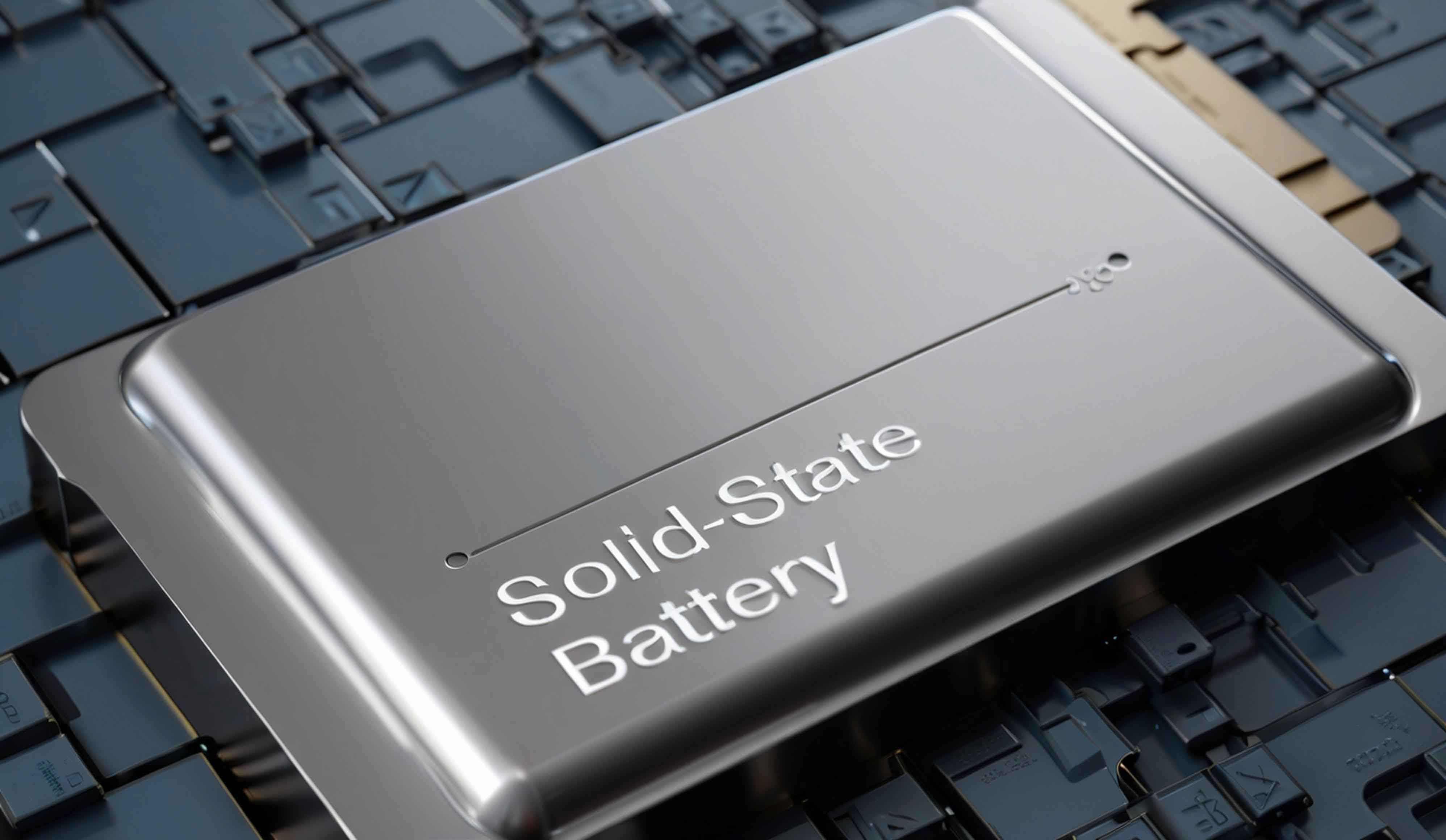
The core promise of the solid-state battery lies in its material science. The search for the ideal solid electrolyte is defined by competing key properties, often illustrated in a classic materials selection chart like the following, which compares ionic conductivity ($\sigma_i$) against electrochemical stability window ($\Delta V$).
$$ \sigma_i = n \cdot q \cdot \mu $$
Where $n$ is the charge carrier concentration, $q$ is the charge per carrier, and $\mu$ is the mobility.
The following table categorizes major solid electrolyte families and their key characteristics:
| Electrolyte Class | Example Materials | Ionic Conductivity (S/cm, at 25°C) | Key Advantages | Key Challenges |
|---|---|---|---|---|
| Oxide-based | LLZO (Garnet), LLTO (Perovskite), LATP (NASICON) | ~10-4 to 10-3 | High stability, wide window, good mechanical strength | Brittleness, high interfacial resistance with electrodes |
| Sulfide-based | LGPS, Argyrodites (e.g., Li6PS5Cl) | ~10-3 to 10-2 (comparable to liquids) | Very high ionic conductivity, soft mechanical properties | Sensitivity to moisture (H2S generation), stability vs. Li metal |
| Polymer-based | PEO-LiTFSI composites | ~10-5 to 10-4 (at 60-80°C) | Flexible, good processability, low cost | Low conductivity at room temperature, narrow stability window |
| Halide-based | Li3YCl6, Li3InCl6 | ~10-3 | Good stability vs. oxide cathodes, moderate conductivity | Sensitivity to moisture, cost of raw materials |
The theoretical benefits of a solid-state battery are profound and address the core limitations of lithium-ion technology head-on:
- Enhanced Safety: The non-flammable solid electrolyte virtually eliminates the risk of fire and explosion associated with liquid electrolytes, dramatically improving the safety envelope.
- Higher Energy Density: The use of a solid electrolyte enables the practical use of a lithium-metal anode, which has a theoretical capacity of 3,860 mAh/g, compared to graphite’s 372 mAh/g. This can potentially double the energy density. The relationship can be simplified for a cell as:
$$ E_{cell} \approx \frac{1}{\frac{1}{E_{anode}} + \frac{1}{E_{cathode}} + \frac{m_{inactive}}{m_{total}}} $$
A lithium-metal anode ($E_{anode}$) drastically increases the overall $E_{cell}$ by reducing the denominator’s first term and allowing for a thicker, higher-capacity cathode. - Faster Charging: The solid-state design can better suppress lithium dendrite growth, allowing for higher current densities during charging without short-circuit risk, thus reducing $t_c$.
- Longer Cycle Life: Improved interfacial stability and suppression of detrimental side reactions can lead to significantly more charge-discharge cycles.
- Wider Operating Temperature Range: Performance is less degraded at extreme temperatures compared to liquid electrolytes, which can freeze or boil.
Recognizing this potential, the global automotive industry has entered a phase of strategic mobilization. The commercialization timeline for the solid-state battery is no longer a distant dream but a structured race. Major automakers and their partners have laid out aggressive roadmaps:
| Company / Alliance | Key Partnership/Activity | Target for Pilot/Small-Scale Production | Target for Mass Production/Vehicle Integration | Stated Performance Aim |
|---|---|---|---|---|
| Toyota | Collaboration with Idemitsu Kosan (materials) | 2027-2028 | Early 2030s | Focus on durability and cost reduction for commercialization |
| Mercedes-Benz | Investment in and collaboration with various solid-state battery startups | Mid-2020s (pilot lines) | Before 2030 | ~2x the range of current lithium-ion batteries |
| Volkswagen (PowerCo) | Strategic partnership with QuantumScape | Pilot line established; aiming for initial production | Late 2020s / Early 2030s | Enable ~800 km range, fast charging, scalable production |
| BMW, Ford | Investment in Solid Power | Pilot production of electrolyte materials ongoing | Aiming for vehicle integration by 2030 | Integration of sulfide-based electrolyte for higher energy density |
| Nissan | In-house development (sulfide-based electrolyte) | Pilot plant in Yokohama by 2024 | 2028 | Targeting cost parity with lithium-ion batteries by 2028 |
The technological approach varies. For instance, one prominent developer’s unique technology combines aspects of solid and quasi-solid electrolytes to effectively circumvent the dendrite problem, a critical breakthrough for enabling lithium-metal anodes. Their goal is to scale production to eventually supply batteries for up to one million electric vehicles annually. This reflects a broader industry confidence in overcoming the historical hurdles of solid-state battery technology.
However, the path to mass-market solid-state battery adoption is paved with significant engineering and economic challenges that must be quantified and solved:
- Interfacial Resistance ($R_{int}$): Poor solid-solid contact between the electrolyte and electrode particles leads to high impedance, reducing power output. Minimizing this is paramount:
$$ R_{total} = R_{bulk} + R_{int} $$
where $R_{int}$ often dominates in early-stage cells. - Manufacturing Cost ($C_{mfg}$): Complex processing (e.g., thin-film deposition, high-pressure sintering) and expensive raw materials (e.g., germanium in some sulfides) currently make costs prohibitive. Scaling requires innovative, low-cost processes.
- Scalability and Yield: Maintaining consistent quality, defect-free solid electrolyte layers, and stable interfaces at gigawatt-hour production scales is an unproven challenge.
- Mechanical Stress Management: Volume changes in electrodes during cycling can fracture brittle solid electrolytes, breaking ionic pathways and causing rapid failure.
To contextualize the progress, we can model the projected improvement in a key metric like vehicle range ($D$), which is directly proportional to pack energy density ($E_{pack}$) and inversely proportional to vehicle energy consumption rate ($\epsilon$).
$$ D = \frac{E_{pack}}{\epsilon} $$
Assuming $\epsilon$ remains constant, the transition from a current Li-ion pack ($E_{pack, Li-ion} \approx 150$ Wh/kg) to a future solid-state battery pack ($E_{pack, SSB} \approx 350$ Wh/kg) yields:
$$ \frac{D_{SSB}}{D_{Li-ion}} = \frac{E_{pack, SSB}}{E_{pack, Li-ion}} \approx \frac{350}{150} \approx 2.33 $$
This ~133% increase in potential range aligns with industry targets and underscores the transformative impact.
The evolution of the solid-state battery will likely occur in generations, each solving a set of problems and integrating new materials. The following progression is anticipated:
| Generation | Anode | Cathode | Electrolyte Type | Primary Goal | Estimated Timeline |
|---|---|---|---|---|---|
| Gen 1 | Graphite/Si-composite | High-Ni NMC, NCA | Polymer/Oxide Composite | Prove safety & manufacturability; moderate energy boost | ~2025-2028 |
| Gen 2 | Lithium Metal (protected) | High-Voltage Layered Oxides (≥4.5V) | Sulfide or Halide-based | High energy density (>400 Wh/kg at cell level), fast charge | ~2028-2035 |
| Gen 3 | Lithium Metal | Anion-redox (Li-rich) or Sulfur | Advanced Sulfide/Halide | Ultra-high energy density (>500 Wh/kg), ultra-low cost | Post-2035 |
In conclusion, the solid-state battery represents the most promising technological frontier for electric vehicles, with the potential to resolve the fundamental limitations of energy density, safety, and charging speed. Its development is synergistic with global carbon reduction efforts, providing the necessary technological lever to decarbonize long-haul transport and aviation in the future. While formidable challenges in materials science, interface engineering, and manufacturing scalability remain, the concerted global push, evidenced by substantial investments and clear corporate roadmaps, indicates a strong conviction that these hurdles will be overcome. The transition to the solid-state battery is not a matter of “if” but “when.” Its successful commercialization will be a cornerstone achievement, propelling the world towards a truly sustainable, electrified mobility ecosystem and significantly contributing to the emission reduction goals championed by evolving carbon markets worldwide. The race is on, and the finish line—a safer, longer-range, faster-charging electric vehicle—is coming clearly into view.