
The rapid evolution of the new energy vehicle (NEV) industry has placed unprecedented demands on the performance and cost of power batteries. Currently, lithium-ion batteries dominate the market but are fraught with challenges—resource scarcity, volatile costs, and safety concerns—that hinder the sustainable growth of the sector. This situation compels us to explore alternative chemistries. Among them, the sodium-ion battery stands out as a compelling candidate. In this analysis, I will elucidate the fundamental advantages, working principles, and, most critically, the performance characteristics of cathode materials for sodium-ion battery systems. A thorough investigation reveals the substantial application value and replacement potential of the sodium-ion battery within NEV power systems.
The transition to new energy vehicles represents a mainstream direction for the automotive industry, crucial for fostering a sustainable ecological environment and elevating living standards. It is also a pivotal measure for the transportation sector to achieve “dual-carbon” strategic goals. Within the NEV powertrain, the lithium-ion battery remains predominant. However, issues such as uneven global distribution of lithium resources, high extraction costs, and supply chain instability are becoming increasingly acute. There is a pressing need to identify an ideal alternative. The sodium-ion battery, with its attributes of abundant resources, low cost, enhanced safety, and superior low-temperature performance, has emerged as a powerful candidate to address these dilemmas. A deep dive into the substitution potential of sodium-ion battery cathode materials is therefore of significant practical importance for advancing the NEV industry.
Current Landscape and Challenges in New Energy Vehicles
Propelled by technological advancement and heightened environmental focus, the NEV industry has experienced explosive growth, with sales volumes increasing year-on-year. Despite this momentum, the industry confronts several critical challenges. Primarily, the high cost of power batteries, coupled with the scarcity of lithium resources, acts as a key constraint on further expansion. The global distribution of lithium is highly uneven, and its extraction is costly. Furthermore, surging demand for NEVs has led to dramatic fluctuations in lithium material prices, continuously driving up production costs and introducing significant uncertainty into the supply chain.
Inherent Advantages of Sodium-Ion Batteries
The sodium-ion battery demonstrates broad application prospects in the new energy sector due to its low cost, wide operating temperature range, and high safety. Compared to lithium-ion batteries, its advantages are manifold:
- Abundant Sodium Resources: Sodium is approximately 440 times more abundant than lithium in the Earth’s crust. It is widely available in seawater, salt lakes, and rock salt deposits, with a uniform global distribution free from the geopolitical constraints associated with lithium. This provides a solid resource foundation for the mass production of sodium-ion battery systems.
- Significant Cost Advantage: The abundance and low cost of sodium, combined with the use of inexpensive transition metals in cathode materials, can substantially reduce raw material costs. Estimates suggest that under large-scale production, the cost of a sodium-ion battery could be 30-40% lower than that of a lithium-ion battery. Additionally, both the positive and negative current collectors in a sodium-ion battery can use low-cost aluminum foil, further lowering manufacturing expenses.
- Enhanced Safety and Superior Low-Temperature Performance: Sodium-ion battery systems generally exhibit higher internal resistance, leading to lower instantaneous heat generation during short circuits, thereby reducing thermal runaway risks and improving safety. Moreover, sodium ions possess higher mobility in electrolytes at low temperatures, resulting in far better capacity retention for sodium-ion battery units compared to lithium-ion ones in cold climates, a distinct advantage for applications in northern regions.
Working Principle and Cathode Materials for Sodium-Ion Batteries
3.1 Operational Principle
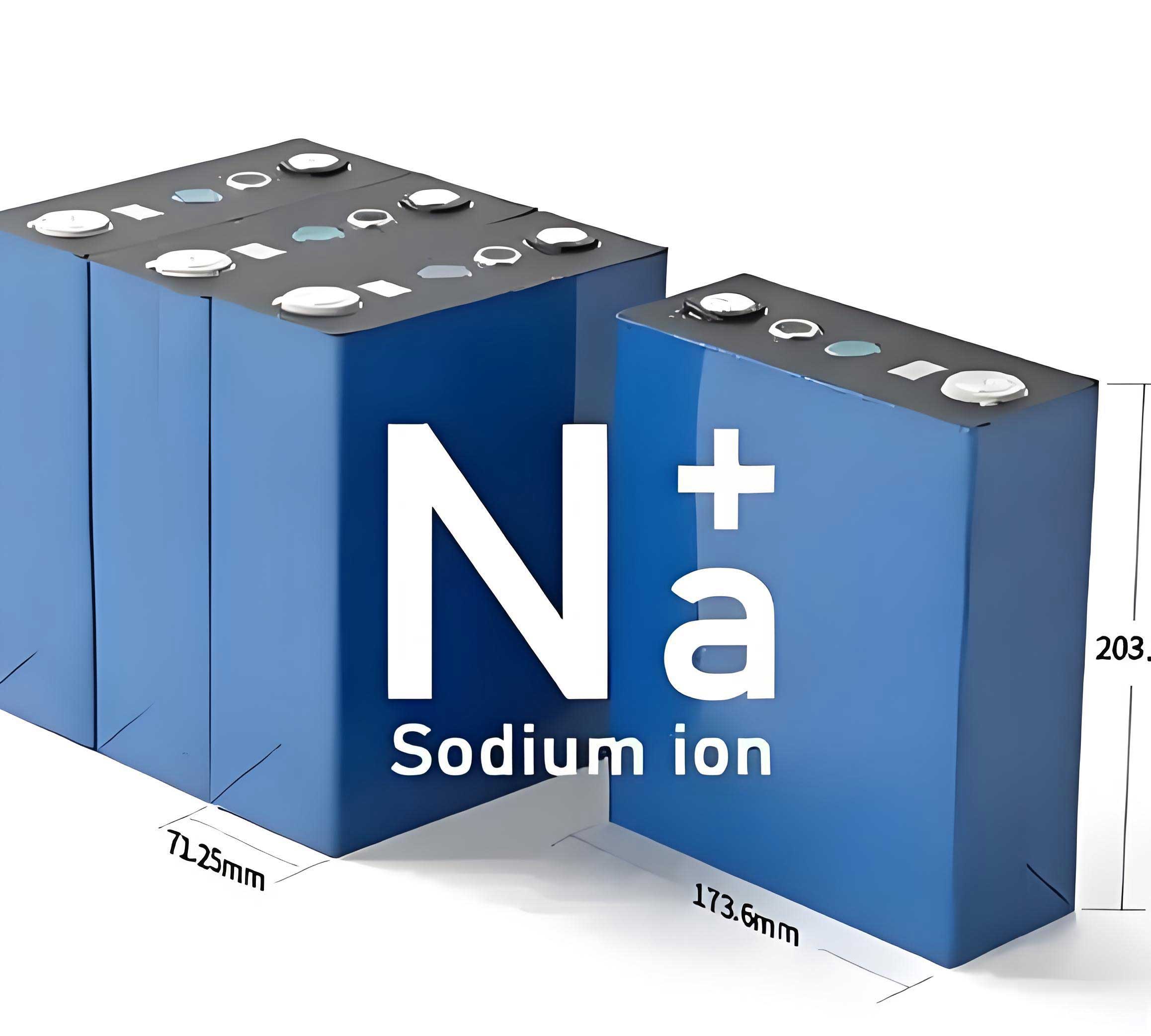
The core function of a sodium-ion battery is based on the reversible intercalation and deintercalation of sodium ions between the cathode and anode, coupled with electron transfer through an external circuit, to store and release energy. Its fundamental structure comprises a cathode, an anode, an electrolyte, and a separator. The cathode hosts sodium ion intercalation/deintercalation, the anode provides sodium storage sites, the electrolyte facilitates sodium ion conduction, and the separator prevents electrical shorting while allowing ionic passage.
The charging and discharging processes can be described by the following general redox reaction, where M represents the transition metal in the cathode material and A represents the anode host material:
$$
\text{Cathode: } Na_xM_yO_z \rightleftharpoons Na_{x-n}M_yO_z + nNa^+ + ne^- \\
\text{Anode: } A + nNa^+ + ne^- \rightleftharpoons Na_nA \\
\text{Overall: } Na_xM_yO_z + A \rightleftharpoons Na_{x-n}M_yO_z + Na_nA
$$
Charging: Sodium ions deintercalate from the cathode, migrate through the electrolyte to the anode, and electrons flow from the cathode to the anode via the external circuit. Sodium ions intercalate into the anode material, converting electrical energy into chemical energy.
Discharging: The reverse process occurs. Sodium ions deintercalate from the anode, move to the cathode, and electrons flow from the anode to the cathode, powering the external load. Sodium ions re-intercalate into the cathode material, converting chemical energy back to electrical energy.
3.2 Overview of Cathode Materials
3.2.1 Impact on Key Battery Metrics
The cathode material is the cornerstone of a sodium-ion battery, critically determining its key performance indicators:
- Energy Density: Determined by the theoretical specific capacity ($C_{th}$, in mAh/g) and the average operating voltage ($V_{avg}$, in V). The gravimetric energy density ($E_g$, in Wh/kg) can be approximated as: $$E_g \propto C_{th} \times V_{avg}$$ Higher values for both parameters are essential for longer driving range.
- Cycle Life: Dependent on the structural stability of the cathode material during repeated sodium ion insertion/extraction. Phase transitions, structural degradation, or parasitic side reactions with the electrolyte lead to capacity fade.
- Rate Capability: Governed by the ionic conductivity ($\sigma_i$) and electronic conductivity ($\sigma_e$) of the cathode material. High conductivity enables rapid ion/electron transport, supporting fast charging and high-power discharge. The effective diffusion coefficient ($D_{eff}$) of Na+ within the material is a key parameter.
- Safety: Intimately linked to the thermal and electrochemical stability of the cathode material. Materials resistant to exothermic decomposition or violent reactions with electrolytes at high temperatures or under abuse conditions are vital for safe sodium-ion battery operation.
3.2.2 Characteristics of Major Cathode Material Families
Primary cathode material families for sodium-ion battery technology include transition metal oxides, polyanionic compounds, and Prussian blue analogues (PBAs). Their characteristics are summarized below:
| Material Family | Examples | General Formula | Key Advantages | Primary Challenges |
|---|---|---|---|---|
| Layered Transition Metal Oxides (O3/P2-type) | NaxMO2 (M=Mn, Fe, Ni, Co, Cu, Ti, etc. and combinations) | NaxMO2 | High specific capacity, good rate performance, mature synthesis methods. | Structural phase transitions during cycling, transition metal dissolution, moisture sensitivity. |
| Tunnel-type Oxides | Na0.44MnO2, Na0.66MnO2 | NaxMyOz | Good structural stability, low cost, simple synthesis. | Lower specific capacity, limited 1D diffusion paths affecting rate capability. |
| Polyanionic Compounds | NaFePO4 (maricite, heterosite), Na3V2(PO4)3 (NVP), Fluorophosphates (e.g., NaVPO4F) | NaxMy(XO4)z or variants | Excellent thermal/structural stability, high operating voltage, long cycle life. | Lower intrinsic electronic conductivity, often lower specific capacity. |
| Prussian Blue Analogues (PBAs) | NaxMa[Mb(CN)6]y·nH2O (Ma/Mb = Fe, Mn, Ni, Cu, etc.) | Open framework structure | Open framework for fast ion diffusion, high theoretical capacity, low-cost precursors. | Presence of coordinated water affecting stability, capacity fade from structural defects. |
Layered Transition Metal Oxides: These feature an alternating layered structure of MO2 slabs and sodium ion layers. Their properties can be finely tuned through transition metal doping and stoichiometry control (e.g., creating Ni-rich or Mn-rich compositions). A critical challenge is managing the complex phase transitions (e.g., O3 ↔ P3) that occur during sodium extraction/insertion, which can lead to capacity decay.
Tunnel-type Oxides: Characterized by a framework with tunnels that provide one-dimensional pathways for sodium ion diffusion. While stable, this structure often limits both the number of Na+ sites (capacity) and their mobility (rate performance).
Polyanionic Compounds: These materials benefit from the strong inductive effect of the (XO4)n- polyanions (X = P, S, Si, etc.), which raises the operating voltage versus Na+/Na. Their robust 3D framework grants exceptional thermal and cycling stability. For instance, the NASICON-type Na3V2(PO4)3 is renowned for its ultra-long cycle life. The voltage is governed by the redox couple and the polyanion group, often described by the relationship: $$V \propto \frac{\Delta \mu}{F} + \text{constant}$$ where $\Delta \mu$ is the chemical potential difference influenced by the anion group’s electronegativity.
Prussian Blue Analogues (PBAs): These feature an open, face-centered cubic framework with large interstitial sites, enabling rapid sodium ion diffusion. Their capacity can be high as two Na+ ions per formula unit can be stored. The main research focus is on reducing crystal water content and synthesizing defect-free materials to improve initial Coulombic efficiency and cycle stability.
Application Potential of Sodium-Ion Battery Cathode Materials in NEVs
4.1 Energy Density and Driving Range
While the current energy density of sodium-ion battery packs is generally lower than that of state-of-the-art lithium-ion batteries, continuous cathode material innovation is rapidly closing the gap. Advanced layered oxides, through precise multi-metal doping (e.g., Ni, Cu, Mn, Ti), have achieved specific capacities exceeding 180 mAh/g in lab settings. When paired with suitable hard carbon anodes, cell-level energy densities of 160-180 Wh/kg are attainable. Polyanionic materials compensate for their moderate specific capacity with higher working voltages, leading to competitive energy densities ($E = C \times V$). Future breakthroughs in material design—such as developing new high-capacity/high-voltage couples, optimizing particle morphology for better packing density, and creating compatible electrolytes—will push the sodium-ion battery energy density beyond 200 Wh/kg, making it suitable for a wider range of EV segments.
4.2 Cost Advantage: A Game-Changer
The cost proposition of the sodium-ion battery is arguably its most transformative aspect for mass-market EV adoption. The raw material cost differential is stark. Sodium carbonate (Na2CO3) prices are stable at a few hundred USD per ton, while lithium carbonate (Li2CO3) prices, despite recent corrections, remain an order of magnitude higher and historically volatile. This fundamental cost advantage permeates the entire sodium-ion battery supply chain. Furthermore, cathode formulations can avoid or minimize expensive cobalt and nickel, utilizing abundant iron and manganese instead. The use of aluminum foil for both electrodes eliminates the need for expensive copper foil on the anode side. A simplified total cost comparison can be conceptualized as:
$$
\text{Cost}_{SIB} \approx f(\text{Low-cost Na salt, Fe/Mn-based cathode, Al foil, Standard BMS}) \\
\text{Cost}_{LIB} \approx f(\text{Expensive Li salt, Co/Ni-rich cathode, Cu+Al foil, Advanced BMS for safety})
$$
This translates to a potential 30-40% reduction in cell cost at scale, directly lowering the upfront price of EVs and accelerating parity with internal combustion engine vehicles.
4.3 Safety and Stability
The intrinsic safety profile of many sodium-ion battery cathode materials is superior. Polyanionic compounds, with their strong covalent-bonded frameworks, exhibit exceptional thermal stability, resisting oxygen release and structural collapse at high temperatures. This inherent stability reduces the risk of thermal runaway propagation within a battery pack. Additionally, improved structural engineering of layered oxides—such as integrating inert pillar ions or creating compositionally graded structures—can effectively suppress detrimental phase transitions and metal dissolution during cycling. This enhances not only safety but also long-term cycle stability, a critical factor for vehicle warranty and longevity.
4.4 Low-Temperature Performance Advantage
This is a standout feature of the sodium-ion battery. The lower desolvation energy and faster ionic mobility of Na+ in electrolytes at sub-zero temperatures lead to significantly less performance degradation. Cathode materials with stable structures in this regime are key enablers. For example, certain layered oxides and Prussian blue analogues maintain excellent low-temperature kinetics. Data shows that at -20°C, a sodium-ion battery can retain over 80% of its room-temperature capacity, compared to ~60% for a typical lithium-ion battery. This performance unlocks reliable EV operation in cold climates without the need for excessive and energy-consuming battery heating systems, effectively increasing usable range in winter.
| Parameter | Typical Lithium-ion (NMC/Gr) | Typical Sodium-ion (Layered Oxide/Hard C) | Implication for NEVs |
|---|---|---|---|
| Resource Abundance & Cost | Limited Li, expensive Co/Ni; volatile cost. | Abundant Na, low-cost Fe/Mn; stable, low cost. | SIB enables cheaper EVs, stable supply chain. |
| Energy Density (Cell) | High (~250-300 Wh/kg) | Moderate (~140-180 Wh/kg), improving rapidly. | LIB leads in range; SIB suitable for urban/short-range EVs. |
| Safety | Moderate; requires complex BMS for protection. | Generally higher; more resistant to thermal runaway. | SIB offers potentially safer pack design, lower BMS overhead. |
| Low-Temp Performance | Poor; significant capacity/power loss below 0°C. | Excellent; maintains >80% capacity at -20°C. | SIB superior for cold-climate operation, reduces range anxiety in winter. |
| Cycle Life | Long (~1000-3000 cycles) | Competitive (~2000-5000 cycles for some chemistries). | Both can meet vehicle lifetime requirements. |
| Fast Charge | Good, but limited by Li plating risk. | Potentially excellent due to faster Na+ kinetics. | SIB may enable faster charging rates. |
Current Energy Density and Future Development Trends
The energy density trajectory for sodium-ion battery technology is on a steep upward curve. As of 2025, leading commercial and prototype cells are achieving 155-200 Wh/kg. For instance, contemporary cells from industry leaders have reached the 180-200 Wh/kg range, with lab-scale demonstrations exceeding this threshold. The future development of cathode materials will focus on several interconnected fronts:
- Material Innovation: Exploring new material families (e.g., organic cathodes, anion-redox materials), developing “cation-disordered” rocksalt oxides for high capacity, and creating dual-ion or hybrid systems.
- Advanced Engineering: Utilizing nanotechnology, core-shell structures, and atomic-layer coatings to enhance conductivity, stabilize interfaces, and suppress side reactions. The goal is to maximize the utilization of active material and minimize irreversible losses. The capacity retention over cycles can be modeled as: $$C_N = C_0 \times (1 – \alpha)^N$$ where $C_N$ is capacity at cycle N, $C_0$ is initial capacity, and $\alpha$ is the decay rate per cycle, which material engineering aims to minimize.
- Synergistic System Development: Co-development of cathode materials with compatible high-capacity anodes (e.g., alloying or conversion materials), stable high-voltage electrolytes, and optimized cell engineering (e.g., electrode porosity, thickness).
- Cost Reduction & Scalability: Developing simpler, aqueous-based, or solid-state synthesis routes that are energy-efficient and suitable for gigawatt-scale production.
| Timeline | Target Energy Density (Cell, Wh/kg) | Key Cathode Material Focus | Primary Application Target in NEVs |
|---|---|---|---|
| Present (~2025) | 150 – 180 | Stable Layered Oxides (Cu/Mn/Fe based), Prussian Blue, Na3V2(PO4)3 | Light EVs, Micro-mobility, Urban commuting vehicles, Low-range models. |
| Near-term (~2028-2030) | 180 – 220 | High-Voltage Polyanionics, Advanced Doped Layered Oxides, Water-free PBAs. | Mainstream compact & midsize EVs, PHEV batteries. |
| Long-term (2030+) | > 220, approaching 300 | Anion-redox materials, New high-capacity structures, Solid-state SIB cathodes. | Competitive with advanced LIB for most EV segments, including some performance/long-range models. |
In conclusion, the analysis confirms that sodium-ion battery cathode materials possess immense application value and substitution potential within new energy vehicle power systems. They offer a credible path to reducing vehicle costs, enhancing safety, and providing reliable performance in diverse climates, particularly in cold regions. While challenges in energy density remain, the pace of innovation is rapid. The sodium-ion battery is not merely a substitute but a complementary technology that will diversify the battery ecosystem. It is poised to become a vital pillar in the sustainable electrification of transport, working alongside lithium-ion technology to cater to different market segments and applications, thereby accelerating the global transition to clean energy vehicles.