
The pursuit of next-generation energy storage has decisively shifted its focus towards the paradigm of the solid-state battery. The fundamental promise—replacing flammable, reactive liquid electrolytes with intrinsically safe, solid ion conductors—offers a tantalizing path to break the perennial trade-offs between energy density, safety, and cycle life that plague conventional lithium-ion technology. The core of this revolution lies in the solid-state electrolyte (SSE). However, the idealized SSE, possessing simultaneously ultra-high ionic conductivity, exceptional mechanical robustness, wide electrochemical stability, and perfect interfacial compatibility, remains elusive in any single material class.
This intrinsic limitation of monolithic materials has catalyzed the emergence of a dominant research paradigm: composite solid-state electrolytes (CSEs). By strategically combining two or more distinct solid electrolyte phases—polymers, oxides, sulfides, or halides—we can engineer materials whose synergistic properties surpass the sum of their parts. The central thesis of my analysis is that the performance of a solid-state battery is not merely dictated by the conductivity of its electrolyte, but by the holistic design of composite architectures that manage ion transport, mechanical stress, and interfacial chemistry across multiple length scales. This article systematically dissects the two primary architectural philosophies—filler-based and layered composite structures—delving into their design principles, underlying ion transport mechanisms, and their critical interplay with electrode materials. I will employ theoretical models and empirical data to frame the current state of the art and chart a course for future development.
The formidable challenge for any SSE can be quantified by a set of interlinked target properties necessary for a commercially viable solid-state battery:
- Ionic Conductivity ($\sigma_{Li^+}$): Must exceed $10^{-4}$ S/cm at room temperature, ideally approaching $10^{-3}$ S/cm to rival liquid electrolytes. Conductivity follows an Arrhenius relationship: $$\sigma T = A \exp\left(\frac{-E_a}{k_B T}\right)$$ where $E_a$ is the activation energy for ion hopping, $k_B$ is Boltzmann’s constant, and $T$ is temperature. Lowering $E_a$ is a key goal of composite design.
- Transference Number ($t_{Li^+}$): Should be as close to unity as possible to mitigate concentration polarization. For a composite, the effective transference number is complex but can be enhanced by creating Li+-selective pathways.
- Electrochemical Stability Window: Must be stable against reduction by Li metal (∼0 V vs. Li/Li+) and oxidation by high-voltage cathodes (>4.3 V). The window is not solely an intrinsic material property but is heavily influenced by interface kinetics, which composites can modulate.
- Mechanical Properties: Requires a shear modulus ($G$) sufficiently high (theoretically >2$\times$GLi ≈ 6 GPa) to mechanically suppress Li dendrite propagation. This is where the blend of rigid and soft phases becomes critical.
- Interfacial Stability & Impedance: The solid-solid interface must be chemically stable and possess low area-specific resistance (ASR), often the most significant barrier. ASR can be modeled as: $$ASR_{total} = R_{bulk} + R_{cathode|SSE} + R_{SSE|anode}$$ where composite strategies aim to minimize the interfacial terms $R_{cathode|SSE}$ and $R_{SSE|anode}$.
Single-component SSEs, as summarized in Table 1, are fundamentally incapable of satisfying all these criteria simultaneously. Polymers like PEO offer excellent processability and interfacial contact but suffer from low room-temperature conductivity and poor mechanical strength. Oxide ceramics (e.g., LLZO, LATP) provide outstanding stability and mechanical rigidity but are plagued by high grain-boundary resistance and brittle electrode contacts. Sulfides (e.g., LPS, LGPS) boast superb ionic conductivity but are air-sensitive and have limited electrochemical stability. This predicament makes the composite approach not just advantageous but essential.
| Material Class | Exemplar | Intrinsic Advantages | Critical Limitations | Primary Role in a Composite |
|---|---|---|---|---|
| Polymer | PEO-LiTFSI | Flexibility, low interfacial impedance, easy processing | Low $\sigma_{RT}$ ($<10^{-5}$ S/cm), low $G$, narrow thermal window | Flexible matrix, interfacial wetting agent, dendrite buffer layer |
| Oxide | Li7La3Zr2O12 (LLZO) | High chemical/electrochemical stability, high $G$ (>10 GPa), air-stable | High sintering temperature, high interfacial ASR (>500 Ω cm²) | Mechanical reinforcement, wide-voltage stabilizer, 3D scaffold |
| Sulfide | Li6PS5Cl (LPSCl) | Very high $\sigma_{RT}$ (>10-3 S/cm), good sinterability | Air/moisture sensitive, narrow E-window, reacts with Li metal | Primary high-conductivity pathway, interfacial filler |
| Halide | Li3YCl6 | Good $\sigma_{RT}$, wide E-window, solution processable | Hygroscopic, low $G$, unstable vs. Li metal | Cathode interface stabilizer, plasticizing filler |
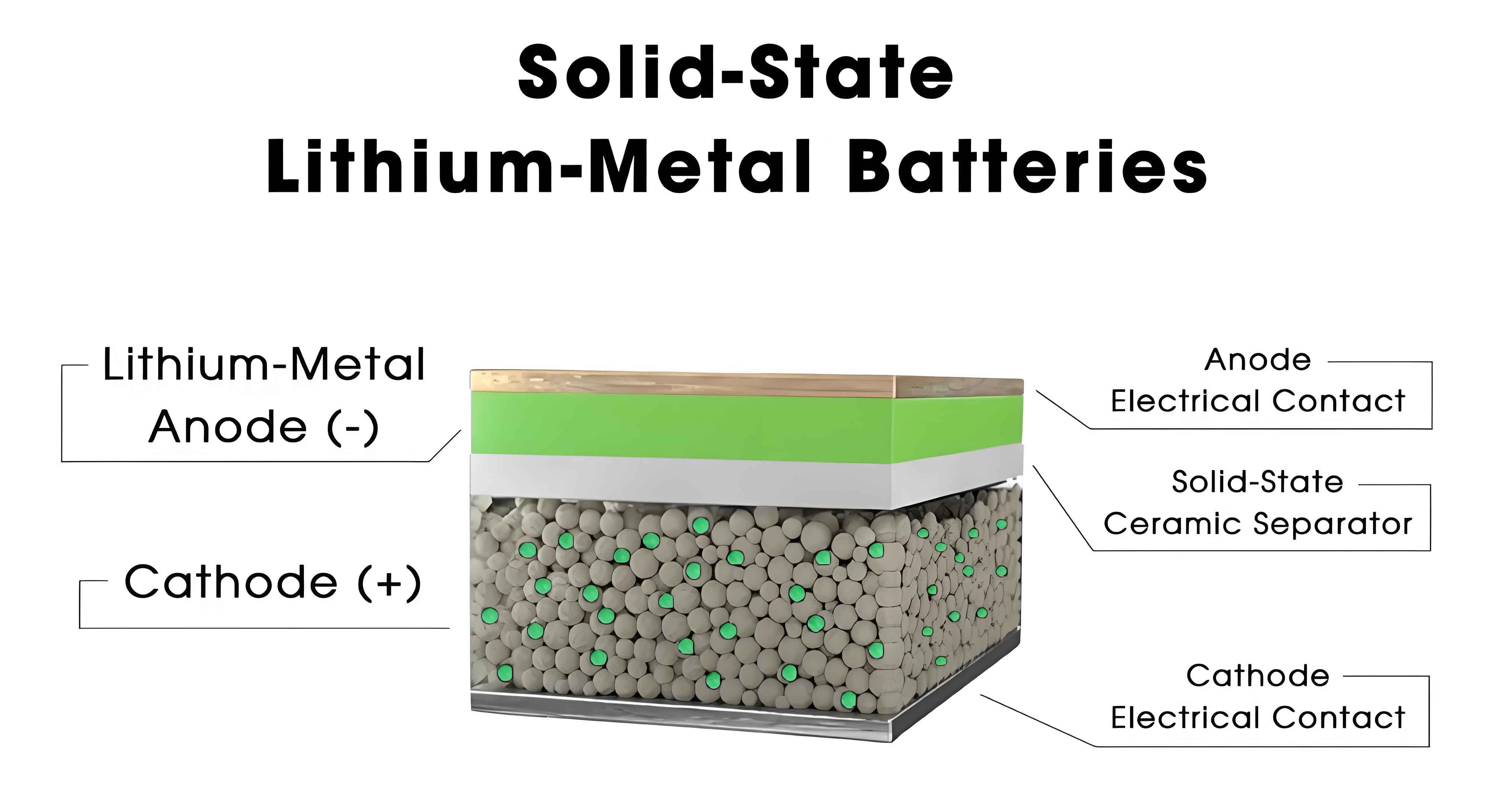
Filler-Based Composite Architectures: Building Continuous Pathways
Filler-based CSEs involve the homogeneous dispersion of a secondary phase (the filler) within a primary matrix. The goal is to create a percolating network that enhances a specific property—most commonly ionic conductivity—while the matrix maintains structural integrity and interfacial contact. The performance is governed by percolation theory and effective medium approximations. The effective conductivity ($\sigma_{eff}$) of a two-phase composite can be described by general effective media (GEM) equation:
$$
\frac{(\sigma_{eff})^{1/t} – (\sigma_m)^{1/t}}{(\sigma_{eff})^{1/t} + A(\sigma_m)^{1/t}} = (1 – \phi)\frac{(\sigma_f)^{1/t} – (\sigma_m)^{1/t}}{(\sigma_f)^{1/t} + A(\sigma_m)^{1/t}}
$$
where $\sigma_m$ and $\sigma_f$ are the conductivities of the matrix and filler, $\phi$ is the filler volume fraction, $t$ is a critical exponent related to dimensionality, and $A$ is a function of the percolation threshold $\phi_c$. For a solid-state battery, optimizing $\phi$ to be just above $\phi_c$ is crucial to maximize conductivity without sacrificing other properties.
Polymer/Inorganic Filler Composites
This is the most studied category, where a polymer (e.g., PEO, PVDF, PAN) acts as the flexible, continuous matrix, and ceramic particles provide conductive or reinforcing fillers. The enhancement mechanisms are multifaceted:
- Reduction of Polymer Crystallinity: Fillers disrupt the orderly arrangement of polymer chains, increasing the amorphous phase volume where ion transport primarily occurs. The degree of crystallinity ($X_c$) drop correlates with conductivity increase.
- Creation of Fast Ion Pathways: Conductive fillers (like LLZO or LPS) can form percolating networks for Li+ transport, bypassing the slower polymer matrix.
- Lewis Acid-Base Interactions: Surface groups on fillers (e.g., -OH on oxides) can interact with polymer chains or Li-salt anions (TFSI–), promoting salt dissociation and increasing the number of free Li+ carriers.
- Mechanical Reinforcement: The composite’s modulus increases, aiding dendrite suppression. The rule of mixtures provides a first-order estimate: $$E_c = \phi_f E_f + (1-\phi_f)E_m$$ for a perfectly bonded system.
The filler’s dimensionality plays a profound role, as summarized in Table 2.
| Dimension | Exemplar Material | Synthesis/Form | Key Mechanism & Advantage | Typical $\sigma_{RT}$ Achieved |
|---|---|---|---|---|
| 0D (Nanoparticles) | LLZTO, SiO2, TiO2 | Commercial powders, sol-gel synthesis | High surface area increases polymer/filler interface, disrupts crystallization. Simple but prone to agglomeration. | $10^{-5}$ – $10^{-4}$ S/cm |
| 1D (Nanowires/Nanofibers) | LLTO, LLZO nanowires | Electrospinning, hydrothermal growth | Form long-range percolation networks at lower $\phi_c$. Bridge gaps between particles, providing continuous highways for Li+. | $10^{-4}$ – $10^{-3}$ S/cm |
| 2D (Nanosheets) | Garnet nanosheets, h-BN, GO | Exfoliation, templated growth | Ultra-high aspect ratio maximizes interfacial area. Can create laminated ion-conducting channels. Excellent barrier properties. | ~$10^{-4}$ S/cm |
| 3D (Sintered Scaffold) | Porous LLZO, LATP framework | Template sintering, freeze-casting | Provides a bicontinuous, mechanically rigid 3D network. Polymer fills pores, ensuring perfect interface. Excellent $G$ and $\sigma$. | $10^{-4}$ – $10^{-3}$ S/cm |
The ion transport in such composites is not merely through the matrix or the filler alone. A sophisticated model involves parallel and series pathways: conduction through the polymer matrix ($\sigma_m$), conduction through the filler network ($\sigma_f$), and enhanced conduction at the polymer/filler interfacial region ($\sigma_i$), where the local structure and chemistry differ from the bulk. The total conductivity can be conceptualized as:
$$
\sigma_{total} \approx \phi_f \sigma_f + (1-\phi_f)\sigma_m^* + \Sigma S_i \sigma_i
$$
where $\sigma_m^*$ is the enhanced matrix conductivity due to amorphization, and $S_i$ represents the effective cross-sectional area of the interfacial pathways. For a successful solid-state battery using such electrolytes, achieving a high $\sigma_i$ and ensuring its connectivity is as important as using a high-$\sigma_f$ filler.
Inorganic/Inorganic Filler Composites
This approach combines two or more inorganic SSEs, typically to marry the conductivity of one with the stability of another. A classic example is the oxide-sulfide composite (e.g., LLZO + LPS). Here, the oxide (LLZO) provides mechanical strength and stability against Li metal, while the sulfide (LPS) fills the oxide grain boundaries, drastically reducing interfacial resistance and creating a continuous high-conductivity phase. The conductivity enhancement often follows a percolation model where the soft sulfide phase forms the conducting network around the rigid oxide particles.
The interfacial space-charge layer effect is another critical mechanism. When two different ionic conductors with different chemical potentials for Li+ ($\mu_{Li^+}$) are in contact, Li+ redistributes to equilibrate the electrochemical potential, creating a space-charge region with altered conductivity. For instance, at a Li3PS4/Al2O3 interface, Li+ accumulates in the space-charge layer of the sulfide, creating a fast 2D conduction channel along the filler surface. The space-charge potential $\Delta \phi_{sc}$ and layer width $\lambda$ can be estimated using Poisson-Boltzmann formalism for ionic solids. This effect is maximized with nano-sized, highly dispersed fillers.
Table 3 highlights performance outcomes from various inorganic/inorganic composite strategies.
| Matrix | Filler (Ratio) | Composite Method | Key Mechanism | $\sigma_{RT}$ (S/cm) | Critical Current Density (mA/cm²) |
|---|---|---|---|---|---|
| Li6PS5Cl | 5 wt% LLZTO | Ball-milling | Space-charge layer, mechanical blocking | $5.4 \times 10^{-4}$ | >0.3 |
| Li3PS4 | 60 wt% LLZO | Mechanical Mixing | Percolating sulfide network, oxide stabilization | $5.4 \times 10^{-4}$ | N/A |
| Li1.3Al0.3Ti1.7(PO4)3 | 20 wt% Li3InCl6 | Cold Sintering | Halide plastic flow bridges oxide grains | $1.4 \times 10^{-4}$ | ~0.1 |
| Li6.4La3Zr1.4Ta0.6O12 | 80 wt% Li6PS5Cl | Ball-milling & Pressing | 3D interpenetrating conductive network | $1.27 \times 10^{-3}$ | N/A |
Layered Composite Architectures: Functional Zoning for Interface Mastery
While filler composites aim for homogeneous property enhancement, layered composites adopt a “divide and conquer” strategy. By stacking distinct electrolyte layers, each layer is optimized for a specific function: one for high conductivity, another for anode stability, and a third for cathode compatibility. This architecture directly addresses the most vexing problem in a solid-state battery: the disparate interfacial requirements at the anode and cathode.
The design principle is akin to creating a functional gradient material. The total resistance of a multilayer stack is the sum of the resistances of individual layers plus the interfacial resistances between them:
$$
ASR_{stack} = \sum_{i=1}^{n} \frac{d_i}{\sigma_i} + \sum_{j=1}^{n-1} R_{int,j}
$$
where $d_i$ and $\sigma_i$ are the thickness and conductivity of the i-th layer. The primary challenge is to minimize $R_{int,j}$ between dissimilar layers, which can arise from poor physical contact, chemical interdiffusion, or electrochemical instability.
Polymer-Ceramic-Polymer “Sandwich” Structures
The most common layered design features a rigid, high-modulus ceramic layer (e.g., LATP, LLZO) sandwiched between two softer polymer layers (e.g., PEO). The ceramic layer acts as a dense, dendrite-blocking barrier, while the polymer layers ensure intimate, low-impedance contact with both electrodes. The outer polymer layers also protect the ceramic from direct reaction with Li metal. The effectiveness hinges on the adhesion and ionic continuity across the polymer/ceramic interface. Often, the polymer layer is designed to partially infiltrate the ceramic’s surface pores, creating an interdigitated region that lowers $R_{int}$.
Asymmetric Inorganic Bilayers
This advanced concept involves stacking two different inorganic SSEs. A canonical example is a cathode-facing halide layer (Li3YCl6) paired with an anode-facing sulfide layer (Li6PS5Cl). The halide offers superior oxidation stability and good contact with high-voltage oxide cathodes. The sulfide provides higher conductivity and, crucially, a somewhat more stable interface with Li metal (though often still requiring interlayers). The halide|sulfide interface itself must be engineered to prevent mutual decomposition. Thermodynamic calculations based on the Gibbs free energy of possible interfacial reactions, $\Delta G_{rxn} = \sum \nu_i \mu_i$, are essential to screen compatible layer pairs. When $\Delta G_{rxn} << 0$, spontaneous reaction is likely, leading to high $R_{int}$.
Core-Shell Structures as a Pseudo-Layered System
An elegant nanoscale analogue to layering is the core-shell particle, where one SSE is coated uniformly onto another. For example, an oxide particle (LLZO core) can be coated with a thin sulfide or halide shell (Li3PS4 or Li3InCl6). When compressed into a pellet, these particles create an intrinsic, nanoscopically layered composite. The shell serves multiple functions: it passivates the core from air/moisture, improves sinterability at lower temperatures, and can be tailored to improve interfacial compatibility with electrodes. The effective conductivity in such a system depends on the shell thickness ($t_{shell}$) and percolation. If the shell is conductive and forms a continuous network, $\sigma_{eff}$ can be high even with an insulating core, following a modified effective medium theory.
Matching Composite Architecture to Electrode Chemistry
The choice between filler-based and layered composite electrolytes is not arbitrary; it must be driven by the specific electrode pair in the solid-state battery. Table 4 provides a strategic mapping.
| Electrode System | Challenges | Recommended Composite Architecture | Rationale & Required Properties |
|---|---|---|---|
| High-Ni NCM (NCA) / Li Metal | High operating voltage, O2 release, Li dendrites, volume change. | Filler-Based (Oxide in Polymer) or Asymmetric Bilayer | Need wide voltage stability (oxide/halide) + interfacial compliance (polymer). Filler composites offer simpler processing; bilayers offer superior dendrite blocking. |
| LiCoO2 / Li Metal | High voltage (>4.5V), Co dissolution, interfacial instability. | Layered (Halide|Sulfide or Halide|Polymer) | Halide layer is critical for stable contact with high-voltage LCO. A second layer (sulfide/polymer) manages the Li anode interface. |
| Sulfur or Li-Rich Cathode / Li Metal | Polysulfide shuttling (S), oxygen activity (Li-rich), huge volume change. | 3D Scaffold Filler Composite or Sandwich Structure | 3D rigid scaffold contains volume change and blocks polysulfides. Sandwich structure’s dense ceramic mid-layer acts as an ionic/electronic insulator. |
| High-Voltage Cathode / Silicon-Carbon Anode | Cathode oxidation, Si huge volume expansion (~300%), unstable SEI. | Filler-Based (Mixed Conductors) | Need a highly compliant, adhesive electrolyte. Polymer matrix with nanofillers can accommodate Si expansion while maintaining contact. Cathode-side filler (e.g., coated LATP) provides voltage stability. |
Fundamental Ion Transport Mechanisms: A Unified View
Across all composite architectures, the enhancement of ionic conductivity stems from the interplay of several physical phenomena. A comprehensive understanding is vital for rational design.
- Percolation and Network Theory: This geometric effect is dominant when the filler’s conductivity is much higher than the matrix’s ($\sigma_f >> \sigma_m$). Conductivity spikes when the filler volume fraction $\phi$ exceeds the percolation threshold $\phi_c$. For spherical particles, $\phi_c \approx 0.16$; for high-aspect-ratio rods or sheets, $\phi_c$ can be much lower (<0.1). The conductivity near the threshold scales as: $$\sigma_{eff} \propto (\phi – \phi_c)^t$$ where $t$ is a universal exponent (~2 for 3D systems).
- Interfacial Ion Transport: The region within a few nanometers of the filler/matrix interface often has distinct structure and composition, leading to different ionic mobility. This can be due to:
- Space-Charge Layers: As previously described, for ionic conductors in contact.
- Polymer Chain Dynamics: Near a filler surface, polymer chain mobility may be increased or decreased, altering local viscosity and Li+ hopping rates. The Vogel-Fulmann-Tammann (VFT) equation, $\sigma = \sigma_0 \exp[-B/(T-T_0)]$, parameters $B$ and $T_0$ (ideal glass transition) are modified at the interface.
- Lewis Acid-Base Centers: Filler surface sites can coordinate with anions, freeing Li+ and creating a Li+-rich interfacial zone with high $\sigma_i$.
- Morphology-Induced Amorphization: Fillers, especially nanoparticles, act as impurities that inhibit polymer crystallization. The increased amorphous fraction $f_{amorph}$ directly increases the number of accessible Li+ hopping sites. The relationship can be semi-empirical: $$\sigma \approx \sigma_{amorph} \cdot f_{amorph} + \sigma_{cryst} \cdot (1-f_{amorph})$$ where $\sigma_{cryst}$ is negligible.
- Stress Fields and Defect Generation: In inorganic/inorganic composites, the mismatch in thermal expansion coefficients or lattice parameters between phases generates localized stress fields upon cooling or compression. These stresses can distort crystal lattices, increase point defect concentrations (e.g., vacancies), and thereby enhance bulk ion mobility within the grains themselves. The defect concentration $[V_{Li}’]$ may be related to stress $\sigma_{stress}$ via: $$[V_{Li}’] \propto \exp\left(-\frac{E_f – \Omega \sigma_{stress}}{k_B T}\right)$$ where $E_f$ is the vacancy formation energy and $\Omega$ is an activation volume.
In a practical solid-state battery composite, these mechanisms are concurrent and coupled. Advanced characterization like in situ solid-state NMR, neutron scattering, and electrochemical strain microscopy is required to deconvolute their individual contributions.
Current Challenges and Future Pathways
Despite remarkable progress, the journey from lab-scale demonstration to mass-produced solid-state battery cells is strewn with persistent challenges that demand innovative solutions.
| Challenge Category | Specific Issues | Potential Solutions & Future Directions |
|---|---|---|
| Material-Level | – Irreconcilable property trade-offs in new materials. – Uncontrolled interfacial side reactions. – Lack of self-healing capability. |
– AI/ML-guided discovery of novel phases with inherently balanced properties. – Design of kinetically stabilized interfaces using metastable coatings or kinetic barriers. – Integration of dynamic covalent bonds or supramolecular motifs into polymer matrices for autonomic repair of cracks. |
| Interface Engineering | – High $R_{int}$ in multilayer stacks. – Chemical interdiffusion and degradation. – Poor cycling stability under high current. |
– Development of atomically-precise interlayers via ALD/MLD (e.g., Li3PO4, LiPON). – Use of phase-field modeling coupled with ab initio calculations to predict and design stable triple-phase boundaries. – Creation of gradient interfaces where composition changes continuously over 10-100 nm to mitigate stress and diffusion. |
| Manufacturing & Scalability | – Difficulty producing ultra-thin (<50 µm), defect-free membranes. – High-temperature sintering incompatible with polymers. – High cost of raw materials (e.g., Ge, Ta). |
– Advancement of low-temperature sintering techniques: Cold sintering, spark plasma sintering, photonic curing. – Adoption of scalable web-handling processes: Slot-die coating, multilayer electrospinning, and roll-to-roll lamination. – Exploration of earth-abundant alternatives (e.g., Zr, Sn-based sulfides/halides) and recycling protocols. |
| System Integration | – Managing stack pressure in a practical cell. – Thermal management of all-solid-state packs. – Limited understanding of long-term degradation modes. |
– Design of internal stress-managing cell architectures (e.g., corrugated electrodes, compliant interlayers). – Multi-physics modeling integrating electrochemistry, mechanics, and thermal transport for pack design. – Establishment of accelerated aging protocols and post-mortem standards specifically for composite SSEs to build failure mode libraries. |
Looking forward, I believe the most promising path lies in multi-scale rational design. This means concurrently engineering the composite at the atomic scale (doping, surface termination), the nanoscale (morphology, core-shell design), the microscale (phase distribution, porosity), and the macroscale (layer stacking, cell geometry). Computational tools spanning density functional theory (DFT), molecular dynamics (MD), phase-field models, and continuum-scale simulations must be integrated into a cohesive workflow that guides experimental synthesis. The ultimate goal is to establish “materials-by-design” platforms for composite electrolytes, where target performance metrics for a specific solid-state battery application (e.g., EV, grid storage, aerospace) input a set of optimized composite parameters—material pair, filler morphology, volume fraction, layer sequence, and processing route.
The transition from liquid to solid-state electrolytes represents one of the most significant material challenges in modern electrochemistry. Composite strategies, through their inherent flexibility and capacity for synergy, provide the most viable framework to overcome this challenge. By deepening our fundamental understanding of ion transport across complex hetero-interfaces and relentlessly innovating in material synthesis and manufacturing, the vision of a safe, high-energy-density, and long-lasting solid-state battery can move decisively from the realm of promising research into the foundation of our future energy infrastructure.