
As a cornerstone of modern electrochemical energy storage, the li ion battery has revolutionized portable electronics and is pivotal for the future of electric transportation and grid-scale storage. Central to the performance metrics of a li ion battery—energy density, power capability, cycle life, and safety—is the cathode material. This component acts as the host lattice, providing and accepting lithium ions (Li+) during the charge and discharge processes. My analysis focuses on a fundamental truth: the crystal structure of the cathode material dictates the dimensionality and pathways available for Li+ migration. This structural foundation, in turn, directly governs the electrochemical properties we observe. In this article, I will explore this intimate relationship by categorizing prominent cathode materials based on the dimensionality of their Li+ migration channels: one-dimensional tunnel structures, two-dimensional layered structures, and three-dimensional framework structures.
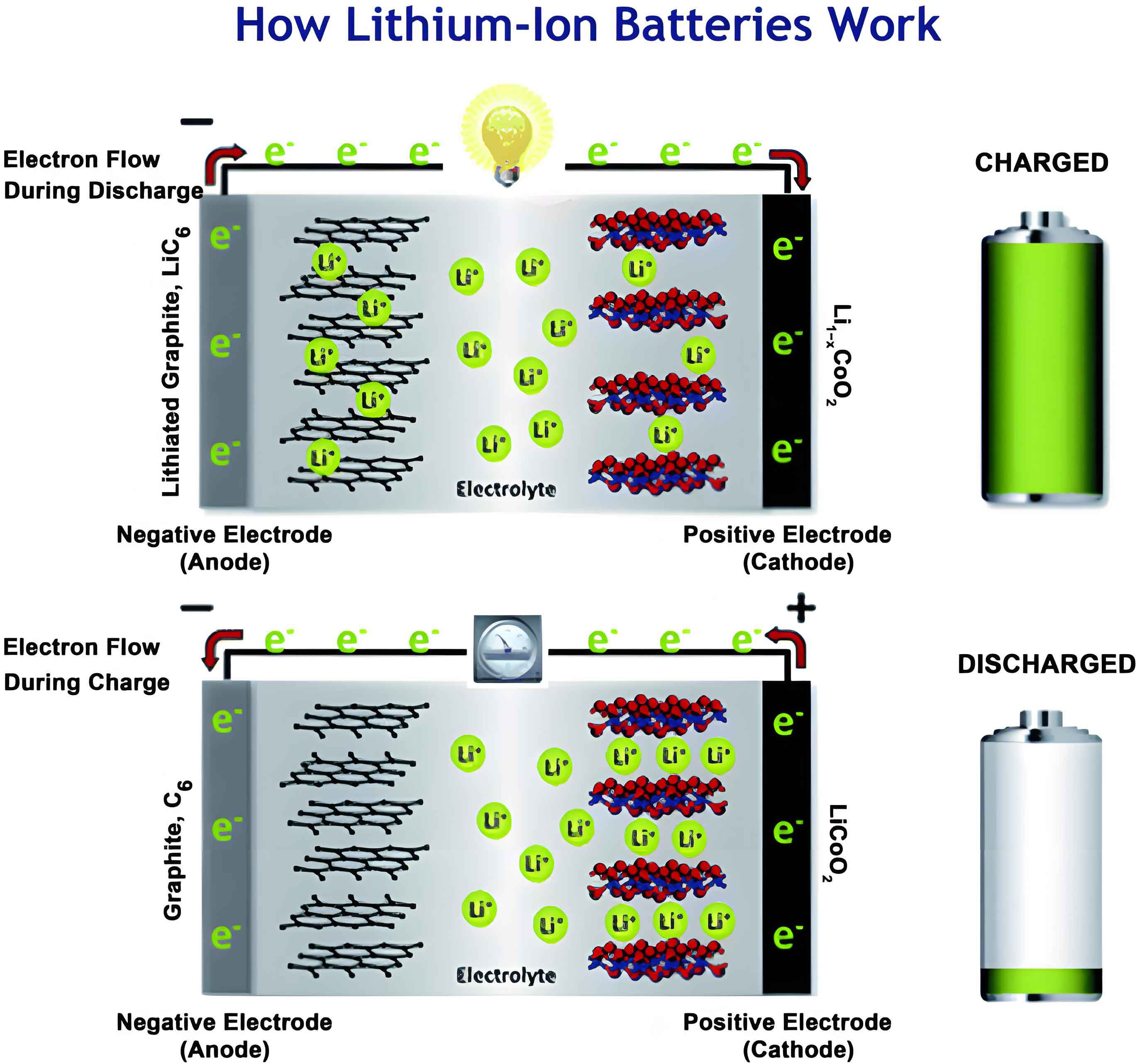
The working principle of a li ion battery cathode can be generalized by the reversible intercalation/deintercalation reaction:
$$ \text{Li}_n[\text{Host}] \rightleftharpoons [\text{Host}] + n\text{Li}^+ + n e^- $$
where $[\text{Host}]$ represents the crystalline framework of the transition metal compound. The ease and kinetics of this reaction are intrinsically linked to how the interstitial sites within the crystal are connected, forming the “roads” for Li+ travel. Let’s first look at the theoretical landscape of potential cathode materials to understand the trade-offs between voltage and capacity.
| Material Class | Example Compounds | Average Voltage (vs. Li/Li+) | Theoretical Specific Capacity (mAh/g) |
|---|---|---|---|
| Layered Oxides | LiCoO2, LiNiO2 | ~3.9 V | ~274 |
| Spinel Oxides | LiMn2O4 | ~4.1 V | 148 |
| Olivine Phosphates | LiFePO4 | ~3.45 V | 170 |
| NASICON Phosphates | Li3V2(PO4)3 | ~3.8 V (for 2 Li) | 197 (for 3 Li) |
| Silicate | Li2MnSiO4 | ~3-4.5 V | ~330 |
One-Dimensional Tunnel Structures: The Case of LiFePO4
Materials with one-dimensional (1D) ion channels are characterized by interconnected interstitial sites that form continuous paths along a single crystal direction. The most prominent and commercially successful example is the olivine-structured LiFePO4, a pivotal material for safe and long-life li ion battery applications.
Crystal Architecture and Transport Limitation
LiFePO4 crystallizes in the orthorhombic Pnma space group. Its structure consists of a hexagonal close-packed oxygen array with Fe and Li residing in octahedral sites, and P in tetrahedral sites. The FeO6 octahedra share corners, forming sheets in the bc-plane. Critically, the LiO6 octahedra form edge-sharing chains that run parallel to the b-axis. This creates a strictly one-dimensional tunnel for Li+ diffusion. The electrochemical reaction involves a two-phase transformation between LiFePO4 and FePO4:
$$ \text{LiFePO}_4 \rightleftharpoons \text{FePO}_4 + \text{Li}^+ + e^- $$
The strong covalent P-O bonds stabilize the structure, leading to exceptional thermal and cycling stability. However, the 1D nature of the diffusion path is its Achilles’ heel. Li+ transport is confined to a single direction, making it highly susceptible to blocking by point defects, impurities, or grain boundaries. Theoretical calculations using density functional theory (DFT) quantify the migration energy barriers ($E_{\text{mig}}$) for different paths:
$$ E_{\text{mig}}([010]) \approx 0.55 \text{ eV}, \quad E_{\text{mig}}([001]) \approx 2.89 \text{ eV}, \quad E_{\text{mig}}([101]) \approx 3.36 \text{ eV} $$
This confirms that migration along the b-axis ([010]) is the only viable low-energy path, resulting in inherently low ionic and electronic conductivity (~10-9–10-10 S cm-1), which limits rate capability.
Strategies for Performance Enhancement
Overcoming the intrinsic 1D transport limitation has been the central research theme for LiFePO4 in the li ion battery field. The strategies can be categorized as follows:
- Particle Size Reduction (Nanostructuring): Shortening the absolute Li+ diffusion distance within a particle. The characteristic diffusion time $\tau$ is related to the diffusion coefficient $D$ and particle radius $r$ by:
$$ \tau \propto \frac{r^2}{D} $$
Thus, reducing $r$ to the nanoscale dramatically decreases $\tau$, enabling high-rate performance. - Conductive Surface Coating: Encapsulating particles with a conductive layer (e.g., carbon, metal) enhances electron transport between particles. Carbon coating, often achieved via in-situ carbon thermal reduction during synthesis, is ubiquitous. It creates a percolating electronic network, addressing the poor electronic conductivity.
- Cation Doping: Introducing aliovalent cations (e.g., Mg2+, Al3+, Zr4+, Nb5+) into the crystal lattice. Doping at the Li-site (M1) primarily increases electronic conductivity by generating charge carriers, but may block Li+ channels. Doping at the Fe-site (M2) can increase lattice parameters, potentially widening the diffusion channel, while also improving electronic conduction.
- Morphology Engineering: Controlling particle shape to maximize the surface area oriented along the fast [010] diffusion direction. For instance, platelet-like particles with the large face perpendicular to the b-axis provide more entry/exit points for Li+.
- Creating Porous or Hierarchical Structures: Mesoporous or hollow spherical morphologies combine short solid-state diffusion lengths with enhanced electrolyte infiltration, facilitating ionic transport via the liquid phase in the pores.
The success of LiFePO4 in the commercial li ion battery market is a testament to the effectiveness of these combined approaches, particularly carbon coating and nanosizing.
Two-Dimensional Layered Structures: Planar Ionic Highways
Two-dimensional (2D) layered materials offer Li+ migration channels within the planes of the crystal structure. This provides more pathways compared to 1D systems, generally leading to higher ionic conductivity and power density.
Layered Rock-Salt Oxides: LiMO2 (M = Co, Ni, Mn, and Mixtures)
These materials adopt the $\alpha$-NaFeO2 structure (space group R$\bar{3}$m), where oxygen atoms form a cubic close-packed lattice. Transition metal (M) and lithium ions occupy octahedral sites in alternating layers perpendicular to the [111] direction. Li+ can move relatively freely within the two-dimensional van der Waals gap between the MO2 slabs. The reaction is:
$$ \text{LiMO}_2 \rightleftharpoons \text{Li}_{1-x}\text{MO}_2 + x\text{Li}^+ + x e^- $$
This structure yields high specific capacities and good rate performance. However, each member of this family faces distinct challenges in the context of a practical li ion battery.
| Material | Advantages | Key Challenges | Mitigation Strategies |
|---|---|---|---|
| LiCoO2 | High tap density, excellent cycle life (for x < 0.5 in Li1-xCoO2), mature process. | High cost, toxicity, structural instability at high voltage (>4.2V), thermal runaway risk. | Surface coatings (Al2O3, MgO), limited depth of charge. |
| LiNiO2 | Higher capacity, lower cost. | Cation mixing (Ni in Li sites), poor thermal stability, synthesis difficulty. | Co and Mn co-doping to form NMC (LiNixMnyCozO2), Al doping (NCA). |
| LiMnO2 (layered) | Low cost, high capacity. | Jahn-Teller distortion, phase transformation to spinel during cycling. | Often stabilized in composite or doped forms (e.g., Li-rich layered materials). |
| NMC / NCA | Balanced performance: good capacity, improved safety and stability vs. LiCoO2. | Voltage fade (for Li-rich), cation mixing, surface degradation. | Precision synthesis (e.g., core-shell, concentration-gradient particles), surface modifications, electrolyte additives. |
The general formula for capacity is:
$$ C_{\text{theoretical}} = \frac{nF}{3.6 M_w} $$
where $n$ is moles of exchanged Li+, $F$ is Faraday’s constant, and $M_w$ is the molecular weight. For LiNi1/3Mn1/3Co1/3O2 (NMC111), $n \approx 1$, $M_w \approx 96.1$ g/mol, giving $C_{\text{theo}} \approx 278$ mAh/g.
Layered Vanadates: Li1+xV3O8
This monoclinic (P21/m) material features a distinctive layered structure built from VO6 octahedra and VO5 trigonal bipyramids, forming [V3O8]– layers. Lithium ions reside in both octahedral and tetrahedral sites between these layers. Its appeal lies in its ability to intercalate more than 1 Li per formula unit, offering high theoretical capacity (>300 mAh/g). The multi-electron process involves V5+/V4+/V3+ redox couples. However, the multiple phase transitions during cycling and moderate electronic conductivity have limited its widespread adoption in commercial li ion battery systems. Synthesis plays a critical role; nanostructured or defect-engineered LiV3O8 prepared by sol-gel or hydrothermal methods shows significantly improved kinetics and capacity retention compared to materials from solid-state reactions.
Orthosilicates: Li2MSiO4 (M = Fe, Mn)
This family represents a promising next-generation candidate for the high-energy li ion battery due to its very high theoretical capacity, originating from the potential for extracting two Li+ ions per formula unit:
$$ \text{Li}_2\text{MSiO}_4 \rightleftharpoons \text{LiMSiO}_4 + \text{Li}^+ + e^- \rightleftharpoons \text{MSiO}_4 + 2\text{Li}^+ + 2e^- $$
With $M_w$ around 130-140 g/mol, $C_{\text{theo}}$ approaches 330 mAh/g. The structure is orthorhombic (Pmn21), consisting of corner-sharing SiO4 and MO4 tetrahedra forming layered polyanionic sheets. While the silicate framework offers excellent stability, the materials suffer from extremely low electronic conductivity and significant structural rearrangements upon removal of the second lithium, leading to kinetic limitations and voltage hysteresis. Intensive research focuses on carbon nanocomposites and cation doping to unlock their potential for future li ion battery applications.
Three-Dimensional Framework Structures: Isotropic Ion Conduction
Three-dimensional (3D) framework materials possess interconnected interstitial sites in all three spatial directions, creating an isotropic network for rapid Li+ diffusion. This often translates to excellent rate capability.
Spinel Oxides: LiMn2O4
The spinel structure (space group Fd$\bar{3}$m) provides a robust 3D scaffold. Oxygen forms a cubic close-packed array. Li+ occupies 1/8 of the tetrahedral (8a) sites, and Mn occupies 1/2 of the octahedral (16d) sites. This creates a [Mn2O4] framework with interconnected tetrahedral and octahedral sites forming a 3D diffusion pathway for Li+. The primary redox couple is Mn3+/Mn4+ at ~4.1 V vs. Li/Li+. Despite the favorable structure for ion transport, the spinel li ion battery cathode faces a major challenge: capacity fade during cycling, especially at elevated temperatures. The primary degradation mechanisms are:
- Jahn-Teller Distortion: The high-spin Mn3+ ion (d4) is Jahn-Teller active. At high depths of discharge (lower voltages, ~3V region), the increased concentration of Mn3+ causes a cooperative distortion from cubic to tetragonal symmetry, inducing mechanical strain and structural damage.
- Manganese Dissolution: Acidic species (e.g., HF from electrolyte decomposition) catalyze the disproportionation reaction: 2Mn3+ (solid) → Mn4+ (solid) + Mn2+ (dissolved). The dissolved Mn2+ migrates to the anode, degrading the solid electrolyte interphase (SEI).
Mitigation strategies are centered on raising the average Mn oxidation state above +3.5 to suppress the Jahn-Teller effect. This is achieved through cationic substitution:
$$ \text{LiM}_x\text{Mn}_{2-x}\text{O}_4 \quad (\text{M = Li, Ni, Co, Al, Cr, etc.}) $$
For example, LiNi0.5Mn1.5O4 is a high-voltage (~4.7 V) spinel where the redox activity shifts to Ni2+/Ni4+, minimizing Mn3+ content and improving stability, though at the cost of dealing with high-voltage electrolyte compatibility.
NASICON-Type Phosphates: Li3V2(PO4)3
This material embodies a 3D framework with outstanding structural and thermal stability, highly desirable for a safe li ion battery. It crystallizes in a monoclinic (P21/n) NASICON (Na Superionic Conductor) structure. The framework is built from VO6 octahedra and PO4 tetrahedra sharing oxygen vertices, creating a rigid 3D network with large interconnected channels for Li+ migration. The V3+/V4+/V5+ redox couples operate at relatively high, flat plateaus. The electrochemical extraction of Li+ occurs in distinct steps:
$$ \begin{align*}
\text{Li}_3\text{V}_2(\text{PO}_4)_3 & \rightleftharpoons \text{Li}_{2.5}\text{V}_2(\text{PO}_4)_3 + 0.5\text{Li}^+ + 0.5e^- \quad (\sim3.6 \text{ V}) \\
\text{Li}_{2.5}\text{V}_2(\text{PO}_4)_3 & \rightleftharpoons \text{Li}_{2}\text{V}_2(\text{PO}_4)_3 + 0.5\text{Li}^+ + 0.5e^- \quad (\sim3.7 \text{ V}) \\
\text{Li}_{2}\text{V}_2(\text{PO}_4)_3 & \rightleftharpoons \text{Li}_{1}\text{V}_2(\text{PO}_4)_3 + 1.0\text{Li}^+ + 1.0e^- \quad (\sim4.1 \text{ V}) \\
\text{Li}_{1}\text{V}_2(\text{PO}_4)_3 & \rightleftharpoons \text{V}_2(\text{PO}_4)_3 + 1.0\text{Li}^+ + 1.0e^- \quad (\sim4.6-4.8 \text{ V})
\end{align*} $$
The theoretical capacity for extracting 2 Li+ is ~131 mAh/g and for 3 Li+ is ~197 mAh/g. While the 3D diffusion is fast, the electronic conductivity is low, necessitating carbon coating. The extraction of the third lithium at high voltage (>4.5 V) often leads to accelerated electrolyte decomposition and faster capacity fade, making the 2-Li region more practical for many li ion battery designs.
Synthesis, Nanostructuring, and the Path Forward
The performance of any cathode material in a li ion battery is not solely determined by its ideal crystal structure but is profoundly influenced by its real-world morphology, microstructure, and interface properties. Synthesis methodology is therefore a critical degree of freedom.
| Synthesis Method | Principle | Impact on Material Properties | Typical Materials |
|---|---|---|---|
| Solid-State Reaction | High-temperature annealing of mixed solid precursors. | Large particles, possible inhomogeneity, simple scaling. | LiCoO2, LiMn2O4 |
| Co-precipitation | Precipitation of mixed metal hydroxides/carbonates from solution. | Excellent control over stoichiometry, spherical secondary particles, homogeneous cation mixing. | NMC, NCA |
| Sol-Gel | Formation of an organic-inorganic network from molecular precursors. | High homogeneity, fine particle size, good control at molecular level. | LiFePO4/C, Li3V2(PO4)3/C |
| Hydrothermal/Solvothermal | Crystallization from aqueous/non-aqueous solution at elevated T & P. | Direct synthesis of nanocrystals, control over crystal shape and size. | Nanowires, platelets of various oxides/phosphates |
| Spray Pyrolysis | Atomization of precursor solution into a hot zone. | Formation of spherical, often hollow or porous particles, good for composites. | NMC, doped spinels |
The future of cathode development for advanced li ion battery technology lies in the intelligent integration of material design concepts:
- Multi-scale Design: Combining atomic-scale doping for electronic structure modification, nanoscale morphology control for short diffusion lengths, and micro-scale particle engineering (e.g., dense spherical aggregates of nanoparticles) for high tap density and electrolyte access.
- Surface and Interface Engineering: Applying functional coatings (e.g., Li3PO4, Al2O3, conductive polymers) to suppress side reactions, transition metal dissolution, and oxygen loss, especially for high-voltage and Ni-rich layered oxides.
- Exploration of New Chemistries: Continued research into polyanionic compounds (silicates, borates, sulfates) and disordered rocksalt cathodes, which can offer high capacities through multi-electron redox processes, albeit often with kinetic challenges to overcome.
- Understanding Degradation in Operando: Using advanced characterization techniques (in-situ XRD, XAS, NMR, TEM) to map structural evolution and phase boundaries in real-time, guiding more rational material design.
In conclusion, the journey to optimize the li ion battery is inextricably linked to a deep understanding of cathode crystal chemistry. From the confined tunnels of LiFePO4 to the expansive planes of NMC and the isotropic networks of spinel and NASICON structures, the dimensionality of Li+ migration is a fundamental design parameter. The continuous refinement of these materials through compositional tuning, nanostructuring, and interface control will be essential to push the boundaries of energy density, power, longevity, and safety, powering the next generation of electrochemical energy storage systems.