
1. Current Development Status and Trends
1.1 Historical Progression
The evolution of solar panel technology spans three distinct phases. Initially designed for residential use, solar panels have transitioned into industrial and architectural integration through material innovations and efficiency breakthroughs. Key milestones include:
| Technology | 2010 Efficiency | 2023 Efficiency | 2025 Projection |
|---|---|---|---|
| Monocrystalline Silicon | 17% | 24.5% | 26% |
| Thin-Film (CIGS) | 12% | 19.8% | 22% |
| Perovskite-Silicon Tandem | N/A | 31.2% | 35% |
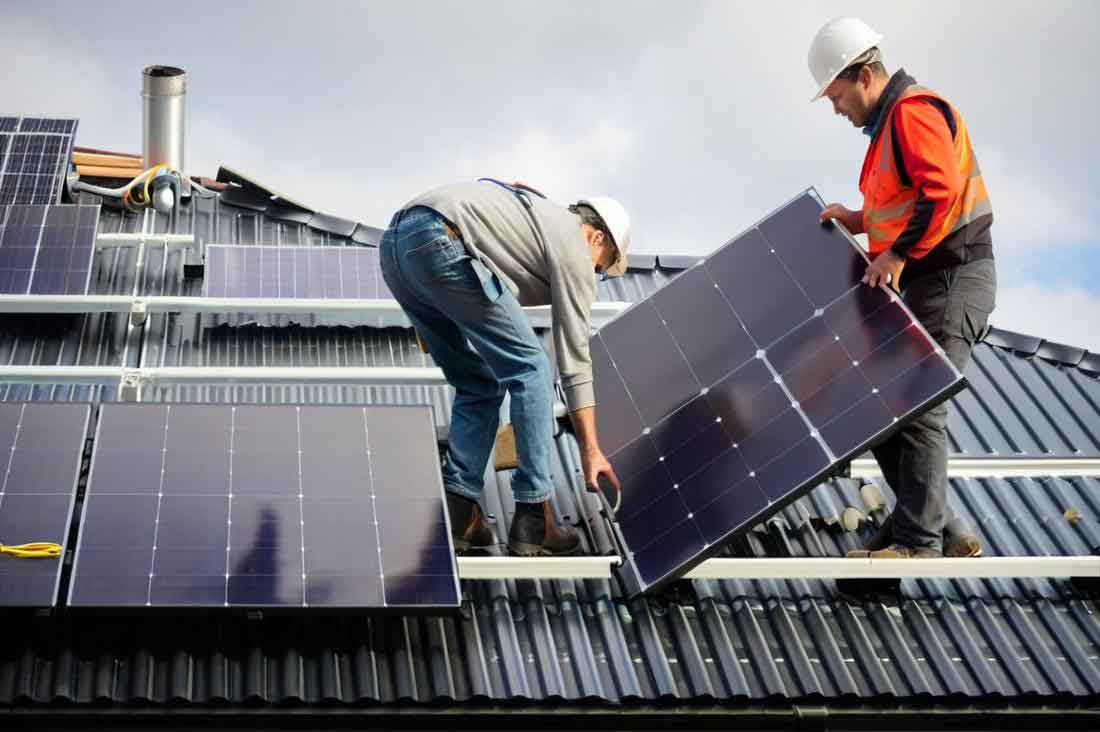
1.2 Core Application Areas
Modern solar panels now dominate three sectors:
- Industrial Manufacturing: Integrated into factory rooftops and equipment surfaces
- Smart Buildings: Building-integrated photovoltaics (BIPV) for façades and windows
- Energy Management Systems: AI-optimized solar grids with real-time load balancing
1.3 Emerging Trends
The energy output of solar panels under variable conditions can be modeled as:
$$ P_{total} = \eta \cdot A \cdot G \cdot (1 – \alpha(T – T_{STC})) $$
Where \( \eta \) = panel efficiency, \( A \) = surface area, \( G \) = solar irradiance (W/m²), \( \alpha \) = temperature coefficient, and \( T_{STC} \) = standard test condition temperature (25°C).
2. Critical Technologies and Challenges
2.1 Technological Framework
Advanced solar panel systems now incorporate:
| Parameter | Monocrystalline | Thin-Film | BIPV Modules |
|---|---|---|---|
| Avg. Efficiency | 22-24% | 15-19% | 18-21% |
| Cost/Watt (USD) | 0.32 | 0.28 | 0.41 |
| Architectural Flexibility | Low | High | Maximum |
2.2 Research Frontiers
Current research focuses on overcoming the Schockley-Queisser limit through tandem cell designs:
$$ \eta_{tandem} = \eta_{top} + \eta_{bottom} – \eta_{top}\eta_{bottom} $$
Where \( \eta_{top} \) and \( \eta_{bottom} \) represent the efficiencies of top/perovskite and bottom/silicon cells respectively.
2.3 Implementation Barriers
Key challenges in solar panel deployment include:
- Intermittency mitigation: \( E_{storage} \geq \frac{P_{peak} \cdot t_{night}}{\eta_{round-trip}} \)
- Degradation rates: Commercial panels lose 0.5-0.8% efficiency annually
- Grid integration complexities for industrial loads
3. Market Dynamics and Projections
3.1 Growth Metrics
The global solar panel market shows exponential growth:
| Year | Installed Capacity (GW) | Market Value (USD Billion) | CAGR |
|---|---|---|---|
| 2023 | 320 | 180 | 12.4% |
| 2025 | 450 | 245 | 14.1% |
| 2030 | 1,200 | 680 | 18.3% |
3.2 Application Hotspots
Solar panel adoption is accelerating across sectors:
- Industrial parks: 42% of new installations
- Commercial buildings: 33% market share
- Transportation infrastructure: 15% growth in solar-powered EV stations
3.3 Competitive Landscape
The solar panel industry follows a power law distribution:
$$ \text{Market Share}_i = \frac{k}{R_i^\alpha} $$
Where \( R_i \) = company rank, \( k \) = normalization constant, and \( \alpha \) ≈ 1.2 based on 2023 data.
4. Future Pathways and Innovations
Next-generation solar panel systems will leverage:
- Quantum dot-enhanced absorption spectra
- Self-cleaning nano-coatings improving maintenance efficiency by 40%
- AI-driven fault prediction models reducing downtime by 65%
The ultimate goal remains achieving grid parity through cost reduction:
$$ LCOE_{solar} = \frac{\sum_{t=1}^{n} \frac{I_t + M_t}{(1+r)^t}}{\sum_{t=1}^{n} \frac{E_t}{(1+r)^t}} $$
Where \( LCOE \) = levelized cost of electricity, \( I_t \) = investment costs, \( M_t \) = maintenance, \( E_t \) = energy output, and \( r \) = discount rate.
Through continuous innovation in materials science, manufacturing processes, and system integration, solar panel technology is poised to become the cornerstone of sustainable industrial and architectural development in the 21st century.