
The integration of large-scale renewable energy sources, characterized by their intermittency and uncertainty, poses significant challenges to the frequency stability of modern power grids. To address this, cell energy storage systems have emerged as a pivotal technology for providing fast and accurate frequency regulation ancillary services. Among these services, primary frequency regulation (PFR) is often cited as one of the most lucrative. However, the economic viability of deploying a cell energy storage system for PFR is not uniform; it depends critically on the specific type of storage technology employed—each with distinct characteristics in efficiency, response time, cycle life, and cost—and the control strategy governing its operation. This study conducts a comprehensive techno-economic analysis to evaluate the lifecycle economics of different cell energy storage systems—namely lead-acid batteries, lithium iron phosphate (LFP) batteries, vanadium redox flow batteries (VRFB), and supercapacitors—when participating in PFR alongside conventional thermal generation units under various control strategies.
The core of our analysis is a detailed lifecycle cost-benefit model for a cell energy storage system. The total cost over the project’s lifespan (T) considers the initial investment, replacement costs, operation and maintenance (O&M), and end-of-life disposal costs, all discounted to their present value using a given interest rate (i). The initial and replacement costs for the cell energy storage system are calculated based on its rated power (\(P_{rated}\)) and energy capacity (\(E_{rated}\)):
$$C_{inv} = C_{PCS}P_{rated} + C_{bat}E_{rated} + \sum_{k=0}^{n} C_{bat}E_{rated}(1+i)^{-(kT_n)}$$
Here, \(C_{PCS}\) and \(C_{bat}\) are the unit power conversion system cost and unit battery storage cost, respectively. \(n\) represents the number of replacements needed within the lifespan \(T\), which is determined by dividing the total lifecycle by the battery’s usable life in years (\(T_n\)), itself a function of its degradation under the specific duty cycle. The O&M costs (\(C_{O&M}\)) include both power- and capacity-dependent annual costs, while salvage costs (\(C_{scr}\)) are similarly structured.
The benefits of integrating a cell energy storage system for PFR are threefold: savings for the conventional generator, environmental benefits, and regulation service payments. The savings (\(Y_C\)) stem from reduced fuel consumption and decreased wear-and-tear on the thermal units due to less frequent and severe power adjustments. The environmental benefit (\(Y_E\)) is monetized based on the reduction in emissions (like SO₂ and NOx) from the lower fossil fuel burn. Finally, the service payment (\(Y_S\)) is a direct revenue stream based on the committed and delivered regulation power.
$$Y_S = \sum_{t=1}^{T} \left( \sum_{j=1}^{t} P_b(j) \Delta t \right) P_{PFR} (1+i)^{-t}$$
where \(P_b(j)\) is the power output of the cell energy storage system at time interval \(j\), and \(P_{PFR}\) is the service payment rate per unit of energy provided for regulation.
The cell energy storage system must be appropriately sized to meet the technical requirements of PFR. We consider two fundamental frequency control characteristics: steady-state deviation and rate-of-change-of-frequency (RoCoF). The target is to maintain frequency deviation (\(|\Delta f|\)) within 0.04 Hz and RoCoF (\(|d(\Delta f)/dt|\)) within 0.02 Hz/s after a disturbance. For a “virtual droop” control strategy, which mimics the governor response of a synchronous generator, the required power rating (\(S_{ESS,droop}\)) is determined by the difference between the desired system droop (\(\lambda_{target}\)) and the existing droop from conventional units (\(\lambda_{PS}\)):
$$S_{ESS,droop} = R_{ESS} f_0 (\lambda_{target} – \lambda_{PS})$$
The required energy capacity (\(E_{ESS,droop}\)) is then sized to sustain this power output for the required duration (e.g., 15 minutes), accounting for charge/discharge efficiencies (\(\eta_c, \eta_d\)):
$$E_{ESS,droop} = 3600 \cdot t_{req} \cdot S_{ESS,droop} \left( \frac{1}{\eta_d} + \eta_c \right) / 2$$
For a “virtual inertia” control strategy, which mimics the inertial response of rotating masses, the sizing is based on the target system inertia constant (\(H_{target}\)). The required power rating (\(S_{ESS,inertia}\)) is derived from the inertia shortfall:
$$S_{ESS,inertia} = S_{PS1} \cdot \frac{H_{target} – H_{PS1}}{H_{ESS} – H_{PS1}}$$
The corresponding energy capacity is calculated by integrating the expected power output profile of the cell energy storage system during inertial response events. Hybrid strategies that combine both droop and inertia control require the cell energy storage system to be sized for the combined duty, typically taking the larger power rating and summing the energy capacities from both control modes.
We evaluate four distinct control strategies for the cell energy storage system: 1) Virtual Droop Control (VDC): Output is proportional to frequency deviation (\(\Delta P_b = -K_E \Delta f\)). 2) Virtual Inertia Control (VIC): Output is proportional to the RoCoF (\(\Delta P_b = -K_I d(\Delta f)/dt\)). 3) Hybrid Control (HC): Combines VDC and VIC, activating both during large, worsening frequency deviations and only VDC during recovery. 4) Hybrid Control with Energy Storage Priority Deadband (HC-DB): A refined HC strategy where the cell energy storage system is assigned a narrower deadband (e.g., 60% of the conventional unit’s deadband). This ensures the cell energy storage system responds to smaller frequency deviations first, reserving the conventional generator’s slower, more costly response for larger imbalances.
The technical and economic parameters for the four types of cell energy storage systems considered are summarized below. Supercapacitors, while having exceptional power density and cycle life, have a very low energy density, making them suitable only for strategies with minimal energy requirements, such as pure virtual inertia control.
| Parameter | Lead-Acid | LFP Battery | VRFB | Supercapacitor |
|---|---|---|---|---|
| Cycle Life (to 80% DoD) | 500-1,000 | 3,000-5,000 | >12,000 | >100,000 |
| Response Time | Seconds | 20ms-Seconds | 20ms-Seconds | 1-20ms |
| Round-Trip Efficiency | 75% | 90% | 80% | 95% |
| Energy Density (Wh/kg) | 30-50 | 75-200 | 40-130 | 2.5-15 |
| Power Cost ($/kW) | 150 | 240 | 190 | 60 |
| Energy Cost ($/kWh) | 120 | 300 | 560 | 2000 |
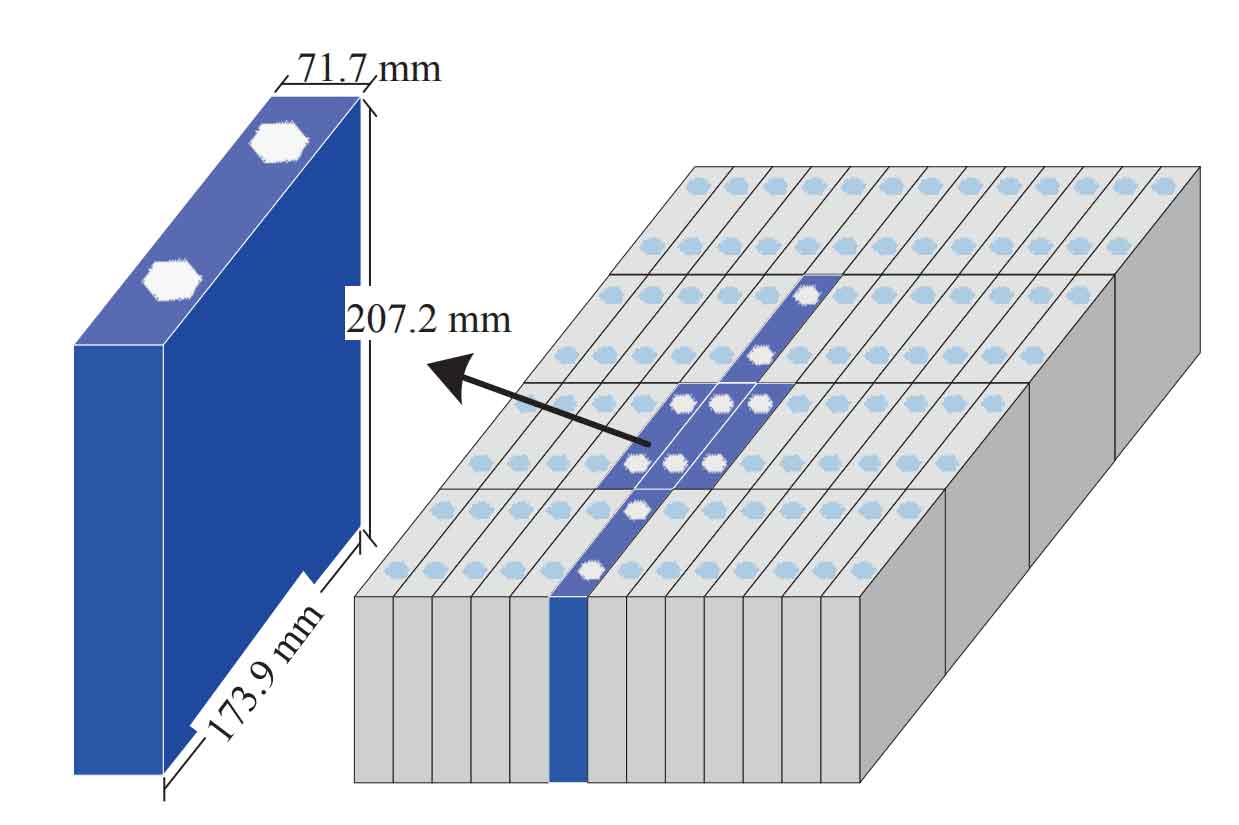
The physical form factor of a cell energy storage system, such as the modular design of lithium iron phosphate batteries shown above, influences installation and scalability but is secondary to the core cost and performance parameters for this high-level economic analysis.
A year-long simulation was conducted using typical daily load fluctuation profiles for a power system containing a 100 MW conventional generator. For each type of cell energy storage system and each control strategy, the required power and energy ratings were first calculated based on the technical frequency criteria. Then, the system’s operation was simulated to obtain the annual duty cycle—the sequence of charge/discharge power and state-of-charge (SOC) swings. This duty cycle is crucial for estimating the degradation and usable life of the cell energy storage system. We employ the rainflow counting algorithm to convert the irregular SOC profile into an equivalent number of standard full-cycle equivalents, which is then used to calculate the battery’s usable life (\(T_n\)) based on its cycle life rating. The net present value of the project over a 30-year period was calculated for each case.
The economic results, expressed as annualized net profit, reveal clear synergies between specific cell energy storage system technologies and control strategies.
| Strategy / Battery Type | Lead-Acid | LFP Battery | VRFB | Supercapacitor |
|---|---|---|---|---|
| Virtual Droop Control (VDC) | 11,689 | 9,324 | 8,622 | N/A |
| Virtual Inertia Control (VIC) | -11,297 | -6,248 | -3,644 | 5,014 |
| Hybrid Control (HC) | 25,831 | 45,862 | 44,800 | N/A |
| HC with Deadband (HC-DB) | 83,038 | 90,661 | 100,556 | N/A |
Table: Annualized Net Profit (in currency units per year) for different Cell Energy Storage System types under various control strategies. Bold indicates the most profitable technology for a given strategy.
The results lead to several key conclusions. For the Virtual Droop Control (VDC) strategy, which imposes a relatively mild duty cycle with shallow cycles, the lead-acid battery proves to be the most economical choice. Its low upfront capital cost outweighs its shorter cycle life in this application, resulting in the highest annualized profit. This demonstrates that for less demanding frequency regulation profiles, a simpler and cheaper cell energy storage system can be optimal.
The Virtual Inertia Control (VIC) strategy requires very high power capability but minimal energy storage. Here, the supercapacitor is the only technology that yields a positive profit. Its extremely low cost per kW and virtually unlimited cycle life perfectly match the strategy’s requirements, whereas the energy-based cell energy storage systems are penalized by their higher power costs and unnecessary energy capacity. This highlights the importance of matching the storage technology’s strength (power vs. energy) to the grid service demand.
For the more advanced Hybrid Control (HC) strategy, which demands both power and significant energy throughput, the cycle life and efficiency of the cell energy storage system become paramount. Both the LFP battery and the VRFB show strong performance, with LFP having a slight edge in this simulation due to its superior round-trip efficiency. The higher cycling stress of the hybrid strategy makes the longevity of these technologies economically valuable.
Most notably, the Hybrid Control with Deadband (HC-DB) strategy, which actively prioritizes the cell energy storage system to absorb minor fluctuations, creates the most valuable service profile. It significantly reduces wear and fuel cost on the conventional generator. While this strategy imposes the most strenuous duty cycle on the storage system, the VRFB emerges as the most profitable technology. Its exceptionally long cycle life—effectively matching or exceeding the project’s 30-year lifespan without replacement—makes it uniquely capable of handling this intense cycling regime without incurring high replacement costs. The LFP battery also performs very well, but its finite cycle life leads to one or more replacements within the project horizon, slightly reducing its net present value compared to the VRFB in this specific high-utilization scenario.
In summary, the economic viability of a cell energy storage system for primary frequency regulation is not determined by the technology or the control strategy in isolation, but by their combination. A low-cost, shorter-life cell energy storage system can be optimal for basic, low-impact services. A pure power-oriented device like a supercapacitor is ideal for high-power, low-energy applications like inertia emulation. For comprehensive frequency regulation that captures the full value of fast response, high-efficiency and long-cycle-life technologies like lithium iron phosphate and vanadium redox flow batteries in advanced hybrid control schemes offer the greatest economic return. The HC-DB strategy, in particular, unlocks superior value by maximizing the utilization of the cell energy storage system, but this requires a storage technology like VRFB that is robust enough to endure the associated operational intensity over the long term. This analysis provides a clear framework for selecting the optimal cell energy storage system technology based on the chosen grid service control strategy.