
As I walked through the bustling halls of the Tokyo International Exhibition Center in early 2015, the energy was palpable. The event, a major international exhibition for photovoltaic technology, marked a pivotal moment in the evolution of solar energy solutions. My focus was drawn overwhelmingly to the residential sector, where a new era of integrated solar systems was unfolding before my eyes. The shift from mere solar panels to comprehensive home power solutions signaled a transformative trend, driven by a growing global awareness of energy resilience and sustainability. In this article, I will delve into the intricacies of these advanced solar systems, exploring their components, benefits, and the underlying market forces, all from my first-hand perspective. The term “solar system” will be a recurring theme, as it encapsulates not just the technological assembly but the holistic approach to energy independence that was so prominently showcased.
The primary driver behind this surge in integrated residential solar systems is the escalating demand for backup power. Following significant events that highlighted grid vulnerabilities, many homeowners have recognized the necessity of having a reliable alternative energy source. A solar system, when paired with storage and management units, transforms from a simple electricity generator into a robust home energy hub. During my observations, I noted that suppliers were emphasizing how a well-designed solar system can provide peace of mind during power outages, ensuring that critical appliances remain operational. This functionality extends beyond emergency use; it also enables greater self-consumption of solar energy, reducing reliance on the grid and enhancing economic benefits.
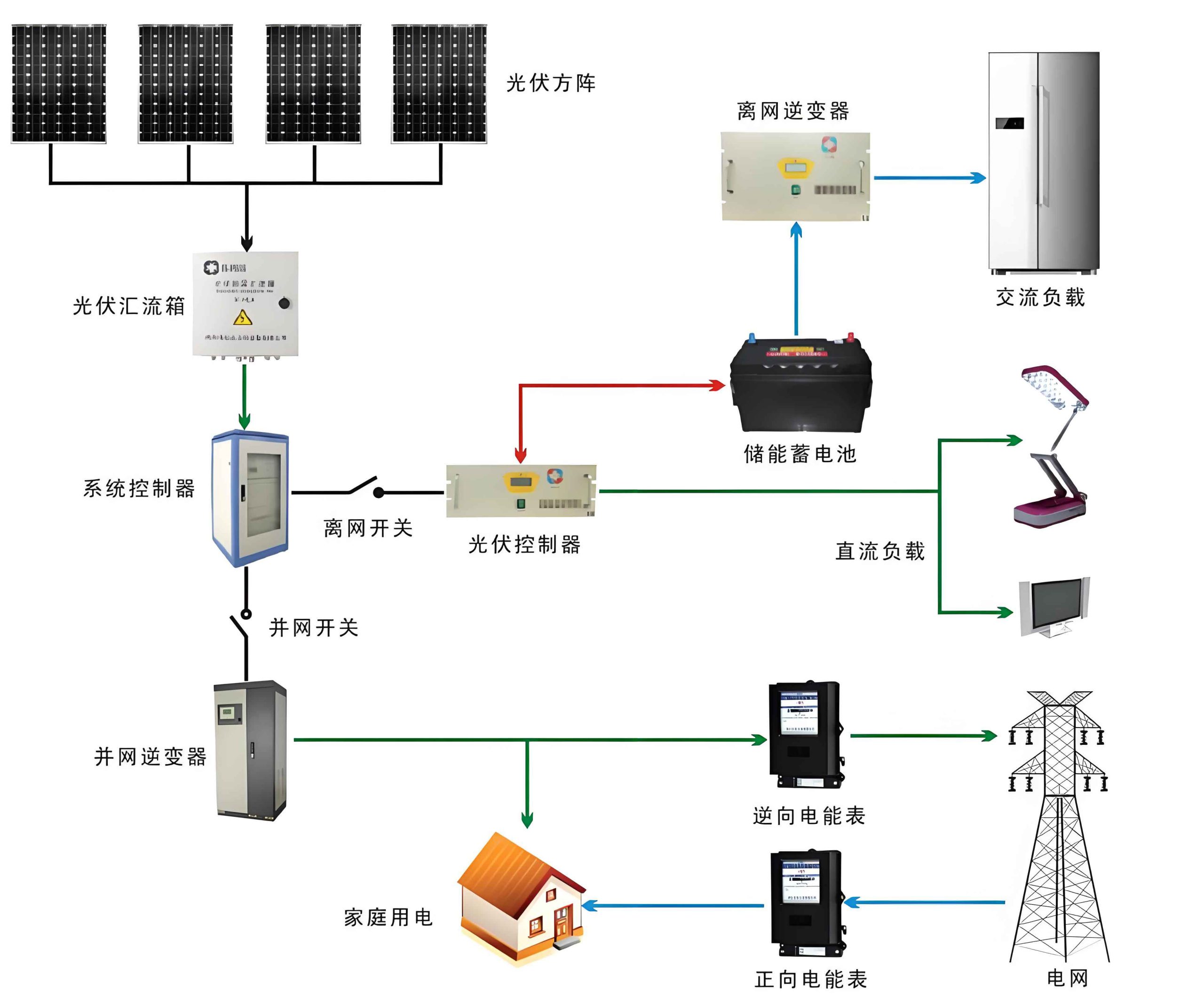
At the core of any modern residential solar system are several key components: photovoltaic (PV) modules, hybrid inverters, battery storage units, and power management systems. Each element plays a crucial role in ensuring efficiency and reliability. Let me break down these components based on what I saw. The PV modules, typically mounted on rooftops, capture sunlight and convert it into direct current (DC) electricity. The efficiency of these modules can be expressed using the formula for power output: $$P_{PV} = A \times \eta \times G \times (1 – \beta (T_c – T_{ref}))$$ where \(P_{PV}\) is the power output in watts, \(A\) is the area of the solar panel in square meters, \(\eta\) is the module efficiency, \(G\) is the solar irradiance in W/m², \(\beta\) is the temperature coefficient, \(T_c\) is the cell temperature, and \(T_{ref}\) is the reference temperature. This equation highlights how environmental factors impact the performance of a solar system.
Next, the hybrid inverter is the brain of the solar system. It converts DC electricity from the panels into alternating current (AC) for home use, while also managing the flow of energy to and from the battery. Some advanced inverters even allow bidirectional power flow, enabling the solar system to feed excess electricity back to the grid. I recall seeing various models with different specifications, which I’ve summarized in the table below to illustrate the diversity in the market.
| Inverter Type | Efficiency (%) | Power Rating (kW) | Battery Compatibility | Key Features |
|---|---|---|---|---|
| Standard Hybrid | 95-97 | 3-10 | Lead-acid, Lithium-ion | Basic energy management, Grid-tie functionality |
| Advanced Bidirectional | 97-99 | 5-15 | Lithium-ion only | Smart grid integration, Remote monitoring, Peak shaving |
| Compact Integrated | 94-96 | 2-5 | Integrated battery units | All-in-one design, Easy installation, Scalable |
Battery storage is perhaps the most transformative component of a modern solar system. It addresses the intermittent nature of solar power by storing excess energy generated during the day for use at night or during outages. The capacity of a battery system is critical, and it’s often measured in kilowatt-hours (kWh). During the exhibition, I learned that the energy storage capability can be modeled using the formula: $$E_{battery} = C \times V \times DoD$$ where \(E_{battery}\) is the usable energy in kWh, \(C\) is the battery capacity in ampere-hours (Ah), \(V\) is the voltage, and \(DoD\) is the depth of discharge (typically 0.8 for lithium-ion batteries). This equation helps in designing a solar system that meets specific household energy needs. Below is a table comparing common battery types used in residential solar systems.
| Battery Type | Energy Density (Wh/kg) | Cycle Life | Cost per kWh (USD) | Best For |
|---|---|---|---|---|
| Lead-Acid | 30-50 | 500-1000 cycles | 150-300 | Budget-conscious setups, Backup power |
| Lithium-Ion | 100-265 | 2000-5000 cycles | 500-800 | High-efficiency solar systems, Daily cycling |
| Saltwater | 60-80 | 3000+ cycles | 400-600 | Environmental sustainability, Long lifespan |
Power management systems (PMS) tie everything together, optimizing the operation of the solar system. They use algorithms to decide when to charge the battery, when to draw from the grid, and when to export electricity. Some systems incorporate weather forecasting data to pre-charge batteries ahead of storms, a feature I found particularly innovative. This intelligent management maximizes the self-consumption rate of the solar system, which can be calculated as: $$SC = \frac{E_{self-consumed}}{E_{total generated}} \times 100\%$$ where \(SC\) is the self-consumption percentage, \(E_{self-consumed}\) is the energy used directly from the solar system, and \(E_{total generated}\) is the total energy produced by the PV panels. A well-integrated solar system can achieve self-consumption rates above 60%, significantly reducing electricity bills.
From my discussions with exhibitors, it was clear that the economic viability of a residential solar system is a major consideration. The return on investment (ROI) depends on factors such as installation costs, energy savings, government incentives, and battery lifespan. A simplified ROI formula for a solar system is: $$ROI = \frac{Net Benefits}{Total Cost} \times 100\%$$ where \(Net Benefits\) include reduced electricity bills and feed-in tariffs over time, minus maintenance costs. To illustrate, I’ve compiled a table showing hypothetical cost-benefit analyses for different solar system configurations in Japan, based on average data from 2015.
| System Size | PV Capacity (kW) | Battery Storage (kWh) | Total Installed Cost (USD) | Annual Savings (USD) | Payback Period (Years) |
|---|---|---|---|---|---|
| Basic Solar System | 4 | 0 (Grid-tied only) | 8,000 | 800 | 10 |
| Standard Solar System with Storage | 5 | 10 | 15,000 | 1,200 | 12.5 |
| Premium Integrated Solar System | 6 | 15 | 20,000 | 1,500 | 13.3 |
The market for these integrated solar systems, while still nascent in 2015, showed promising growth potential. I observed that suppliers were targeting residential customers with tailored solutions, emphasizing scalability and flexibility. For instance, some solar systems could be installed without batteries initially, allowing homeowners to add storage later as prices dropped. This modular approach makes the solar system more accessible and adaptable to changing needs. Moreover, the inclusion of operation and maintenance (O&M) services in many packages ensures long-term reliability, which is crucial for customer trust in the solar system.
Technological innovations were abundant at the exhibition. One standout was the integration of cloud-based monitoring and control into the solar system. This allows homeowners to manage their energy usage remotely via smartphones, optimizing battery charging based on real-time data. For example, if a storm is predicted, the solar system can automatically charge the battery to full capacity, ensuring backup power is available. The algorithm for this predictive charging can be expressed as: $$C_{target} = \min\left(C_{max}, C_{current} + \alpha \times P_{forecast}\right)$$ where \(C_{target}\) is the target battery charge level, \(C_{max}\) is the maximum capacity, \(C_{current}\) is the current charge, \(\alpha\) is a factor based on forecasted outage probability, and \(P_{forecast}\) is the predicted solar generation. Such smart features enhance the resilience of the solar system, making it more than just an energy source—it becomes an intelligent home asset.
Another aspect I explored was the environmental impact of deploying widespread residential solar systems. By reducing dependence on fossil fuels, each solar system contributes to lower carbon emissions. The carbon savings can be estimated using: $$CO2_{saved} = E_{solar} \times EF_{grid}$$ where \(CO2_{saved}\) is the carbon dioxide saved in kilograms per year, \(E_{solar}\) is the annual energy generated by the solar system in kWh, and \(EF_{grid}\) is the emission factor of the grid electricity in kg CO2/kWh. Assuming an average grid emission factor of 0.5 kg CO2/kWh, a 5 kW solar system generating 6,000 kWh annually can save about 3,000 kg of CO2 per year. This highlights how a decentralized network of solar systems can collectively drive significant environmental benefits.
Looking ahead, the future of residential solar systems appears bright. Advances in battery technology, such as solid-state batteries, promise higher energy densities and longer lifespans, which will further enhance the appeal of solar systems. Additionally, the integration of electric vehicle (EV) charging into the solar system is an emerging trend. Imagine a home where the solar system not only powers the house but also charges the EV, creating a fully sustainable energy ecosystem. The synergy between EVs and solar systems can be modeled with: $$E_{total} = E_{PV} + E_{battery} – E_{EV}$$ where \(E_{total}\) is the net energy available for home use, \(E_{PV}\) is solar generation, \(E_{battery}\) is storage discharge, and \(E_{EV}\) is energy used for EV charging. Optimizing this balance will be key to maximizing the utility of the solar system.
In my view, the widespread adoption of residential solar systems hinges on several factors: cost reduction, policy support, and consumer education. Governments can play a role by offering subsidies or tax incentives for installing solar systems, as seen in many countries. Moreover, educating homeowners about the long-term benefits—such as energy independence, cost savings, and environmental stewardship—will drive demand. As I reflected on the exhibition, it was evident that the solar system is evolving from a niche product into a mainstream solution for modern living.
To summarize the technical specifications and performance metrics of a typical advanced residential solar system, I’ve created a comprehensive table below. This table encapsulates the key parameters that define an efficient and reliable solar system, based on the trends I observed in 2015.
| Component | Parameter | Typical Value | Impact on System Performance |
|---|---|---|---|
| PV Modules | Efficiency | 18-22% | Higher efficiency means more power per square meter, optimizing roof space. |
| Temperature Coefficient | -0.3 to -0.5%/°C | Lower coefficient reduces power loss in hot climates, enhancing solar system reliability. | |
| Lifespan | 25+ years | Long lifespan ensures durable energy generation from the solar system. | |
| Hybrid Inverter | Conversion Efficiency | 97-99% | High efficiency minimizes energy losses in the solar system. |
| Maximum Power Point Tracking (MPPT) | 99% accuracy | Optimizes energy harvest from PV panels, boosting solar system output. | |
| Grid Interaction | Bidirectional capability | Enables energy export and import, making the solar system grid-responsive. | |
| Battery Storage | Usable Capacity | 5-20 kWh | Determines backup duration and self-consumption potential of the solar system. |
| Round-Trip Efficiency | 90-95% | Higher efficiency means less energy loss during storage cycles in the solar system. | |
| Cycle Life | 2000-5000 cycles | Long cycle life extends the economic viability of the solar system. | |
| Power Management | Self-Consumption Rate | 50-70% | Indicates how effectively the solar system uses generated energy onsite. |
| Remote Monitoring | Cloud-based interface | Allows real-time optimization and troubleshooting of the solar system. |
In conclusion, my experience at the 2015 exhibition reinforced the transformative potential of integrated residential solar systems. These systems are not merely collections of hardware; they represent a paradigm shift towards decentralized, resilient, and sustainable energy. The solar system, when designed holistically, can provide backup power, reduce electricity costs, and contribute to environmental goals. As technology advances and markets mature, I believe the solar system will become an indispensable part of every home, empowering individuals to take control of their energy future. The journey from simple solar panels to smart, interconnected solar systems is just beginning, and I am excited to witness its evolution.
To further illustrate the energy flow within a residential solar system, consider the following dynamic equation that models the system’s operation over time: $$E_{home}(t) = P_{PV}(t) \times \eta_{inv} + \frac{dE_{battery}(t)}{dt} – E_{load}(t)$$ where \(E_{home}(t)\) is the energy supplied to the home at time \(t\), \(P_{PV}(t)\) is the solar power generation, \(\eta_{inv}\) is the inverter efficiency, \(E_{battery}(t)\) is the energy stored in the battery, and \(E_{load}(t)\) is the household energy demand. This equation captures the balance that a well-managed solar system must maintain to ensure uninterrupted power supply. By optimizing these variables, homeowners can maximize the benefits of their solar system, making it a cornerstone of modern energy infrastructure.
Ultimately, the rise of residential solar systems signifies a broader movement towards energy democratization. Each solar system installed contributes to a more resilient grid, reduces carbon footprints, and fosters innovation. As I left the exhibition, I felt optimistic about the future—a future where every home is equipped with a robust solar system, harnessing the sun’s energy to power our lives sustainably. The path forward involves continued research, supportive policies, and public engagement, but the foundation laid by these integrated solutions is strong. The solar system is not just a technology; it is a beacon of hope for a cleaner, more independent energy era.