
As I reflect on the recent developments in the photovoltaic industry, I am reminded of the ancient poetic line: “The flowers bloom similarly each year, but the people admiring them change.” This sentiment aptly captures the essence of the annual SNEC exhibition, which I had the privilege to attend. The event has always been a barometer for the solar energy sector, and this year was no exception. Following the tumultuous period after the “531” policy in 2018, the industry has undergone significant reshuffling, paving the way for a more mature and innovation-driven landscape. The anticipation for the 2019 national policies was palpable, and with their implementation, a clearer path toward grid parity and high-quality development has emerged. In this article, I will share my insights on the key trends, technologies, and market outlook, emphasizing the evolution of solar systems toward a sustainable future.
The national policies have always served as a compass for industrial growth. This year, the themes of “technological innovation, grid parity, and high-quality development” dominated the discourse at SNEC. Most exhibiting companies aligned their strategies with these directives, showcasing advancements that promise to revolutionize solar systems. From my observations, the exhibition hall, though less crowded than in previous years, was brimming with cutting-edge solutions from resilient players who have consistently invested in R&D. This shift underscores a broader trend: the solar industry is moving from scale-driven expansion to value-driven innovation, where efficiency and reliability are paramount.
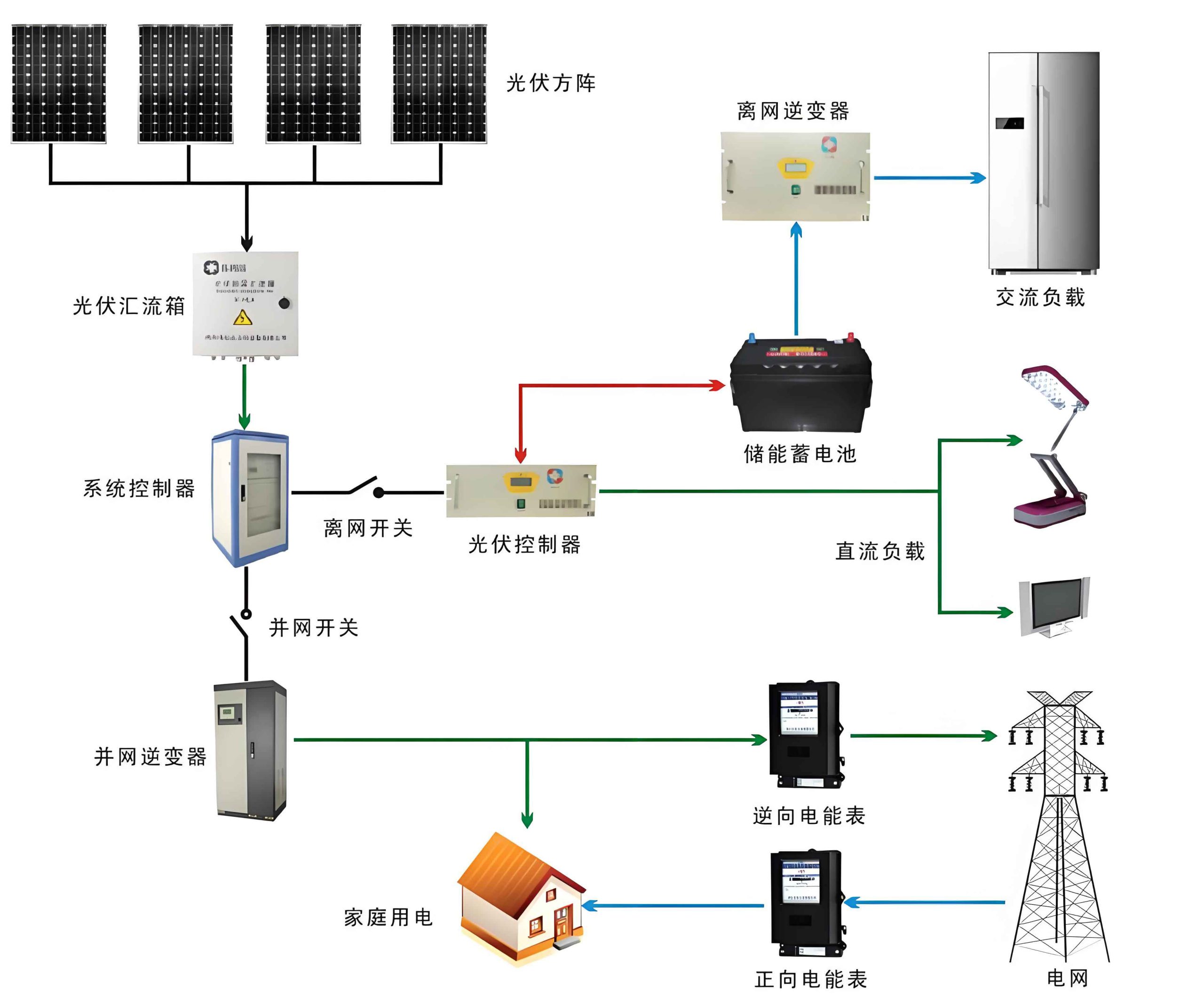
One of the most striking advancements I witnessed was the integration of artificial intelligence into solar systems. A prominent company, often seen as a latecomer to the光伏 field, has leveraged its expertise in communications to introduce an intelligent photovoltaic system. By incorporating AI algorithms, this system optimizes the synergy between bifacial modules, tracking racks, and multi-channel MPPT inverters, surpassing traditional setups that use monofacial modules and fixed racks. The AI-driven approach enables real-time power闭环控制, enhancing发电量 by over 20% compared to conventional methods. Moreover, the智能 MPPT多峰跟踪算法 and AI-enhanced grid-connection algorithms further boost performance, reducing the levelized cost of electricity (LCOE) by more than 7%. This innovation highlights how smart technologies can elevate the efficiency of solar systems, making them more adaptive and profitable in diverse environments.
To quantify the benefits of such intelligent solar systems, consider the following formula for calculating the additional energy yield: $$ \Delta E = E_{\text{AI}} – E_{\text{traditional}} $$ where \( \Delta E \) represents the gain in发电量, \( E_{\text{AI}} \) is the energy output with AI optimization, and \( E_{\text{traditional}} \) is the output from standard systems. For instance, if a solar system produces 1000 MWh annually without AI, the AI-enhanced version could generate up to 1200 MWh, assuming a 20% improvement. This translates to significant financial returns over the system’s lifetime.
| Technology | Energy Yield Gain | LCOE Reduction | Key Features |
|---|---|---|---|
| AI-Optimized Solar System | ≥20% | ≥7% | Multi-MPPT,智能 IV Diagnosis 3.0 |
| Traditional Solar System | Baseline | 0% | Fixed支架, Single MPPT |
Another fascinating trend is the advent of the “4.0 era” for photovoltaic modules. Through the convergence of various technologies—such as PERC, TOPCon, HJT, bifacial designs, half-cut cells, and shingled connections—modules with powers exceeding 400 W have become commonplace. I observed numerous exhibitors showcasing products that push the boundaries of efficiency and durability. For example, some modules integrate n-type i-TOPCon cells with bifacial rates over 80%, achieving conversion efficiencies up to 20.7% and正面功率 of 425 W. Others utilize cast mono-crystalline silicon and large wafers to enhance light absorption and reduce electrical losses. These advancements are crucial for driving down the cost of solar systems, as higher module power directly impacts the balance of system (BOS) expenses and overall LCOE.
The performance of these high-efficiency modules can be modeled using the following equation for module power output: $$ P_{\text{module}} = \eta \times A \times G $$ where \( \eta \) is the conversion efficiency, \( A \) is the module area, and \( G \) is the solar irradiance. For a typical solar system, increasing \( \eta \) from 18% to 22% can boost \( P_{\text{module}} \) by approximately 22%, assuming constant \( A \) and \( G \). This underscores the importance of continuous innovation in cell and module technology.
| Module Type | Max Power (W) | Efficiency (%) | Key Technologies |
|---|---|---|---|
| Bifacial PERC Mono | 430 | 20.5 | Half-cut, MBB, Double Glass |
| HJT Heterojunction | 406.6 | 21.9 | n-type, Double-sided Rate 93% |
| Multi-crystalline P5 | 430 | 22.28 (cell) | Black Silicon, Selective Emitter |
| Shingled Mono | 450 | 21.2 | Overlapping Cells, Lightweight Backsheet |
The shift toward 1500 V photovoltaic systems is also gaining momentum, as it offers a viable path to reduce costs and improve efficiency. Compared to the standard 1000 V systems, 1500 V architectures minimize cable losses and lower BOS costs, which is essential for achieving grid parity. At the exhibition, several companies presented comprehensive solutions, including string inverters and centralized inverters designed for high-voltage applications. One notable example is a 1500 V string inverter with 12 MPPT channels and IP66 protection, capable of operating in harsh environments. Another innovation is the integrated inverter-transformer system that streamlines deployment and maintenance. These developments signal a broader adoption of 1500 V systems in utility-scale solar projects, where economies of scale are critical.
The economic impact of adopting 1500 V solar systems can be estimated using the formula for BOS cost savings: $$ \text{Savings}_{\text{BOS}} = C_{\text{1000V}} – C_{\text{1500V}} $$ where \( C_{\text{1000V}} \) and \( C_{\text{1500V}} \) represent the BOS costs per watt for respective systems. Studies indicate that \( \text{Savings}_{\text{BOS}} \) can reach up to 0.1 USD/W, translating to a 5-10% reduction in overall project costs. Additionally, the enhanced system efficiency from reduced losses can be expressed as: $$ \eta_{\text{system}} = \eta_{\text{inverter}} \times (1 – L_{\text{cable}}) $$ where \( \eta_{\text{inverter}} \) is the inverter efficiency and \( L_{\text{cable}} \) is the percentage loss in cables. By increasing the voltage, \( L_{\text{cable}} \) decreases, thereby boosting \( \eta_{\text{system}} \).
| System Voltage | Typical BOS Cost (USD/W) | Cable Loss Reduction | Application Scenarios |
|---|---|---|---|
| 1000 V | 0.40 | Baseline | Small to Medium Solar Systems |
| 1500 V | 0.30 | Up to 50% | Large-scale Solar Systems |
Energy storage technology has emerged as a key enabler for the high-quality development of solar systems. As photovoltaic penetration increases, issues like intermittency and curtailment must be addressed to ensure grid stability. At SNEC, numerous vendors showcased integrated “solar plus storage” solutions, ranging from containerized battery systems to advanced power conversion systems. These products are designed for diverse applications, including peak shaving, frequency regulation, and off-grid power supply. For instance, a newly released energy storage system features a volumetric energy density of 166 Wh/L, making it suitable for compact installations in commercial or residential solar systems. The synergy between photovoltaics and storage not only enhances self-consumption rates but also provides backup power, thereby increasing the resilience and value of solar energy deployments.
The financial viability of integrating storage into a solar system can be assessed using the net present value (NPV) formula: $$ \text{NPV} = \sum_{t=1}^{T} \frac{R_t – C_t}{(1 + r)^t} – I_0 $$ where \( R_t \) is the revenue from energy arbitrage or grid services in year \( t \), \( C_t \) is the operating cost, \( r \) is the discount rate, \( T \) is the system lifetime, and \( I_0 \) is the initial investment. For a typical solar system with storage, \( R_t \) can include savings from reduced peak demand charges and income from ancillary services, which often justify the higher upfront cost. Moreover, the levelized cost of storage (LCOS) can be calculated as: $$ \text{LCOS} = \frac{I_0 + \sum_{t=1}^{T} \frac{C_t}{(1 + r)^t}}{\sum_{t=1}^{T} \frac{E_{\text{discharged}, t}}{(1 + r)^t}} $$ where \( E_{\text{discharged}, t} \) is the energy discharged annually. As battery prices decline, LCOS is projected to fall below 0.1 USD/kWh, making storage an attractive complement to solar systems.
| Storage Technology | Energy Density (Wh/L) | Typical Application | Key Benefits for Solar Systems |
|---|---|---|---|
| Lithium Iron Phosphate | 166 | Grid-side Peak Shaving | High Safety, Long Cycle Life |
| Flow Batteries | 20-30 | Long-duration Storage | Scalability, Deep Discharge |
| Advanced Lead-acid | 80-100 | Off-grid Solar Systems | Low Cost, Mature Technology |
Looking ahead, the market outlook for 2019 appears promising, driven by policy stability and technological progress. After the slowdown in 2018, when新增光伏装机量 dropped by 17%, the industry is poised for a rebound. With the new policies in place, including quotas and competitive bidding, the installed capacity is expected to reach 40-50 GW this year. This growth will be fueled by distributed generation, poverty-alleviation projects, and平价 initiatives. From my perspective, the emphasis on quality over quantity will reshape the solar landscape, encouraging investments in efficient and durable solar systems. The transition to grid parity is no longer a distant dream but an imminent reality, supported by innovations across the value chain.
To illustrate the projected growth, consider the following table summarizing the key market segments for 2019:
| Segment | Estimated Capacity (GW) | Growth Driver | Impact on Solar Systems |
|---|---|---|---|
| Utility-scale Solar | 20-25 | Competitive Bidding, 1500 V Adoption | Lower LCOE, Enhanced Grid Integration |
| Distributed Solar | 15-20 | Rooftop Policies, Self-consumption | Modular Designs, Storage Integration |
| Poverty Alleviation | ~5 | Government Programs | Rural Electrification, Small-scale Systems |
| 平价 Projects | 4-5 | Unsubsidized Initiatives | Innovation in组件 and BOS |
In conclusion, the evolution of solar systems is accelerating at an unprecedented pace. From AI-driven optimization to high-efficiency modules and integrated storage solutions, the industry is steadily overcoming the challenges of cost and reliability. As a participant in this transformative journey, I am confident that solar energy will play a pivotal role in the global transition to sustainable power. The lessons from SNEC 2019 reinforce the importance of innovation and collaboration in building resilient solar systems that can thrive in a post-subsidy era. By embracing these advancements, stakeholders can unlock new opportunities and ensure a bright future for photovoltaic technology.
Ultimately, the success of any solar system hinges on its ability to deliver clean, affordable, and reliable electricity. The formulas and tables presented here offer a glimpse into the technical and economic considerations that underpin this goal. As we move forward, continuous research and development will be crucial to further reducing costs and enhancing performance. I believe that with the right policies and technologies, solar systems will become the backbone of the energy infrastructure, powering homes, industries, and communities worldwide.