
As I walked through the vast halls of the recent international exhibition on solar photovoltaics and smart energy, I was struck by the sheer scale and innovation on display. This gathering brought together thousands of participants from across the globe, showcasing the latest advancements in photovoltaic technology, energy storage, and digital solutions. The event underscored a pivotal moment for the industry, where despite current challenges, a collective drive towards innovation and integration is fueling a transformative shift. In this article, I will share my insights and observations, delving into the key trends that are reshaping the solar energy landscape, with a focus on technological breakthroughs, the accelerating fusion of solar and storage, and the empowering role of artificial intelligence. Throughout, I will emphasize the evolution of the modern solar system, highlighting how these developments are crafting more efficient, reliable, and intelligent energy solutions.
The exhibition spanned numerous sectors, covering everything from photovoltaic production equipment and high-efficiency cell technologies to comprehensive energy storage systems and smart energy management platforms. It was evident that the industry is no longer just about generating power; it’s about creating holistic, integrated solar systems that can meet diverse energy demands sustainably. The atmosphere was one of cautious optimism, with experts and exhibitors alike acknowledging the cyclical pressures but fervently championing innovation as the path forward. In the following sections, I will explore these dimensions in detail, supported by data, tables, and mathematical models to elucidate the progress being made.
Technological Innovation: Driving Efficiency and Cost Reduction
One of the most prominent themes at the exhibition was the relentless pursuit of higher efficiency and lower costs through technological innovation. As I engaged with various booths and presentations, it became clear that companies are investing heavily in research to push the boundaries of what solar systems can achieve. The competition is fierce, with multiple technology pathways—such as TOPCon (Tunnel Oxide Passivated Contact), BC (Back Contact), and heterojunction—vying for dominance. Each aims to enhance the performance of photovoltaic cells, ultimately making solar energy more competitive.
A critical metric in this race is conversion efficiency, which determines how much sunlight a solar panel can convert into usable electricity. The improvements here are not incremental; they are revolutionary. For instance, I learned about breakthroughs in silicon-perovskite tandem solar cells, where efficiencies have reached new heights. This can be expressed through the fundamental equation for photovoltaic conversion efficiency:
$$ \eta = \frac{P_{max}}{P_{in}} \times 100\% $$
where \( \eta \) is the conversion efficiency, \( P_{max} \) is the maximum power output of the solar cell under standard test conditions, and \( P_{in} \) is the incident solar power. Recent advancements have pushed \( \eta \) beyond 33% for tandem cells, a significant leap from traditional silicon cells that typically hover around 20-22%. This enhancement directly translates to higher energy yield per unit area, a crucial factor for optimizing land use in large-scale solar systems.
Moreover, innovation is not limited to cell efficiency alone. Structural optimizations and material science are playing key roles. Companies are designing modules that pack more power into smaller footprints, challenging the old paradigm that larger size necessarily means higher power. For example, I examined a module that achieved a power density increase of over 34 W/m² compared to conventional designs, thanks to advanced back-contact technology. This is vital for both utility-scale installations and space-constrained applications, as it reduces balance-of-system costs and improves the overall economics of the solar system.
To encapsulate these advancements, I have compiled a table comparing key photovoltaic technologies showcased at the event. This table highlights their efficiency ranges, typical applications, and relative cost trends, providing a snapshot of the current state of the art.
| Technology | Conversion Efficiency Range (%) | Key Advantages | Common Applications | Cost Trend (Relative) |
|---|---|---|---|---|
| TOPCon | 24-26 | High efficiency, compatibility with existing lines | Utility-scale solar systems, commercial rooftops | Decreasing |
| BC (Back Contact) | 25-26+ | Excellent aesthetics, high power density | Residential solar systems, architectural integration | Moderate |
| Heterojunction | 24-26 | Low temperature coefficient, high bifaciality | High-performance installations, variable climates | Gradual reduction |
| Silicon-Perovskite Tandem | 30-33+ | Record efficiencies, potential for low-cost production | Next-generation solar systems, space-constrained sites | Emerging, high R&D |
These innovations are driven by a simple yet powerful equation that guides industry efforts: reducing the levelized cost of electricity (LCOE). The LCOE for a solar system can be approximated as:
$$ LCOE = \frac{C_{capex} + \sum_{t=1}^{n} \frac{C_{opex,t}}{(1+r)^t}}{\sum_{t=1}^{n} \frac{E_{gen,t}}{(1+r)^t}} $$
where \( C_{capex} \) is the capital expenditure, \( C_{opex,t} \) is the operational expenditure in year \( t \), \( E_{gen,t} \) is the electricity generated in year \( t \), \( r \) is the discount rate, and \( n \) is the system lifetime. By boosting efficiency and power density, manufacturers effectively increase \( E_{gen,t} \) while often reducing \( C_{capex} \) through material savings and streamlined production. This dual effect pushes LCOE downward, making solar systems more attractive for widespread adoption.
In my discussions, it was emphasized that overcoming industry challenges like overcapacity and price pressures hinges on continuous technological progress. As one engineer put it, “Innovation is our only way out.” This sentiment resonates across the sector, where every percentage point gain in efficiency or watt per square meter improvement in power density strengthens the competitiveness of solar energy. The modern solar system is thus becoming not just a source of power but a testament to human ingenuity.
The Accelerating Integration of Solar and Storage
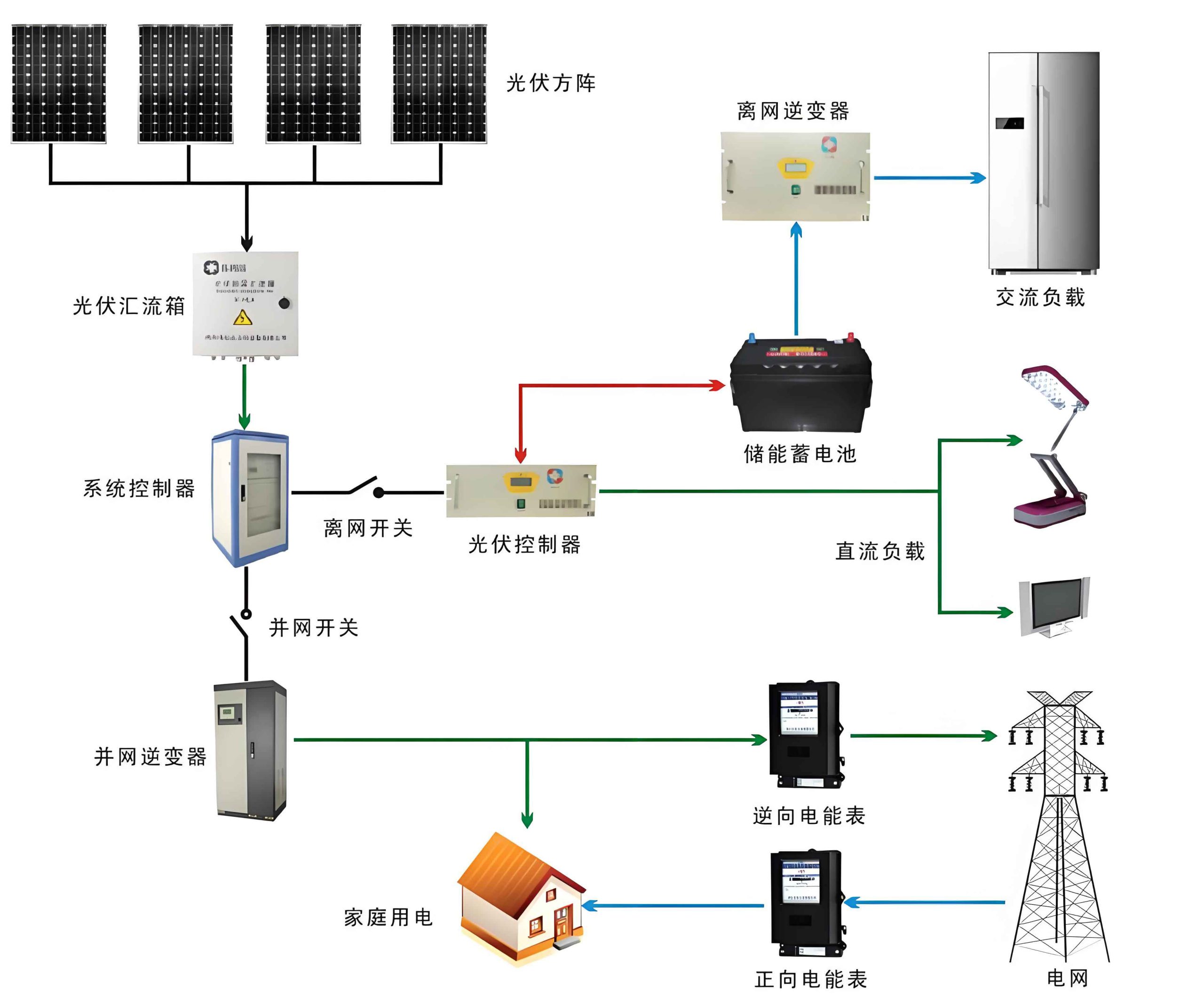
Another dominant theme at the exhibition was the rapid convergence of photovoltaic generation with energy storage solutions. As I explored various exhibits, it was evident that the concept of a standalone solar system is giving way to integrated solar-plus-storage systems. This shift is driven by the inherent intermittency of solar power, which poses challenges for grid stability and energy reliability. By pairing photovoltaic arrays with batteries, we can smooth out power fluctuations, store excess energy for later use, and enhance the overall value proposition of renewable energy installations.
The technical foundation of this integration lies in the ability to manage energy flows dynamically. Consider a simple model for a solar system coupled with storage: the net power output \( P_{net}(t) \) at time \( t \) can be expressed as:
$$ P_{net}(t) = P_{pv}(t) – P_{load}(t) + \eta_{ch} \cdot P_{ch}(t) – \frac{P_{dis}(t)}{\eta_{dis}} $$
where \( P_{pv}(t) \) is the photovoltaic power generation, \( P_{load}(t) \) is the load demand, \( P_{ch}(t) \) and \( P_{dis}(t) \) are the charging and discharging powers of the storage system, and \( \eta_{ch} \) and \( \eta_{dis} \) are the charging and discharging efficiencies, respectively. When \( P_{pv}(t) > P_{load}(t) \), excess energy charges the battery; when \( P_{pv}(t) < P_{load}(t) \), the battery discharges to meet the deficit. This balancing act is crucial for maximizing self-consumption and providing grid services.
At the exhibition, numerous companies showcased advanced energy storage systems designed specifically for seamless integration with solar systems. These systems range from small-scale residential units to massive grid-scale solutions. Key features included modular designs for easy installation, liquid cooling for enhanced safety and longevity, and smart controls for optimized performance. For instance, I was shown a containerized storage solution that claimed to reduce installation time by up to 80% and save over 20% in footprint compared to traditional setups. Such innovations are vital for accelerating the deployment of solar-plus-storage projects.
To illustrate the benefits of integrating storage into a solar system, I have prepared a table comparing different storage technologies in terms of their characteristics and suitability for various applications. This table underscores how lithium-ion batteries, flow batteries, and emerging technologies each play a role in the evolving energy landscape.
| Storage Technology | Energy Density (Wh/L) | Cycle Life (cycles) | Round-Trip Efficiency (%) | Typical Application in Solar Systems | Cost Trend |
|---|---|---|---|---|---|
| Lithium-Ion (LFP) | 200-300 | 3000-6000 | 90-95 | Residential, commercial, utility-scale | Steady decline |
| Flow Battery (Vanadium) | 15-30 | 10000+ | 70-85 | Long-duration storage, grid support | Moderate, scaling benefits |
| Sodium-Ion | 150-250 | 2000-4000 | 85-92 | Cost-sensitive projects, emerging markets | Rapidly decreasing |
| Thermal Storage | 50-150 | 10000+ | 60-80 | Industrial solar systems, concentrated solar power | Stable |
The economic rationale for adding storage to a solar system can be captured through the concept of value stacking. By providing multiple services—such as peak shaving, frequency regulation, and backup power—a solar-plus-storage system can generate revenue streams that improve its return on investment. Mathematically, the total annual value \( V_{total} \) can be approximated as:
$$ V_{total} = \sum_{i=1}^{m} R_i \cdot Q_i $$
where \( R_i \) is the revenue rate for service \( i \) (e.g., in $/kWh or $/kW), and \( Q_i \) is the quantity of service \( i \) delivered. For example, a commercial solar system with storage might earn revenue from reduced demand charges, energy arbitrage (buying low and selling high), and participation in grid ancillary services. This multifaceted value proposition is driving rapid adoption, especially in regions with high electricity prices or unreliable grids.
During panel discussions, experts highlighted that the journey towards a sustainable energy future requires overcoming supply-demand imbalances and fostering collaboration across the value chain. The integration of storage is seen as a key step in this process, transforming solar systems from variable generators into dispatchable assets. As one speaker noted, “The synergy between solar and storage is not just an option; it’s a necessity for scaling renewable energy globally.” This sentiment was echoed in the many product launches and partnership announcements at the event, signaling a collective commitment to building more resilient and flexible energy infrastructure.
Artificial Intelligence: Empowering Smarter Solar Systems
Perhaps the most exciting trend I observed was the deepening integration of artificial intelligence (AI) with photovoltaic and storage technologies. AI is no longer a futuristic concept; it is actively being deployed to optimize every aspect of a solar system, from design and operation to maintenance and trading. As I interacted with demos and presentations, it became clear that AI-driven solutions are unlocking new levels of efficiency, reliability, and intelligence in renewable energy systems.
At the heart of this transformation is data. Modern solar systems are equipped with sensors and IoT devices that generate vast amounts of information on weather conditions, equipment performance, energy production, and consumption patterns. AI algorithms, particularly machine learning models, can analyze this data in real-time to make predictive and prescriptive decisions. For instance, AI can forecast solar irradiance with high accuracy, allowing for better grid planning and energy dispatch. The forecasting model often takes the form:
$$ \hat{I}(t+\Delta t) = f(I(t), W(t), H(t); \theta) $$
where \( \hat{I}(t+\Delta t) \) is the predicted irradiance at time \( t+\Delta t \), \( I(t) \) is historical irradiance, \( W(t) \) is weather data (e.g., cloud cover, temperature), \( H(t) \) is historical patterns, and \( \theta \) represents the learned parameters of the AI model. By integrating such forecasts into energy management systems, operators can optimize battery charging cycles, reduce curtailment, and improve the overall economics of the solar system.
Moreover, AI is revolutionizing maintenance through predictive analytics. Instead of relying on scheduled inspections or reactive repairs, AI can detect anomalies in performance data—such as drops in efficiency or unusual temperature rises—and alert operators to potential failures before they occur. This proactive approach minimizes downtime and extends the lifespan of equipment. The underlying principle can be described using anomaly detection algorithms that compute a deviation score \( D \) for each component:
$$ D = \| \mathbf{x} – \mathbf{\mu} \|_{\Sigma} $$
where \( \mathbf{x} \) is the feature vector of current operating parameters, \( \mathbf{\mu} \) is the mean vector of normal operation, and \( \| \cdot \|_{\Sigma} \) is the Mahalanobis distance weighted by the covariance matrix \( \Sigma \). When \( D \) exceeds a threshold, an alert is triggered. This capability is especially valuable for large-scale solar systems where manual monitoring would be impractical and costly.
To quantify the impact of AI on solar system performance, I have created a table summarizing key AI applications and their benefits. This table draws from case studies and product demonstrations at the exhibition, illustrating how AI is being embedded across the value chain.
| AI Application | Description | Key Benefits | Typical Performance Improvement |
|---|---|---|---|
| Predictive Maintenance | Uses sensor data to forecast equipment failures | Reduces downtime, lowers O&M costs | Up to 30% reduction in maintenance expenses |
| Energy Forecasting | Predicts solar generation and load demand | Enhances grid integration, optimizes storage | Forecast accuracy improved by 15-20% |
| Virtual Power Plants (VPPs) | Aggregates distributed solar systems for grid services | Provides grid stability, new revenue streams | Increases asset utilization by 25%+ |
| Blockchain for Green Energy Trading | Facilitates peer-to-peer energy transactions | Promotes local consumption, transparency | Reduces transaction costs by up to 40% |
| AI-Optimized System Design | Automates layout and component selection for new installations | Maximizes energy yield, minimizes LCOE | Design time shortened by 50%, yield increased by 5-10% |
The synergy between AI and solar systems is bidirectional. Just as AI enhances solar and storage operations, the growth of renewable energy is driving demand for AI solutions to manage complexity. For example, the rise of distributed AI data centers—which require vast amounts of clean energy—creates opportunities for solar-plus-storage systems to provide reliable power while mitigating grid impact. This interdependence is fostering innovative business models and collaborations, as seen in the many partnerships announced at the exhibition.
From a mathematical perspective, AI optimization often involves solving complex, high-dimensional problems. Consider the task of scheduling a solar system’s battery to maximize revenue from energy arbitrage. This can be formulated as a linear programming problem:
$$ \max \sum_{t=1}^{T} (p_{sell}(t) \cdot P_{dis}(t) – p_{buy}(t) \cdot P_{ch}(t)) $$
subject to:
$$ 0 \leq P_{ch}(t) \leq P_{ch}^{max}, \quad 0 \leq P_{dis}(t) \leq P_{dis}^{max} $$
$$ SOC(t+1) = SOC(t) + \eta_{ch} \frac{P_{ch}(t) \Delta t}{E_{cap}} – \frac{P_{dis}(t) \Delta t}{\eta_{dis} E_{cap}} $$
$$ SOC^{min} \leq SOC(t) \leq SOC^{max} $$
where \( p_{sell}(t) \) and \( p_{buy}(t) \) are time-varying electricity prices, \( SOC(t) \) is the state of charge of the battery, \( E_{cap} \) is the energy capacity, and \( \Delta t \) is the time interval. AI algorithms can solve such problems efficiently, adapting to real-time price signals and system conditions to extract maximum value. This capability is transforming solar systems from passive generators into active participants in energy markets.
In my conversations with developers, they emphasized that AI is not just a tool for automation; it is a catalyst for innovation. By leveraging AI, we can design solar systems that are more adaptive, resilient, and user-centric. For instance, AI-powered home energy management systems can learn household patterns and automatically adjust solar generation, storage, and consumption to minimize bills and carbon footprints. This level of intelligence is making renewable energy more accessible and appealing to a broader audience.
Industry Challenges and Collaborative Pathways
Despite the optimism and technological progress, the solar industry faces significant challenges that were widely discussed at the exhibition. As I listened to panel debates and private exchanges, it became clear that issues like overcapacity, supply chain volatility, and intellectual property protection remain pressing concerns. These challenges are intertwined with the global push for energy transition, requiring coordinated efforts to ensure sustainable growth.
A major topic was the cyclical nature of the photovoltaic market, where rapid expansion has sometimes led to supply-demand mismatches. This can be modeled using basic economic principles of supply and demand equilibrium. Let \( Q_s \) be the quantity supplied and \( Q_d \) the quantity demanded, both as functions of price \( p \). In a balanced market, \( Q_s(p) = Q_d(p) \). However, when capacity outpaces demand—as has occurred in some segments—the market experiences downward pressure on prices, squeezing margins and potentially stifling innovation. The industry is navigating this by focusing on differentiation through technology and integration, as seen in the rise of specialized solar systems tailored for specific environments or applications.
Intellectual property (IP) rights also emerged as a critical issue. With so many companies investing in R&D, protecting innovations is essential to foster a healthy competitive landscape. However, overly restrictive IP regimes can hinder collaboration and slow down the diffusion of beneficial technologies. Finding the right balance is key, and many participants called for industry-wide standards and fair licensing practices. This is particularly important for emerging areas like perovskite solar cells or advanced battery chemistries, where open innovation could accelerate progress.
To contextualize these challenges, I have developed a table outlining key barriers and potential solutions for the solar and storage sectors. This table synthesizes insights from various sessions and reflects the collective wisdom of the community.
| Challenge | Description | Impact on Solar Systems | Potential Mitigation Strategies |
|---|---|---|---|
| Overcapacity | Excess manufacturing capacity relative to demand | Price erosion, reduced profitability | Focus on high-value niches, export diversification |
| Supply Chain Disruptions | Volatility in raw material (e.g., polysilicon, lithium) prices and availability | Increased costs, project delays | Vertical integration, material recycling, regional sourcing |
| Grid Integration Limits | Grid infrastructure unable to absorb high penetration of variable solar power | Curtailment, reduced ROI | Grid modernization, storage mandates, smart inverters |
| Intellectual Property Conflicts | Disputes over patents and technology ownership | Slows innovation, increases legal costs | Cross-licensing agreements, industry pools, clear regulations |
| Policy Uncertainty | Changing government incentives and trade policies | Investment hesitation, market fragmentation | Long-term policy frameworks, international cooperation |
Collaboration was a recurring theme in addressing these challenges. I witnessed several announcements of alliances and consortia aimed at fostering knowledge sharing, setting standards, and promoting best practices. For example, initiatives for global green carbon chains and international storage councils were launched, signaling a move towards greater industry cohesion. Such collaborations are vital for scaling solar systems globally, as they help harmonize technical specifications, reduce trade barriers, and pool resources for large-scale projects.
Mathematically, the benefits of collaboration can be understood through game theory or network effects. Consider a simple model where the adoption rate of solar systems \( A(t) \) grows according to:
$$ \frac{dA}{dt} = \alpha A(t) (1 – \frac{A(t)}{K}) + \beta C(t) $$
where \( \alpha \) is the intrinsic growth rate due to factors like cost reductions, \( K \) is the market potential, and \( \beta C(t) \) represents the additional boost from collaborative efforts \( C(t) \). As companies and countries work together on R&D, supply chain resilience, and market development, \( C(t) \) increases, accelerating adoption and helping overcome individual limitations. This collective approach is especially important for achieving climate goals, as no single entity can drive the energy transition alone.
Looking ahead, the exhibition reinforced my belief that the solar industry is on the cusp of a new era. By embracing innovation, integrating storage, leveraging AI, and fostering collaboration, we can build solar systems that are not only more efficient and affordable but also more intelligent and interconnected. These systems will form the backbone of a decentralized, resilient, and clean energy grid, powering everything from homes and factories to entire cities.
Conclusion: Towards a Brighter, Smarter Future
Reflecting on my experience at the exhibition, I am filled with a sense of cautious optimism. The challenges are real, but the collective determination to overcome them is palpable. The evolution of the solar system—from a simple panel on a roof to a sophisticated, AI-managed energy hub—is a testament to human creativity and perseverance. As technology continues to advance, costs will fall further, performance will rise, and integration will deepen, making solar energy an indispensable part of our energy mix.
The journey ahead will require sustained effort from all stakeholders: manufacturers, developers, policymakers, and consumers. By staying committed to innovation, quality, and sustainability, we can ensure that solar systems deliver on their promise of clean, abundant, and reliable power for generations to come. The exhibition was not just a showcase of products; it was a glimpse into a future where energy is generated, stored, and managed in ways that harmonize with our planet and empower our societies. I left inspired, knowing that the light we are chasing is not just from the sun, but from the brilliant minds and collaborative spirit driving this industry forward.