
The relentless pursuit of higher energy density in lithium-ion batteries for electric vehicles and grid storage must be balanced with an unwavering commitment to safety. Among the most severe safety tests designed to simulate mechanical abuse is the nail penetration test, which deliberately induces an internal short circuit. While research often focuses on active materials and separators to mitigate thermal runaway, a fundamental yet frequently overlooked component is the current collector. This article, from my perspective as a researcher analyzing this critical interface, delves into a systematic investigation into how the thickness of the aluminum cathode current collector fundamentally alters the thermal runaway outcome of a lithium-ion battery during nail penetration. The findings reveal a powerful, intrinsic “self-fusing” safety mechanism inherent to thinner foils.
The internal short circuit created during nail penetration is a complex, transient event. The steel nail simultaneously contacts the anode and cathode, creating a low-resistance electronic path that bypasses the normal electrochemical operation of the lithium-ion battery. This leads to rapid localized joule heating, which can trigger exothermic chemical reactions within the cell components, potentially cascading into full-scale thermal runaway—characterized by violently rising temperatures, venting, fire, and explosion. My analysis centers on the hypothesis that the current collector is not merely a passive conductor but an active participant in this failure sequence. Its thickness dictates the current density, heat generation rate, and, crucially, its own structural integrity at the short-circuit point.
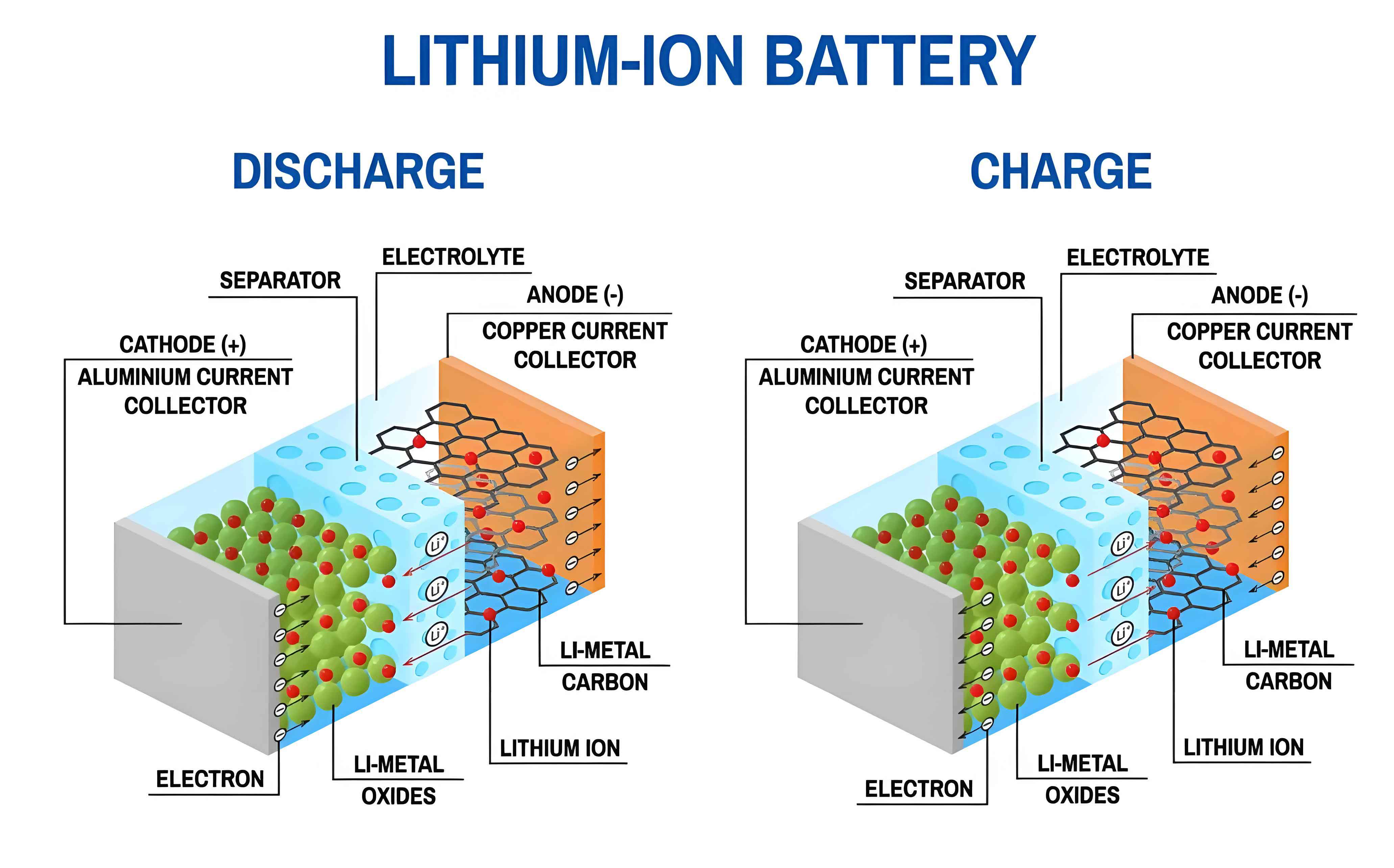
To isolate the effect of current collector thickness, a controlled experiment was conceived using pouch-type lithium-ion battery cells with a hybrid solid-liquid electrolyte system (NCM811/graphite chemistry). The key variable was the thickness of the aluminum foil used for the cathode current collector. Three thicknesses were selected, spanning the common range used in commercial cells: 9 μm, 12 μm, and 15 μm. All other parameters, including the anode copper foil thickness (12 μm), electrode coating, cell design (11 cathode / 12 anode stacks), and formation protocol, were kept identical. The basic specifications of these cells are summarized in Table 1.
| Cell Identifier | Cathode Current Collector Thickness | Nominal Capacity | Voltage Range | Approx. Energy Density |
|---|---|---|---|---|
| Cell-A | 9 μm Al foil | 3.6 Ah | 3.0 – 4.2 V | ~344 Wh/kg |
| Cell-B | 12 μm Al foil | 3.6 Ah | 3.0 – 4.2 V | ~340 Wh/kg |
| Cell-C | 15 μm Al foil | 3.6 Ah | 3.0 – 4.2 V | ~335 Wh/kg |
The nail penetration tests were conducted in strict accordance with a standardized method (similar to GB/T 31485-2015). A conical tungsten steel nail with a 5 mm diameter shaft was driven into the geometric center of a fully charged (4.2 V) pouch cell at a speed of 25 mm/s, completely penetrating the cell stack. The nail was then held in place. Cell voltage and surface temperatures at multiple locations (nail penetration point, side, bottom, and tabs) were monitored at a high sampling rate.
The experimental outcomes presented a stark and dramatic contrast directly correlated to the aluminum foil thickness. The macroscopic behavior, as I observed from the data, is summarized in Table 2.
| Cell Identifier | Al Foil Thickness | Thermal Runaway Outcome | Key Observations | Safety Test Result |
|---|---|---|---|---|
| Cell-C | 15 μm | Violent Thermal Runaway | Immediate violent jetting of sparks and flames within 2 seconds; cell completely destroyed by fire. | FAIL |
| Cell-B | 12 μm | Moderate Thermal Runaway | Rapid swelling and open flame within 1-2 seconds; significant burning but less violent than Cell-C. | FAIL |
| Cell-A | 9 μm | No Thermal Runaway | Minor local deformation at nail site. No swelling, smoke, fire, or explosion during 1-hour hold. | PASS |
The temperature and voltage data provided a quantitative window into the underlying physics. For Cell-C (15 μm), upon nail penetration, the voltage instantly plummeted from 4.2 V to near zero within seconds. The temperature at the nail penetration point skyrocketed to a peak exceeding 600°C. This indicates a sustained, low-resistance internal short circuit that generated heat faster than it could be dissipated, inevitably leading to ignition of cell components.
Cell-B (12 μm) showed a similar initial voltage drop and a sharp temperature peak (~540°C), but the temperature profile suggested a slightly different failure path, potentially involving rapid venting that partially mitigated continued heat buildup, though not sufficiently to prevent fire.
The behavior of Cell-A (9 μm) was profoundly different. The voltage response was critical: it experienced only a minor, transient drop followed by a rapid recovery to a stable plateau slightly below the initial voltage (e.g., ~4.1 V). It did not collapse to zero. Concurrently, the temperature rise at the penetration point was minimal—less than 35°C—and no significant heating occurred elsewhere on the cell. This data clearly indicates that the initial short circuit was not sustained. The question is: what interrupted it?
The proposed mechanism, which I find compelling based on theoretical calculation, is the “Fusible Link” or “Self-Fusing” mechanism of the thin aluminum current collector. At the moment of penetration, the steel nail creates a short-circuit path. The local current density at the contact point between the nail and the aluminum foil is extremely high. The heat generated by Joule heating at this point is concentrated in a very small volume of the foil.
The governing equation for Joule heating is:
$$ Q_{joule} = I_{sc}^2 R_c t $$
where \( Q_{joule} \) is the heat energy (J), \( I_{sc} \) is the short-circuit current (A), \( R_c \) is the contact resistance at the nail/Al interface (Ω), and \( t \) is the duration of the short (s).
Simultaneously, the energy required to melt a given volume of aluminum is given by:
$$ Q_{melt} = m c_p \Delta T + m L $$
where \( m \) is the mass of Al (kg), \( c_p \) is the specific heat capacity (~900 J/kg·K), \( \Delta T \) is the temperature rise from ambient to melting point (~635 K for Al), and \( L \) is the latent heat of fusion (~3.97 × 10⁵ J/kg).
By approximating the affected area (nail diameter ~5 mm) and using the density of aluminum, one can calculate \( Q_{melt} \) for different foil thicknesses. The key insight is that for a very thin foil (9 μm), the calculated \( Q_{melt} \) is on the same order of magnitude as the estimated \( Q_{joule} \) produced in the initial instant of the short. Therefore, the intense, localized heat can rapidly raise the temperature of the thin aluminum foil to its melting point (660°C), causing it to melt and physically separate around the nail. This action effectively “blows” like a fuse, breaking the electronic circuit between the nail and the cathode, thus terminating the internal short circuit before it can generate enough heat to trigger cascading exothermic reactions. The recovered and stabilized voltage of Cell-A is direct evidence of this circuit interruption.
In contrast, for thicker foils (12 and 15 μm), the mass \( m \) of aluminum that needs to be melted is proportionally larger. The same \( Q_{joule} \) is insufficient to raise the temperature of this larger thermal mass to the melting point quickly enough. The aluminum remains intact, maintaining a low-resistance short-circuit path. Heat continues to accumulate unabated, leading to the catastrophic thermal runaway observed. This conceptual breakdown is illustrated in Table 3.
| Foil Thickness | Local Current Density | Joule Heat vs. Melt Energy | Fusing Outcome | Circuit Status | Final Result |
|---|---|---|---|---|---|
| Thin (9 μm) | Very High | \( Q_{joule} \approx Q_{melt} \) | Rapid Local Melting | OPEN (Fuse blown) | Short circuit interrupted. No thermal runaway. |
| Thick (12, 15 μm) | High | \( Q_{joule} < Q_{melt} \) | No Melting / Slow Heating | CLOSED (Persistent short) | Sustained heat generation. Thermal runaway. |
This finding has profound implications for the intrinsic safety design of lithium-ion battery cells. It identifies current collector thickness not just as a design parameter for energy density and cost, but as a primary safety lever. Optimizing thickness toward the lower bound of mechanical feasibility can integrate a passive, reliable safety feature directly into the core component of the cell. The benefits are multiplicative: thinner foil reduces inactive material weight (increasing energy density), lowers material cost, and, as demonstrated, can dramatically enhance nail penetration safety. The fusible link mechanism is elegantly simple and requires no additional components or complex manufacturing steps.
Further analysis can be extended to model the heat generation and transfer dynamics more precisely. The instantaneous short-circuit current \( I_{sc} \) can be related to the cell’s open-circuit voltage \( U_{ocv} \) and the total resistance of the short path \( R_{total} \):
$$ I_{sc} = \frac{U_{ocv}}{R_{total}} $$
where \( R_{total} \) includes the internal resistance of the cell layers and the crucial contact resistance \( R_c \). The thermal diffusion from the short-circuit point can be approximated by the heat equation, showing why localized melting is possible before global heating:
$$ \rho c_p \frac{\partial T}{\partial t} = \nabla \cdot (k \nabla T) + \dot{q}_{gen} $$
where \( \dot{q}_{gen} \) is the volumetric heat generation rate from the short, and \( k \) is thermal conductivity. For thin foils, the geometry favors rapid temperature rise at the point of contact.
In conclusion, my detailed examination of this systematic study unequivocally shows that cathode current collector thickness is a decisive factor governing the safety of a lithium-ion battery under nail penetration. The transition from safe to unsafe behavior occurs within a critical thickness range, driven by a fundamental physical mechanism: the ability of joule heat to fuse the collector and break the short-circuit loop. This “self-fusing” mechanism in thin aluminum foils represents a powerful form of intrinsic safety-by-design. For engineers developing the next generation of high-energy-density lithium-ion battery packs, especially for automotive applications where mechanical integrity is paramount, deliberately optimizing and potentially even grading current collector thickness presents a highly attractive strategy. It simultaneously addresses the trilemma of safety, energy density, and cost, moving us closer to lithium-ion battery systems that are not only powerful but inherently resilient to severe abuse.