
The increasing integration of variable renewable energy sources, characterized by inherent volatility and uncertainty, poses significant challenges to grid stability, particularly in maintaining system frequency. While conventional thermal units remain the primary source for frequency regulation, their slow response, long time delays, and limited ramp rates constrain the overall dynamic performance of the system. In this context, the battery energy storage system emerges as a transformative technology. Its unparalleled advantages—near-instantaneous response, bidirectional power capability, and high precision—offer a potent solution to enhance primary frequency regulation (PFR). However, the finite energy capacity of a battery energy storage system necessitates intelligent coordination with conventional generators to form a complementary, resilient, and sustainable frequency regulation framework. This article explores an adaptive control strategy designed to orchestrate this synergy, maximizing the strengths of each resource while safeguarding the health and longevity of the storage assets.
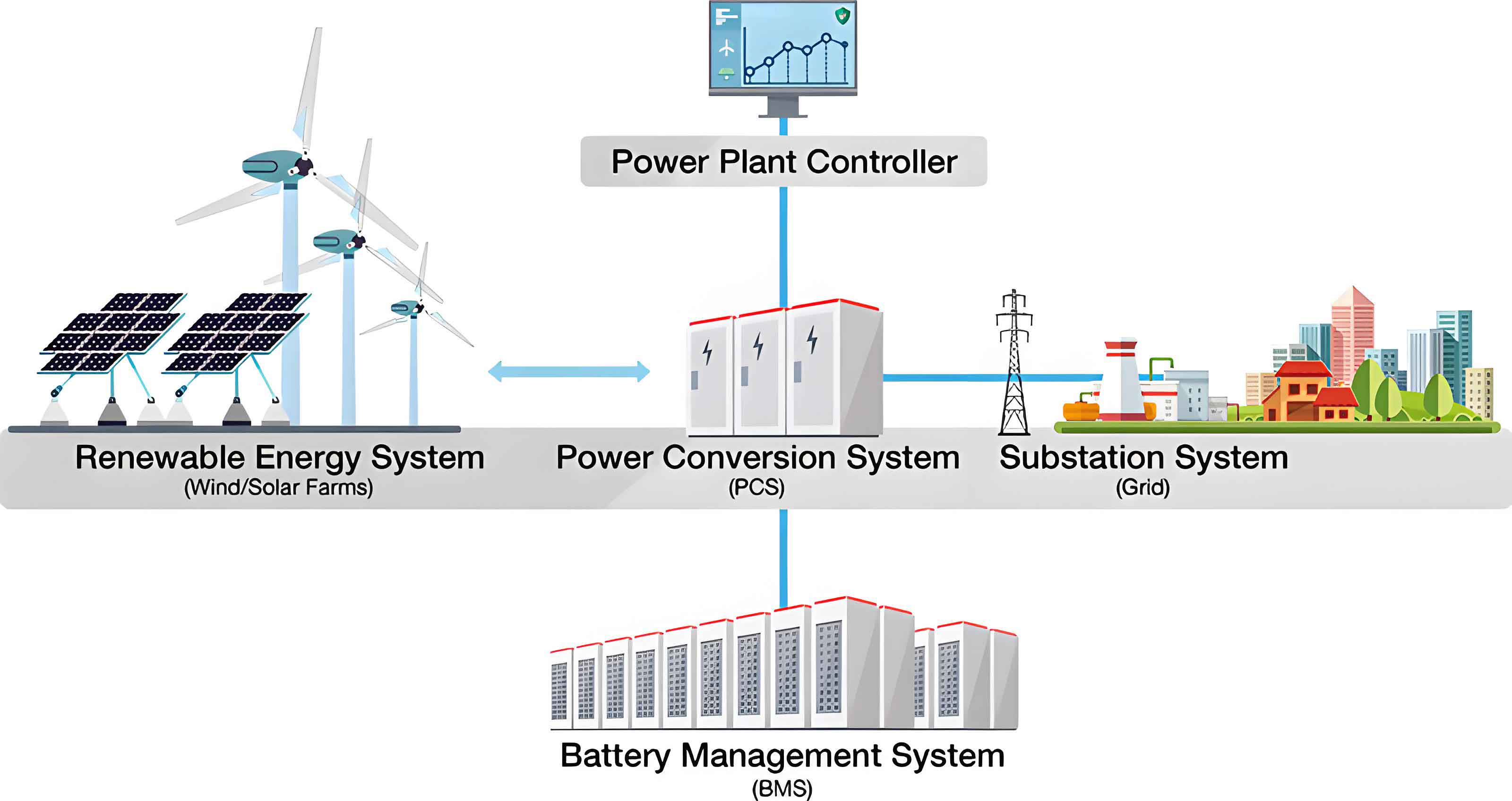
The core objective is to develop a control paradigm where the battery energy storage system and conventional units do not operate in isolation but as a coordinated system. The conventional fleet provides the sustained power support, while the battery energy storage system acts as a rapid-response power buffer, addressing transient imbalances and reducing stress on slower mechanical systems. This requires a control strategy for the battery energy storage system that is both responsive to grid conditions and self-aware of its internal state. We adopt a combined droop and virtual inertia control to emulate desirable generator characteristics. The droop control provides steady-state power support proportional to frequency deviation ($$ \Delta f $$), while virtual inertia control provides power proportional to the Rate of Change of Frequency (RoCoF, $$ d\Delta f/dt $$), crucial for arresting rapid frequency declines. The total power command from the battery energy storage system before constraints is given by:
$$ \Delta P_{B,ref} = -K_B(\Delta f) \cdot \Delta f_c – M_B \cdot \frac{d\Delta f_c}{dt} $$
where $$ \Delta f_c $$ is the frequency deviation beyond the storage’s deadband, $$ M_B $$ is the virtual inertia constant, and $$ K_B(\Delta f) $$ is the adaptive droop coefficient, which is the first key innovation for power sharing.
To ensure the conventional units bear the brunt of sustained regulation while the battery energy storage system handles transients and extremes, $$ K_B $$ is made a function of the frequency deviation magnitude. The principle is to reduce the battery energy storage system‘s droop gain within the conventional unit’s effective regulation band, forcing the generators to respond, and to increase it near the limits of conventional capacity or during small deviations where generators are inactive. The adaptive droop coefficient is defined as follows:
| Frequency Deviation Zone | Droop Coefficient $$ K_B $$ | Rationale |
|---|---|---|
| $$ |\Delta f| < f_{db,B} $$ (Storage Deadband) | 0 | Prevents unnecessary cycling for minor fluctuations. |
| $$ f_{db,B} \leq |\Delta f| \leq f_{db,G} $$ (Gen. Deadband) | $$ K_{B,N} $$ (Rated) | Storage acts alone to smooth frequency within generator deadband. |
| $$ f_{db,G} < |\Delta f| \leq f_1 $$ | $$ \frac{(f_{db,G} – f_{db,B}) K_{B,N}}{|\Delta f| – f_{db,B}} $$ | Hyperbolic decrease. Keeps $$ K_B \cdot (|\Delta f|-f_{db,B}) $$ constant, ensuring smooth power transition as generators ramp up. |
| $$ f_1 < |\Delta f| \leq f_2 $$ | $$ 0.2 K_{B,N} $$ | Low, constant gain. Conventional units provide most power. |
| $$ f_2 < |\Delta f| \leq f_3 $$ (Gen. Limit) | Linearly increases from $$ 0.2K_{B,N} $$ to $$ K_{B,N} $$ | Storage increases support as generators approach their output limit. | $$ |\Delta f| > f_3 $$ | $$ K_{B,N} $$ | Full storage support when generators are saturated. |
This variable $$ K_B $$ strategy ensures efficient power-sharing. However, the finite energy capacity of a battery energy storage system mandates a second, critical layer of adaptation based on its State of Charge (SOC). Continuous operation without regard to SOC leads to depletion or saturation, causing a sudden loss of regulation capability and potentially damaging the batteries. Therefore, we introduce an SOC-feedback loop that adaptively scales the final power command. A power adjustment coefficient, $$ K_{SOC} $$, is defined as a piecewise linear function of the SOC ($$ Q_{SOC} $$).
$$
K_{SOC} = \begin{cases}
K_c(Q_{SOC}) & \text{if } \Delta f > 0 \text{ (Charging)} \\
K_d(Q_{SOC}) & \text{if } \Delta f < 0 \text{ (Discharging)}
\end{cases}
$$
The functions $$ K_c $$ and $$ K_d $$ are designed symmetrically to constrain power when SOC is extreme and allow full power when SOC is in a comfortable mid-range. For example:
$$
K_c(Q_{SOC}) = \begin{cases}
1 & Q_{SOC} \in [0, 0.6] \\
-2Q_{SOC} + 2.2 & Q_{SOC} \in (0.6, 0.7] \\
-6Q_{SOC} + 5.0 & Q_{SOC} \in (0.7, 0.8] \\
-2Q_{SOC} + 1.8 & Q_{SOC} \in (0.8, 0.9] \\
0 & Q_{SOC} \in (0.9, 1.0]
\end{cases}
$$
$$
K_d(Q_{SOC}) = \begin{cases}
0 & Q_{SOC} \in [0.0, 0.1] \\
2Q_{SOC} – 0.2 & Q_{SOC} \in (0.1, 0.2] \\
6Q_{SOC} – 1.0 & Q_{SOC} \in (0.2, 0.3] \\
2Q_{SOC} + 0.2 & Q_{SOC} \in (0.3, 0.4] \\
1 & Q_{SOC} \in (0.4, 1.0]
\end{cases}
$$
The final, constrained power command for the battery energy storage system is:
$$ P_B = \left( -K_B(\Delta f) \cdot \Delta f_c – M_B \cdot \frac{d\Delta f_c}{dt} \right) \cdot K_{SOC}(Q_{SOC}) $$
$$ \text{subject to: } P_B \in [-P_{B,max}, +P_{B,max}] $$
The third pillar of the adaptive strategy involves the intelligent engagement and disengagement of the battery energy storage system. Its fast response is most valuable during transient periods. Once frequency is stabilized (indicated by a low RoCoF, $$ |df/dt| < \epsilon $$), and provided the frequency deviation lies within a region where conventional units can manage it alone without saturating, the battery energy storage system should gracefully exit regulation to conserve its SOC. A “handback” logic is crucial. The storage exits only if: 1) frequency is quasi-steady ($$ |df/dt| < \epsilon $$), AND 2) the frequency deviation $$ |\Delta f| $$ is between the generator deadband ($$ f_{db,G} $$) and a calculated safety threshold $$ f_4 $$, where $$ f_4 < f_3 $$. The threshold $$ f_4 $$ is calculated to ensure that after the battery energy storage system power is handed back to the generators, the new steady-state frequency deviation does not exceed the generators’ limit $$ f_3 $$. A smooth exit ramp, governed by a PI controller, prevents a secondary power disturbance.
To validate the proposed adaptive control strategy for the battery energy storage system, time-domain simulations were conducted on a regional grid model under two distinct disturbance scenarios: a step load change and a continuous, variable load profile. The performance was compared against a baseline with no storage and a fixed-gain storage control strategy from literature. Key metrics include maximum frequency deviation ($$ \Delta f_m $$), settling time, steady-state deviation ($$ \Delta f_s $$), and for continuous disturbances, the root-mean-square of frequency error ($$ f_{rms} $$) and SOC deviation ($$ Q_{SOC,rms} $$).
For an 11 MW step increase, the coordinated battery energy storage system control demonstrated superior transient performance.
| Control Strategy | Max Freq. Dev. $$ \Delta f_m $$ (Hz) | Time to $$ \Delta f_m $$ (s) | Steady-State Dev. $$ \Delta f_s $$ (Hz) |
|---|---|---|---|
| No Storage | -0.275 | 8.46 | -0.175 |
| Fixed-Gain Storage | -0.224 | 8.46 | -0.175 |
| Proposed Adaptive Strategy | -0.206 | 7.88 | -0.175 |
The adaptive strategy reduced the nadir by over 25% compared to no storage and achieved it earlier. The battery energy storage system power output showed no abrupt changes due to the hyperbolic $$ K_B $$ adjustment, and it successfully exited regulation after stabilization, conserving SOC. Under a larger 17 MW step, the fixed-gain strategy caused frequency oscillations during the handback process, while the proposed strategy maintained stability, showcasing the robustness of its exit logic.
The true test of the adaptive battery energy storage system strategy is under continuous, fluctuating load. Over a 5-minute period, the strategy was compared against a fixed, high-gain droop control for the storage.
| Performance Metric | Fixed High-Gain BESS | Proposed Adaptive BESS Strategy |
|---|---|---|
| Frequency Regulation $$ (f_{rms}) $$ | 0.131 Hz | 0.140 Hz |
| SOC Maintenance $$ (Q_{SOC,rms}) $$ | 0.102 | 0.066 |
The results are illuminating. The fixed-gain battery energy storage system provides slightly better frequency regulation (lower $$ f_{rms} $$) because it constantly injects/absorbs power at maximum responsiveness. However, it does so at a high cost to its SOC, as indicated by the much higher $$ Q_{SOC,rms} $$. In contrast, the proposed strategy sacrifices a minimal amount of frequency performance (a 7% increase in $$ f_{rms} $$) to achieve a 35% improvement in SOC preservation. This trade-off is highly desirable: it extends the operational availability of the battery energy storage system, prevents deep cycling, prolongs battery life, and ensures capacity is reserved for large, critical disturbances. The adaptive strategy successfully distinguished between periods requiring rapid response and periods where it could safely disengage, allowing conventional units to handle slow, sustained imbalances.
In conclusion, the integration of a battery energy storage system into primary frequency regulation is not merely about adding a fast resource; it is about creating an intelligent, adaptive partnership with existing conventional generation. The tripartite strategy—adaptive droop for power sharing, SOC-feedback for asset preservation, and conditional engagement/disengagement for capacity management—forms a comprehensive solution. It leverages the speed of the battery energy storage system to dramatically improve transient frequency metrics like nadir and RoCoF while leveraging the endurance of conventional units for steady-state regulation. Crucially, by actively managing its SOC, the battery energy storage system ensures its own long-term viability and readiness. This approach moves beyond viewing storage as a standalone frequency regulator, instead positioning it as a synergistic core component of a modern, resilient, and efficient grid frequency control system.