
The rapid advancement of electric vehicles and energy storage systems has cemented the position of lithium-ion battery technology as a cornerstone of modern electrification. Its widespread adoption is primarily driven by superior energy density, extended cycle life, and declining costs. However, the intrinsic safety risks associated with these high-energy-density systems remain a critical bottleneck, particularly under mechanical abuse conditions such as collisions, impacts, or crush events. These scenarios can induce internal short circuits, trigger exothermic chemical reactions, and ultimately lead to catastrophic thermal runaway—a self-accelerating process characterized by rapid temperature escalation, gas venting, and potential fire or explosion.
Accurate prediction of the maximum temperature during such events is paramount for designing effective safety countermeasures, establishing reliable early warning systems, and performing rigorous risk assessments. Traditional approaches relying on physics-based modeling and numerical simulation, while insightful, often struggle with the high complexity, strong non-linearity, and multi-physics coupling inherent in lithium-ion battery failure mechanisms. Constructing precise models for every abuse scenario is computationally expensive and practically challenging.
Recently, data-driven methods, especially deep learning, have shown remarkable promise in modeling complex system behaviors. For lithium-ion battery safety, machine learning techniques have been applied to state-of-health estimation, remaining useful life prediction, and fault diagnosis. However, predicting thermal runaway under mechanical abuse presents unique challenges. Most existing studies focus on a single data modality—such as voltage, temperature, or acoustic signals—neglecting the rich, complementary information available from multiple sensors. Furthermore, simple feature concatenation or averaging fails to capture the intricate cross-modal interactions that dictate the failure progression. The lack of integration of physical principles can also lead to predictions that, while numerically accurate, may violate fundamental thermodynamic laws, limiting model interpretability and robustness.
This article addresses these gaps by proposing a novel multimodal neural network framework for predicting the maximum surface temperature of a lithium-ion battery subjected to mechanical indentation. The core innovation lies in the synergistic fusion of heterogeneous data streams—thermal imaging, voltage, state-of-charge (SOC), applied force, and deformation—through an architecture designed for deep cross-modal interaction. We introduce specialized encoders for spatio-temporal (image) and temporal (numerical) feature extraction, a transformer-based fusion module for adaptive information integration, and a physics-informed loss function to constrain predictions within physically plausible bounds. Validated on a comprehensive dataset from controlled mechanical abuse experiments, this approach demonstrates superior accuracy, robustness, and multi-step predictive capability compared to conventional methods.
Understanding Thermal Runaway in Lithium-Ion Batteries under Mechanical Abuse
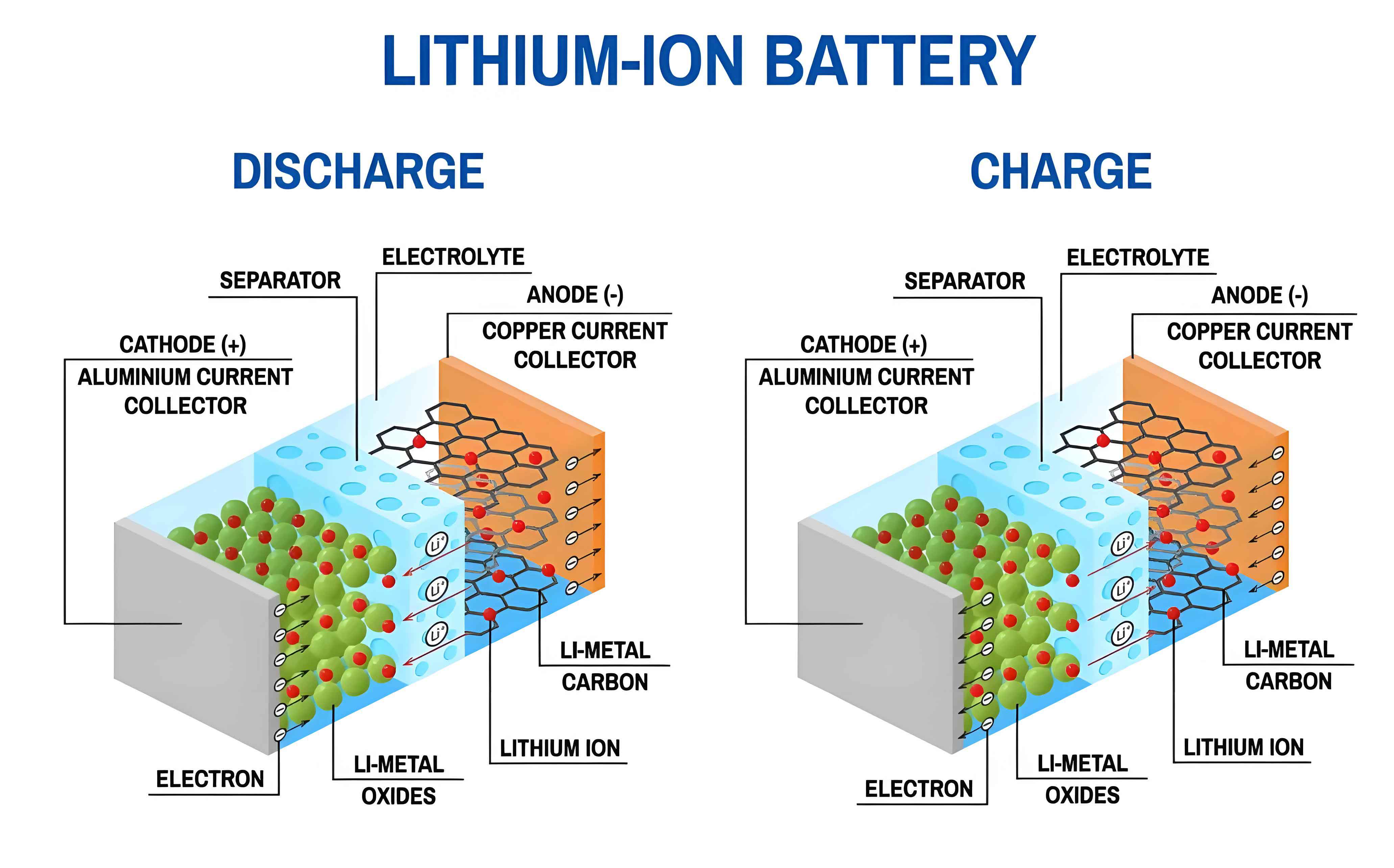
The path from mechanical insult to thermal runaway in a lithium-ion battery involves a cascading sequence of mechanical, electrical, thermal, and chemical failures. When an external force is applied, the internal cell components—including the anode, cathode, separator, and current collectors—undergo deformation.
The key mechanisms can be summarized as follows:
- Mechanical Failure: The separator, a critical micro-porous polymer film, is the most vulnerable component. Beyond a certain strain threshold, it ruptures, creating a direct electrical path between the anode and cathode.
- Internal Short Circuit (ISC): Separator failure leads to a localized ISC. The large potential difference between electrodes drives a high current through the shorted spot, generating intense Joule heating ($P_{Joule} = I_{sc}^2 R_{sc}$).
- Heat Generation and Accumulation: The localized heat raises the temperature, triggering a series of exothermic decomposition reactions. These include Solid Electrolyte Interphase (SEI) decomposition, electrolyte reaction with anode/cathode materials, and cathode oxygen release.
- Thermal Runaway: These reactions are highly temperature-sensitive and self-accelerating. The heat generated further increases the temperature, which in turn accelerates the reaction rates, creating a violent positive feedback loop. This culminates in thermal runaway, with temperatures often exceeding 400–800°C.
The severity and onset time of this cascade are strongly influenced by operational and abuse conditions. As shown in experimental studies, the State of Charge (SOC) is a dominant factor. A lithium-ion battery at high SOC stores more chemical energy, possesses a lower anode potential, and has a less stable SEI layer, making it significantly more prone to severe and rapid thermal runaway upon mechanical damage. The geometry of the indenter (e.g., radius) affects the stress distribution and the extent of damage, thereby influencing the short-circuit initiation time.
This complex, coupled physics makes analytical modeling exceptionally difficult. Data-driven approaches that learn from direct observations of these events offer a powerful alternative, provided they can effectively integrate the diverse signals that herald the impending failure.
A Multimodal Neural Network Framework for Temperature Prediction
The proposed framework is designed to ingest multimodal time-series data from the onset of mechanical loading up to the current time step and predict the future trajectory of the maximum surface temperature for multiple steps ahead. The overall architecture comprises three main modules: an Image Encoder for thermal image sequences, a Numerical Encoder for time-series sensor data, and a Modality Fusion Module for cross-modal integration and final prediction.
1. Image Encoder: Capturing Spatio-Temporal Thermal Dynamics
Thermal imaging provides a rich, two-dimensional map of surface temperature evolution, containing crucial spatial patterns (e.g., hot spot formation) and temporal dynamics. The Image Encoder is tasked with extracting these spatio-temporal features. Its structure employs a multi-branch design for robust feature learning:
- Multi-Scale Convolutional Blocks: Parallel convolutional layers with kernel sizes of 3, 5, and 7 process the input thermal image frame. This allows the model to capture local temperature gradients (small kernel) and broader thermal distribution patterns (larger kernels) simultaneously. Each convolution is followed by Batch Normalization and ReLU activation.
$$F_{conv}^k = \text{ReLU}(\text{BN}(\text{Conv}_{k}(I_t))) \quad \text{for } k \in \{3,5,7\}$$ - Convolutional Block Attention Module (CBAM): The features from different scales are concatenated and passed through a CBAM. This module sequentially applies channel attention and spatial attention mechanisms. Channel attention learns “what” thermal features are meaningful, while spatial attention learns “where” the critical regions (like emerging hot spots) are. This suppresses irrelevant background information and focuses computational resources on prognostically significant areas.
- Bidirectional Long Short-Term Memory (Bi-LSTM): The refined spatial features from each time step are sequenced and fed into a Bi-LSTM network. This recurrent architecture is ideal for modeling temporal dependencies, capturing both the historical context and future trends implied by past states, which is essential for predicting the rapid temperature rise during lithium-ion battery failure.
$$h_t^{\rightarrow} = \text{LSTM}(F_{img,t}, h_{t-1}^{\rightarrow}); \quad h_t^{\leftarrow} = \text{LSTM}(F_{img,t}, h_{t+1}^{\leftarrow}); \quad h_t = [h_t^{\rightarrow}; h_t^{\leftarrow}]$$
The final hidden state sequence ${h_t}$ represents the encoded spatio-temporal thermal features $F_{img}$.
2. Numerical Encoder: Modeling Electrochemical and Mechanical Signatures
Concurrent with thermal images, scalar sensor data provide direct measures of the lithium-ion battery‘s state and the abuse input. The Numerical Encoder processes four key temporal sequences: Voltage ($V$), State-of-Charge ($SOC$), Applied Force ($F$), and Deformation ($D$). Each modality is processed independently through a shared subnet architecture:
- 1D Convolutional Neural Networks (1D-CNN): A series of 1D convolves operate on each uni-variate sequence to extract local temporal patterns and high-frequency features (e.g., voltage drop, force fluctuation).
$$F_{CNN,m} = \text{ReLU}(\text{Conv1D}(X_m))$$
where $X_m$ represents the sequence for modality $m$. - Bidirectional LSTM (Bi-LSTM): The local features are then fed into a Bi-LSTM to model long-range dependencies and trends, such as the gradual decay of voltage or the cumulative increase in deformation.
The final hidden states from the Bi-LSTM for all four modalities are concatenated to form the comprehensive numerical feature vector $F_{num}$.
3. Modality Fusion Module: Adaptive Cross-Modal Integration
This is the core module where heterogeneous features from the thermal ($F_{img}$) and numerical ($F_{num}$) streams are integrated. Simple concatenation is insufficient as it assumes equal and independent contribution from each modality. Our fusion module employs a transformer-based mechanism to model complex inter-modal relationships:
- Cross-Modal Attention: We treat the combined features $[F_{img}; F_{num}]$ as a sequence of tokens. A multi-head self-attention layer allows each feature element (or token) to attend to all others, regardless of its original modality. This enables the model to learn interactions, such as how a sudden voltage drop correlates with the spatial spread of a hot spot in the thermal image.
$$\text{Attention}(Q,K,V) = \text{softmax}\left(\frac{QK^T}{\sqrt{d_k}}\right)V$$
where $Q, K, V$ are linear projections of the input token sequence. - Dynamic Modality Weighting: To explicitly quantify the contribution of each data stream, a shallow neural network (a modality attention regulator) generates a set of adaptive weights $\alpha_i$ for the $i$-th modality group (e.g., image, voltage, SOC, force, deformation).
$$\alpha_i = \frac{\exp(\phi(F_i))}{\sum_{j=1}^{5} \exp(\phi(F_j))}$$
where $\phi$ is a learned scoring function. These weights sum to 1 and reflect the instantaneous importance of each modality for the current prediction. - Fusion and Prediction: The attended features are then aggregated using the dynamic weights and passed through a stack of feed-forward neural networks (FFN) with residual connections and layer normalization (forming a Transformer block). The output of the final fusion block is fed into a Multi-Layer Perceptron (MLP) regressor head to produce the multi-step temperature predictions.
$$F_{fusion} = \sum_{i=1}^{5} \alpha_i \cdot F_i^{attended}$$
$$\hat{y}_{1:T_{pred}} = \text{MLP}(F_{fusion})$$
where $\hat{y}_{1:T_{pred}}$ is the predicted maximum temperature for the next $T_{pred}$ time steps.
4. Physics-Informed Loss Function
To enhance the physical plausibility and robustness of predictions, we design a composite loss function that combines data-fitting terms with a physics-based constraint.
$$L_{total} = \lambda_{mse} L_{mse} + \lambda_{mae} L_{mae} + \lambda_{phy} L_{phy}$$
where:
$$L_{mse} = \frac{1}{B \cdot T_{pred}} \sum_{i=1}^{B} \sum_{t=1}^{T_{pred}} (y_{i,t}^{true} – \hat{y}_{i,t})^2$$
$$L_{mae} = \frac{1}{B \cdot T_{pred}} \sum_{i=1}^{B} \sum_{t=1}^{T_{pred}} |y_{i,t}^{true} – \hat{y}_{i,t}|$$
The physics loss $L_{phy}$ penalizes predictions that violate a reasonable maximum rate of temperature change, which is governed by heat capacity and energy release rates:
$$L_{phy} = \frac{1}{B \cdot (T_{pred}-1)} \sum_{i=1}^{B} \sum_{t=1}^{T_{pred}-1} \text{ReLU}\left( |\hat{y}_{i,t+1} – \hat{y}_{i,t}| – \Delta T_{max} \right)$$
Here, $\Delta T_{max}$ is a hyperparameter representing the maximum physically plausible temperature change between consecutive time steps. The $\text{ReLU}(\cdot)$ function ensures the penalty is only applied when the constraint is violated. This term guides the model to generate smoother, more thermodynamically consistent temperature trajectories, especially during the critical runaway phase.
Experimental Validation and Results Analysis
1. Data Preparation and Model Setup
Experimental data was generated using 18650 cylindrical lithium-ion battery cells with a nominal capacity of 1200 mAh. A mechanical indentation test setup was used, varying key parameters:
- State of Charge (SOC): 10%, 30%, 50%, 70%, 90%.
- Indenter Radius: 2.5 mm, 5.0 mm, 7.5 mm.
- Loading Speed: 10 mm/min until a fixed deformation.
During each test, synchronized data was collected: thermal image sequences (converted to temperature maps), cell voltage, applied force, and platen displacement. Over 200 experimental runs constituted the final dataset. The data was split into training, validation, and test sets with a ratio of approximately 72:18:10.
The model was implemented in PyTorch. Key hyperparameters are summarized in the table below.
| Module | Component | Parameter / Value |
|---|---|---|
| Image Encoder | Multi-Scale Conv | Kernels: [3,5,7]; Channels: [16,32,64] |
| Bi-LSTM | Hidden units: 128; Dropout: 0.3 | |
| CBAM | Integrated after convolution | |
| Numerical Encoder | 1D-CNN | Kernel: 3; Channels: 16, 32 |
| Bi-LSTM | Hidden units: 64; Dropout: 0.3 | |
| Fusion Module | Transformer | Embed dim: 256; Heads: 8; Layers: 4 |
| Modality Weights | Learned via attention network | |
| Prediction Head | MLP with two hidden layers | |
| Training | Optimizer: Adam; LR: 1e-4; Batch: 8; Epochs: 100 Loss weights ($\lambda_{mse}, \lambda_{mae}, \lambda_{phy}$): 0.5, 0.3, 0.2 |
|
2. Prediction Performance Analysis
The model’s performance was evaluated for multi-step-ahead prediction, with horizons ($T_{pred}$) ranging from 1 to 15 steps. The primary evaluation metrics were Root Mean Square Error (RMSE), Mean Absolute Error (MAE), and the Coefficient of Determination ($R^2$).
Quantitative Results Across Prediction Horizons: The model demonstrated high accuracy across all prediction steps. As expected, prediction error increases with the horizon, but the model maintains remarkable performance even for long-term predictions.
| Prediction Horizon (Steps) | MAE (°C) | RMSE (°C) | R² Score |
|---|---|---|---|
| 1 | 1.79 | 5.89 | 0.990 |
| 3 | 2.35 | 10.61 | 0.972 |
| 6 | 3.30 | 15.16 | 0.949 |
| 9 | 4.00 | 18.02 | 0.936 |
| 12 | 4.60 | 20.11 | 0.927 |
| 15 | 5.38 | 22.03 | 0.918 |
The results show that for short-term prediction (1-3 steps), the model achieves near-perfect accuracy with $R^2 > 0.97$. For medium to long-term horizons (6-15 steps), the $R^2$ remains above 0.90, indicating the model’s robust capability to forecast the overall temperature trajectory during a critical lithium-ion battery failure event.
Performance Across Different SOC Levels: A key finding is the model’s consistent performance across the wide SOC range. While high-SOC (70%, 90%) conditions present a greater challenge due to more abrupt thermal runaway, the model’s MAE for a 15-step prediction stayed below 6°C for all SOCs, and $R^2$ exceeded 0.90. For low to mid SOC (10%-50%), where temperature rise is more gradual, predictions were even more accurate. This validates the model’s ability to adapt to varying failure severities induced by different initial energy states of the lithium-ion battery.
3. Ablation Study and Model Comparison
To isolate the contribution of different components, an ablation study was conducted. The baseline model used simple concatenation of features from separate encoders. Our full model includes the Transformer-based fusion and the physics-informed loss.
| Model Variant | MAE (°C) | RMSE (°C) | R² |
|---|---|---|---|
| Baseline (Concatenation) | 7.21 | 28.45 | 0.864 |
| + Transformer Fusion | 5.95 | 24.10 | 0.902 |
| + Physics Loss (Full Model) | 5.38 | 22.03 | 0.918 |
The results clearly demonstrate the value of each component. The Transformer fusion module provides a significant boost by effectively modeling cross-modal interactions. The addition of the physics-informed loss further refines predictions, reducing error and increasing $R^2$, confirming that incorporating domain knowledge enhances both accuracy and robustness.
Discussion
1. The Value of Multimodal Data
The superior performance of the proposed model underscores the critical importance of multimodal data for understanding lithium-ion battery failure. Each data modality provides a unique and complementary view of the underlying physics:
- Thermal Imaging: Offers direct, spatially resolved measurement of the consequence—heat generation and propagation. It is the target variable but also a rich feature source indicating failure localization.
- Voltage: Acts as a direct electrical indicator of internal short circuit initiation and progression. A sudden voltage drop is a clear precursor to massive heat generation.
- State of Charge (SOC): Provides the crucial context of the lithium-ion battery‘s stored electrochemical energy, which dictates the severity of the runaway reaction.
- Force & Deformation: Quantify the mechanical insult input. Their evolution correlates with the degree of internal structural damage and the timing of separator failure.
A model that only uses voltage or only temperature misses these interlinked narratives. Our fusion architecture successfully learns the complex mappings between mechanical input (force/deformation), electrical response (voltage/SOC), and thermal output (image), which is essential for accurate and early prediction.
2. Role of the Physics-Informed Constraint
The physics-based loss term $L_{phy}$ plays a dual role. First, it acts as a regularizer, preventing the model from generating physically implausible, wildly oscillating temperature predictions that might still minimize the data-fitting losses ($L_{mse}$, $L_{mae}$) on a noisy dataset. Second, it embeds a fundamental thermodynamic prior—that temperature changes are bounded by the system’s heat transfer and generation rates—effectively transferring domain knowledge into the learning process. This makes the model more reliable, especially for extrapolation or in scenarios with sparse training data, enhancing the safety-critical application of lithium-ion battery prognostic systems.
3. Comparison with Existing Methods
Traditional methods for lithium-ion battery thermal analysis, such as finite element models coupling electro-thermal-mechanical equations, require detailed material properties and geometries, are computationally intensive, and are difficult to calibrate for abuse conditions. Pure data-driven models using single-modal LSTM or CNN networks lack the comprehensive situational awareness provided by multimodal fusion.
Recent multimodal approaches often employ late fusion (e.g., averaging predictions from separate models) or early fusion (simple concatenation of raw data). Our method advances the field by implementing a deep intermediate fusion strategy. The Transformer-based fusion allows for dynamic, context-aware interaction of high-level features from all modalities before the final prediction is made. This is more expressive and capable of learning the complex synergies between signals than simpler fusion schemes, as evidenced by the ablation study.
Conclusion and Future Perspectives
This article presented a novel multimodal neural network framework for predicting the maximum surface temperature of a lithium-ion battery under mechanical abuse. By integrating thermal imaging, voltage, SOC, force, and deformation data through dedicated encoders and a transformer-based fusion module, the model captures the intricate cross-modal dynamics leading to thermal runaway. The incorporation of a physics-informed loss function further ensures predictions are thermodynamically consistent and robust.
Experimental validation on a comprehensive dataset demonstrates the model’s high accuracy across multiple prediction horizons (1-15 steps) and its adaptability to varying states of charge. It significantly outperforms models using simpler fusion strategies or single-modal data. This work provides a powerful data-driven tool for enhancing the safety management of lithium-ion battery systems, enabling more reliable early warning and proactive mitigation strategies in applications ranging from electric vehicles to grid storage.
Future work will focus on several promising directions. First, extending the framework to predict other critical parameters like internal pressure or gas generation would provide a more comprehensive safety assessment. Second, exploring meta-learning or transfer learning techniques could improve the model’s generalizability to different lithium-ion battery chemistries, formats, and abuse types with limited new data. Finally, implementing the trained model in an edge-computing device for real-time, onboard prognosis in electric vehicles represents the ultimate engineering goal, moving towards truly intelligent and fail-safe lithium-ion battery systems.