
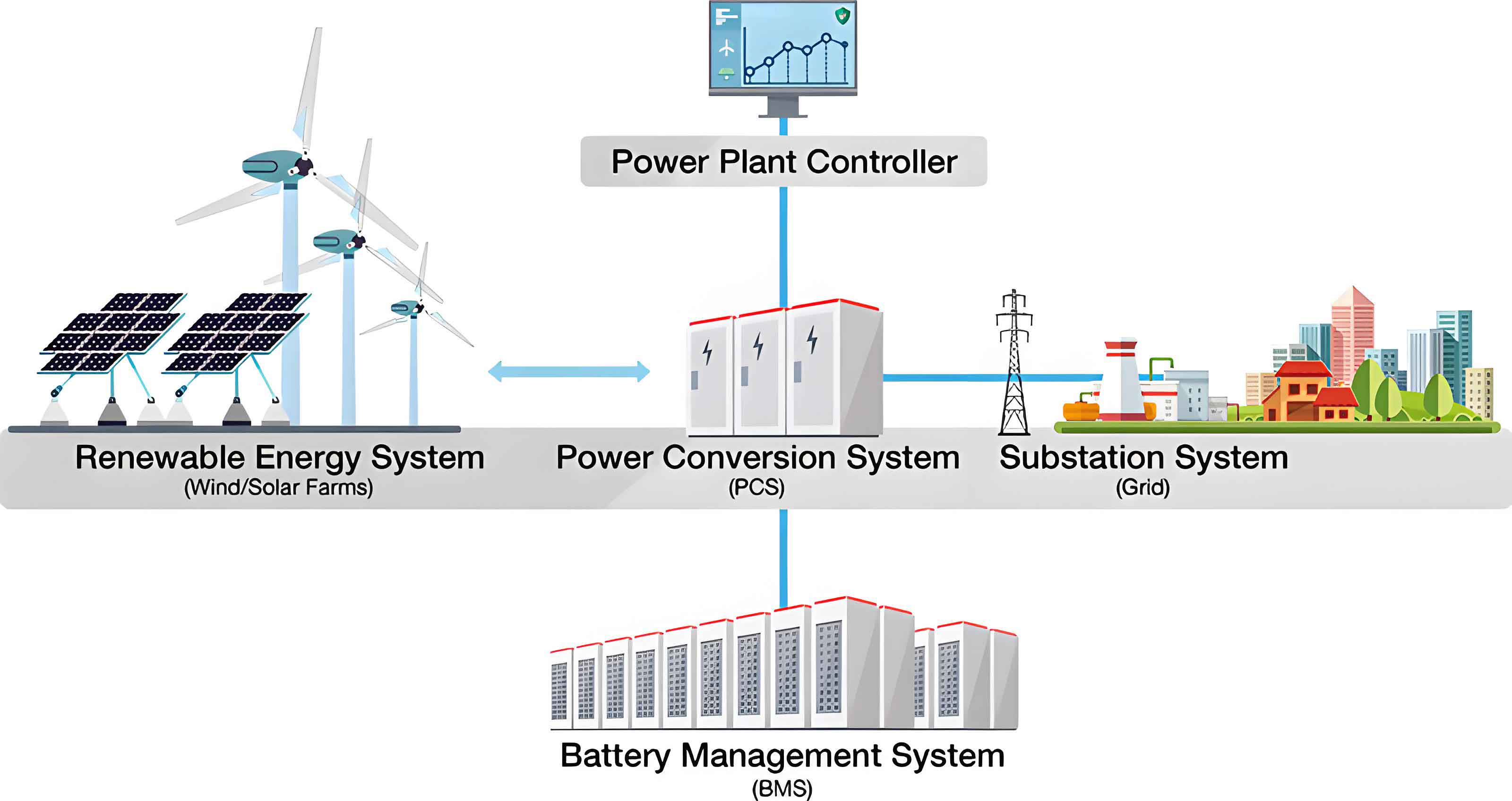
Energy storage systems (ESS) have become pivotal in modern power grids, enabling renewable energy integration, grid stabilization, and economic optimization. This study presents a comprehensive framework for evaluating the techno-economic performance of battery energy storage systems (BESS) under diverse pricing mechanisms while accounting for battery degradation. A detailed degradation model is integrated to quantify the impacts of depth-of-discharge (DOD), temperature, charging/discharging rates, and state-of-charge (SOC) on battery lifespan.
1. Operational Models for Energy Storage Systems
The profitability of BESS depends on pricing mechanisms and operational constraints. Three common electricity pricing structures are analyzed:
1.1 Time-of-Use (TOU) Pricing
Under TOU, energy costs vary across peak, off-peak, and shoulder periods. The daily profit ($C_{TOU}$) is calculated as:
$$ C_{TOU} = \sum_{t \in T_1} \lambda_1 E_{d,t} + \sum_{t \in T_2} \lambda_2 E_{d,t} – \sum_{t \in T_3} \lambda_3 E_{c,t} – \sum_{t \in T_4} \lambda_4 E_{c,t} $$
where $\lambda_1, \lambda_2, \lambda_3, \lambda_4$ denote electricity prices during peak, shoulder, off-peak, and super-off-peak periods, respectively.
1.2 Real-Time Pricing (RTP)
In RTP markets, prices fluctuate hourly based on supply-demand dynamics. The daily profit ($C_{RTP}$) is:
$$ C_{RTP} = \sum_{t=1}^{24} \lambda_t (E_{d,t} – E_{c,t}) $$
1.3 Operational Constraints
BESS operation is governed by SOC dynamics and power limits:
$$ S_t = S_{t-1} + \frac{\Delta E_t}{E_r}, \quad \Delta E_t = E_{c,t} – E_{d,t} $$
$$ E_{c,t} = P_{c,t} \tau \gamma_c, \quad E_{d,t} = \frac{P_{d,t} \tau}{\gamma_d} $$
$$ S_{min} \leq S_t \leq S_{max}, \quad 0 \leq P_{c,t}, P_{d,t} \leq P_{max} $$
2. Battery Degradation Modeling
A semi-empirical degradation model captures capacity fade from cycling and calendar aging:
$$ L = 1 – \alpha_1 e^{(-\alpha_2 f_d)} – (1 – \alpha_1) e^{(-f_d)} $$
$$ f_d = f_{cyc} + f_{cal} $$
$$ f_{cyc} = \sum_{i=1}^{N_{cyc}} f_D(x_{D,i}) f_S(x_{S,i}) f_C(x_{C,i}) f_T(x_{T,i}) $$
$$ f_D(x_D) = (k_{D1}x_D^{k_{D2}} + k_{D3})^{-1}, \quad f_S(x_S) = e^{k_S(x_S – S_{ref})} $$
| Degradation Factor | Model Equation | Parameters |
|---|---|---|
| Cycling (DOD) | $f_D(x_D)$ | $k_{D1}=1.4$, $k_{D2}=0.5$ |
| State-of-Charge | $f_S(x_S)$ | $k_S=0.12$, $S_{ref}=50\%$ |
| Temperature | $f_T(x_T) = e^{k_T(\frac{1}{x_T} – \frac{1}{T_{ref}})}$ | $k_T=0.069$, $T_{ref}=25°C$ |
3. Economic Evaluation Framework
Key metrics for assessing energy storage system viability include:
3.1 Levelized Cost of Storage (LCOS)
$$ LCOS = \frac{C_0 + \sum_{n=1}^N \frac{C_{om,n} + C_{ch,n}}{(1+r)^n} + \frac{C_{eol}}{(1+r)^{N+1}}}{E_{total}} $$
where $C_0$ = capital cost, $C_{om,n}$ = O&M cost, $C_{ch,n}$ = charging cost, and $E_{total}$ = lifetime energy throughput.
3.2 Net Present Value (NPV)
$$ NPV = -C_0 + \sum_{n=1}^N \frac{C_{profit,n} – C_{om,n}}{(1+r)^n} $$
| Cost Component | Li-ion BESS | Flow Battery |
|---|---|---|
| Capital Cost ($/kWh) | 300 | 450 |
| O&M (%/year) | 2.5% | 1.8% |
| Cycle Life | 4,000 | 15,000 |
4. Case Studies and Results
Simulations compare BESS performance under TOU and RTP mechanisms:
| Scenario | Annual Profit ($) | LCOS ($/kWh) | Payback Period (years) |
|---|---|---|---|
| TOU (ConEdison) | 54,780 | 0.123 | 6.3 |
| TOU (Jiangsu) | 31,050 | 0.181 | 12.1 |
| RTP (PJM) | 17,150 | 0.225 | 18.6 |
5. Sensitivity Analysis
BESS economics vary significantly with operational strategies:
| SOC Range | Lifetime (years) | Energy Throughput (MWh) | LCOS ($/kWh) |
|---|---|---|---|
| 10–90% | 10 | 2,850 | 0.123 |
| 20–80% | 12 | 2,190 | 0.141 |
| 30–70% | 15 | 1,740 | 0.162 |
6. Conclusion
This analysis demonstrates that energy storage system viability heavily depends on:
- Pricing mechanism design and peak/off-peak price differentials
- Battery degradation characteristics and SOC management
- Capital cost reduction through technological advancements
Optimal BESS operation requires adaptive control strategies that balance immediate economic returns with long-term degradation costs. Future energy storage system deployments must consider region-specific market structures and battery chemistry characteristics to maximize lifetime value.