
Introduction
With the rapid integration of solar energy into modern power systems, solar inverter has become critical components for converting and managing renewable energy. However, weak grid conditions—characterized by low short-circuit ratios (SCR) and high grid impedance—pose significant challenges to the synchronization stability of grid-following solar inverter. Instability events, such as subsynchronous oscillations and transient desynchronization, have been reported in large-scale solar farms, underscoring the urgency to develop robust control strategies.
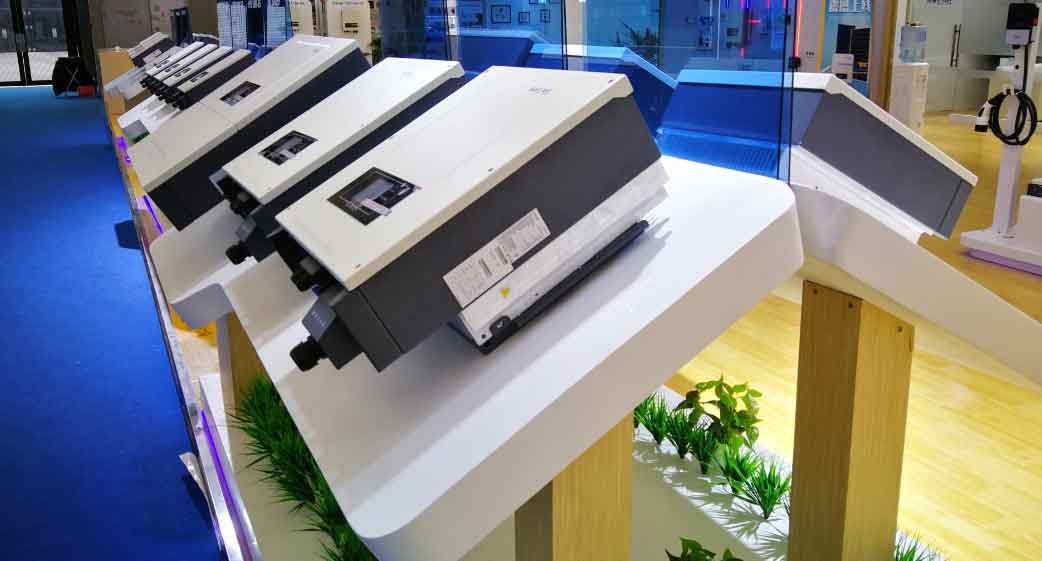
This paper addresses the synchronization stability issues of solar inverter in weak grids by proposing a synchronization decoupling control strategy. Unlike conventional phase-locked loop (PLL)-based methods, which suffer from coupling effects between synchronization and current control loops, our strategy decouples these interactions to enhance both small-signal and transient stability.
Mechanism of Synchronization Instability
Solar inverter in weak grids are prone to instability due to feedback loops introduced by grid impedance. Two synchronization methods are analyzed:
- PLL-Based Synchronization
The PLL tracks grid voltage phase but introduces coupling between the synchronization loop and current control. A voltage perturbation ΔuΔu induces a phase angle deviation ΔθΔθ, distorting the reference current in the dqdq-frame:Iref,a≈(Id,refcosθ1−Iq,refsinθ1)+(−Id,refsinθ1−Iq,refcosθ1)ΔθIref,a≈(Id,refcosθ1−Iq,refsinθ1)+(−Id,refsinθ1−Iq,refcosθ1)ΔθThis deviation propagates through the current loop, creating harmonic distortions and destabilizing the system. - PLL-Less Synchronization
Instantaneous power theory eliminates explicit phase tracking but still exhibits coupling. For example, the dqdq-axis currents are derived as:id=Puterm,iq=Quterm,uterm=utd2+utq2id=utermP,iq=utermQ,uterm=utd2+utq2While avoiding PLL delays, this method amplifies coupling during rapid voltage fluctuations.
Proposed Synchronization Decoupling Strategy
The proposed strategy decouples synchronization and current control through two key mechanisms:
1. Decoupling the Controller Reference Frame
The controller’s dqdq-frame rotates at a filtered grid frequency fgfg, derived from the PLL output:fg=fPLL1+Tf1sfg=1+Tf1sfPLL
where Tf1Tf1 is a low-pass filter time constant. This approach mitigates reference frame oscillations caused by grid voltage fluctuations.
2. Decoupling Reference Current Variations
A low-pass filter (LPF) attenuates high-frequency perturbations in the reference current:id,ref,LPF=id,ref1+Tf2s,iq,ref,LPF=iq,ref1+Tf2sid,ref,LPF=1+Tf2sid,ref,iq,ref,LPF=1+Tf2siq,ref
where Tf2Tf2 ensures harmonic suppression while maintaining dynamic response.
Parameter Design Methodology
A hybrid time-frequency domain approach optimizes parameters:
| Parameter | Design Criteria | Initial Value |
|---|---|---|
| Tf1Tf1 | Balances decoupling and frequency tracking accuracy | 1 s |
| Tf2Tf2 | Trade-off between harmonic filtering and transient response | 0.01 s |
| KPLLKPLL | Damping enhancement without compromising bandwidth | 253 |
| Ki,PLLKi,PLL | Prevents integrator windup | 16016 |
Impedance Modeling and Stability Analysis
A sequence impedance model incorporating frequency-coupling effects is developed to validate stability. The admittance matrix relates harmonic currents (Ip,InIp,In) to voltages (Up,UnUp,Un):[IpIn]=[Y11(s)Y12(s)Y21(s)Y22(s)][UpUn][IpIn]=[Y11(s)Y21(s)Y12(s)Y22(s)][UpUn]
Key components include:
- Positive-Sequence Admittance (Y11Y11):
Y11(s)=N1N2D1+D2,N1=1+L1Cs2+KPWMHiKicCsY11(s)=D1+D2N1N2,N1=1+L1Cs2+KPWMHiKicCs
- Cross-Coupling Admittance (Y21Y21):
Y21(s)=KPWMHi(id,ref−jiq,ref)N3D3+D4Y21(s)=D3+D4KPWMHi(id,ref−jiq,ref)N3
Stability Metrics
The proposed strategy improves phase margins significantly:
| SCR | Conventional PLL (Phase Margin) | Proposed Strategy (Phase Margin) |
|---|---|---|
| 10 | 29.2° (Positive), 49.4° (Negative) | 46.8° (Positive), 53.3° (Negative) |
| 1.5 | Unstable | 44.7° (Positive), 51.0° (Negative) |
Experimental Validation
A controller hardware-in-loop (CHIL) platform validated the strategy under varying grid strengths:
1. Small-Signal Stability
- Harmonic Injection Test: A 30 Hz voltage disturbance caused severe oscillations in conventional PLL systems (5.45% THD) but only 0.98% THD with the proposed strategy.
- Frequency Response: The decoupling strategy suppressed harmonic coupling, as shown below:
| Frequency | Conventional PLL (Harmonic Amplitude) | Proposed Strategy (Harmonic Amplitude) |
|---|---|---|
| 30 Hz | 5.45% | 0.98% |
| 70 Hz | 6.72% | 1.20% |
2. Transient Stability
During grid faults, the proposed strategy maintained synchronization, while conventional methods triggered overcurrent protection:
| Metric | Conventional PLL | Proposed Strategy |
|---|---|---|
| Voltage Recovery Time | >50 ms | <5 ms |
| Current Overshoot | 150% | 20% |
Conclusion
This paper presents a synchronization decoupling control strategy to enhance the stability of solar inverter in weak grids. By decoupling the controller reference frame and reference current dynamics, the strategy mitigates harmonic distortions and improves transient response. Experimental results demonstrate superior performance in both small-signal and large-disturbance scenarios, with phase margins exceeding 40° across SCR ranges. The methodology provides a scalable solution for integrating solar energy into low-inertia power systems.